
276. The Turning Point (2).
Now, before me, those who had come from the far distant steppe were bending one knee. And their name, they said, was Bulgar.
Bulgar? It was a name that brought to mind that friendly neighbor of the Eastern Roman Empire, but these Bulgars carried a much stronger scent of the steppe.
One could say they were the main house of the Bulgar people, so to speak—the ones who, of the two households that split long ago, had clung more to tradition and stayed to guard the ancestral home.
"Brave riders who have come from the Volga River. I have heard that whenever my brother Ivar passed through your lands and rivers, he received your help. A friend of my brother is by law a friend of mine. What help can I offer you, friends who have sought out the North Sea?"
The Volga-Bulgars. The Bulgar people dwelling in the Volga basin. If the Empire of the North Sea had the valiant adventurer, Flóki the Raven, in the west, then in the east, it had the valiant adventurer Ivar the Boneless.
Was it not by sailing down that very Volga River, striking the Khazar Khaganate city of Atil, and trading with the turbaned ones at the southernmost edge of the Caspian Sea that Ivar's name had been so greatly exalted? The skalds still recounted the countless tales of adventure that had unfolded in that process.
According to information from this very Ivar, more and more North Sea merchants were now choosing the safe and highly profitable Dnieper route over the perilous Volga route, devoting themselves fervently to trade with the Eastern Roman Empire. Naturally, I had heard, the tribes of the Volga basin were utterly devoted to serving the Northmen and Muslim merchants who came visiting from time to time.
A chaotic region of fragmented small and medium tribes warring and cooperating with one another. I had heard that neighborhood over there was quite noisy, but did they truly have the wherewithal to send envoys to this distant Árós?
"Insignificant ones behold the Khagan of the vast sea."
I had felt the famously harsh discipline of the nomads every time I dealt with the Magyar and Khazar riders who invariably claimed victory at every horse race. How to describe it? The sensation of living one's life with a blade perpetually held near the throat? The envoys of the Bulgar people from the Volga basin seemed to have that air about them somewhat intensely, and seeing them frozen stiff as wax, not a single twitch, they were likely extremely tense.
"How could a friend of my brother, one who has set foot in my palace, be called insignificant? So come, raise yourselves up and lift your heads."
"Yes! Khagan!"
Perhaps mistaking my repeated urging for a command, the three Bulgar envoys sprang to their feet, and though they lifted their heads as I had bade them, their eyes were desperately fixed on the floor.
"Then let us hear your tale now. And speaking of which, I have not even asked upon whose orders you have come. From which tribe of the Volga do you hail?"
"O great Khagan! We are warriors sent by Shelki (Şilki) Elteber, who has united the tribes of the Volga and Kama Rivers, and who rules the steppes and waterways there!"
"Shelki Elteber?"
I stroked my beard with my left hand, mulling over the word that was translating itself automatically within my mind. A vassal king, was it?
I turned my head toward Ivar, who stood at my side in his capacity as chairman and advisor of the Marmaros Council, and he mouthed a word: "Kha.zar."
A vassal state of the Khazar Khaganate, then. The Khazar Khagan's prestige was loftier than I had thought.
"I had understood that your people pay tribute to the Khazar Khaganate. Is my understanding perhaps mistaken?"
"The Khagan of the sea knows precisely. We tribes of the Volga and Kama Rivers have paid tribute to the Khagan of the Khazars."
Somehow, I had a feeling the word 'but' was about to follow.
"But the Khazar Khagan has lately been waging unnecessary wars, undertaking unreasonable expeditions and reorganizing the tribes within the Khazar Khaganate. He has been seizing ever more horses and warriors, furs and grain from our people of the Volga and Kama."
A truly pitiable situation, but what in the world did that have to do with me?
"And so our chieftain Shelki sought to request aid from the turbaned ones under the Khazar Khaganate, but some years ago, news began to arrive of the North Sea, which lies upon the Dnieper River to the west and further above. At first, naturally, we thought it false, but the eyes of our own warriors who had journeyed all the way to the Dnieper pointed to the truth."
Wait, this scene was somehow familiar. Why were the faces of the Sámi chieftains—no, now Jarls—seeming to overlap onto the face of that Bulgar man?
"Our chieftain sent the three of us expressly to convey this intent to the Khagan of the North Sea. And so the ruler of the tribal union of the Volga and Kama basins lowers his head before the great Khagan of the North Sea and his goddess, and with a sincere heart, pleads for submission."
"Accept us! Khagan!"
"Accept us! Khagan!"
"..."
The head shapes of the three men who had abruptly said their piece and then bowed were peculiar. In a way, their hairstyle was similar to mine, but more focused on practicality. When one wears a helm, heat naturally concentrates on the head, and so one shaves the sides, or the top, or one side, to display one's strength—
No, honestly, I did not know why they wore that hairstyle. But Ivar, whose handsome head made baldness suit him to a degree, was stroking his well-groomed beard with a satisfied smile.
Was he feeling a sense of camaraderie, a kind of soldierly bond, looking at their heads? However, there was a difference: for them, it was fashion; for Ivar, he no longer had any choice in hairstyle.
I was dumbfounded by this sudden proposal of vassalage. Could this be a sophisticated scheme to sow discord? A cunning plot by Chieftain Shelki to destabilize relations between the Khazar Khaganate and myself? Was it something like that?
I gently massaged the veins bulging on my temples and stared intently at the three crowns of heads pressed completely to the ground, but I sensed no whiff of foul conspiracy.
I turned my head to the left and looked at the elders seated in a row on a step one level lower than my throne. To a man, they wore expressions of curiosity, wondering what words had passed between those envoys and myself just now.
Now that I thought of it, these people would not have understood a single word of the conversation moments before. For I had spoken at length in the language of the Volga Bulgars.
At least Damian, who could be considered an external advisor, was watching the bowing men with an expression of keen amusement.
I had thought the past five years had been rather quiet, but was the world slowly beginning to contort itself?
"Friends of the Volga and Kama Rivers. We of the North Sea shall devote our sincere thought to this matter. In the meantime, I hope you will rest your weary bodies and minds well here in my palace."
"Yes! Khagan!"
The Bulgar warriors shouted back with such force it seemed the great hall of the palace would shake apart, as if they were soldiers of Norrland. I bade them follow the palace steward out, and soon these brave men would be assigned a guest chamber where they could rest in comfort.
And in the meanwhile, I would have to explain this absurd business to my subordinates and receive their sundry advice.
'How on earth am I supposed to explain this?'
The doors shut with a heavy sound. And the people, every last one of them, fixing their gazes upon me with sparkling eyes, clearly expecting something.
I inwardly let out a sigh and began to explain what had just transpired.
Sparkle, sparkle.
The eyes of the Konungrs, Jarls, and external advisors were all glinting.
*****
Many hands make light work, they say. After discussing the matter with the seasoned Konungr trio (Bagsecg, Olaf, Halfdan), the old serpent Damian, the fox Hrolf, and the boneless and scalpless Ivar, the situation east of the Dnieper River had roughly pieced itself together, fragment by fragment.
First, this newly emerged tribal union of the Volga-Kama basin. Ivar said it had not even existed just a few years prior, when he had visited Atil in the Khazar Khaganate.
If so, then the matter had been achieved with a speed akin to roasting beans in a lightning flash, something impossible by brute force alone. According to Ivar, the tribes dwelling in that basin alone included the Mari, Merya, Meshchera, Mordva, Muromia, and Perm. And within those, he said, the villages bore such a diversity of names that one could not possibly guess them all.
To gather all of them by force? I would not say it was impossible, but for a man like Chieftain Shelki to achieve such a feat in barely five years, he would have to be at least as mighty a warrior as myself for it to make sense.
So ultimately, it meant those tribes had somehow formed a vast consensus and agreed to unite.
Perhaps the tribute demands of the Khazar Khaganate had become too excessive, or their eyes had been turned by the prosperity of the Dnieper basin just to the left of the Volga. To think they would plead for submission so actively as this.
On this point, the conclusion my brilliant subordinates had reached was, in the end, to accept. After all, in this age, it was hardly extraordinary for a small power to perform a tightrope walk between great powers. And the more hardline voices argued that, in any case, should the Khazar Khaganate protest, what exactly could they do about it?
And that was only reasonable, for Kyiv, the city dominating the Dnieper basin, was no longer the feeble city of old that merely paid furs to the Magyars and Khazars.
Jarl Haskuldr of Kyiv possessed a surprisingly scarecrow-like affability. Though he had been pushed and pulled this way and that among the strong powers around him—the Eastern Romans, Magyars, and Khazars—he had steadfastly held his center. And now, he had become a heavy counterweight, a great king of a scarecrow, imposing the interests of the North Sea upon three nations. A full-build Fiddlesticks? There was no stopping this.
While the renowned heavy cavalry of the North Sea Empire's west operated mainly around Rouen Fortress, the riders of the empire's east, light cavalry composed outright of nomads swearing allegiance to the North Sea, were active centered on Kyiv.
Which was to say, Kyiv, armed with economic power and now military might, was no longer a neutral zone in the Dnieper basin but a solidifier of the North Sea Empire's hegemony.
This had resulted in the Magyars and Khazars being physically driven apart. In the end, the Magyars and the Eastern Roman Empire had accepted this without particular complaint, but the Khazar Khaganate had been left in a somewhat regretful position, for everyone had known the Khazars had designs upon the Magyars.
Naturally, that regret had turned into fresh resentment. And now, the Khazar Khaganate, which had once been a mere seal swimming the rivers, found itself confronting the North Sea Empire, whose people had inexplicably changed their profession to steppe warriors. It had not taken long for the relationship between them and us of the North Sea to gradually turn to a state of tension. They still seemed to maintain, for now, somewhat friendly relations with the Eastern Roman Empire, but with us, the division was certain. They had even staged armed demonstrations, venturing out on raids near several relay stations. In a sense, all of this was a butterfly effect I had stirred into being.
And I was a Fylkir who knew how to take responsibility for his choices.
"Thank you for your meaningful counsel. I intend to think on this matter a little more, and I hope that all of you present here will give it further thought as well."
"It shall be as the Fylkir wishes."
"Whatever decision you make, we shall only follow."
The faces of the councilors who expressed their humility in response to my thanks were all utterly wreathed in smiles. As if they already knew what choice I would make.
Indeed. In truth, my mind was already made up.
If some tribe from somewhere in Africa, wholly unconnected to me, had come and suddenly pleaded for submission, I would have refused at once. But the Volga basin was a place the North Sea's merchants had been busily in and out of already.
And now that things had come to this, I was growing curious, too. Just how far was this empire trying to stretch out? Though what was amusing was that we were not swallowing them—rather, they were sticking to us one by one, as if being pulled into a black hole.
Let us accept. Our household in the North Sea is not so impoverished as to ignore the hands of those who seek help, and there is a need to send a message to the Khazar Khaganate as well.
A message stating that you are not the only ones who know how to wield power.
☆☆☆☆☆Reference Material☆☆☆☆☆
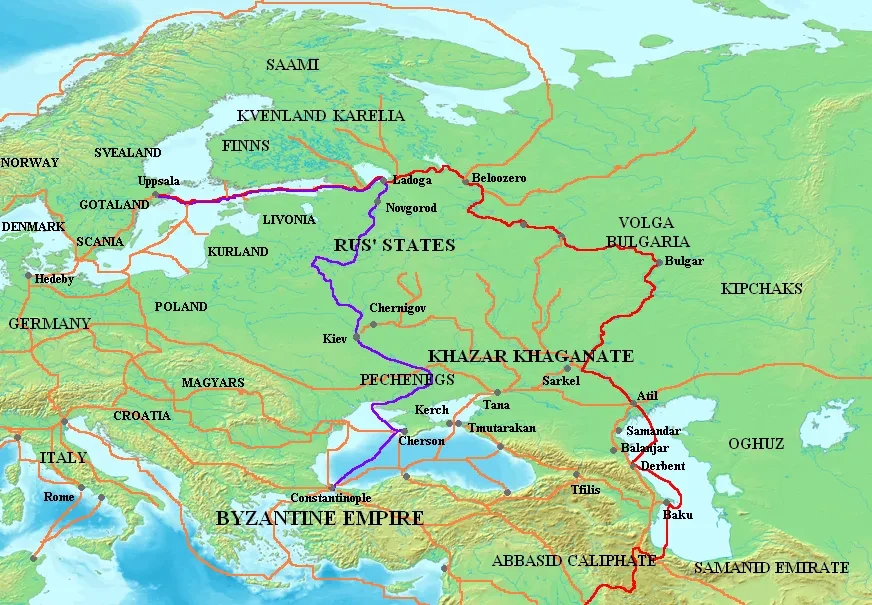
Briangotts, CC BY-SA 3.0 <http://creativecommons.org/licenses/by-sa/3.0/>, via Wikimedia Commons
Viking trade routes, revisited! The red line on the Örn side is the Volga River route...!
Helgi's North Sea Empire is simply conducting an immense amount of trade with the Eastern Roman Empire centered on Kyiv...! So trade along the Volga basin is naturally declining...! Of course, the chaos in the Abbasid Empire is also playing its part...!
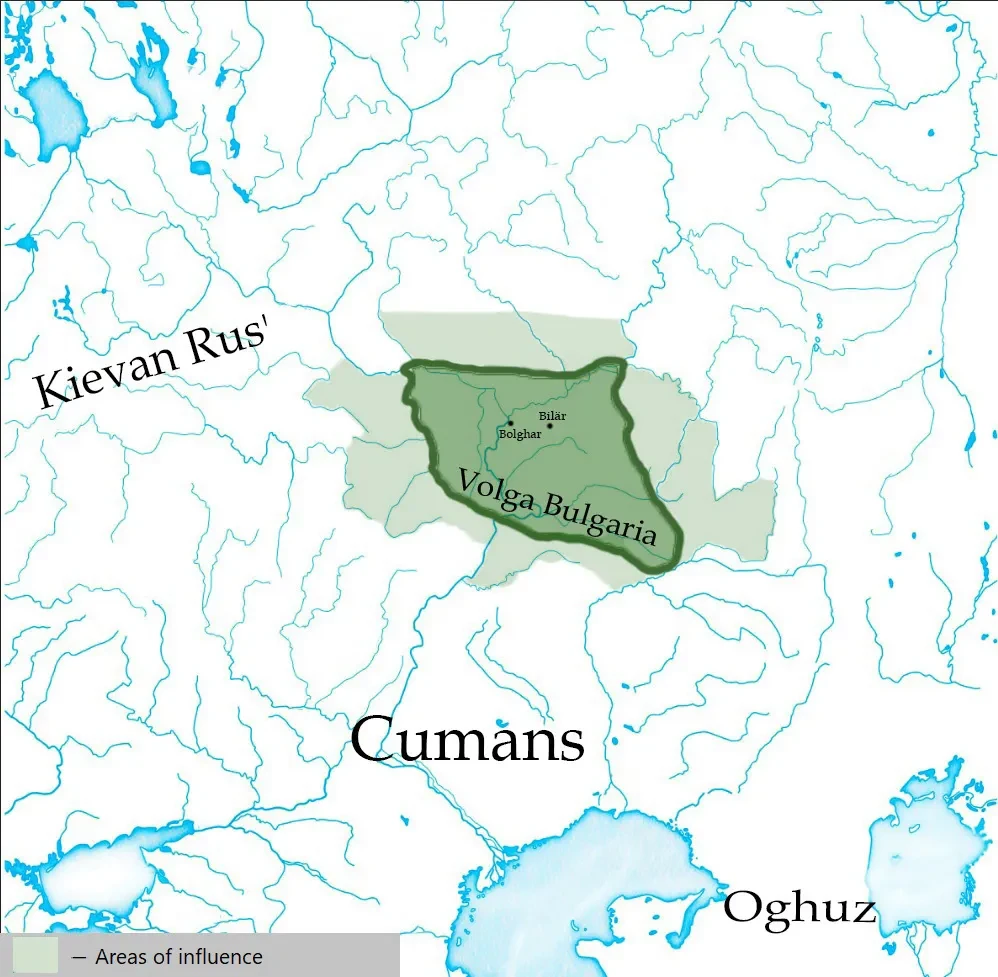
Татарин116, CC BY-SA 4.0 <https://creativecommons.org/licenses/by-sa/4.0>, via Wikimedia Commons
The location of Volga-Bulgar.
They really are blood kin with the Kingdom of Bulgaria, which is situated just above the Eastern Roman Empire...! The names aren't just similar...!
Roughly one or two hundred years ago, they were one group living on the Black Sea. Then the second son moved toward the Eastern Roman Empire, and the first son moved to the Volga basin...! They're the same family, but much has changed between them in that time...!
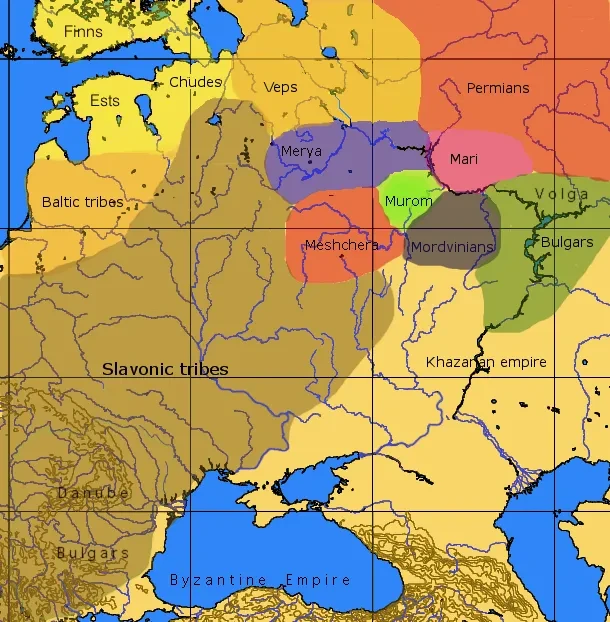
Wiglaf., CC BY-SA 3.0 <http://creativecommons.org/licenses/by-sa/3.0/>, via Wikimedia Commons
Population distribution of the Volga basin.
Mainly the Volga Finns! Anyway, just understand that there were a lot of tribes there, lol.
The conflict with the Khazar Khaganate was, in truth, somewhat foreseen... perhaps from the very moment Helgi reached Kyiv!
Moreover, there are many tribes with chilling names within the Khazar Khaganate... the Pechenegs... the Alans... and then there's the Eastern Roman Empire...