
277. The Turning Point (3).
The winter of 874 arrived a little earlier than expected and was far colder than anticipated.
Of course, the lands south of Fylkirland (Iceland) where warm currents flow were surprisingly mild, but winter was still winter. And the early frost that settled over the steppe was especially lethal to the people there.
A starving beast hunts because it is hungry, and those who failed to prepare for the harsh winter in advance had no choice but to cling to their last remaining means with the desperate resolve of kill or be killed.
Even a great kingdom of nomads could not escape this simple law. After the numerous tribal union centered on the Bulgars of the Volga River basin took shelter under the great and broad umbrella of the North Sea, the riders of the Khazar Khaganate grew bolder, and the resentment between the two powers reached a point where it could no longer be resolved with fair words.
The Bulgars moved every single person from the areas bordering the Khazar Khaganate—whose borders were ambiguous—to the left bank of the Volga, closer to the North Sea, and the more they did so, the more the Khazar riders gradually expanded their range of activity.
At last, tribesmen of the Khazar Khaganate with urgent circumstances began to prowl around the various rapids of the Dnieper River basin—which should have originally belonged to the Khazar Khaganate—the territory of the North Sea Empire now sitting squarely behind the backs of the Volga-Bulgars.
Naturally, the Jarl of Kiyiu and even the Konungrs of Polotsk and Novgorod above him sent envoys to the Khazar Khagan, expressing their intent to refrain from unnecessary conflict. But in truth, before the merciless force of nature, there was nothing a Khagan—who was merely a ruler of men—could do.
If they did not plunder their prosperous neighbors right now, the tribesmen would all die this winter. Was there any problem with taking a little from those who had plenty? And if by any chance that vast empire showed an opening, could they not perhaps snatch a trade post like Örn relay village, or even a somewhat larger city like Kiyiu?
If life could be seen as a series of choices and the process of confirming their outcomes, as Jarl Oleg had felt down in southern Italy, the desperate people of the Khazar Khaganate could have asked the North Sea for a bit more food, or at the very least tried to trade by selling horses and the like. But due to their own various circumstances, they made a different choice.
And upon hearing all the circumstances leading up to this, the Fylkir of Árós ordered the lords of the empire's eastern territories to prepare for war.
Merchants no longer headed toward the Khazar Khaganate, and at the strategic points along the Dnieper River, soldiers and war materials began to gather and pile up, one by one.
All the surrounding powers who watched this scene ceased their own conflicts and collectively held their breath.
Boris of Bulgaria had to postpone the purge of chieftains who still followed the old Tengri faith, and East Frankia and Bohemia, which had been harassing the borders of Moravia, also withdrew their troops and concentrated on guarding their frontiers.
Amid the tension gripping everyone, Árpád of the Magyars—who alone seemed rather pleased—sent word all the way to Árós declaring his active cooperation in striking the Khazars. The Eastern Roman Emperor sent word to the Khazar Khagan declaring that Rome would maintain neutrality, while simultaneously and discreetly dispatching emissaries to the Alans near the Caucasus Mountains.
At a point not far from the clash with the North Sea, in the dead of winter, the Khazar Khagan settled accounts with a few tribes he had marked in advance for their disobedience, while tacitly allowing several others to flee.
Seizing this opportunity, Khagan Zachariah—who had spent the past five years consolidating his internal power under the pretext of attacking the Abbasids and had now filled the ranks with his own men—left the Volga Bulgars, who could do nothing but flee in disarray, and began attacking the North Sea Empire along the Dnieper in earnest. But horses could not cross walls built of solid stone, and even when they tried to ford the river by making a distant detour, they found the mad Northmen had blockaded every single strategic point along the long Dnieper.
To make matters worse, those traitorous slave scum, the Magyars, with the North Sea's tacit approval, crossed the Dnieper and began raiding the completely emptied Khazar rear.
Thus, Khagan Zachariah exerted every desperate effort—calling upon the name of Yahweh, whom he did not usually seek out, requesting mediation from the Eastern Roman Empire to buy time, and unleashing pursuit parties to catch the Magyar rats that had infiltrated his rear. Yet before he could even fight a proper battle, the Khagan's host was crumbling before nature's brutal winter.
"What!? How did those bastards get out from there! What in the world were the tribes that went to plunder the Bulgars doing!?"
Across from Kiyiu, which had been wafting the fragrant smell of roasting meat and all manner of smoke throughout the winter, the Sagarya Khagan—who had been licking his lips, unable to bring himself to cross the heavily fortified defensive line of the North Sea Empire—had to suffer a fierce blow to the back of his head.
"We turn back at once! Attila is in danger!"
Having arrived early, the ice of the East Sea (Baltic) and Lake Ladoga had also retreated a little earlier than usual.
Following the still-cold Volga River, the North Sea's longships were descending in a long line.
*****
875 AD. The 9th year of the Fylkir.
I was twenty-eight years old. I had lived far more time than in my previous life. Despite having experienced the miracle of being born again, I had been blessed beyond what I deserved—gaining the mother I loved most in the world, my wife, my children, and my brothers.
Originally, I had not believed in gods, but now, without realizing it, my hand drifted naturally to the necklace carved with Hel's golden skull mask.
Before my youngest daughter was born, I had gone once to the grave at Jorvik on the island of Britain, where my warriors and father were buried together, bringing my three children, my wife, my stepmother, and my birth mother. There, I had in fact offered a prayer to the Goddess Hel.
Calling it a prayer made it feel too holy and solemn. So let's just call it a request for a consultation.
Whether the Goddess Hel had been involved in my obtaining this new life, whether she had helped me find the place where my father Ragnar was buried, and whether what I had seen in that dreamlike world in my dreams was indeed you.
I had wanted to ask a few things, so earnestly—for the first time in my life, I had submitted a consultation request to the Goddess. I was cleanly ignored.
Still, I am a man called a Great Warrior in my own right, but the Goddess was too much.
Perhaps it meant that even the Goddess could not give me a proper answer?
In any case, I had now practically forgotten even my name from my previous life. Helgi Ragnarsson had learned a great many things over the past years. How to handle sword and spear, how to use a shield. How to ride a horse. How to shoot a bow and throw a spear. How to catch fox or deer, wolf and bear. How to shatter rock with my bare fists and move like a cannonball through seawater.
How to win a war.
In war, everything was money and food. At the beginning and end of war, there were always silver coins and bread.
And so, from the moment I received the Bulgar tribal union of the Volga under the wings of my empire, I prepared for war. I ordered the reinforcement of personnel and the stockpiling of supplies along the loosely operated defensive line near the Dnieper River. I coordinated with Árpád of the Magyars, diverting various goods bound for the Khazars to the Magyars, and maintained continuous contact with Jarl Haskuldr of Kiyiu—the very frontline facing the Khazar Khaganate—instructing him to watch for the enemy's gaps.
I moved Jarl Miroslav of the Marmaros Council, my own merchant coalition, and ordered him to buy up every last sack of wheat around the Khazar Khanate with even more silver so that not a single bag could get in. I told him I didn't care if it all ended up dumped on the bottom of the Baltic Sea, so long as not one grain of wheat passed the lips of the Khazar Khagan.
What was unexpected was only the reaction of the Eastern Roman Empire.
They had been old allies—the Eastern Roman Empire and the Khazars. They had stood together against the Eastern Muslim empires since the days when the Umayyads reigned as Caliphs. Yet Michael's intent, secretly conveyed through Damian, was truly chilling and cold.
The look on Damian's face as he casually offered to help me and the North Sea by mobilizing the Alan tribe that dwelled in the farthest rear of the Khazar Khanate, north of the Caucasus Mountains, as if tossing aside a gnawed bone after eating the meat...
The chill of conspiracy and intrigue I had sensed in Constantinople came rushing back to me. A snake pit, a demon's den, a Schrödinger's conspiracy that did not exist until you looked, and so on.
That foulness aside, I was unspeakably grateful for the consideration that Michael and Damian showed toward me.
Thus I cut off their food supply, stirred instability in their rear, and rendered the mobility of the Khazar Khanate's famed light cavalry meaningless with solid defensive lines. Any soul hailing from the Korean Peninsula would carry the memory of the Manchu war when they were stripped to the bone by those northern horsemen. So I sealed up everything tightly from Novgorod to Kiyiu, perhaps to an excessive degree.
And I decided to do the very thing they loved so much: penetrate their rear.
If the steppe was theirs, then all the waters that flowed upon it were mine. And as it happened, the great river where the Bulgars who had submitted to me clustered together—the Volga River—was long and broad, flowing all the way to the distant Caspian Sea, was it not?
How could a river's shape be so exquisitely convenient?
Even in the dead of winter, the people of the North Sea who would venture out to skate despite the cold began preparing for war before the horn was even blown. Excluding the soldiers from Novgorod, Polotsk, and Kiyiu deployed on the Dnieper River defensive line, the men of mainland Scandinavia and the northern Sámi and Finns started joining one after another.
Since crossing the West Sea (the sea between Britain and Scandinavia) in large numbers in the frozen winter was quite dangerous, Uhtred of Northumbria in northern Britain was preparing to muster his forces in advance in case the war dragged on.
As for Ubba of Mercia and Björn of Rouen Fortress in Normandy, they were trading blows with the Muslims in the west and therefore could not participate in this great war unfolding in the eastern part of the empire. Likewise, Sigurdeu and Halfdan, who were glaring at East Frankia in the south of the empire, could not join either.
The funny thing was that there was still no hindrance to the war at all.
I had learned from history that a multi-front war was a certain defeat, yet why was I not afraid of them?
Right now, the great fleet slowly moving around my longship numbered 300 longships alone. The new model longships could comfortably carry 50 warriors even loaded with all manner of supplies, which meant 15,000 North Sea warriors were on the move at once.
Furthermore, Refil, appointed as overall commander of the follow-up force, would soon sail down with another 300 ships, so 30,000 regular soldiers would be committed to this operation alone.
Even more daunting was that the number of soldiers raised simultaneously from Novgorod, Kiyiu, and Polotsk was at least twice that. And I hadn't even counted the forces of southern and northern Britain, Normandy, and Oleg dispatched to southern Italy that had seized maritime supremacy in the west.
Viewed in this light, I could understand the Eastern Roman Empire's swift reassessment and change of posture. I also understood why East Frankia's envoy had braved the blizzard to come and reaffirm that they had absolutely no intention of breaking the peace treaty.
I had thought it would take at least ten years—ten years for the North Sea to grow into a power that could not be ignored. Yet in only five years, the North Sea Empire was contending for supremacy over the sea and the steppe.
"Lord Fylkir. News from the vanguard. They say people are gathering again on the riverbank near Örn. What should we do?"
What had changed over the past five years was not only the scale of the empire.
Seutorolpeu, who had somehow become the father of three wives (...) and six children, stood by my side with a somewhat more dignified air, stalwart and steadfast.
"There truly are many tribes along this Volga River. Tell them I will seek them out on my return. Tell them I will smash Attila and capture their Khagan, whether alive or dead."
"Yes! Fylkir!"
Seutorolpeu answered energetically and hurried off. To my silent gaze fixed straight ahead, the Volga River seemed to part its own body and yield a path for us.
☆☆☆☆☆Reference Materials☆☆☆☆☆
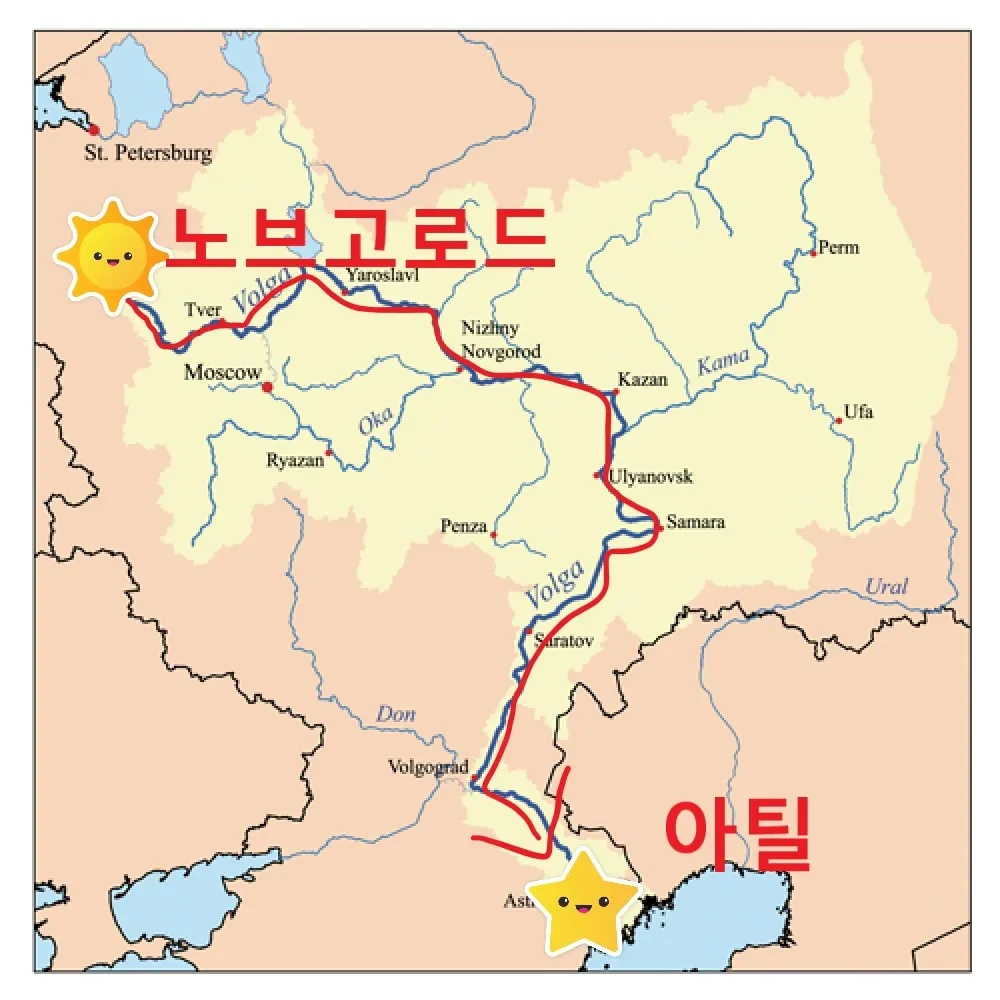
This file is licensed under the Creative Commons Attribution-Share Alike 2.5 Generic (https://creativecommons.org/licenses/by-sa/2.5/deed.en)
Wikipedia.
The movement route of Helgi and the Norrland North Sea standing army...! The defection of the tribal union in the Volga basin became a terrible nightmare for the Khazar Khanate and Sagarya Khagan...!
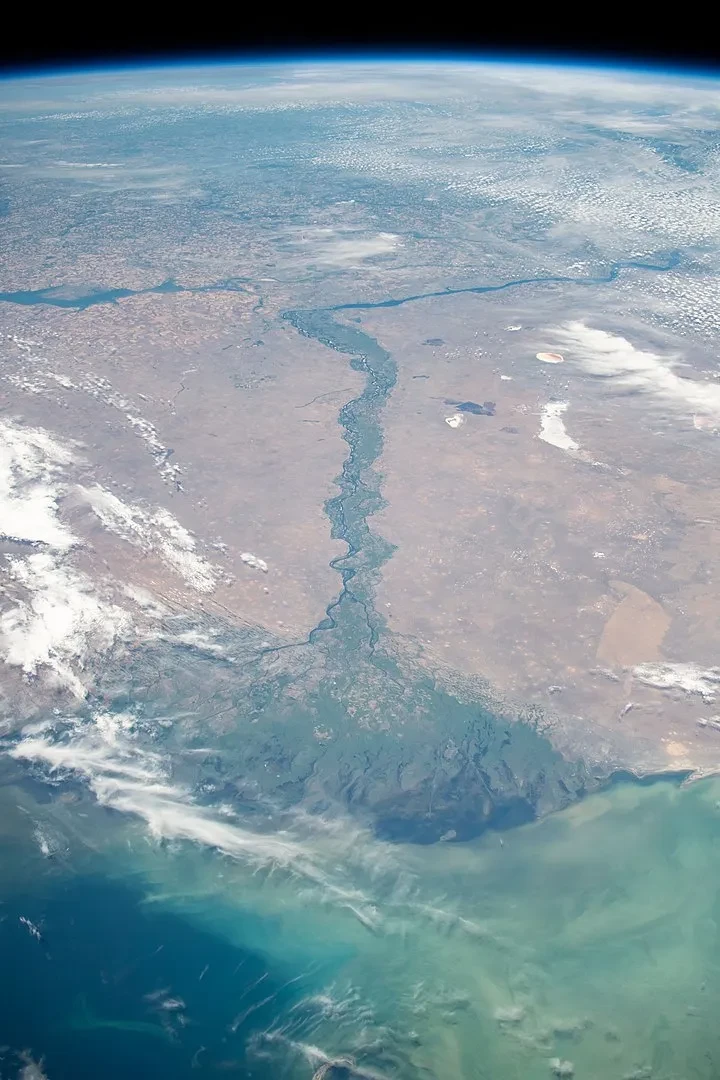
NASA, Public domain, via Wikimedia Commons
The Volga River flowing into the Caspian Sea. This is the Volga Delta. Attila is somewhere over there on the left...!
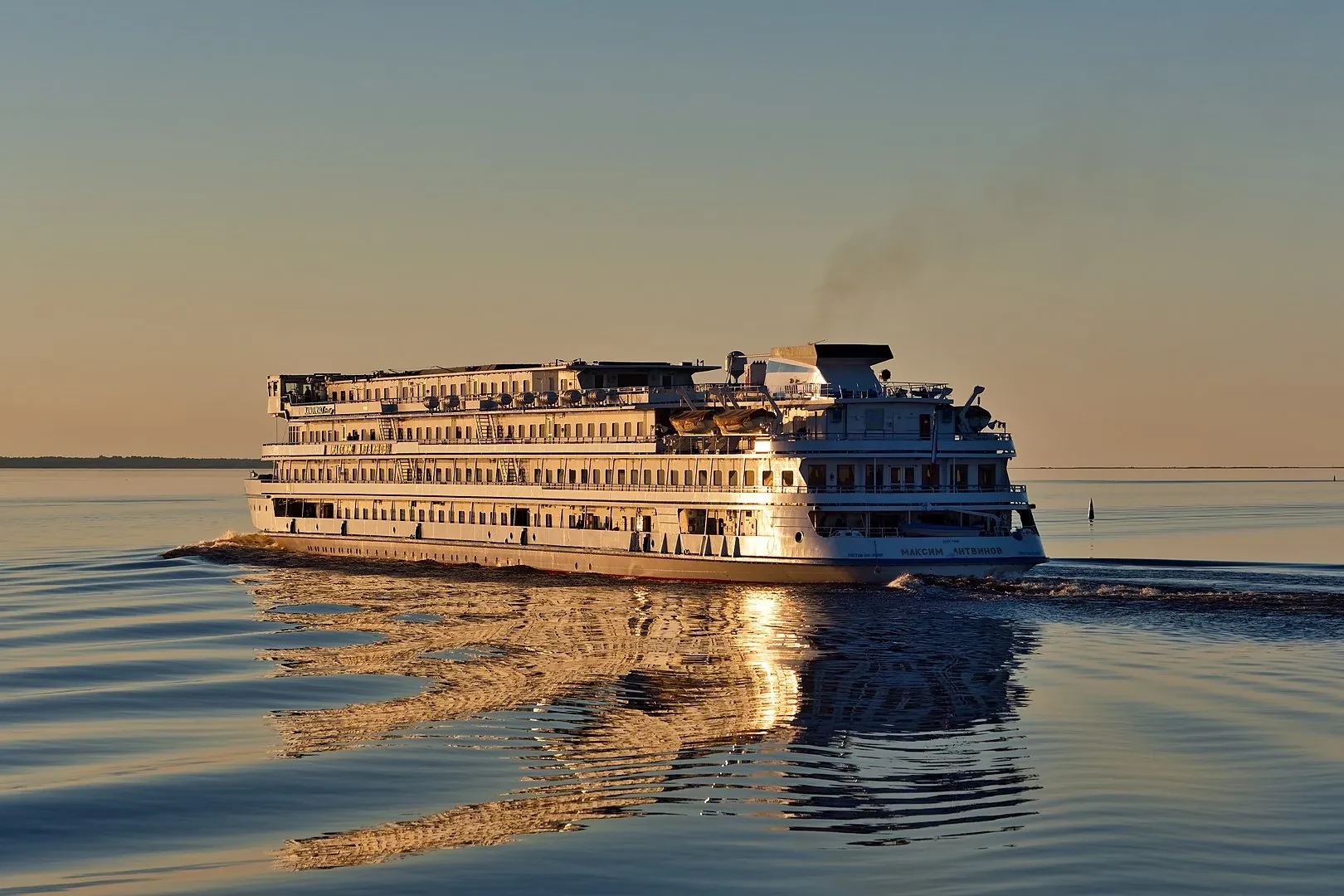
Alexxx1979, CC BY-SA 4.0 <https://creativecommons.org/licenses/by-sa/4.0>, via Wikimedia Commons
A cruise ship plying the Volga. You can get a sense of the river's size... of course it varies by section, but there is no waterway the North Sea longships cannot navigate...!
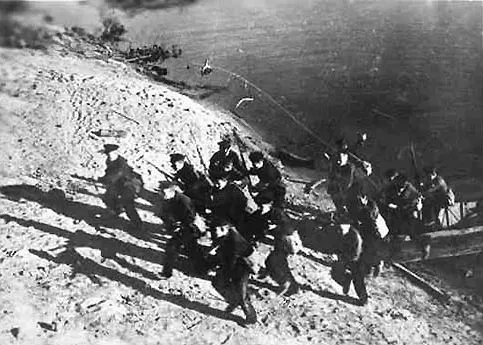
Soviet Government, Public domain, via Wikimedia Commons
Charge! Asseu-i!
Soviet naval infantry charging on the Volga. Red x Red = super-powerful Hugh-mi!
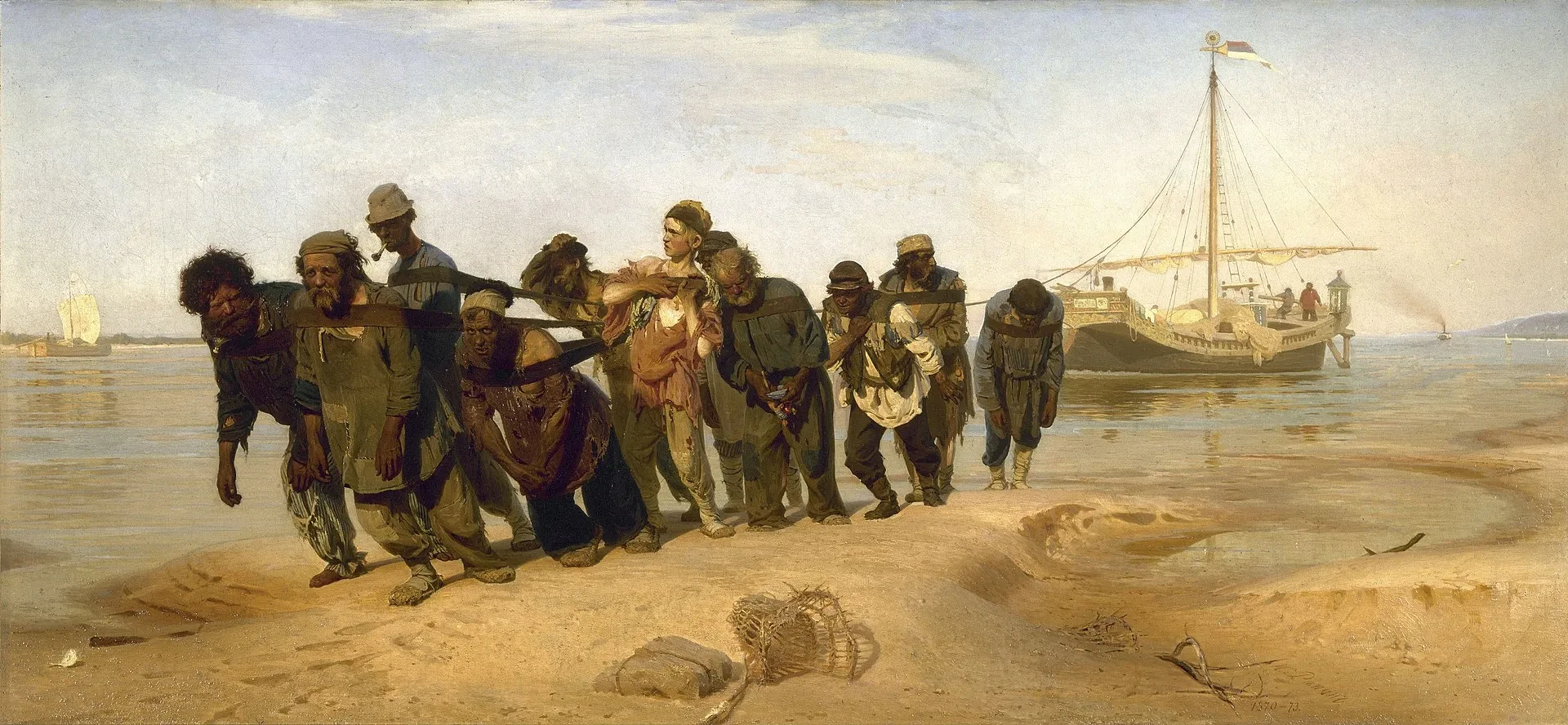
Ilia Efimovich Repin (1844-1930) - Volga Boatmen (1870-1873)
Wikipedia.
Or you can pull a boat like this... It's surprisingly common in Europe to overcome land obstacles with ships... maybe it's a feature of flatlands with scattered waterways? Unthinkable in our country. Climb a mountain carrying a boat...? That's rebellion...!
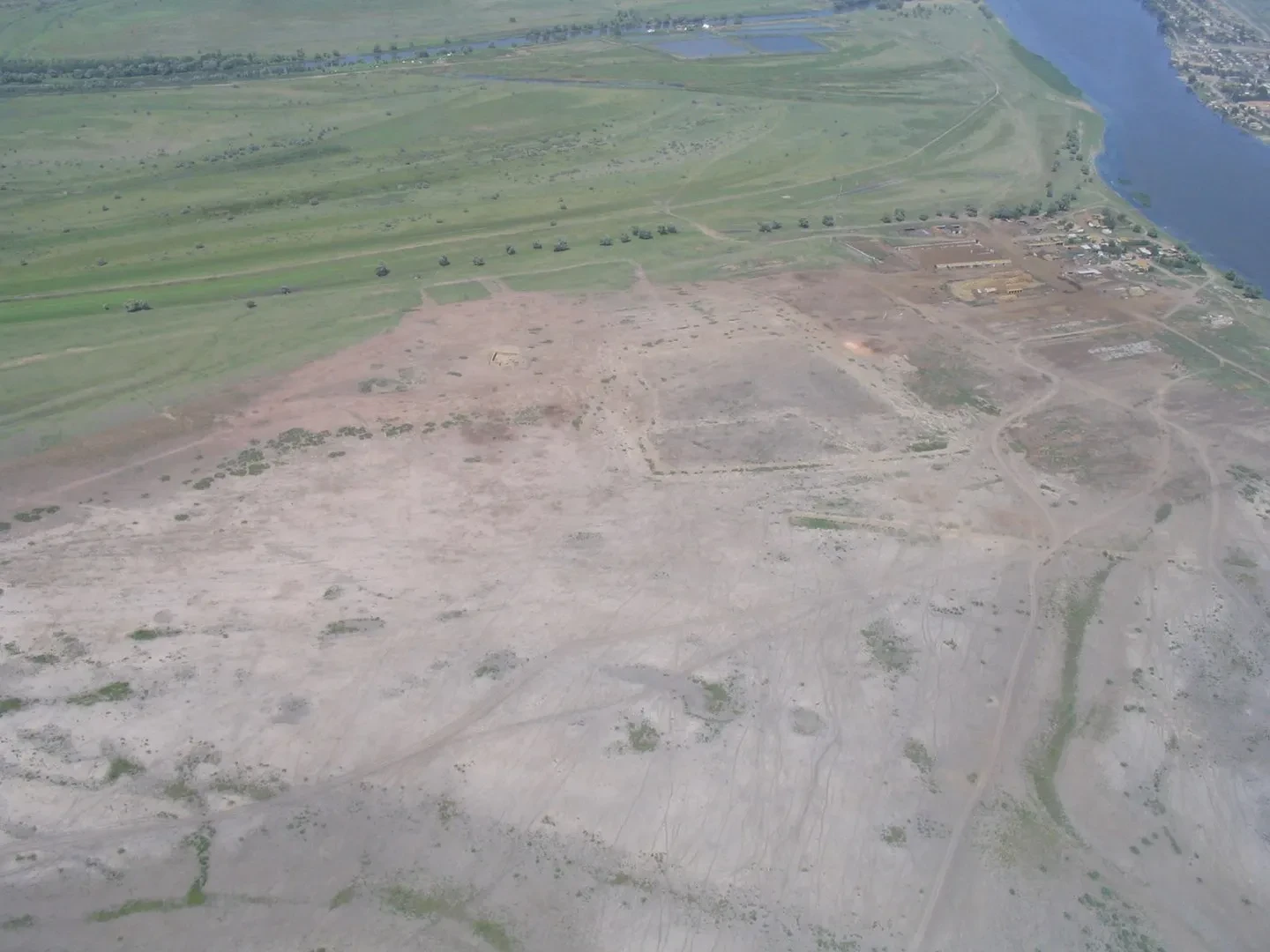
Vasiliev1972, CC BY-SA 3.0 <https://creativecommons.org/licenses/by-sa/3.0>, via Wikimedia Commons
The site of Attila.
The reason Attila was important to the nomadic Khazar Khanate is none other than because this city was part of the famous Silk Road.
I'd like to show related content too, but I've already uploaded too many photos today... I'll put it off until tomorrow lol.
I'll also make the map of the North Sea Empire and the influence map that readers requested~.