
275. The Turning Point.
The warriors of the North Sea charged with terrifying momentum.
But in truth, they were the ones defending.
"We cannot lose either! Fight back!"
"To heaven, not hell! Kill those barbarians!"
"For the Muslims! Allahu Akbar!"
[Uryaa!]
A loyal city of the Eastern Roman Empire remaining in the southeast of Sicily. In truth, its loyalty was somewhat questionable, so to be more precise: the city of Sicily, so vital to the Eastern Romans, faced ever-intensifying Muslim attacks each year, and considering the vast borders of the empire stretching in all directions, Emperor Michael had made a momentous decision to save the realm!
It was to seek help from that very strong friend of the North Sea who had, in fact, once saved his life and the life of the empire.
"Those turbaned bastards have gone mad! Push right through them! Brothers! Attack! Attack!"
"Sound the horn! Nothing can stop us!"
"Val-hall-a--!! Hel--la--!"
[Buuuuung-! Uryaa!]
[Chukchukchukchuk! Fyl-kir-! Kwang! Kwakwang!]
Life was, after all, an endless series of choices. The choice of Jarl Oleg to charge before the walls of Syracuse, and the choice of the Muslim commander to boldly stand against him.
If one looked more broadly, it was the choice of the Eastern Roman Emperor, who acknowledged the empire's inferiority in southern Italy and Sicily and sought help, and the choice of the Emir of North Africa, who shoved all the disobedient tribesmen down the throat of the Catholic world.
[Kwang! Puk! Pupuk! Keok! Chaeng-! Chwareureuk!]
Men clad in similar armor mingled in one place, and the two groups, differing in average height and build, soon spilled blood and iron everywhere, falling and felling one another over and over.
"Kill them all!"
[Hwoong- Pak!]
"Keok!"
"Ali! Ali!! These Shayatīn!"
[Sswaeeeek-! Pak!]
"Urk!"
"Die!"
An axe blade that flew into a comrade's neck split the armor and the bone and flesh beneath it as if chopping into rotten wood, and an arrow that flew beside the helmet of a Muslim warrior, consumed by rage, embedded itself into the left shoulder of that Shaitan.
To finish off that boar, who let out a groan mixed with pain, the Muslim warrior thrust forward the spear he had been gripping until his knuckles turned white.
[Hwoong! Peoseok!]
"Huh?"
[Chwak!]
"Uh-"
But then a green light flew in, splitting his spear in two, and as he felt his body rising into the sky and spinning back down to the ground, he lost consciousness.
"The wounded, withdraw! Those still with strength, press them harder! Today, I shall dedicate this place to Hel and the Fylkir!"
"Fylkir-! Fylkir Helgi!"
"Hel--la--!!"
Amid the vortex of the battlefield, one warrior exuded a singular presence. The warrior who held a sword glowing faintly green in one hand expelled every breath from his belly in a great cry, then drew the air deep into his lungs again.
This ferocious North Sea warrior, having sucked in the stench of blood and iron, charged forward vigorously, his eyes bloodshot red and his breath seeming to stream out as if smeared with fresh blood.
[Chalgeurak! Chalgeurak!]
"Th-this- Shayatīn-!!"
[Hwoong! Peoseok! Seogeok!]
A clumsy thrust already paralyzed by terror hewed through the spear shaft and the one who held it beyond.
[Hwik! Chalgeurak!]
Without a moment's rest, he lashed his sword left and right, splitting the enemy's armor and the flesh beyond it like scaling a fish, sending them to the ground.
"Aak!"
"O Áli! O Áli!"
The fallen would scream in agony until they died, and hearing them, the enemy would be either excited or frightened. Even if the place of battle changed, the actions of men struck by a blade were no different from those on that dear homeland soil.
And Oleg's battle was no different either. If anything had changed, it was that now Oleg fought not for his brother, but for the Fylkir. And perhaps that this southern land suited Oleg's heart perfectly.
Oleg, the lord of Liubice, the North Sea land he had conquered, paid little mind to his fief. His name had somehow become a magnet, drawing in the rough men from the eastern reaches of the North Sea.
"There! Break through!"
"Push them back with your bodies!"
"Odin! Keep your eyes upon us!"
[Uaaaa-! Valhalla-!!]
The warriors who had left behind the comforts of the North Sea and flocked to this far land were every one of them pitiable souls whose spirits had been stolen by the honor and thrill of battle.
Men addicted to the mental exaltation found only when standing in the gap between life and death.
These fierce wolves, who had already tasted blood plenty in this south, rushed mercilessly into the enemy ranks that Oleg had momentarily torn open, and as a result, the fairly disciplined Muslim warriors turned their backs and began to flee.
[Dung-dung-dung-]
"Do not flee! Fight back!!"
"Save yourselves-!"
"Áli wills it! Áli has told me to flee!!"
"To Bal'harm! Let us all meet again alive!"
At the rear of the Muslim line, men clad in solemn, splendid armor beat the drums of advance, while at the front, those whose morale was broken scattered in all directions.
Having witnessed this scene countless times since the arrival of Jarl Oleg and the North Sea army, the soldiers of Syracuse threw open the great gates and streamed out in unison.
"Kill those Saracen infidels! Aid our saviors!"
"Offspring spat out from Satan's wicked womb! Let us slay all these unclean ones!"
"Heracles! Heracles! O Syracuse! To the field! To the field!"
[Paaaaaam-]
With a clamorous string instrument sounding, the garrison of Syracuse laid down a wooden bridge capable of quickly crossing the deep moat and swiftly came over. As soon as they took their position, they immediately began loosing arrows.
The sound of bowstrings being released and arrows embroidering the empty air. Following that, the screams of men and the sound of hundreds of arrowheads embedding into something.
At last, even the drum of advance ceased and the Muslim command turned their horses' heads around. At that moment, all as one heart—those who had been upon the walls of Syracuse, the garrison that had sallied beyond the moat, and the North Sea warriors who had emerged from a side gate to strike the enemy's flank—sang the song of victory together.
And in a place not far from Syracuse, at Bari in the east of southern Italy, the allied forces of Italy and Lotharingia finally crossed the walls of the starving and exhausted enemy, while the Eastern Roman navy, coiled upon Crete and dominating those seas, stood against the enemy fleet stretching out from Egypt and Syria.
The time for a grand counteroffensive was ripening, and everyone surrounding the Mediterranean knew it.
*****
As news of victory and the names of those who had fallen on the field and reached Valhalla began their journey from Sicily to southern Italy, over the Alf Mountains and into Lothar's land, and at last across Frisia and Jutland to reach the Fylkir in Árós—
The ambitious Emir of Egypt, Ahmad ibn Tulun, silently gazed upon the site where the mosque bearing his name was being erected.
Ahmad ibn Tulun, the first independent ruler of Egypt since the ancient Ptolemies, could not long continue his grand musings.
His beloved second son, Khumarawayh's gentle voice tickled his ear.
"Khumarawayh. My darling eaglet. What is it?"
The boy, only ten years old, already displayed brilliance and fanned the flames of Ahmad's ambition, which in turn led to an unconscious check upon his untrustworthy firstborn, Abbas. Yet neither Ahmad himself nor the Turkic officers who followed their valiant general with their lives showed any disquiet. For Khumarawayh was that outstanding, and succession by the outstanding was a thing that happened on the steppe as well as in the Abbasid Empire. Just look at the war of nerves being waged right now between the Caliph of Baghdad and his brother! That the holy ones—the royal family—fought and killed each other was no longer a particularly special problem for those who had once lived under the Abbasid dynasty's influence.
"Word has come in from the Emir of North Africa. He failed in the assault on Syracuse."
"Hah. Those bastards, of course they did."
All that talk of brothers in faith and so on was only for the pious and those imams drunk thick on their own doctrine. If you looked at the emirs beneath the Caliph, they moved only for power and silver coin.
At the present time, there were two Muhammads to the west of Egypt whose names must be remembered. One was the powerful Umayyad Emir Muhammad of al-Andalus.
The other was precisely this Emir Muhammad of North Africa, near Tunis and the lands of ancient Carthage.
Both the Muhammad of al-Andalus and the Muhammad of North Africa nominally bowed their heads to the Abbasids of Baghdad, yet they reigned as kings of effectively independent realms. This tendency was deepening and accelerating, just as Ahmad himself in Egypt was reducing the taxes he sent to Baghdad.
The great Abbasid Empire had already crumbled.
"What great deeds could those Sahara Desert rustics who care only for their own interests ever accomplish? It would be lucky enough if they didn't just stab each other in the bellies."
"But father. Mustn't they succeed so that we can again set our sights on Chandax—on Crete?"
Khumarawayh. My brilliant son.
At the voice emerging from that small mouth, Ahmad could not conceal a satisfied smile.
"Chandax, too, must certainly be reclaimed. My son."
Although Ahmad held a powerful army in Egypt, to maintain this strength he needed the aid of the merchants who stretched from Egypt all the way to the coastline of Syria.
And what the merchants desired were the goods and slaves flowing in from fertile Eastern Rome and Italy, centered on the island of Cyprus and Chandax.
He had freely cursed the Emir of North Africa in front of his son, but Ahmad's own circumstances were not so different.
The Eastern Romans and the Franks were rightly bound to bow before the will of Allah.
"But right now, our most urgent task is securing Syria."
From the western sea, precious goods like silver and slaves flowed in. But from the east, beyond Egypt and Syria, the brother of the Caliph in Baghdad—the combined emperor and pope of Islam—was eyeing Ahmad's Egypt.
Caliph al-Mu'tamid, 'the one who relies upon God,' and his older brother, the true wielder of power in the Abbasid Empire.
al-Muwaffaq. Al-Muwaffaq. 'The one blessed by God.'
A man who would push in without mercy and strike off the heads of Ahmad and the Tulunid clan if they showed even a moment's negligence.
A man who had stabilized the Abbasid dynasty, which had long been toyed with in the hands of Turkic generals, and who dreamed once more of resurrecting the empire.
And thus, the enemy of every emir who dreamed of independence from the Abbasids and Baghdad.
A man he would have no choice but to clash with someday.
Ahmad's eyes sank deep as he thought of his mortal foe, and Khumarawayh's eyes gleamed bright as he watched his father's expression.
*****
In the late autumn of the year 874 by the Christian calendar, a world where division and war had become the dominant trend everywhere save for the solitary, lofty North Sea Empire and its friends, the Eastern Roman Empire and Lotharingia.
Here, yet another household was being smashed to pieces.
The Knyaz of Bulgaria. King. The betrayer of Tengri who had cast aside the title of Khan and accepted a new religion. An apostate.
It seemed as though sparks might leap from Boris's two eyes at any moment.
Did Boris himself wish to abandon Tengri, the god his father and grandfather and countless ancestors before them had believed in? But all of this was for the great Bulgars and the future of this nation. For the integration of the ruling Bulgar stratum and the subject Slav stratum, who even now did not share a single common tongue, this was the best way!
He had shown a tightrope-walking skill bordering on the miraculous between the Pope's office in Rome to the west and the Patriarchate of Rome in the east, and at last, after all that effort, at the council in Constantinople, he had finally won recognition for an independent archdiocese and a distinct Bulgarian church.
How could such a thing happen to him...?
"Vladimir, bring me my son Vladimir! At once!"
Boris-Mikhail, king of the Bulgars, had received word that his son, the boy he cherished so dearly he would feel no pain even if he put him in his eye, had gone out hunting with the boyars who opposed Catholicism. He had no choice but to summon his son.
Storms were rising everywhere in the world.
☆☆☆☆☆ Reference Material ☆☆☆☆☆
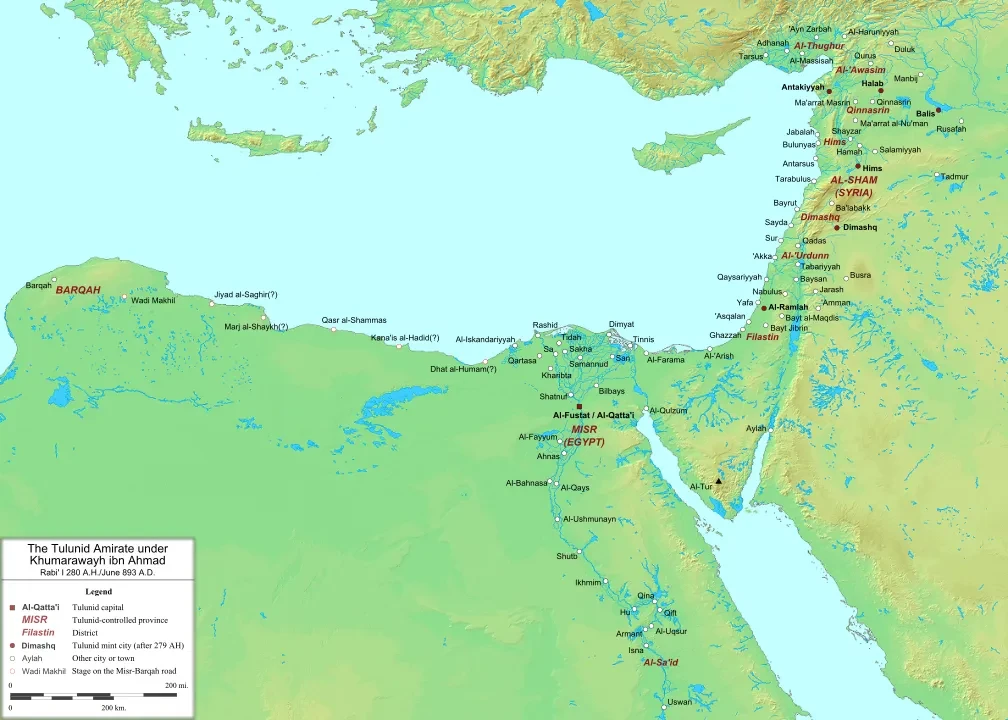
Ro4444, CC BY-SA 3.0 <https://creativecommons.org/licenses/by-sa/3.0>, via Wikimedia Commons
The sphere of influence of the Tulunid dynasty.
The founder of the Tulunid dynasty, Ahmad ibn Tulun, was an amazing person. Originally a Turk from the steppe, his abilities were recognized, he rose to the position of vice-governor of Egypt, ousted the existing Abbasid-loyalist governor, and effectively declared independence...!
The image above shows the Tulunid dynasty at its peak, when its influence extended over Egypt and even into the northern parts of Syria...!
It was a formidable power that exerted enormous influence not only over Cyprus but also over Chandax and the island of Crete...!
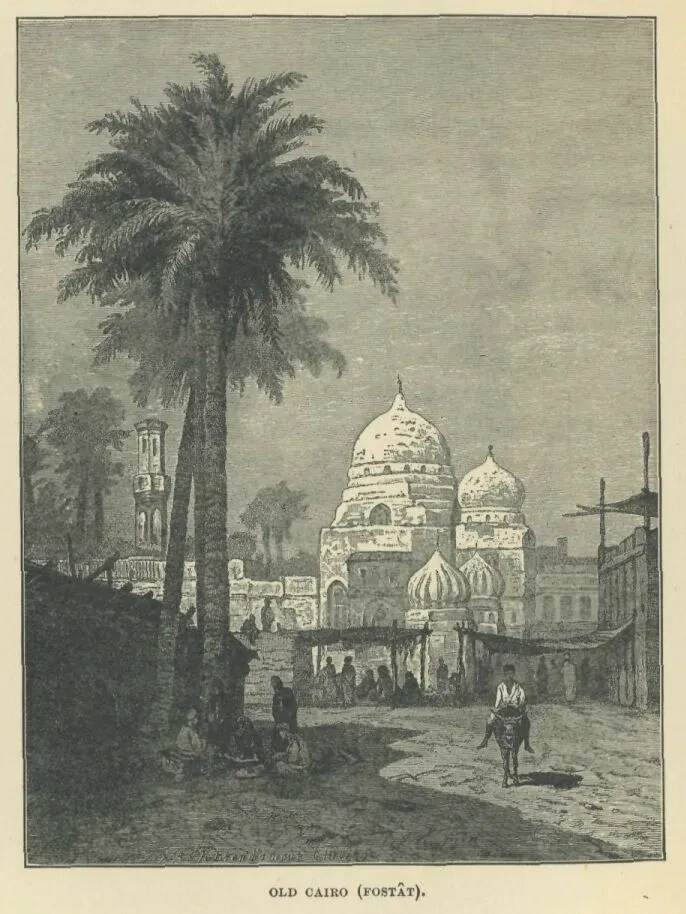
Rappoport, A.S. (Angelo Solomon), 1871-1950 VIAF (71482297), Public domain, via Wikimedia Commons
A painting of Fustat that lets you savor the tastes of Egypt.
The inscription labeling it as Old Cairo is striking...! In truth, the foundations of what is present-day Cairo began to be laid in the time of Ahmad, the founder of this Tulunid dynasty...!
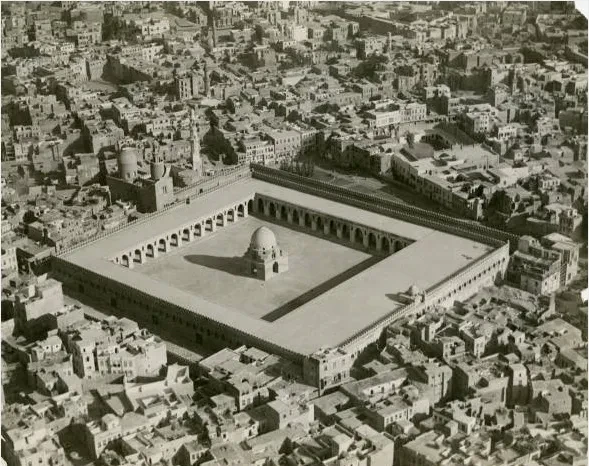
K. A. C. Creswell, Public domain, via Wikimedia Commons
The appearance of the mosque that Ahmad personally commissioned in the new city.
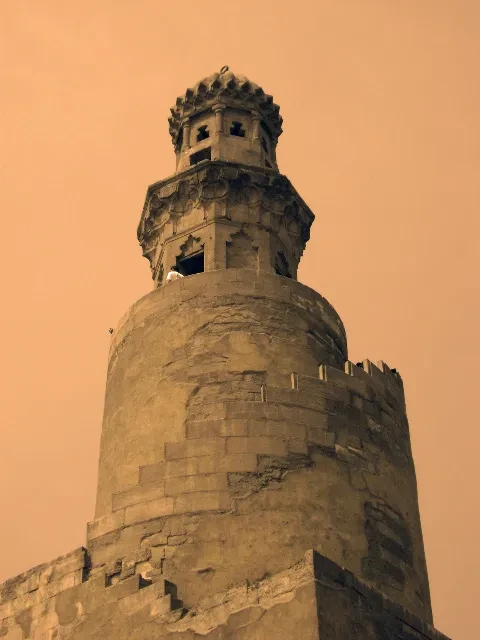
Andrew A. Shenouda from Cairo, Egypt, CC BY 2.0 <https://creativecommons.org/licenses/by/2.0>, via Wikimedia Commons
The minaret of the Ibn Tulun Mosque. Literally translated, it is a place where there is a flame; it is a kind of tower and a place from which the call to prayer is announced.
It adopted the style of Samarra, which was actually the center of the Abbasid dynasty rather than Baghdad—though after the Abbasid Caliph spent a supremely chaotic time laughing and toasting there with the Turkic generals, he fled to Baghdad, thus truly opening the Baghdad era...!