
243. Fools Think They Will Live Forever.
Travel was always a heart-pounding affair.
As with all things in the world, if one were to dig up only the bad parts, there could be no stupider act than journeying.
One had to step into the lands of people whose speech could not be understood. One wrong gesture or expression could invite unnecessary misunderstanding and immediately lead to drawn blades, and meeting men with truly vile intentions could make that very spot life's final destination.
Yet by that same reckoning, a farmer tilling his field could, if luck failed him, fall backward and crack his skull. Warriors in training could brush against a spearhead faintly rusted and suffer in agony for days on end before dying. Fishermen who challenged the sea each day might, on that particular day, let their greed swell a little more, venture into the far waters, and be caught by a sudden storm, never to return home.
At least, Lech, the stout-hearted man of the plains, had lived his life holding such thoughts about life's ironies.
Of course, Lech himself knew better than anyone that this was a somewhat crude argument meant to defend his own dreadful wanderlust fate. But the innate disposition one was born with was not something easily changed.
For the sake of sights like the one now before his eyes, Lech could never restrain his adventurous spirit.
"This place is Árós. The heart of the Northmen."
[Swaaa- swaaa- kee-ruk kee-ruk- kee-ruk kee-ruk-]
The gulls that often descended upon the Polanie plains in summer—he had wondered where they had all gone, and it seemed they had all flocked to this Norseman's white city. Did even such beasts possess eyes to discern the beautiful and the excellent?
The sight of Árós reflected in Lech's eyes was majestic, and beautiful.
A city that scattered such white radiance upon this grey-tinged, mysterious landmass, where cool breezes blew in between though it was clearly summer. Favored especially by the sun amid the overall cloudy weather, this city resembled a fiercely pulsing furnace, or the waves he had faced on the sea road here.
The force that endlessly surged forth was coiled around this city, its people, and all that surrounded it.
"Welcome! Lech of Polanie! This is the city built by the Fylkir himself, Árós!"
At first, he had marveled at Uppsala, which stood on the road leading to Árós, but once he passed the endless lines of ships and took Árós into his eyes, Uppsala and that splintered rock upon its shore swiftly vanished from his mind.
"This is sacred ground? I feel a god?"
Lech, who had roamed many corners of the eastern European world, had actually seen and heard so much that he held a skeptical view regarding a four-headed god or the thunder god Perun and the many other deities. Yet in this far-off land, he was to meet a god.
Unlike Lech, who had remained hale even upon boarding the rough sea road, the two warriors of the plains whom Siemowit had assigned as his guards had spent the entire voyage clinging to the prow, returning all that was within them back to nature.
Even those men, their faces pallid, were turning their eyes this way and that, dazedly drinking in the sight of Árós into their heads. At this, the warriors of the North Sea burst into pleased laughter.
"Haha! A god? It is too early for surprises, Lech! Jarl Hrólfr bade us guide you straight to Fylkir's Hill, so you shall soon behold our demigod!"
"Demigod?"
"Indeed! You would have seen the splintered rock on Uppsala's shore on your way here. After doing a deed no human hand could ever accomplish, the Fylkir himself declared all the gods to be dead, so fellows like us have no choice but to call the Fylkir a demigod."
The fierce islanders to the northwest of the Polanie lands believed in a four-headed god, so did a demigod perhaps bear two heads?
It was true that Árós's unreal scale, its tidiness, and its peculiar beauty born of rules and planning had seized his mind and spirit, but a demigod? A man's hand shattering that great rock? Was this Norseman mocking him now?
Still, Lech considered that he was the agent of the ruler of the plains and could not lose his nerve so soon. He feigned indifference, curling his nose as he nodded.
"Haha! My expectations grow keener? The meeting with the Fylkir!"
*****
"Ah, greetings to you! Master of all seas? Fylkir-man, two-headed demigod!!"
...?
Fylkir-man?
Two heads, was it? I was quite large in frame and height, to be sure, but wasn't this rather excessive for a first meeting?
The content and tone of the speech were both utterly scattered and incomprehensible, yet the greeting of this Polanie man, which somehow felt brimming with tenacity, did not seem to carry any insult or hostility toward me.
If such had been his intent, he would not have thrown himself flat on the ground and trembled so.
As I grew older, the power of this body and my bearing seemed to grow ever stronger. Even with my efforts to control it, this was the extent of it, and that was increasingly awkward. Mortal men were simply too frail to bear the spiritual pressure of this body.
"Well met, brave man of the plains, Lech. I am the man called Fylkir Helgi Ragnarsson, who rules over this North Sea."
I had been uncertain thus far about my mysterious language-acquisition ability and its conditions, but I could confirm that the language of one I directly faced was absorbed in a single instant, the neurons in my brain touching fingertips like a scene from the film E.T.
Thus, before the familiar words and sentences that sounded as spoken by one who had lived a good thirty years in some city of Polanie, Lech lifted his head sharply from his prostrate position, and his eyes grew wide as a frog's, showing his amazement.
'He's the type whose emotions are revealed all over his body. No professional diplomat, then.'
When I recalled men like Charles of the Franks or Damian of the Eastern Rome, whose expressions and thoughts inevitably ran separate courses, his reaction was as candid as to be called innocent. That appearance actually pleased me, and I bade Lech rise at once. At my word, Lech rose obediently and approached, soon bowing his head and speaking in a trembling voice.
"I never imagined I would hear the speech of the plains in this place. King (Knyaz) Siemowit of Polanie sends his greetings to the Fylkir who rules the wild sea, the land beyond, and the beautiful Árós."
Thankfully, he spoke the plains tongue well enough.
"The Fylkir of the North Sea conveys his grateful heart to Knyaz Siemowit. I had already known that our North Sea merchants had set up a few trading posts in the lands across the sea. Has the King of the plains something he wishes to say on that matter?"
If they were called the Polanie, they were surely the people who would later be Poland. Generally, if a people had survived to the 21st century, their reserves of strength were exceptional, so my interest naturally stirred. In a way, it could even be called nostalgia.
"That is not so, Fylkir. The trading village on the coast is a place of benefit to both the North Sea and the people of the plains, so what opinion could there be? However, the King wished to strengthen friendship with the mighty Fylkir who brought down the cities of the fierce Obotrites, and so he sent me, his unworthy servant, as an envoy."
This man was more eloquent than I had expected. To be honest, I had been slightly hopeful when he went on about the two heads, but he was so normal that it was almost a letdown.
"In our North Sea, we have a song that tells of guiding guests who visit to the seat of the householder and giving food to the hungry. How much more so when the King of the Plains himself has sent a wise man such as yourself to seek friendship with me—how could I possibly treat you and your Knyaz with neglect?"
[Sseu-euk-]
Being in an uplifted mood from playing with Sigmarr since morning, I rose readily from my seat, strode swiftly down the stone throne set upon the high dais, and soon clasped forearms with the bowing Lech and the two warriors of the plains trembling behind him, offering them encouragement directly.
"As it so happens, a joyous occasion has come upon my household, so I shall hold a grand banquet. Let the steward of the palace provide our guests with lodging and food."
"Aye, Fylkir. Please, follow me."
"If you follow my steward, he will prepare a place for you to rest. I hope you will make yourselves as comfortable as if this were your own plains."
"Thank you, Fylkir. May the blessing of the Thunder God (Perun) be with the merciful one."
"And may the blessing of the Thunder God (Thor) be with you as well."
Indeed, in this age, a sense of linguistic and religious kinship could overcome even my overwhelming size and presence.
With a much more relaxed expression, Lech turned and followed the palace steward out of the long, high-arched hall.
Just as my longhouse had become a palace and the mead hall had transformed into a grand audience chamber, various official posts were being newly created and the system was becoming quite organized.
Naturally, this was not something I had conjured up overnight like a shooting star descending from beyond the sky, nor had I, having awakened to all creation in the universe, hammered it out in a single morning. I had received the help of Eastern Rome—the finest bureaucratic group of this age—and Damian, who had once stood at its pinnacle.
One might look at this and ask if the North Sea was becoming little more than a half-baked copy of Eastern Rome, a ninja copycat of Eastern Rome, or the second company of Eastern Rome. But in truth, this was precisely the true identity and true face of our North Sea.
We plunder all things that are good, that look good, or that seem likely to become good in the future. Be they institutions, objects, people, or religions—anything at all.
In any case, while the broad framework was quite similar, the inner workings were naturally different. First, for the position of palace steward overseeing all the business of my hall, I appointed the Huskarl who had followed me onto many a battlefield and had ultimately been forced to have one arm cut away.
Beyond him, I arranged for many other disabled warriors—those who had injured their bodies for my sake—to begin the second act of a new life: working in various parts of the palace, serving as training instructors in Norrland, or, for those who no longer wished to handle edged weapons, joining the merchants of the Marmaros Council or becoming members of my vast farmlands.
Along the way, some of them, feeling some calling or another, entered the temple of Hel as apprentice priests. This meant that the immensely critical and important matter of compensation and treatment for postwar soldiers was being appropriately managed, one could say.
While it was less dramatic than Miklagard (Constantinople) of Eastern Rome, where each day felt like walking through a minefield, the great scholar Kyrillos had come to Árós—where the water was good, the air was good, and it was far better for a man to live—and with his complexion brightening by the day, he had launched a new project for the North Sea's education. Most likely, my warriors and their families would be able to receive far greater benefits in the future.
On whichever side of this North Sea society they might be.
This was something fundamentally tolerated by the culture of the Norsemen, unlike the personal will I had exerted to kill the gods (rocks) and thereby erase a Norse tradition that was not at all beautiful, such as human sacrifice.
A warrior society that honored scars and accepted without any resistance the belief that only by dying on the field of battle could one reach Valhalla—this was the very essence of the North Sea people.
According to this trait, it was a truly honorable and natural thing that those who had fought alongside the Fylkir and earned glorious wounds should serve as his closest aides.
Thus, I had never entertained, nor had any need to entertain, the dilemma of taking on some heir of a famous house or the son of so-and-so for political purposes.
At any rate, while the arrangement of the menfolk in the palace was roughly settled in this manner, in the case of the womenfolk, it was chiefly the daughters of my subordinates or the priestesses of the Temple of Hel who lent their hands. With wages that were high even by the standards of wealthy Árós, along with priority rights to settle in the planned expansion city of Árós that Leon was designing, the posts seemed to be extremely popular.
The authority over managing them naturally belonged to the mistress of this palace, Inga. Since she always showed only a face full of smiles and happiness to Sigmarr and me, I had not known it well, but unexpectedly, the women of the palace held her in great awe.
According to the words of my mother—who in truth wielded immense influence behind the North Sea Empire through the faith of Hel—a woman had many faces by nature, and to uncover that secret was a truly dangerous thing, so that sometimes it was better not to know.
Were these not truly wise and righteous words? Sometimes ignorance was medicine.
Once more, at any rate, while I thought it was a pity for Oleg—who had unexpectedly left Novgorod to build a new nest in Liubice—it was better to approach relations with the people of the plains in a friendly manner.
At that moment, Rune—my captain of the guard who also handled audience affairs—emerged from beyond the long corridor and the ornate doors and summarized the identity and the matter at hand of the person waiting there.
'A land dispute between two Jarls, was it? The stakes I had driven in early this year must have been washed away by the rain, and now each is insisting on seizing even a hand's breadth more land.'
Why did they have to quarrel over something that could be settled simply by roughly eyeballing the midpoint and driving the stake back in?
But since these seemingly trivial problems were, when related to water management, truly enormous issues in the countryside, someone's arbitration was absolutely necessary.
"Bring in the next petitioners—no, the Jarls."
"Aye, Fylkir! Open the doors!"
"He says to open the doors!"
[Grrrrrrng-]
The palace that Leon had insisted on building large—on the grounds that anything large was good—was proving its worth handsomely. Look at those expressions of being overwhelmed!
'Now, let us get back to work.'
Governing greedy rulers. It was time to fulfill the duty of the Fylkir.
☆☆☆☆☆Reference Material☆☆☆☆☆
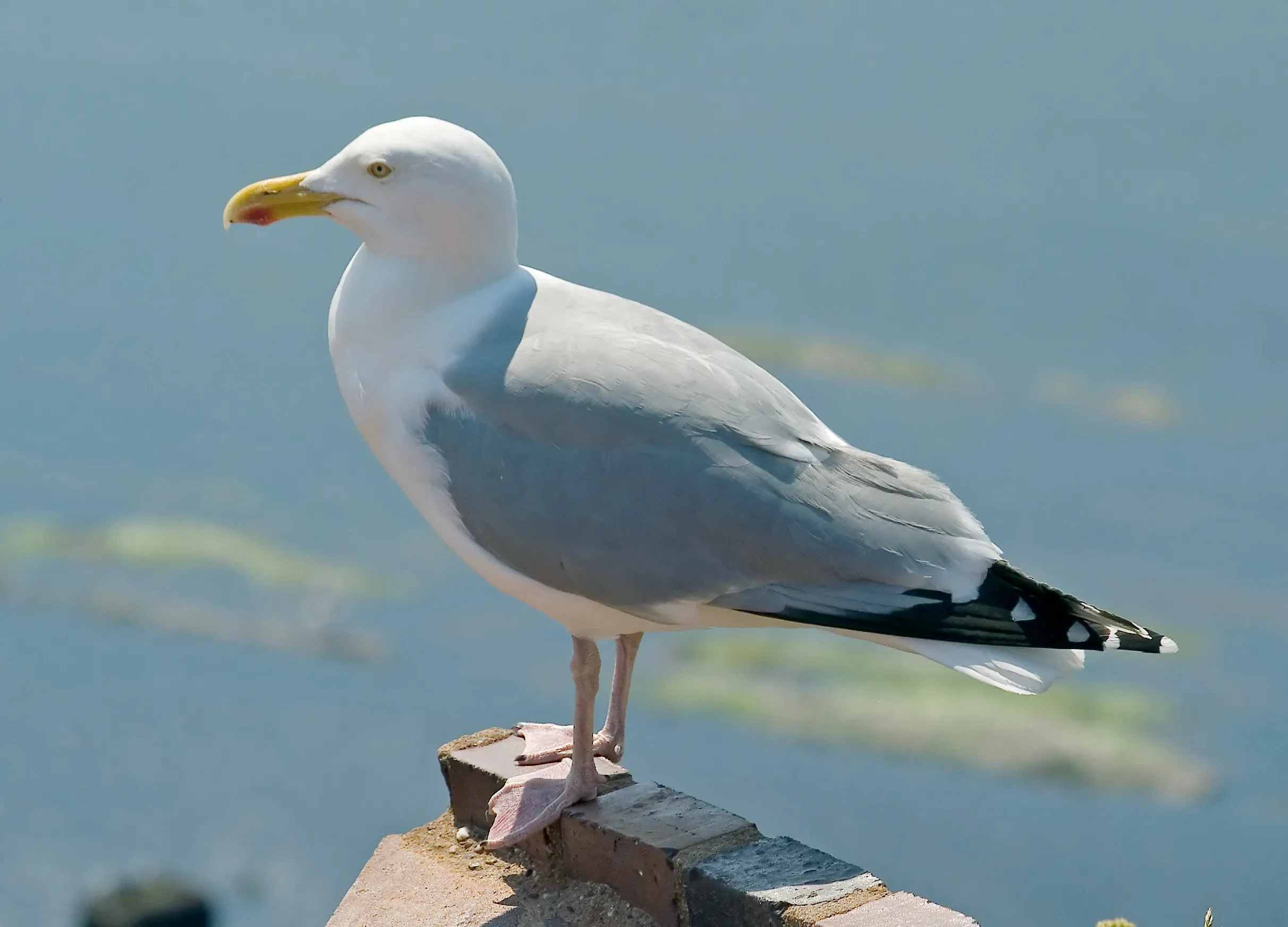
Kulac, CC BY-SA 2.5 <https://creativecommons.org/licenses/by-sa/2.5>, via Wikimedia Commons
European herring gull.
These are gulls that briefly move to the northern coast of Spain in winter, and then travel all over Northern Europe—even as far as Iceland—to live!!!
The reason the image that comes to mind when you think of a seagull is exactly like this is probably because these guys really are seagulls...!!!! What am I even saying...?
From the description, they seem like complete migratory birds, but in fact, there are also many that don't migrate and stay in the place they were born!!!
Since Árós is currently unable to handle the resources of its growing population, naturally, the number of extra(?) animals must also be considered to have grown!!!!!
Ecosystem destroyer(?) Helgi...!