
244. Fools Think They Will Live Forever (2).
[Kee-ruk kee-ruk-keeruk-keeruk!]
Seagulls were the creatures that connected the world of the North Sea. Wherever those seagulls cried, was that not a land that ought rightly to come under the North Sea and the Fylkir?
It was a somewhat fanatical thought, but those of similar age who had participated in the expeditions to West Frankia and East Frankia alongside the Fylkir and witnessed that god-possessed spectacle of earth-slaying—they all, every one of them, thought that way!
Stan, the youngest Hundred-Chief of the Fylkir's direct Jorvik Engineer Corps, matured far too early, thought so.
The war begun in winter had ended by the time summer arrived, but someone still had to hold the newly won occupied territories. Stan's Thousand-man unit, rumored to have lost the lot-drawing among the Jarls, had to remain in Verden below Hamburg for roughly a month, and could only move toward home after the peacekeeping force came in from Kaupang.
To begin a war in winter and end it by summer.
Though he had not lived an especially long life, Stan, who had his sights on the position of youngest Jarl, knew well enough that this was by no means a normal war.
What had been the wars of the Cyningas and Ealdormen that I had watched all that time? What in the world had those men been fighting over for a year, two years, up to ten years, tediously trading blows?
The Fylkir, meanwhile, had even taken the fortress of Rouen in that land of West Frankia now named Suthrland, and in northern Saxony had taken Verden and Hamburg together with the Frisian allies.
It was not easy to end a war in half a year even in open field, let alone bringing down not one but three of the tall, sturdy Frankish fortresses—which were no mere palisades, for the Franks showed a peculiar talent for fortification—all in a single campaign.
With results such as these, was war not, in truth, a thing worth waging?
It was not as though Stan's own Hundred had been without those who perished here and there in the fierce fighting, but in the end, all men died.
It had not been even five years since men froze to death and starved to death in winter, and all Northumbria had been half-withered and filled with corpses before the meaningless war of two Cyningas.
Compared to such a wretched fate, how meaningful a thing it was to offer one's life beneath the name of a demigod who yet walked this land alive! Moreover, word had it that the demigod himself had prayed first of all for the rest of the dead in the Square of Gods at Árós.
It was a great pity not to have been present in that place in person, but upon hearing that news, Stan and the warriors of his age could all summon the thought, for the first time in their lives, that they might gladly die for someone's sake.
The Fylkir was mighty, yet merciful. Could it be that only the mighty were capable of mercy?
Was life beneath that mighty and merciful ruler not a better life than being under those other nobles and kings who were neither mighty nor merciful?
In that regard, Stan was deeply satisfied with his present life. That day long ago on the walls of Jorvik, fighting against Cyning Ælla—the Fylkir's words to the small boy Stan had been then, telling him to go down below the wall and lend a hand carrying arrows and stones.
Those words, still vivid, had led him to begin life in the supply corps, learning the way of riding a longship, the manner of working pulleys for transporting goods, the method of twisting rope, the way of organizing chests, the way of fighting with the commanders of those blockheaded heavy infantrymen who gave absurd orders, the way of gently explaining to the cavalrymen—who sometimes seemed good at nothing except laying down their lives—why the hay transport was delayed, and so on.
The years had shaved away the soft heart of a young boy and made a hard young man, but within Stan's breast there still shone a hope, shameful to speak of to others, of following the Fylkir and making a better world.
'Much had already changed. I, and Jorvik, and the North Sea.'
[Kee-ruk- kee-ruk kee-ruk! Peol-leok- peol-leok-]
The seagulls, increasing in number in proportion to the swelling multitude of men. These shrewd negotiators, these scavengers, unafraid of humans, flapped their wings and circled above people's heads. Stan took out a piece of jerky from his pocket and waved it at one particular bird that hovered near him.
[Keeruk-keeruk-keeruk! Pal-lak-pal-lak!]
At that, the seagull noisily chattered with its beak while cautiously approaching and snatching the jerky. In earlier days, he would not have had the leisure for such a thing.
So much had changed, and more would change yet.
Jorvik was no longer the place full of the scent of wood where the young Stan had once roamed.
By virtue of its geographical position facing the sea, it had received the honor of being chosen as the Fylkir's direct holding—Stan's hometown, under the capable hand of Jarl Ecgberht, had transformed into a port visited even by merchants from a far-off place called Constantinople, and upon the central hill of the city a palace for the Fylkir and a temple for Hel were being built, modeled after that famed Fylkir's Hill in Árós.
The reason Stan had sought out a tavern by the nearby river today was that he had heard word his old commander, who had chosen discharge from the army, had gotten a foot into that very construction site, and Stan meant to cadge a free meal.
If one would not follow a man who thus looked after those wounded fighting for him, those who died, and even their families—then whom ought one to follow?
"Hey-y! Stan! You little pebble of a man! Hahaha!"
"Here I am!"
The old commander, missing a finger, had received a fair sum upon leaving the army and newly started a construction business, and had heard that work kept pouring in without pause. With the Fylkir's palace now rising on Jorvik's hill, and also Jarl Ecgberht's mansion planned—which was to be built precisely one man's height shorter than the Fylkir's palace—he was running a quite successful enterprise.
Word was he intended to grow it larger still and form some kind of civil engineering guild—a stonemasons' organization or the like.
At any rate, with a bright smile filling his face at the sight of a warmly familiar man after so long, Stan waved both arms vigorously. Around them, the people coming and going moved busily toward their own purposes, working, laughing, living their lives.
In the glass-bead eyes of the seagulls looking down upon that scene, the image of vast, teeming humanity was reflected.
*****
"Seeing you again, you seem stronger still. Ha-ha! I am the Gyula of the Magyars, Árpád."
"You flatter me too highly. I have heard all of the battles you waged in East Frankia. I am Fylkir of the North Sea, Helgi Ragnarsson."
The first foreign royal to be received upon Fylkir's Hill. And not a collateral kinsman, but the very heir who already led the Magyars in substance, the supreme military commander, had set foot in Árós in person.
Naturally, at this unprecedented, unexampled news, the palace stewards, Hrolf of course, and even my wife Inga had all grown busy.
In truth, I had wondered if this was really something to cause such a commotion, but considering it broadly a kind of learning, I simply let them do as they pleased.
Thus Árós, following the recent triumphal procession, the news of Halfdan and Botilda's pregnancy, and the preparations for the upcoming Great North Sea Sports Meet, now found itself holding festival after festival upon the news that an allied royal was visiting.
If Ivar and Damian planned the large-scale expedition to the Khazars, Seutorolpeu, who had taken charge of all the practical work beneath them, was showing signs that his soul might soon escape from his mouth, so he was excluded. Refil had already lost his soul amidst an impossibly packed schedule, so he was excluded.
In the end, for the ceremony, Baldr—Ivar's son, my nephew (a year older than me), who had been demonstrating his ability as an administrator under Hrolf—became the first in our North Sea to take charge of protocol for receiving a guest of royal rank.
Following the Eastern Roman style I had experienced firsthand in Constantinople would have required too many preparations and didn't seem to suit my taste for simplicity, so what I chose was merely an event beginning in Novgorod and a simple parade in Árós.
Because of this, Rurik, who had been building friendly ties with various chieftains along the southern Baltic, was hastily summoned to Novgorod, and even the people who had been training hard, determined to outshine their rival city Polotsk this time, enthusiastically applauded the fast-moving Magyar friends.
I had wondered if we really needed to go this far, but since this allowed us to check our army's communications system again, it wasn't bad.
Thus, about an hour ago, at the unexpected hospitality and the sight of me personally coming out to wait at the harbor of Árós, Árpád and the entire Magyar honor guard beamed with broad smiles, and I had led them over the clean slopes of Árós to reach my palace.
After that, I gave Árpád and the Magyar friends, worn down by the long journey and rough waterways, time to catch their breath and provided them with clean clothing. I sent word that if their condition was not good, it would be fine to postpone the talks, but Árpád's will, which had driven his body through the treacherous waterways of the Dnieper and the North Sea, seemed to have forgotten the screams his flesh was letting out.
"Ha ha ha. Isn't the Fylkir rather overpraising my paltry merit? I'm embarrassed."
The first place I had met this man was Kiyiu, where I had stopped briefly on my way back to Árós after finishing my business in Eastern Rome.
At that time, the tension between the Magyars and the Khazars had been palpable on the skin, so I had requested a meeting to ensure the stability of Kiyiu and its people, caught in between; and Árpád, who had already exuded the fierce spirit of an eagle-eyed hunter, seemed to have added caution after clashing with Eastern Rome.
"Thanks to Gyula Árpád and the Magyar warriors keeping East Frankia's Carloman and the Imperator Ludwig occupied and drawing their attention, the North Sea and I have greatly profited. So I express my gratitude once more here."
Placing the Eagle hand near the heart and bowing the head—that is a gesture that anywhere on this earth would convey meaning such as respect, deference, and gratitude.
Árpád, seemingly flustered by my appearance, stretched both arms forward and shook his head, hastily adding a few sentences to dissuade my gesture.
"Fylkir! For us Magyars, you are as if the Kende and Gyula combined, so such courtesy from you is too much. It is true that the Fylkir conveyed information about East Frankia to us through Jarl Haskuldr of Kiyiu, but in the end, we would not have moved if we had not gained anything ourselves, so there is no need for separate thanks.
Moreover, since the Fylkir yielded and we received a few relay stations south of Kiyiu, we would say we gained more than we gave."
And then, because he himself bowed his head, I had to raise both arms to dissuade that Magyar Gyula.
It was a sight—grown men flapping their arms at each other and shaking their heads.
We had shown each other such an unsightly spectacle, so an awkward silence flowed between us sitting at the round table.
'Look at this?'
If the name of the man sitting opposite me had been Damian of Eastern Rome, or Charles of West Frankia, I would naturally have considered every gesture, expression, look, word, and breath to be deceit.
However, the Magyar military leader seemed to fight well but had no particular skill in this diplomatic language, making him rather difficult to deal with.
Was the greatest weapon indeed sincerity?
After collecting his thoughts for a moment, Árpád downed a cup of mead placed on the round table and laid out the main topic to me.
"Facing East Frankia, Moravia, and Bohemia was a fresh shock for me and our Magyars. The army of East Frankia was heavy and slow, but solid and strong. However—"
Árpád's pupils, as he spoke recalling East Frankia, narrowed as if looking at something far away, and a brilliant light shone through them.
"The more we clashed, the more it felt like it was doable. What we need are simply more iron, food, and wood for arrows. If we only have those things in our hands, I'm not sure about the south of the Danube River that the Bulgars hold, but the north above it we can certainly take."
A seat facing not a seasoned diplomat but a true warrior was welcome, but what gain did the North Sea get from that?
Árpád, immediately catching my glance, swallowed once and said.
"I looked at the waters following the Danube west, and if you take the waterway extending further down from there, you soon reach the sea they call the Mare Adriaticum. And beside it is Italy. Please increase the trade volume of the iron and food we need for our Magyars. We can give the Fylkir excellent horses, riders, and equestrian training. And when our power is more fully ripe—
We will offer the Fylkir the waterway leading to Rome."
'Look at this?'
The scale of Árpád's ambition was no ordinary thing.
And yet that sight didn't look bad either.
Rome. Rome.
Even if things went wrong or fizzled out, I had nothing to lose, didn't I?
Somehow, it seemed I had gained one more story to tell Michael of Rome through Damian.
"I think the Magyars and our North Sea can become even closer than now, Gyula Árpád."
"My thoughts as well, Fylkir Helgi."
Upon the shining eyes of this steppe raider, my own face with a similar smile was reflected.
☆☆☆☆☆Reference Material☆☆☆☆☆
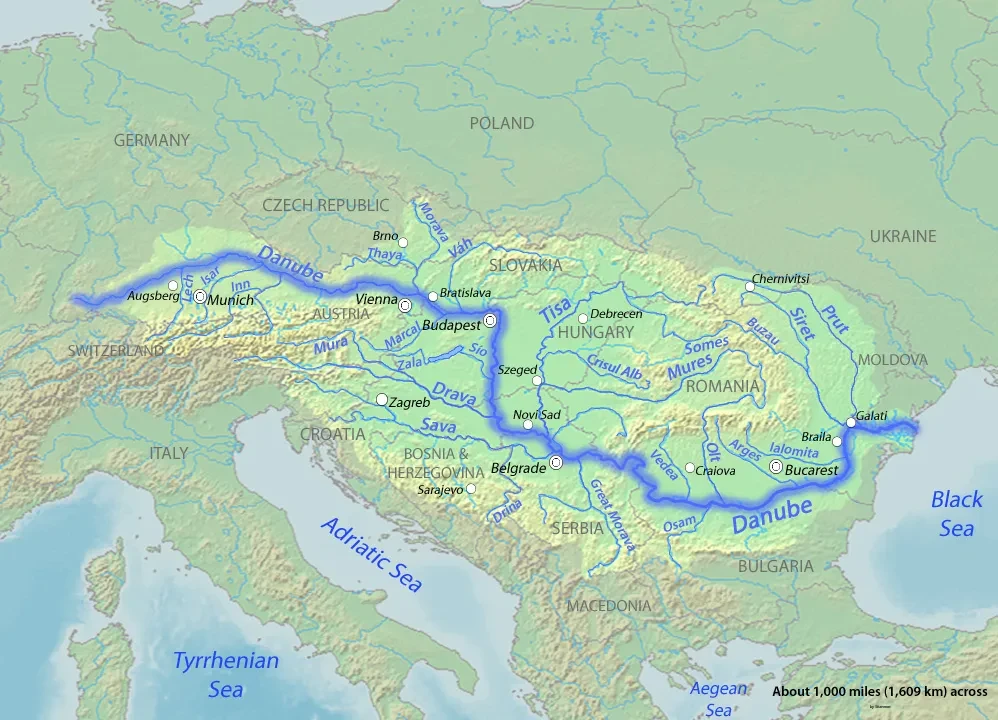
Shannon, CC BY-SA 4.0 <https://creativecommons.org/licenses/by-sa/4.0>, via Wikimedia Commons
Árpád's ambition.
The Danube and its friends, that's what it is...!
Actually, looking at it this way, even if you take the Sava River, which is closest to the Adriatic Sea, you don't directly reach the sea... but as you can see, northern Italy is right in front and the distance to the sea isn't that far...!
Right now this land is held by the fierce and well-fighting Croats, the predecessor of Croatia...!!!!!
In Helgi's thinking, even without reaching Rome, if we can just seize the Danube, trading continuously with the Magyars alone is already a profitable venture...!!!
There's no reason not to accept...! Plus, the Magyar friends are experts in horseback riding...! For Helgi, who dreams of a fully armored Viking lance charge even today, it's a sweet proposal...!!!!!!