
242. There Is No Wave That Stays Still (4).
The warrior Lech of the Plains People (Polans) was an adventurous man of the green fields.
Although Lech himself would probably not admit it, among those who ruled that vast plain and were slowly creeping toward the coast—among these Pol, or Lęda (in Old Polish also meaning 'plain') people—there were, of course, those taller, stronger, and better with weapons than Lech.
But none could match Lech's adventurous spirit.
Since childhood he had roamed the vicinity of Gniezno, exploring every corner of the king's city that might even be older than the River Warta, and by the time he had become an adult his own family had given up on, he fearlessly wandered the northern sea, the western forests, and the lands of the Rus to the east.
Naturally, in a medieval society where rumors traveled at a distinct speed, Lech's name reached even the king's palace in the deepest part of Gniezno.
Thus, about seven days earlier, Siemowit, who had been enjoying Lech's company as a drinking companion, mood-maker, and teller of tales—working under the title of the king's escort and effectively serving as a kind of skald—summoned Lech with an uncharacteristically solemn expression.
The king had called him out of nowhere on an ambitious evening, making Lech think the king was about to start another drinking bout. The memory of that moment arose vividly in Lech's mind.
'My friend Lech. The bravest man among us Plains people!'
'...? Why so ominous, Knyaz.'
'You truly have a remarkable sense! An ability to sense impending danger!'
'Are you saying that you mean a threat to me, Knyaz?'
'You, how much do you know about those Sea People?'
'They are terrifying people. Large, strong, good at sailing, and fierce fighters. They're a bit different from the people beyond the western forest (East Franks), and I often encountered them in the villages of our Rus friends to the east. They are hearty, but fearsome people.'
'You must go and see these people for yourself. They must have a king as well, no? Representing the king of the Plains people, you shall meet the king of the Sea People.'
'Pardon?'
Mad Siemowit. Mad Plains people. May they all rot.
Without a hint of hesitation, the Polanie people and their king had sent Lech off with only two guards. After unleashing a torrent of curses at them, Lech turned to the Norseman guide who held his life in his hands and spoke amiably.
"Hahaha! North man? You're big! Ship big too! How come I not big like that?"
The Norsemen's language, which he had picked up while mingling with drunk Northmen during his stay in the Rus city of Polotsk.
Thanks to this language, Lech had won the great honor of working in the Knyaz's palace; yet because of that skill he now had to meet the king of those terrifying Northmen. Truly, life was like the old saying "a blessing in disguise," to be sure.
"Heh heh. Every time you speak, I simply cannot hold back my laughter! Lehu (mispronouncing Lech)! Wherever did you learn such speech? In any case, it's true that this dragon ship is large, but this one has been specially modified for speed, and the ones we ride for war or the one the Fylkir boards are far larger."
"Anumundr! My name is not Lehu, it's Lech! I never heard of Fylkir? Who is that!"
"You've never heard of the Fylkir? By Odin's luscious beard and Hel's smile, good heavens! Do you live in a corner of the world? How can you not know that name?"
Anumundr, the large Northman warrior whom Jarl Oleg of Liubice had personally assigned to escort the honored guest, opened his eyes and mouth as wide as possible as if genuinely astonished.
[Swaaa- Cheolsseok!]
Just at that moment, seawater flew onto that gaping face, but this Northman warrior, so accustomed to the sea, maintained his dumbfounded expression even as his face and whole body got drenched.
Lech thought the man might truly not know—it felt like pointless boasting—but since the word seemed important, he asked about the Fylkir once again.
"We are Plains people? Plains not corner? Who is Fylkir! Is he North's Kunung (mispronouncing Konungr)!"
Indeed, the more one used a language, the more one's skill grew. When he had first faced their fierce-looking Jarl, extreme tension had made him bite his tongue; now the Northmen's tongue was flowing freely.
"Oh, you truly are astonishingly ignorant! Please forgive my rudeness, Lehu of Polanie! But I do not mean to slight you or your people. Knowing the Fylkir might be more important than anything else in our North Sea."
The man who had been pouring down drink all journey long, rejoicing at leaving the forests and insects behind, now hardened his expression and bowed his waist, and the atmosphere shifted.
His brown eyes and brown hair were the same as Lech's own, but like the difference between a dog and a wolf, there was a sense of him gazing at something other than a fellow man.
Lech had seen that look somewhere before—even a chilling glint—and he soon recalled that it resembled the gaze of a priest officiating a ritual.
"Fylkir Helgi Ragnarsson. Hel's Great Warrior, Ruler of the Sea, Master of Konungrs. Never forget this name."
[Swaaa- Swaaa-]
A heavy voice flowed from Anumundr's face, which momentarily darkened, and even the madly churning sea seemed to hold its breath before that name.
"Understood? Knyaz above Knyazes, Fylkir Helgi Ragnarsson? I will not forget."
"Mm. That's right, do not forget. Heh heh-"
"Puhahahaha!"
"By Njord, I beg you! Someone do something about that accent!"
As soon as Lech's slightly stiff words fell, laughter bloomed again on the Northmen's ship, where silence had settled a moment before.
"Here, Lehu! Take this cup! Now that we are aboard past Örn, you and we are comrades!"
"Take my cup too, Lehu!"
"My name is not Lehu, it's Lech! Northmen are stupid!"
"Uwahahaha!"
[Swaaa- Cheolsseok!]
Once again, laughter flowed over the wicked waves that approached.
Soon, with the Northmen breaking into song as a backdrop, Lech glanced at the land of Örn receding into the distance and then took in the land on the left drawing near.
*****
[Jiiing- Jing- Jing- Jing- Jing-]
"Huuuh- huuuum- ooom- huuuh-"
West of the Dnieper, north of the Danube. Somewhere in the vast steppe.
The power that was gradually rising in momentum—the Magyar chieftains gathered in one place.
On the surface, it was a meeting to determine the grazing lands of each tribe before the full onset of the steppe winter, and also an occasion to see the faces of the brothers who had sworn unity under Álmos and to share cups together.
But if one looked deeper, the true purpose was to hear firsthand the outcome of the great war that the mysterious North Sea Empire beyond the far end of the long Dnieper River—and its Fylkir—had requested.
Thus, while the warriors ate and made merry outside the great tent, the chieftains sat where the sounds of Hmi (nomadic throat-singing) and the Horsehead fiddle (a stringed instrument made of horsehair) faintly resonated, gazing upon the Gyula (military chief) and Kende (celestial chief) whom they had raised up with their own hands.
"You and our warriors have traveled a truly long road, Árpád. Have you been injured anywhere?"
"Of course not, Kende Álmos. Who am I? I am the son of the sacred raven."
"Judging by your words, you are not greatly harmed—neither in body nor in spirit."
[Swish-]
"Huuuuuh- ..."
[Jing- jingjing- ...]
Álmos dismissed the musicians and shamans who had been prepared for the souls of his son and the warriors who had traveled a road long and harsh even by nomadic standards. Then he met the gazes of the brothers who had drunk the blood of the white horse together and sworn their oath, one by one.
The ruler of all Magyars, seated with a commanding bearing, asked his son the questions that stirred his curiosity, one after another.
"The weariness of the journey will not yet have faded, but old men are ill-equipped to contain their curiosity. What did you go and see, Árpád? Those silver coins and grains that you and your warriors have brought back—how strong was the one who gave them?"
To Árpád, who had been doted upon by the chieftains since childhood, the elders gathered here were all familiar faces anyway.
Well aware of how wolf-like these men were—and especially how coldly clear-sighted his father was, the man who had bound the muzzles of these fierce ones into one—Árpád did not speak around the point but pierced straight to the heart of the matter.
"If you follow the long river westward, you come upon men called Franks, clad entirely in sturdy iron. Even their mounts are armored in iron, so much so that the thought of engaging them head-on never entered my mind. The number of their cavalry that I roughly counted was three to four thousand alone. Given time, one must assume they can gather more than that."
"Steel cavalry? It is not unfamiliar, but that number is grievously large."
The Magyars, the Khazars, and of course the Bulgarians, the Eastern Romans, and the Muslim empires beyond—they all employed heavy cavalry.
However, in the case of nomads like the Magyars or Khazars, the proportion was not as high as it was in the empires of settled peoples.
Differences in fighting methods certainly played a part, but the most critical issue was that nomads simply lacked the material resources—and Árpád knew this well.
"After a great battle, we struck a place called Bohemia, further north, together with those who call themselves Morava. It is a terrain of gentle, rolling hills, and the way the people there and the Moravians fight closely resembles the Franks. They hold with infantry and strike with cavalry. Their bows are weaker than ours. And—"
Árpád's words, interspersed with occasional sips of Mare's Milk Liquor, unfolding all that he had heard, seen, and felt from a military perspective, possessed a power that commanded attention.
At the fascinating tales of the western world, Álmos and the chieftains likewise drank Mare's Milk Liquor or chewed on dried goat jerky, their eyes gleaming.
And so, over the span of roughly five songs, Árpád calmly explained everything—the quality of the soil his warriors had ridden across, the potential for pastureland, and the vast grassland north of the Danube (the Puszta steppe, the Carpathian Basin) where, in truth, no overwhelmingly dominant power held sway.
"Westward, then. Westward."
Stroking his long beard with a fine comb imported from the North Sea, Álmos and the chieftains pondered deeply upon Árpád's tales of adventure and battle.
Amid that weighty atmosphere, Árpád, who had likewise been lost in thought, quietly called out to Álmos after the span of another song had ended.
"Kende. Has the messenger dispatched to the Fylkir of the North Sea through Kyiv still not returned with an answer?"
"No matter how swift the sea route, the Fylkir of the North Sea is a man beyond that ocean, so it will take a little more time. Why do you ask?"
Álmos's thick eyebrows drew a line of inquiry, and the brow of Árpád—so closely resembling his father's—set in a line of resolve.
"The reason those Franks retreated a step before the combined force of us Magyars and the Moravians was not because we were strong. In truth, if we consider the battle alone, the accurate judgment is that we came out the worse for it."
Árpád's own warriors, being mostly light cavalry, had not been greatly harmed, but the Moravians, who had fought truly to the death, had seen a considerable number become cold corpses, never to leave the field of war.
"It was something I learned while fighting the Bohemians, but I believe the Fylkir of the North Sea must have won a truly great victory. The ruler beyond that sea is a man far stronger than we have supposed—so surely we ought all the more to build closer ties with him, should we not?"
The Dnieper trade route had already become a lifeline that the Magyars could never abandon. Had it not been for the endlessly flowing grain and furs, the boundlessly useful cow's milk and mare's milk, they could never have endured the merciless winter of the steppe so comfortably.
"We have already sent their ruler a messenger requesting trading posts and strategic points along the Dnieper. That in itself is likely an excessive request—what more can we ask of them?"
The seven Magyar tribes who had raised the banner of revolt and broken away from under the Khazars. They were now making their presence felt somewhat in the western Dnieper, but all around them stood too many large and powerful neighbors.
The Bulgars to the south, who were quiet for now; the ever-despised Khazars to the east; and the Eastern Romans below them.
All they possessed were horses, bows, arrows, and brothers who—though their blood was not mingled—had together drunk the blood of the white horse and sworn their oath.
What could we who had so little possibly give them?
Álmos's question was a reasonable one, and the answer that followed from Árpád was no less sound.
"Horses. He who would walk upon this steppe must, in the end, have horses. The Fylkir of the North Sea cannot fail to know this. And in any case, we have aided him this time, so have we not, in effect, proven ourselves useful? I will go and see for myself. Their strength, that is."
Living off the byproducts of the North Sea-Rome trade along the Dnieper was sufficient for survival—but Árpád saw a far greater possibility.
☆☆☆☆☆Reference☆☆☆☆☆
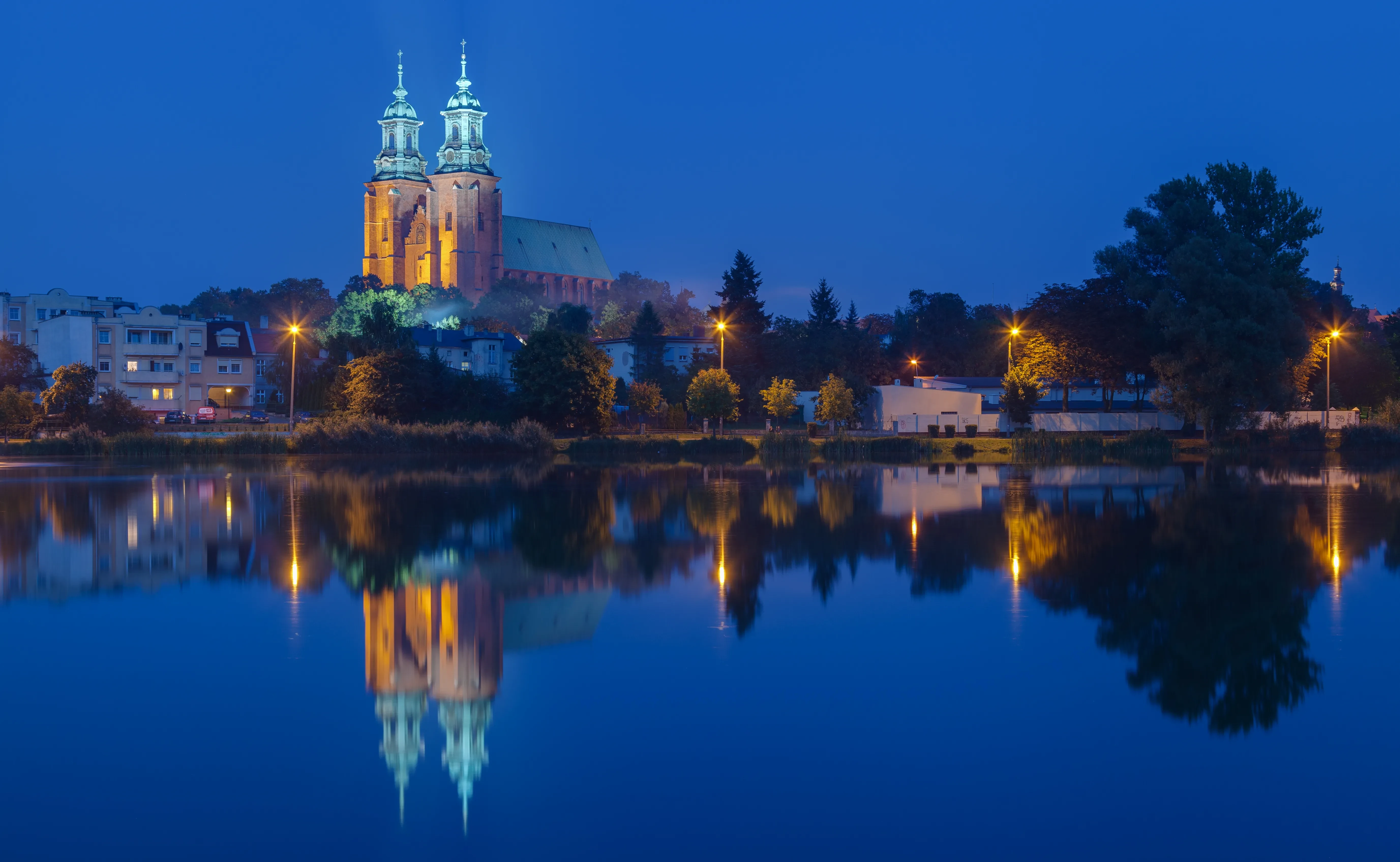
Diego Delso, CC BY-SA 4.0 <https://creativecommons.org/licenses/by-sa/4.0>, via Wikimedia Commons
Poland, a view of the beautiful Gniezno Cathedral and its lake~
The land where those Polish guys live is truly gorgeous, isn't it~?