
225. The Highest Branch, the Imugi That Leapt into the Sky (3).
Three days and then four more had already passed since we occupied Verden without authorization.
The weather, which had still held a slight chill, now shifted fully into spring, with the scent of flowers and grass wafting about and all manner of insects poking their heads out here and there.
Watching the fluttering wings of a butterfly, I wondered if the twin blossoms of my homeland Árós had bloomed yet. Whether my stepmother and birth mother, Inga and Sigmarr, Hrolf and Young Rolo, Constantine, Baldr and Leon were all doing well.
Such curiosity visited me without warning and unsettled my heart.
That a month's time had already slipped by since I left home—wasn't time truly swift?
The residents of Verden, who had lost beloved neighbors or family in the siege, gathered at the church every day to bury the dead and hold memorials.
The fallen warriors of Frisia and the North Sea were laid to rest together a short distance from Verden, beneath a sunny hill beside the Weser River, and above them we gathered large stones and decorated the grave in the fine shape of a longship.
Though each had lost those dear to them, those who remained moved to adapt and survive as best they could within the circumstances given to them.
The residents of Verden minded their conduct with the utmost care so as not to provoke the North Sea-Frisian allied army occupying their city, and the warriors under my command honored the memory of those who had departed before them.
I regularly entrusted the lists of the fallen—along with the amount of silver to be delivered to the bereaved families and the names to be inscribed in the great volumes of the University of Árós—to the supply merchants traveling up and down the Weser River.
These would surely reach Hrolf of Árós within three days at most and be implemented forthwith.
Veterans of the Garmr Brotherhood remaining in Árós would personally visit the homes of those who had honorably leapt to Valhalla and knock on their doors, and no small number of tears would flow from many eyes.
But even if the weight of all those things was exceedingly heavy, I no longer hesitated to give the command.
This was simply our way of life. We fought for gain, treated the dead with honor, and swore to meet them again afterward.
There was no grand moral cause like world peace. Nor was there any lofty ambition difficult for ordinary people to comprehend, as Alexander the Great had displayed.
I had somehow ended up a king, and though called Fylkir, I had become an emperor in truth and forged the North Sea Empire. For the countless souls who had shed blood and died for this, I meant to do everything within my power.
"Preparations for departure are complete, Fylkir."
The legion currently on the move numbered roughly twenty-five thousand.
Around Rouen in West Frankia, mainly eight thousand levied from the island of Britain—East Anglia, Mercia, and the Kingdom of the Isles.
Here near the Weser: my personal guard of five hundred, some two thousand warriors mustered from Kaupang, and two thousand five hundred allied troops from Frisia.
Near Hamburg, around eight thousand North Sea troops composed mainly of Jutes, and beside them, in the territory of the Obotrite tribal confederation, some five thousand North Sea troops made up of Rus from around Novgorod.
The military forces that rose up simultaneously during the sowing season skillfully exploited the element of surprise and were in the process of neutralizing all of our intended targets.
For once this season passed, the two words—North Sea and Fylkir—would likely remain seared into the minds of the world's people as if branded onto flesh with a red-hot iron.
We had to seize this opportunity the enemy never expected, and I possessed the capacity to obtain what I desired.
Not only my personal strength, of course, but also the power of that frozen land I had cultivated until now was anything but ordinary.
"As you instructed, we will administer the Weser basin centered on Bremen and Verden here. Konungr Hrorek and Jarl Harald will station themselves in the two cities with the troops under their command, and the supply and emergency support of the forces will be handled by Kaupang and the influential men of that region."
"Men of renowned name seem to have been stirred to action, I see? Jarl Harald's name will grow higher still."
Though I was the son of Ragnar, the legendary Norseman Konungr, I was a bastard, and so I had been forced to redden faces with various men of great name.
Of course, in the end, I had beaten all those insolent bastards into submission. Thus, for the historically deep-rooted houses of Kaupang—reachable from Árós in barely half a day—such a history of mine could only be a burden.
The proposal Jarl Harald had covertly extended to me had been to gather the many malcontents within and push them into the trade—mercenary work—with the Eastern Romans, a route I had opened and where no one could even launch a ship without my permission.
Though that plan had been temporarily suspended as the situation shifted rapidly, the day Harald—whose name had been greatly elevated by the results of this Bremen and Verden battle—returned to Kaupang, the members of those proud and ancient houses would have to choose.
Would they confront me, lurking in truth behind Harald's back? Or would they meekly bow their heads and cease this meaningless contest of strength?
As long as not only Konungr Olaf the White but even Konungr Halfdan 'the Black' remained in Árós, virtually all the Norsemen of the western coast of the Scandinavian peninsula except for Kaupang were effectively subordinate to me.
I merely hoped that there would be no needless bloodshed.
"In the view of my father and myself, the Kaupang nobles' intent was never to oppose the Fylkir in the first place. Had they lacked that much discernment, they would have vanished long ago. They have always moved to protect their own lands and property, but they will have concluded that rejecting Jarl Harald any further is dangerous."
To maintain so calm a demeanor before my cynical mood was something neither Strolf nor even Ivar—whose cynicism I could never hope to match—was capable of.
The one who could coolly add his own opinion to my sentences was Refil, who had crossed over from Rouen.
Though I felt a little sorry toward Strolf, my right arm, beside whom I felt most at ease when fighting, had reached my side alongside the news that the 2nd Expeditionary Force had departed Northumbria and Árós.
From Northumbria, Uhtred—likely the finest commander remaining in Britain—personally led three thousand troops.
From Norrland, the vast garrison city north of Árós, three thousand elite soldiers hardened in the bitter cold and the mountains of Scandinavia were now crossing the waves of the North Sea under the command of Baldr, Ivar's son and my nephew—actually a year older than me.
Though it was something I myself had built.
The power of the North Sea Empire, which bound Scandinavia and Britain into one, was already manifesting.
'That we still have reserves left after all this is, honestly, absurd.'
Perhaps the golden time for the Frankish emperors to stop us had already passed.
But was that not the Franks' business and none of mine?
Carolus of West Frankia had spoken words that left room for me, but before the renewed fierce assault of Salomon, King of Breizh, Le Mans—its very Robert dead—was wavering. And while he gazed upon the son-in-law of Flanders and the son of Aquitaine, who for some reason utterly refused to heed him, he would soon correct that wicked thought of refusing to recognize Lothar's divorce.
Because Lothar, who had been quietly biding his time in Aachen, finally sent me word that he would rouse his wrath-filled body.
If I were Lothar, I would seize this chance to thoroughly trample the territory of that uncle I can't stand the sight of, especially his stronghold in Burgundy. That was Lothar's part to deal with; I only had to do my part.
"Tell Jarl Harald, Konungr Hrørekr, and Jarl Hroldulfr that I wish to see them. From my standpoint, Barmen and Breden are places I could abandon at any time without a second thought, but our allies and the jarls under me might feel differently, so I must tell them once more to pull back immediately if things turn."
Contrary to the prejudice of the Dark Ages around the end of the 9th century, Frankish architecture was exceedingly elegant and dignified.
It may have owed something to the soft, pliable stone, so different from our Scandinavian granite, that the craftsmen could easily shape this way and that, but it gave me the feeling that they had inherited the old traditions of Rome better than I had expected.
Beside me, as I opened a beautifully carved wooden window and looked down upon the sun-drenched city, Refil bowed his head and received my orders.
"The Konungr and jarls would never dare slight the Fylkir's command."
Soon, as I left the antique room I was using as an office, I saw Refil issuing instructions to the guards who had been waiting outside. In his face I caught a glimpse of Björn, and also a hint of Hrólfr in his prime, when he had bristled and thrown himself into action to protect my mother and me.
'Time had really flown by.'
I stood watching quietly for a moment, then turned my head. Before me I saw the ceaselessly drifting clouds, and the people beneath them.
And again, nine days later.
After confirming that Paderborn remained silent, the 2nd Expeditionary Force and I departed Verden.
*****
Before I knew it, the second month of summer was drawing near.
In the large and famous cities of the North Sea, the sowing season was wrapping up, and it was time to prepare for festivals.
The morale of the 2nd Expeditionary Force, which had left their homeland, crossed the rough waves, and answered my call, was soaring. The northern sea, gradually becoming the lake of the North Sea Empire, throbbed with the ceaseless movement of logistics.
I had known that war cost a great deal of money. Was it because the empire had grown so large? Or because food, the most crucial thing, was overflowing?
It even seemed to take on a certain vitality. As we conducted military operations here and there, and the legions of Britain and Scandinavia cooperated and shed blood together in the process, I also had the feeling that the empire that had been tied together under my name was slowly becoming one.
It was a war with many tangible gains, like the Rouen Fortress or Breden, and also many invisible ones.
Yet all of this would ultimately lose its meaning if Hamburg were not brought to its knees.
That was how important controlling the Elbe River basin was, especially for the Scandinavian peninsula.
Securing Hamburg and the Elbe basin alone was not simply a matter of gaining land and a river—it meant I could freely stride the left side of the North Sea split by Jutland (modern Denmark) and the Örn side.
Moreover, from Novgorod all the way to Hamburg, I could trade overland with the countless tribes in between.
The military significance could perhaps be even greater than the economic advantage.
In conclusion, Hamburg had become a strategic point that the Fylkir of the North Sea absolutely had to hold, beyond merely repaying the long-standing grudge of Konungr Bagsecg and the Jutes.
For that purpose, Ivar, Refil, Baldr, Stórolf, and I were advancing vigorously on horseback across the open plain.
[Pururuk-! Puruk! Puruk!]
Camembert, who had joined by ship, seemed immensely pleased to be moving with me again after nearly a month. He never stopped murmuring, flicked his ears, and displayed his delight with sprightly footsteps.
At that sight, I let out a hearty laugh, scratched his neck a few times, and then turned my head slightly to check on Rhun following behind me.
The cavalry commander Thorbjörn had remained beside Björn at Rouen Fortress to lead the cavalry, and Rhun ap Arthgal—whom I had placed as the second-in-command of my bodyguard due to his status as the de facto ruler of the Kingdom of Alt Clut-Strathclyde—was adapting to the role quite quickly. He never stopped turning his head this way and that.
That sight of him searching for any possible threat was exactly like a meerkat, and it reminded me so much of Thorbjörn that another laugh escaped me.
Unlike the usual formation of a long horizontal line, our army, spread out in a wide column, was rapidly crossing the plain.
Given the nature of an army filled with left-handed fighters, the left wing, which could have been a weak point, was led by the dependable commander Uhtred. The right wing was led by Refil, whose eye for reading the battlefield was exceptionally sharp, and the center was held and commanded by the seasoned and menacing Ivar and Baldr.
Stórolf and I served as a flying column leading the cavalry, essentially a reserve with a free role.
I closed my eyes tight to the agony of Leofric, who was screaming over his manpower shortage, and ignored it. The scouts from Huntadun and Lincoln, whom I had managed to pull out, displayed excellent skills, constantly relaying information about the surroundings to me.
No suspicious movement ahead. No abnormalities on the flanks or rear.
After a night's Hugh-style forced march, the army of six thousand was able to approach the southwest of Hamburg. The reaction of the Hamburg walls as they watched our army calmly appear and begin setting up camp did not look pleasant, even from a distance.
☆☆☆☆☆Reference☆☆☆☆☆
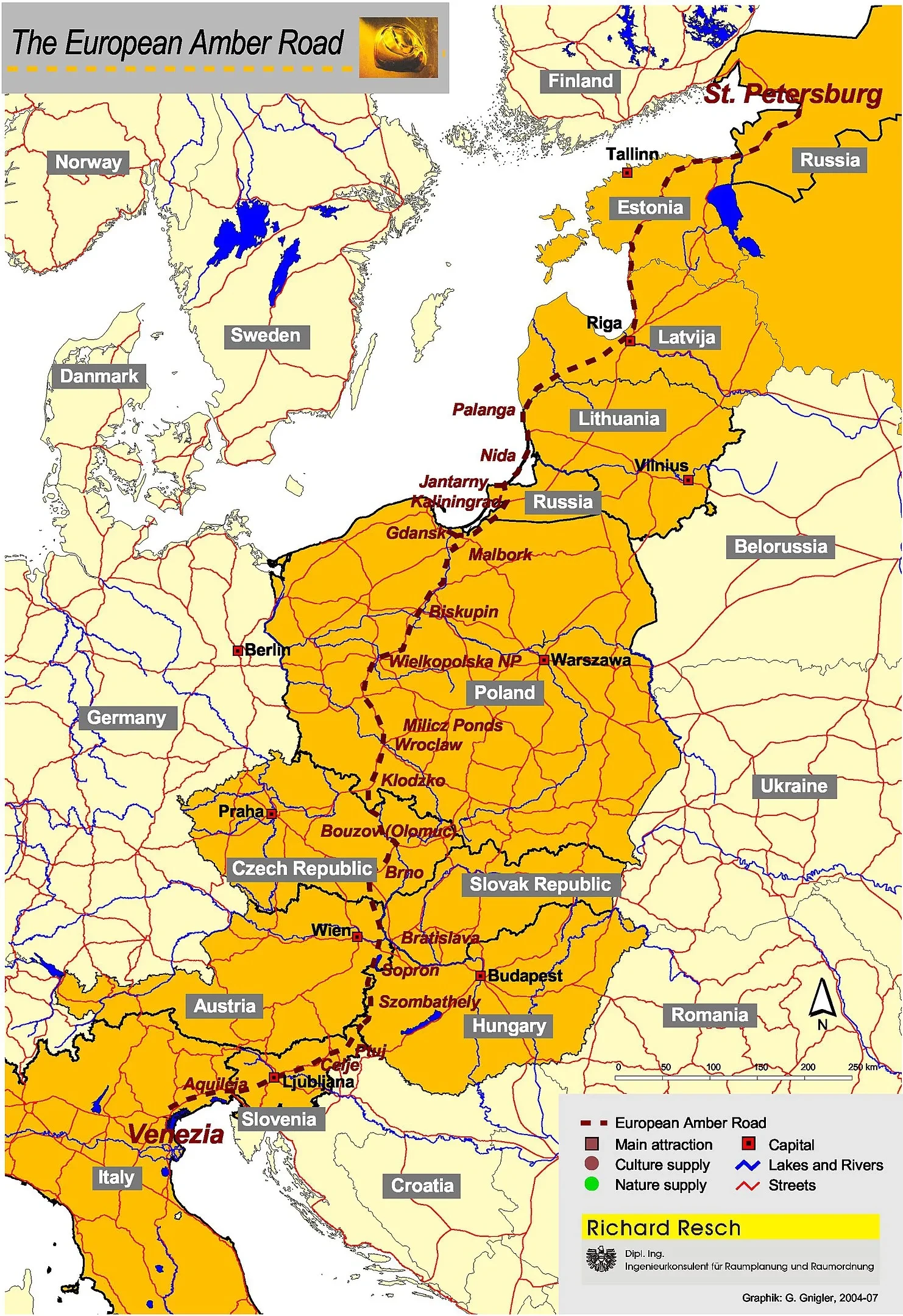
DI Richard Resch, Copyrighted free use, via Wikimedia Commons
One reason why control of the Elbe River was so important to the North Sea Empire. The Amber Road...!
It's similar to the Silk Road...! In other words, it was a trade route from Novgorod (Saint Petersburg) to Venice, running through central and eastern Europe!!!!!
Vikings were also quite knowledgeable about the Eastern European amber trade...! Beautiful amber was often found in their graves...!
The greatness of this amber trade goes all the way back to the Bronze Age...! Naturally, the Roman Empire also had a hand in it, and it seemed to have continued well after that....!!!
On top of that, the sea from Hamburg to Novgorod also came under the influence of the North Sea...!!!!!
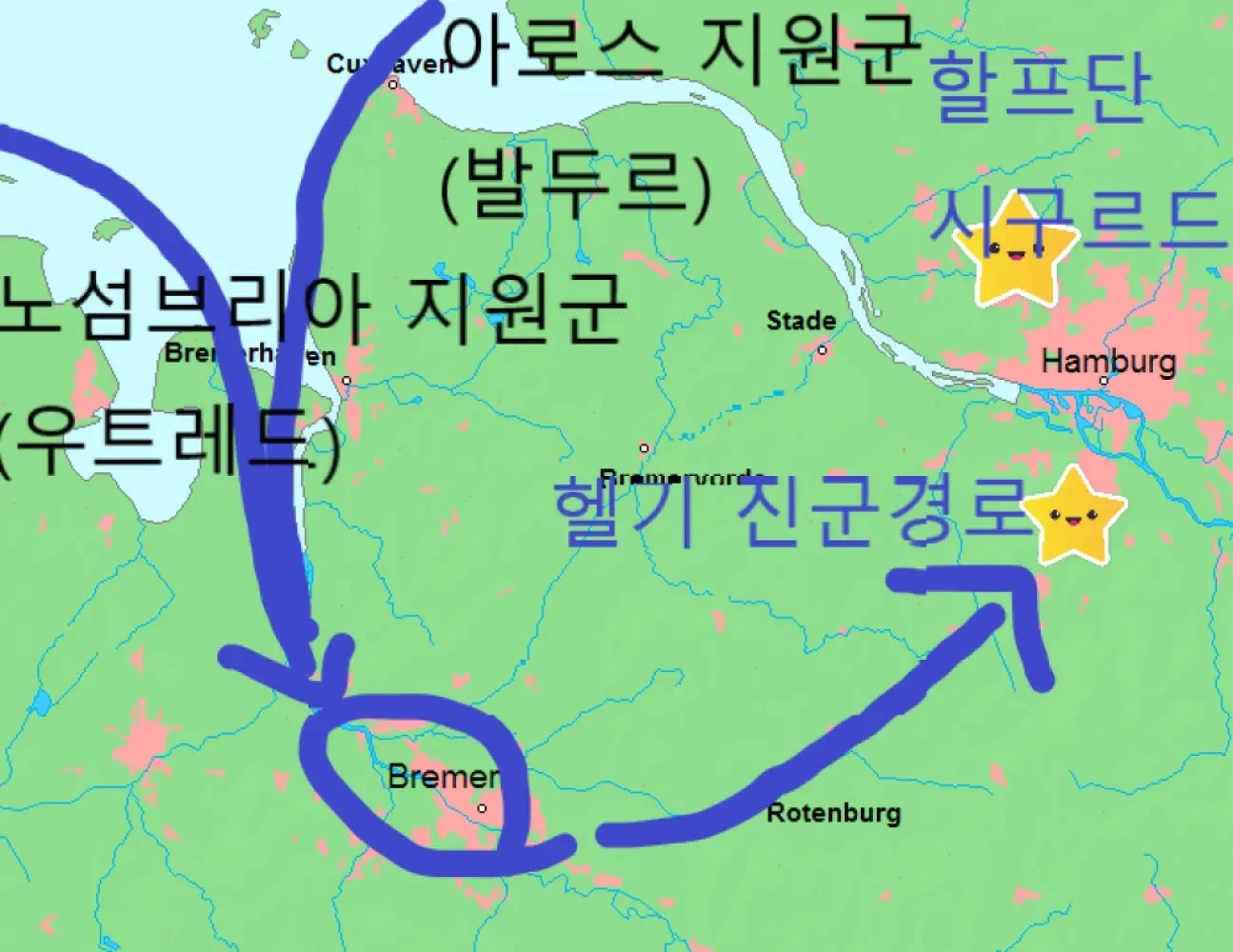
based on map data from www.demis.nl, Copyrighted free use, via Wikimedia Commons
The scene of Uhtred and Baldr's reinforcements entering the Weser River, and Helgi's advance route. And the scene of Hamburg being encircled from the south and north...!
Even where Halfdan and Sigurd were, a new fortress was being built using the materials secured by dismantling the Dane Barrier...!!!!
Helgi hadn't yet received word, but if you go to the Örn side of Hamburg as seen above, a bloody battle was also in full swing at Liubice, the center of the Obotrite tribal confederation!