
224. The Highest Branch, the Imugi That Leapt into the Sky (2).
"Come out! I said, out of my way!"
Rough voices and the clamor of men grappling violently shook the palace of Paderborn.
"General! General! Please, calm yourself! This is the palace where the ruler of Saxony resides! I beg of you!"
"Is it not true that I have words to deliver to that ruler! I said, come out!"
The appearance of Heinrich, the renowned general of northern East Frankia, was not something one wished to encounter even in a nightmare.
His hair, bristling in every direction, and his shaggy beard were matted here and there with blood and grime, betraying that this man had been in the thick of fierce battle only moments before, and his heavily bloodshot eyes, tightly clamped mouth, and jaw made it seem as though he would draw his sword at any instant and cut down everyone around him.
Because of this, even the servants of the Paderborn palace, where the master of Saxony and the emperor's second son resided, trembled as one and could not bring themselves to meet the enraged general's eyes.
"General! Please, calm yours—"
[Smack!]
"Agh!"
At last, the uproar seemed to subside only when the master of this space made his appearance.
[Rumble—]
"Enough. What discourtesy is this toward the general? Enough. Everyone, withdraw."
The great door leading into the inner chamber of the palace opened with a noise befitting its bulk, and through it strode a man clad in dignified garments arrayed in splendid colors, who quietly gave the command.
"My Dux."
"Dux Ludovicus."
Thereupon, those who had been clinging to the general and pleading with him as he tried to charge forward like an enraged aurochs bowed their heads as one and stepped back.
The silence that descended in an instant filled the wide hall of the Paderborn palace, and within it, Heinrich, still exhaling ragged breaths, also bowed his head, showing respect to the ruler of this sacred bloodline.
"General Heinrich. There is much I must hear from you, and much I must inform you of as well."
At the sight of Heinrich, filled with murderous intent, the guards around the Dux of Saxony flinched unconsciously and moved their hands to their weapons, but the Dux himself walked toward Heinrich as if it were nothing and raised his hand.
The ring fitted upon that hand was the seal signifying the master of Saxony. Even before that weight, he could not very well rage like a thunderstruck madman, so Heinrich barely suppressed the furious rage and resentment threatening to incinerate his entire being and met the Dux's eyes with a subdued gaze.
A gentle demeanor and glance, nearly impossible to believe belonged to the son of that great warrior-emperor, Ludwig Germanicus, as the East Franks affectionately called him in place of the Latin title.
Yet Heinrich knew all too well that within that gentleness lay a vast ambition, just like that of Carloman, King of Bavaria.
"I understand the general's fury. I, too, would be angered. I would have cursed everyone in the rear as a coward."
Turning with a gentle and dignified air, the Dux of Saxony led Heinrich and calmly explained the situation.
"However, General, the situation surrounding East Frankia is unfavorable. Here, this is a letter sent by my father, the Emperor. Please, examine it."
The letter extended by that pale hand was a fine parchment, already broken of the imperial seal, folded neatly and exuding a subtle fragrance from within.
Opening the letter with trembling hands, Heinrich could do nothing but widen his eyes, for it read:
[Let the Dux of Saxony hold Paderborn. The Magyars and Moravia have attacked the empire's east. Carloman of Bavaria, unable to overcome them, has pleaded for aid, and in the empire's west, Lothar stirs.]
"What is the meaning of..."
Stripping away all the flowery rhetoric praising every god and extolling courage, and grasping only the core message, Heinrich's mind began to spin furiously.
'Who in the blazes are these Magyars? And Moravia knelt before the emperor's sword and sent all manner of hostages only the other day, and now they raise rebellion again? Seeing that Carloman of Bavaria has swallowed that towering pride of his and pleaded for his father's aid, it's clear he's suffered a great blow. And what of His Majesty Lothar in the west? What is the meaning of that?'
Plunged into confusion, Heinrich did not even notice that the Dux of Saxony, walking ahead of him, had come to a halt.
[Thud!]
"Ah! My apologies. My Dux!"
"It is nothing, pay it no mind. When I first saw that letter, I, too, could not believe my own eyes, just as you are now, General."
Contrary to his gentle-seeming air, the Dux of Saxony's body, which Heinrich had momentarily bumped against, was not that of a man who had neglected his training.
"Now then, since you now know all of my circumstances. Let us devise a solution together. It may be a cruel thing to ask of one who has only just arrived at the palace, but the situation is not favorable."
[Glug-glug—]
At the end of the long table, the Dux of Saxony, seated in a great chair, still wore a gentle smile, but within it, a deep fatigue was visible.
At the Dux's gesture, the servants who had been holding their breath poured fragrant wine to the full, and at their master's next gesture, Heinrich raised his cup and wet his throat.
His throat, utterly cracked and hoarse, screamed in agony before the sudden arrival of liquid, but Heinrich welcomed that pain rather.
"From Hamburg, requests for aid come without pause, and Hrorek of Frisia remains silent. Heinrich, having faced them yourself, what was the strength of those Northmen like?"
It was terrible.
The one they hailed as Fylkir was nightmare itself.
For the first time in my life, I had no certainty that I could defeat a foe.
Before his revered lord's question, Heinrich could not fathom how he should give voice to these sentences that rose immediately in his mind.
*****
"Indeed. What message did the Margrave of Flanders bid you deliver?"
Verden. The city that held the leash of the Weser River.
This scar-ridden city was in the midst of feverish restoration and clearing work.
Come to think of it, though I had fought countless battles until now, I had never once conducted a campaign of plunder, which was practically common sense in this age.
This time as well, feeling no necessity to plunder, I had instructed Jarl Harald of Kaupang to merely occupy the key points within the city, and gave orders to the warriors under my command not to cause unnecessary commotion.
Isn't it something everyone else does, so shouldn't you do it too? In this dark age of the 9th century, what great matter is it to kill a few people, pillage, and commit a few wicked deeds?
I posed these questions to myself, but each time, my answer was the same.
I would do it if necessary, but I had no need for such things.
Look at the area around the Fortress of Rouen in West Frankia which I now held. The peasants cast wary eyes upon the warriors of the North Sea who posed little threat to them, yet little by little, they returned to their farmland, sowing seeds and tilling their fields.
I was already a presence that instilled sufficient fear in them without any looting. The performance a few days ago—running atop a shield and hurling an iron bar—would be long remembered in the history of this place.
Besides, since I had to run away if things went south, there was really nothing good to be gained from antagonizing the locals.
In this world, how many lords truly paid their warriors proper silver coins and supported them with enough food and clothing? If such a lord told them to refrain from a little looting, who would have harbored any discontent?
If they could not contain their discontent, they could simply rise in rebellion. And then they would have faced me in a contest of strength.
Of course, I would win.
"Th-that is correct! Great ruler of the North Sea, master of all waterways, great Fylkir who has seized Rouen Fortress and the surrounding 'land of the Northmen'!"
Since my disposition was already fairly well-known among the North Sea warriors, I had not been particularly worried. What was unexpected, however, was that even Frisia's Konungr Hrørekr, Jarl Hroldulfr, and the warriors under them readily complied with this command.
It was strange that, while they had freely plundered our North Sea army's supplies, they showed no interest whatsoever in the people's homes or the churches of Bremen, and were focused entirely on clearing the battlefield.
At any rate, it had already been three days since we seized the palace at Verden under the smooth cooperation of the alliance.
A messenger came running hastily to the vicinity of the western gate, where fierce fighting had occurred under Harald's command. His point of origin was so unexpected that I had to summon all my subordinates and the allied lords.
"Margrave Boudewijn bade me say that we of Flanders bear no hostility toward the Fylkir of the North Sea, and ordered me to deliver this letter!"
The Flemish messenger stood at rigid attention, exactly like a Norrland recruit, and barked out his message.
It was pitiful how he could not quite meet my eyes and fixed his gaze on the air instead.
I told the messenger, who handed the letter to Stórolf with trembling hands, that he had done his work and to go out and wait for my reply. Then I broke the seal on the rather neatly rolled parchment.
Was this hardened red wax? I cracked in half the design of a comical lion sticking out its tongue, and unrolled the parchment. Immediately, I was greeted by Latin written in an elegant script and fine sentences.
"What— what does this say? The letters are all curly so I can't make out a single thing."
Ivar, who had leaned in from beside me and was peering at the letter's contents, immediately declared his surrender.
To think such a remark came from a Norseman—who, before I asked Kyrillos to devise a writing system for the North Sea, had no concept of horizontal or vertical writing and carved snake-like patterns into big stones—was astounding.
A hollow laugh escaped me, but the contents of the letter were not funny at all.
[The war of the West Frankish Emperor is not our war. We have always admired the name of the Fylkir and waited for the day to deepen our friendship. Who, when facing the North Sea, could dare to oppose the master of the North Sea? Therefore, we of Flanders will offer no cooperation in this futile war, and wish to maintain an even deeper relationship with the North Sea—]
'Boudewijn wrote this?'
The first thought that crossed my mind was this. That Boudewijn wrote sentences like these?
Back when Wessex's Æthelred was still alive, Boudewijn and I and Æthelred had met together in northern Wessex.
Boudewijn, who had come to the island of Britain as the spokesman for the West Frankish Emperor Carolus, who even then was trying to cut ties with Wessex.
I still vividly remembered how embarrassed he had been at not being able to understand Latin at that time. In just one or two years, he had mastered Latin and written such elegant prose?
In the Romance of the Three Kingdoms, there is the story of Lü Meng catching the eye, a man who achieved scholarship through desperate effort at a late age—but even he would not have mastered learning in a mere year or two.
'So Boudewijn had a fairly clever advisor by his side.'
Indeed, no matter how good a fighter Boudewijn was, he could not rule the locals of Flanders, who were just as fierce as the Frisians, by strength alone.
Just as I had smashed that West Frankish Emperor and pulverized East Frankia's famed general, but respected the lives and property of the locals. Ruling required gentleness as a matter of course.
There was definitely someone at Boudewijn's side wielding both the whip and the carrot.
And this was far welcome news to me. If both Frisia and Flanders were friendly to the North Sea, then the entire northern coastline of Western Europe was as good as in my hands.
"Boudewijn of Flanders wants to befriend us, I hear?"
I was the only one present who could read Latin, but I placed the letter in the center of the long table for them to examine anyway, and they all just rolled their eyes around.
Amidst them, Frisia's Konungr Hrørekr, who had a fairly deep connection with Flanders, raised his voice proudly.
"If it's Boudewijn, I know him well, Fylkir. That hard-headed fellow would not have dared to refuse the West Frankish Emperor's command. It must be Judith's work. Judith was renowned for her brilliance and beauty."
"Judith? You mean the Judith who married Wessex's Æthelwulf and then his sons?"
"Haha! You knew of it too, Fylkir! Even back then, many were muttering that it was madness! That Carolus, blind to the alliance with Wessex, did a terrible thing to his daughter! It was Boudewijn who rescued Judith from the convent after all her husbands died and she returned home! And it was I who personally hid them from the wicked Carolus's pursuers! Wahahaha!"
A tragic woman and the honorable warrior who saved her.
The tale, spun firsthand by the supporting actor who played the comic relief in this fascinating story, was highly stimulating, and soon not just Ivar but Stórolf, myself, and Hroldulfr were all absorbed in Hrørekr's story.
By the time Hrørekr's story, heavily colored by personal feelings, ended, Carolus had somehow become the greatest villain under heaven, and Hrørekr himself an honorable Konungr who could not abide injustice—though this was a tolerable bit of embellishment.
In a space full of laughter, I thought of my next move, for an opportunity to settle the matters of Hamburg and beyond at a single stroke had unfolded before me.
☆☆☆☆☆ Reference Material ☆☆☆☆☆
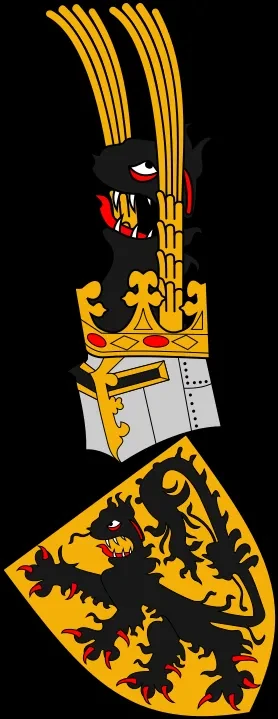
Original: Claes Heynensoon Vector: Tom Lemmens, CC0, via Wikimedia Commons
Flanders, the coat of arms of Flanders.
Actually, in the late 9th century, when Flanders was being formed, it's very, very, very, very likely they didn't use this coat of arms.
They probably put the margrave's initials on the seal or used some other simple pattern...
This is the power of fiction, isn't it...!!!!!! Look at that dumb expression...! It's adorable...!