
226. The Highest Branch, the Imugi That Leapt into the Sky (4).
It was the first time I had seen Hamburg with my own eyes.
This must have been the sight that captivated Charlemagne.
The Elbe River flowed into the sea, branching into countless small streams, and beneath that stream, which so perfectly blocked any approach from the north, Hamburg coiled itself like a snake and gazed arrogantly toward the North.
Come whenever you wish. I shall stop you here.
But did Charlemagne and Hamburg know? That a mere hundred years after Charlemagne's death, some illegitimate son of a Norseman would appear, found the North Sea Empire, and descend upon the iron fortress of Hamburg from both north and south at once.
If he had known, he would have certainly adjusted Hamburg's location.
Because while this position where I now stood had no trouble repelling attacks from the north, it appeared vulnerable to an approach from the south.
"We hold control of the Elbe, don't we?"
"Yes, Lord Fylkir. King Bagsecg, Jarl Halfdan, and Sigurd have already completed all the work. Now that river obeys only the Fylkir's command, not the Franks."
After the great battles of Bremen and Verden, my already high prestige had become something unknowable. North Sea warriors, allied lords from Breis and Frisia, and even lords from ambiguous gray zones like Flanders.
All those who bowed before my name were powerful warriors, renowned kings, and lords, but before the name Helgi Ragnarsson they paid endless homage, and deep within it lay a thick fear.
'But deep down, I was a soft and tender-hearted person—with a face like this, what could I do? I could never dream of gentle leadership.'
"Haha. King Bagsecg has truly steeled his resolve. Do you see that fortress beyond Hamburg? It is understandable why Hamburg's lord attacks so desperately."
"Yes, I see it well, Lord Fylkir. Once that fortification is completed, Hamburg and the Elbe will become an impregnable stronghold."
"You speak as if Hamburg is already ours."
'This confident side of Refil... Is this truly the same commander who used to be so cautious?'
"In every battle you have personally led, our North Sea has won completely. Could they be any different? And given only a little more time, they would eventually collapse on their own."
Indeed, the frequent drinking sessions in Britain with Leofric of Huntadun-Lincoln and Ecgberht of Jorvik—two of the greatest traitors (?) or perhaps silver-tongued serpents (?)—had had an effect.
Refil had finally shed Björn's rigid manner and gained some ease.
A few words that gave the lord proper face, with a spoonful of cool-headed analysis added—it lifted my spirits, like watching a promising talent grow properly.
As Refil said, I understood well that Hamburg was a strong fortress, but in the end, war was waged not by walls but by the people within them.
Already at Verden we had crushed Heinrich's East Frankish reinforcements, and with Paderborn remaining silent, the only thing Hamburg could rely on was the Obotrite tribal confederation to the east.
But over there, the most reliable generals of the eastern North Sea Empire, King Rurik and Jarl Oleg, were surely already in action.
No matter how high and solid Hamburg's walls were, that fortress was not named Constantinople, and we now had all kinds of siege weapons.
The fact that it was close to Árós, my stronghold and the home of North Sea science and technology, was also not good news for them at all.
Of course, the most important thing was that I was here.
Facing the southern walls, which were relatively lower and thinner than those to the north, I sat on a low hill ringed by my iron guard and looked down upon them in silence.
"Send a messenger to King Bagsecg. Tell him to secure our approach and proceed with transporting the siege weapons. The moment all preparations are complete, we will strike."
"Yes, Fylkir."
*****
Under the newly established organization, Örn Stān was overwhelmed by his position as a Karl (hundred-man leader) in the 1st Logistics Thousand-man Unit of the Jorvik Army, directly under the Fylkir, in the North Sea Empire's Northumbria.
[Kiiik- kiiik-]
"Slowly! More slowly! You colts! Do you have any idea how much this is worth! Slower is fine, so lower it more slowly, I said!"
Stān had served in the North Sea army ever since the Fylkir had personally delivered the old Eoforwic, now better known as Jorvik, from the hands of those two cruel and greedy Cyning, Ella and Osberht.
In just three or four years, the boy had become a young man, and with the tremendous honor that the Fylkir himself remembered his name, along with his innate ability, he had risen swiftly through the ranks.
Of course, the hand of Ecgberht, the steward of the Fylkir's direct territory of Jorvik who personally saw to everything concerning the Fylkir or his family, was behind it, but no one ever doubted Stān's ability.
His boundless loyalty, his sharp mind, and the bold character and quick tongue that naturally came with working in a logistics unit.
A rising star of Jorvik's logistics, for whom the rank of Thousand-man Leader (Jarl) was all but reserved, Karl Stān was personally operating the pulleys of a large transport ship that had crossed the Elbe, carefully unloading timber to be used for siege weapon construction. As befitted a task requiring delicate attention, he was on edge, proceeding without a single mistake.
[Kirik- kirik- Kun!]
"Good! Now release the lines! Leave the pulley on standby! We'll move the timber onto the hill first!"
"Pulley standby! Everyone get over here!"
"Come on, let's go earn our keep!"
"Why the hell did I end up in logistics...!"
Given the nature of the logistics unit, which required so much manual labor, even a scrawny fellow would be forged into a robust man after a month of plentiful meals, rations, and tremendous physical exercise.
The sweaty men of the logistics unit grumbled out of habit, but they moved swiftly and lifted the great timbers.
"One, two!"
"Heave-ho!"
"Urghhh!"
"Now! Go! One, two!"
"One, two!"
Jarl Sigurd, who wished for war songs to flow through every part of the North Sea army, had personally witnessed the daily life of the logistics unit and composed a song inspired by it, but on a worksite requiring every ounce of strength, there was no leisure to sing.
When, with grinding teeth and bleeding hands, they wondered when the work would ever end, they would lift their heads to look at the riverbank and, seeing the ships laden with supplies waiting beyond, simply abandon the thought.
At least, if there had been no pulley, they would have had to unload all the cargo by hand.
In that case, perhaps drowning and ending it all would have been better.
"Karl Stān! They say it's Hugh-style time!"
"What? Already!? Damn, we still have three longships' worth to do... Everyone, Hugh-style! It's Hugh-style!"
"Hugh-style!"
"Lord Thor, save me!"
With groaning and pained sounds, the unit members slumped to the ground here and there, and soon the space filled with men bloomed with laughter as the usual idle jokes and lewd banter circulated.
A leisurely sight, even with the Hamburg fortress packed with enemies stubbornly holding out right next to them.
Gazing down upon that scene from a low hill, the commander of the Northumbrian forces, Jarl Uhtred of Bamburgh, once again gave thanks and felt relief that his choice had been the right one.
'It is foolish to oppose the Fylkir.'
Uhtred, being a scion of a renowned noble house and a man of military talent himself, had many opportunities to examine the old Roman military treatises and the famous battle records of the old Anglo-Saxon kings. The churches kept many books, and reading books was the privilege of the noble-born and a right they were meant to enjoy.
Yet no record he had ever seen described a military operation this systematic.
Looking back quietly at the military successes the Fylkir had displayed over the past five years, it was clear that the Fylkir's perspective on war was exceedingly unique.
He did not plunder and alienate the local populace; instead, he used numerical inferiority to draw the enemy out and then employed tactical—and personal(?)—ability to smash them utterly.
A power truly akin to a god of war.
And what of the Fylkir's other power that supported this?
In Jorvik and Edinburgh in Northumbria, Tamworth in Mercia, and Beodericsworth in East Anglia, which had all become the Fylkir's direct territories, a great harvest had already been reaped.
If such bumper harvests continued, soon the North Sea Empire's Britain would have to build countless granaries just like Árós, to the point where they would need to wage war against the hordes of rats, which were even more fearsome than men.
Children were no longer buried in the church's rear-yard cemetery, which had always been bustling before the arrival of the bitter winter each year.
This power.
Unless one experienced it, it could not be believed, nor could the nature of that power be truly known.
Moreover, what of the Fylkir himself, whom he had faced directly on the battlefield? Could legendary heroes like Alexander, Hannibal, or Caesar be confident of victory before the Fylkir? Had history ever recorded a general who could single-handedly overturn a tactical disadvantage?
How could a mere human oppose a demigod? One who encompassed both life and death?
Yes, perhaps all of this had been preordained from the very beginning.
From the moment Ragnar 'Loðbrók' Sigurdsson met the High Priestess of Hel and begot Helgi Ragnarsson.
None of this could be explained save by fate. These days, Uhtred found such thoughts coming to him with increasing frequency.
His hand brushed over the necklace at his chest, the symbol of Hel. Uhtred soon gave the order for work to resume, and along the long stretch of the riverbank, the reliable logistics units moved to hasten the unloading of the longships.
Hamburg was large and strong, but that alone could not stop the North Sea.
The Fylkir would have what he desired, and he himself would do his utmost for him.
For Britain, for Northumbria, for Bamburgh. For his own house and his descendants.
Uhtred, Jarl of the North Sea, carved that resolve anew into his heart.
*****
[Fweeeeeee-]
"Everyone get your heads down—!!"
[Boom! Baboom!]
"Gwaaak!"
"Cough! Cough, cough!"
Bruno, the Lord of Hamburg and Dux of Saxony, was in despair.
To the north, Konungr Bagsecg of the mad Jutes, who was committing the insane act of building a fortress in the middle of a war, sat astride the hill and had thwarted countless attacks on Hamburg.
To the south, Norsemen who had suddenly appeared had haphazardly knocked together siege engines and, from some point onward, had begun ceaselessly hurling great stones into the sky.
Already, dozens of messengers had been dispatched to Verden, Paderborn, and the Obotrite alliance in the east.
Those hollow requests for aid, to which not even a reply now came, soon turned into frustration and rage, and Hamburg continued its lonely fight.
"Get the wounded below! Same for the dead! There is no time for mourning now! Hurry and shelter your bodies beneath the wall!"
The enemy's stone-throwing could never destroy Hamburg's great and sturdy walls, but their catapults, boldly thrust right up to the front, frequently hurled large stones over the walls.
Unlike the solid walls, the human body, frail to an extreme, could offer no resistance and was swept away before that colossal force.
Originally designed as a final fortress to simultaneously check both the north of Saxony and the Norsemen and Obotrites, Hamburg was a large and sprawling stronghold. However, it had not anticipated an attack from the south, making it perfectly suited for a great army to assault.
[Fweeeeeee-]
"Here it comes again!"
"Aaaagh! Lord! Lord!"
[Boom! Baboom!]
"It is fine! It hit the wall!"
"Everyone, take heart! Reinforcements will surely come!"
If they could at least face the enemy with spear and sword to die, it would be one thing. But their lot was to beg for their lives before fate under stones they had no means of opposing.
Bruno despaired of God, despaired of the Emperor and the Duke of Saxony, and despaired of his own helplessness.
But could he tell those valiant Saxon men, still filled with the will to fight, to give up? Could he tell them that, in truth, there were no reinforcements, and that he did not know if they could endure to win?
Could he say that all of this was merely wagering their lives on a futile cause?
"We can prevail! We can survive! God wills it! Hamburg shall not fall!"
"Dux Bruno! Dux Bruno!"
"Imperator Ludwig! Duke Ludwig of Saxony!"
Though they shouted the names of the Emperor and his second son, both bearing the same name, at the top of their lungs, why did those two not answer?
Bruno was instilling courage in the warriors, but he could understand the concern of his younger brother Otto, who stood beside him, surveying the enemy lines with uneasy eyes.
They would likely attack soon.
If it were Bruno himself, he would have pounded the exhausted enemy with stone-throwing assaults day and night for at least two days, or as many as five, before finishing the matter.
And when that time came, he would fight fiercely. If his strength failed him in the fight, he would die.
That was their life, and the path a brave Saxon man was meant to walk.
But what of his younger brother?
What of their house?
Who would remain to protect his sister and vassals, who would be left alone?
Bruno could only look upon his beloved brother, Otto, with a complicated gaze.
☆☆☆☆☆Reference☆☆☆☆☆
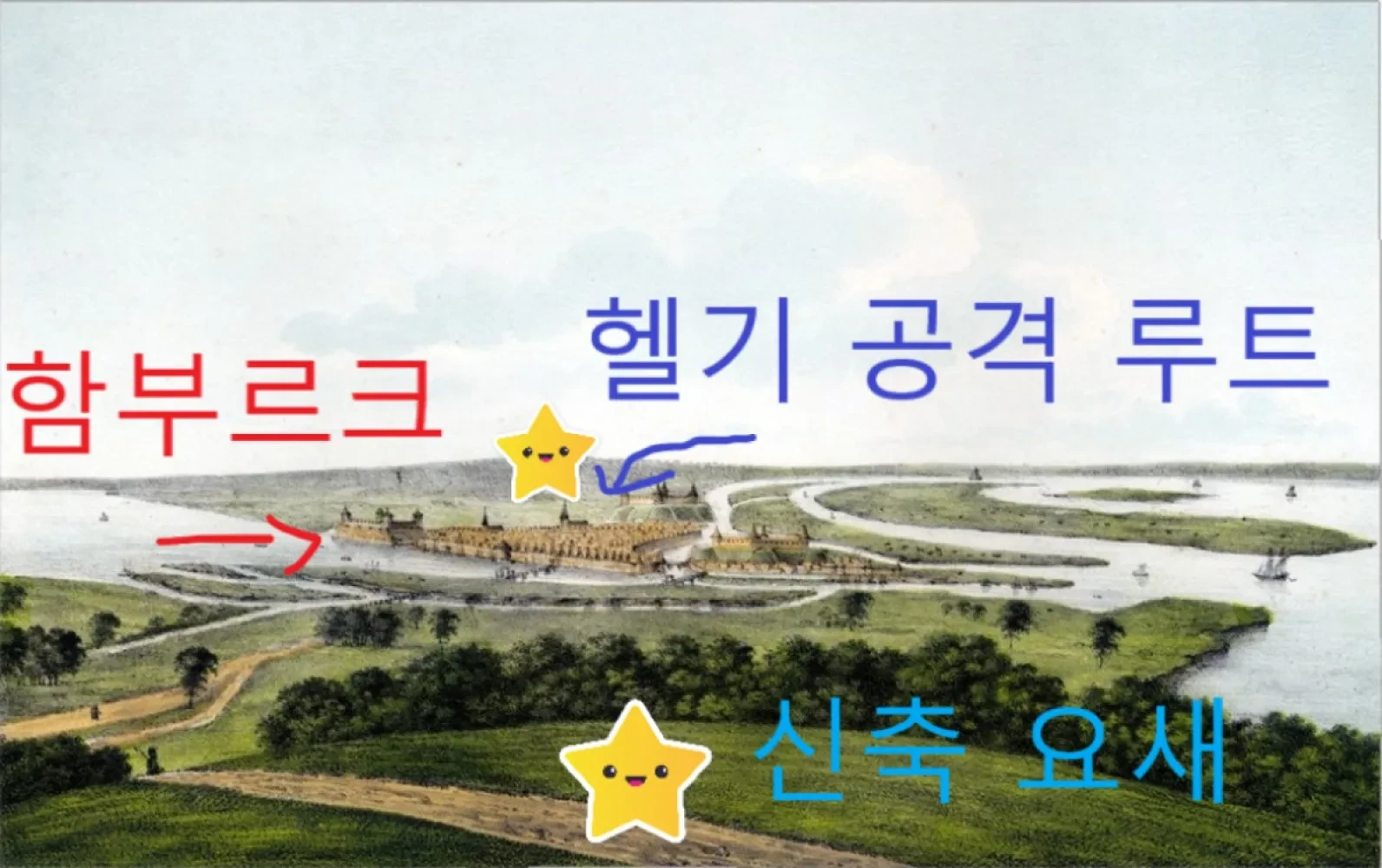
Peter Suhr, Public domain, via Wikimedia Commons
This is Hamburg in 1150...!
To be honest, I'm not quite sure which way is north or south in this picture... but the image I had in my head of Hamburg is the reverse of the picture above haha
With the waterway blocking the northern side and an open plain to the south allowing for easy maneuver of reinforcements...!
Of course, later on Hamburg would be surrounded by rivers on all sides and essentially become an independent city, but...
The Hamburg of the late 9th century hadn't yet been outfitted with perfect defenses...!!!!