
185. Do Not Welcome the New Shoots (3).
The letters from my uncles came flying in.
It was a ridiculous matter. Ever since I took my precious son, Hugh, this sort of thing had never happened before.
Wasn't this a situation that proved a kind heart would only be taken advantage of?
"Well, well. Both Imperatores must have their feet to the fire. Were the movements in the North Sea truly so unusual? Haha—."
Before Lothair II, who looked somewhat haggard, and from whose dark-rimmed eyes a white light seemed to pour forth in contrast.
A bishop concealing deep fury and another bishop struggling to hide his anxious eyes sat side by side.
No, their vestments might well have been those of bishops. Yet the names of the two men personally excommunicated by the late Pope Nicholas, who had breathed his last only a few months before, were Günther and Theotgaud.
The bishops of Cologne and Trier.
In other words, Lothair's fervent supporters.
'Unlike that fox-like Adventius of Metz, these are men who respect my words.'
Would Lothair have wished to do this to his beloved (...) family?
Would Lothair himself have wanted to push his uncles into the pit of ruin?
No matter how much Carolus on the left of Lotharingia and Ludovicus on the right had both grown old and, coveting their nephew's lands, had tacitly sided with the late pope to ensure even that succession could not proceed as he wished.
'It did not have to come to this.'
What good was regretting it now? When he had heard the news that the resentful Pope Nicholas was dead, a feeling of emptiness surpassed that of exhilaration.
Adrian II, who newly wore the Ring of the Fisherman, was a figure slightly more Roman-centric than the late pope. Thanks to this, wings had sprouted upon the back of Lothair's brother beyond the Alps, Imperator Augustus.
"Bishop Adventius of Metz told me that I must aid Charles of West Frankia. What are the thoughts of Your Grace bishops?"
Lothair, who in contrast to his gloomy countenance shone a brilliant light in his eyes, asked as he took a draught of mead sent by the ruler of the North Sea, which had entered through Frisia. Günther, who still wielded powerful influence over the Rhine region, answered.
"Indeed, the Archbishop of Metz is truly a man loyal to God. Though it seems his loyalty is excessive, and he occasionally forgets the fact that he himself is an advisor to Imperator Lothair."
A solemn expression and voice. Yet within them was a sentence brimming with venom.
Lothair, smiling with satisfaction before that fierce hostility, nodded and looked toward Theotgaud. Theotgaud, who was even breaking into a cold sweat before the two wolves, was busy shaking his head up and down without conviction, agreeing with Lothair's words.
"The Patriarch of Constantinople, Photius, has sent me an answer. Expressing condolences for the late pope who passed of old age, he stated he would speak to the current pope of the unjust circumstances of the two bishops, Günther and Theotgaud. How grateful a matter this is."
As Lothair's low voice continued, the eyes of the two bishops also shone, and the smile upon Lothair's lips gradually deepened.
"My brother in Italy, Imperator Augustus, is focusing his attention on the wars in southern Italy, but as Your Grace bishops know, the Saracens of the south are dangerous enemies. So from the standpoint of my brother in Italy, would it not be more encouraging if Constantinople joined him?"
Constantinople would propose joining forces with Ludovicus of Italy, and into that proposal, the restoration of Günther and Theotgaud would be inserted.
In return, what Constantinople desired from Lothair was to foster a friendly atmosphere toward Constantinople within the Frankish Empire.
Of course, this was only the superficial condition.
Though only God knew what schemes the Empire of the East was plotting, it was not truly Lothair's concern.
What was important to Lothair was simply that Constantinople was helpful regarding his own divorce, and the uncles on either side were not.
"Imperator Lothair. I have devoted my mission to your father and to you. Please tell me what I should do."
Günther, who had been with him since childhood, was indeed a man of great nerve. The Bishop of Cologne, personally raised by my father. A man who took only my side.
"When spring comes, Your Grace the Bishop of Cologne must cross the Alps. Approach Imperator Augustus and ask him: must we not reclaim the rightful rights of our father? Should he show interest, tell him, with a more detailed explanation, that I will always guard my brother's back."
That ambitious elder brother, Ludovicus, would absolutely not let this opportunity slip.
From northern Italy, Burgundy, the stronghold of Uncle Charles, was just a stone's throw away to the west, and Bavaria, held by Carloman, the eldest son of Uncle Ludovicus, was just a stone's throw away to the east.
'Just how will my brother regard the plainly exposed underbellies of the two uncles?'
Thinking this too was a matter to be watched, Lothair looked down upon the two reverently bowed bishops.
*****
No matter how quietly a bear moved, it could not ultimately hide its massive bulk from an opponent paying close attention.
A mere three years.
With the appearance of Helgi Ragnarsson, the movements of the North Sea, which had swallowed the entirety of the island of Britain in that absurdly short span of time, were naturally a matter of grave importance for all the surrounding independent sovereigns.
Especially when those fierce men moved as a group, all the more so.
West Frankia, which had opened channels of trade here and there, was no exception. At the news that renowned Jarls from various places were vacating their jarldoms and heading for Åros, Imperator Charles felt something ominous.
He had already heard through Burgred, the former Cyning of Mercia whom he had settled south of Aquitaine, but the Fylkir of the North Sea was a dangerous man. So much so that the battles waged by the descendants of the great ancestor 'Carolus Magnus' might seem ludicrous.
Something ominous was stirring beyond the veil of the North Sea, but there were limits to what could be learned from the information provided by merchants trading in nothing more than grain, liquor, and leather.
'Furthermore, Alfred of Wessex bears no goodwill toward us.'
Alfred, newly ascended to the position of Cyning of Wessex, was the type of royal who was both quick-witted and intelligent—an extremely tiresome man to deal with.
It was almost certain he had perceived the trickery that West Frankia had engaged in by sending Baudouin near the end of the Great British War.
In the worst case, the master of the North Sea might simply swallow whole the Wessex they had worked so hard upon. Yet, most lamentably, Charles, who was beyond the sea, could do nothing in particular.
'Helgi Ragnarsson. So he was never a man who merely pushed through with force.'
In truth, the shift of Wessex's allegiance was largely due to Alfred's calculations and Ubba's intentions, but Charles, who had no way of knowing this, only sank deeper into thought.
'Should I grant more power to Robert of Neustria and Baudouin of Flanders?'
This was a truly difficult decision. Grant even more power to two already powerful Margraves because of suspicious rumors?
Already, Robert was more of a political rival than a military ally, and though he had somewhat resolved past grievances with Baudouin through his daughter.
Rather than the simple and honest Baudouin, Charles's own daughter Judith was the greater problem. Unlike the two boys who had already died, Louis of Aquitaine, and the youngest child in the monastery, Judith had inherited his own ruthlessness exactly.
Moreover, a woman's heart does not easily forget a grudge. There was bound to be a great difference between how a father viewed his daughter and how a daughter viewed her father.
"Imperator, the Bishop of Metz has arrived."
A respectful voice awakened Charles's consciousness, which had been immersed in deep contemplation. While the steward of the Palace of Orléans, situated below Paris, waited beyond the door, Charles hurriedly raised his voice.
"Adventius? Bid him enter at once."
"Yes, Imperator."
[Creeeak-]
With the sound of hinges, the Bishop of Metz revealed himself beyond the neatly finished door. Adventius was a man of tidy impression.
His trimmed tonsure was neat, and his cleanly shaven face made him appear slightly younger than his actual age.
Although his diocese, Metz, lay within Lothair's lands, a bright smile settled upon Charles's face as he welcomed Adventius, who had long been his friend and supporter.
"Bishop Adventius! A good friend on such a fine day! God bestows a great blessing upon me!"
"Haha— the joy is mine, Imperator. Seeing you in good health still puts my heart somewhat at ease."
"Come, come, you must be tired from the long journey. Let us take a seat at once."
"Thank you, Imperator Charles."
Adventius was, of course, loyal to Lothair, but he was a figure whose heart leaned a little more toward Charles if he had to choose. The reasons might include the influence of the late pope or disappointment in Lothair, who had humiliated his wife in all manner of ways to secure a divorce.
Yet it was because this Charles before his eyes truly possessed, in the eyes of Adventius, the qualities to become a genuine Imperator.
Piety, dignity, ambition, cool-headedness.
In difficult times, a ruler befitting them was necessary.
Such thoughts had guided Adventius to this place. Around the time the conversation, interspersed with low laughter, came to an end, the Bishop of Metz laid out the information Charles needed.
"Charles. Your nephew in the east has stated that he would naturally offer help should difficulties befall West Frankia."
"Is that so? This is truly welcome news. It seems blood is indeed thicker than water. Then, what is the price?"
To Charles, who nonchalantly uttered insincere words while piercing to the heart of the matter, Adventius, equally without batting an eye, continued.
"Would it not be the matter of the divorce? Since the former pope closed his eyes, Lothair must be burning with fervor."
"What should I do? Adventius. What are your wise thoughts?"
"Do not give a clear answer. Something along the lines of 'I will consider it positively' should suffice."
"Consider it positively? Hehe— Adventius, though you are my friend, you are a truly fearsome man."
A smile he could not quite conceal rose upon the face of Charles, who shook his head from side to side.
Adventius, wearing a similar smile, quietly bowed his head and answered.
"Is it not a regrettable but unavoidable matter? All is under the guidance of God, and we humans merely follow."
Then, for a moment, they gauged each other's intentions. The first to break the silence, Charles laughed and inquired about the recent situation in Metz and Lotharingia. Beyond the conversation of Adventius, who replied likewise laughing, the pure white snow that had settled upon the windowsill slowly melted away.
The silently beating sun seemed to look down upon the ruler of West Frankia and his friend with a warmth that was simultaneously a stern gaze.
*****
868. The fifth month of winter (late February by the solar calendar), the waxing moon.
The ice began to melt.
The snowflakes lessened, and across the plains that had been blanketed white, the surviving greenery began to reveal itself one by one.
The people who had eaten and enjoyed themselves to their fill all winter grumbled, "Aye, it's time to work again!" yet they could not ultimately hide the smile creeping onto the corners of their faces.
And it was the same for the valiant warriors awaiting new adventures.
The advantage of a warrior society was that it could move in an instant with a strict hierarchy.
Entering the first month of winter, the Fylkir had left room for interpretation. During the second and third months, the North Sea, which had diligently carved ships and shields and crafted spears and helmets, was already like heated steel.
A superheated iron that awaited only the command of a single man.
Then, from the fourth month of winter, when the frozen waterways began to thaw, the Jarls from various regions headed in earnest for Åros and returned carrying the Fylkir's commands.
Behind the shadows of farmers who, preparing for sowing, were tending the melting earth, the figures of warriors training were already unfolding across the North Sea.
The first to move was not from Britain, Scandinavia, or Rus.
Nor was it from Breis, Cymru, or Kernow.
It was those who did not sow seeds. The Magyars.
☆☆☆☆☆Reference☆☆☆☆☆
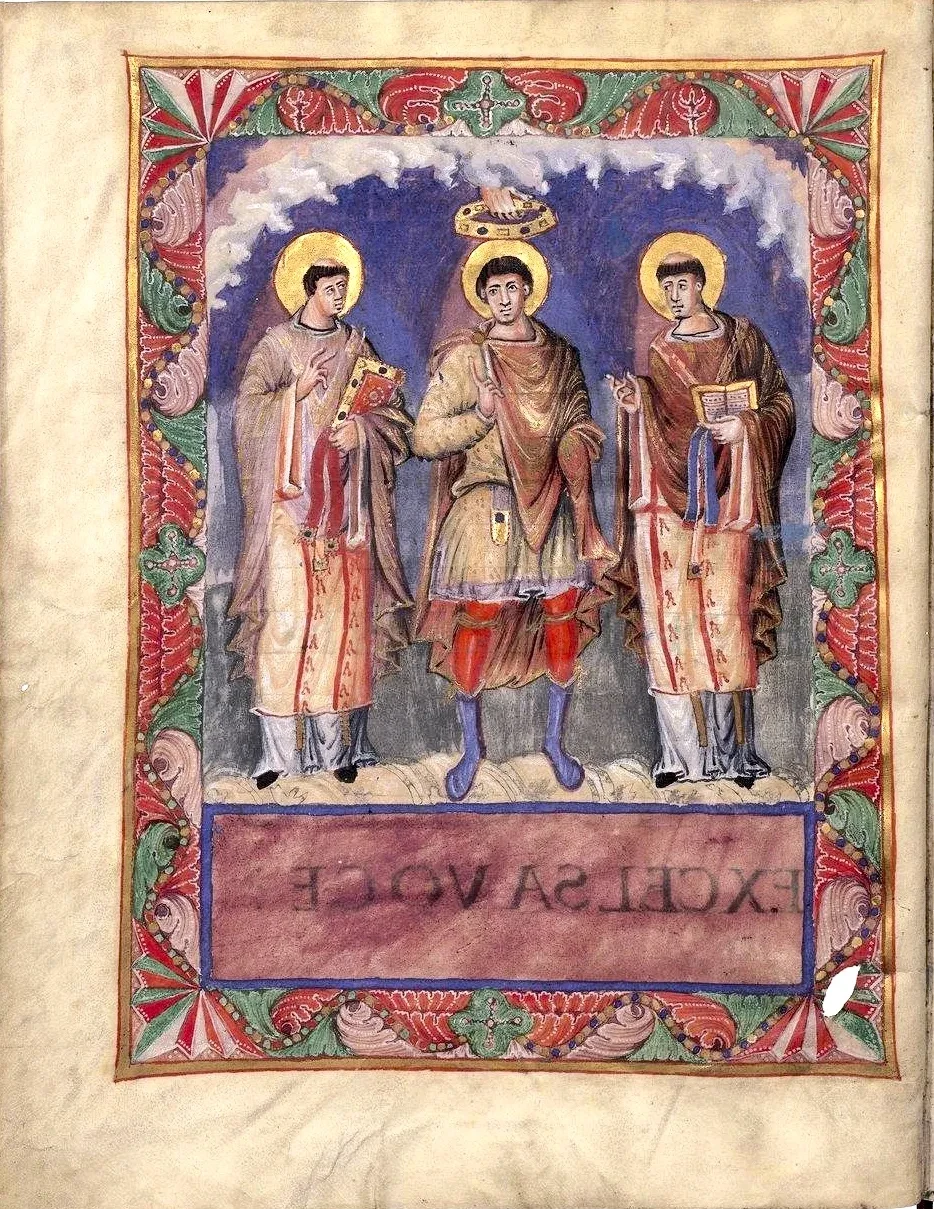
Bibliothèque nationale de France, Public domain, via Wikimedia Commons
The Imperator of West Frankia, Charles, and his intimate friends, Bishop Adventius and Bishop Hincmar
Charles certainly has his resourceful side. He is bold, but fundamentally, a cold-blooded ruler!
These two bishops played a great role in the reign of Charles...!