
186. Do Not Welcome the New Shoots (4).
"Father. I shall go and return."
"Go well, my son. May Tengri watch over you."
Magyars.
The seven nomadic tribes that had stood against the Khazars united their will, and under the name of 'Magyar,' led by Álmos, the most powerful and charismatic chieftain, they performed a blood oath.
They proclaimed to Tengri: Álmos and Előd, Ond, Kond, Tas, Huba, Tétény. These seven persons resolved with one another's blood to rely upon and protect each other and fight as one before foreign foes.
They cut their forearms, mingled their blood in a great bowl, and drank. Even neighboring nomads like the Bulgars or Khazars found it hard to fathom the binding force of these tribes.
Thus, those who had joined forces to fight against the Khazars, Bulgars, Moravians, and East Franks became fully one in the generation of Álmos's son, the Gyula Árpád, and now they were about to reveal that immense power to the world for the first time.
"Kende, do not worry overmuch. To you, I may always seem like a reckless child, but I, for all appearances, am called the reincarnation of the swift eagle. I will never drive warriors to vain death, nor disappoint the tribe."
Árpád's faint smile spoke of a reliable man. Álmos at last understood that his son had become a man fully grown, and he silently patted Árpád's shoulder.
Watching this quietly beside them, the two seasoned chieftains Előd and Kond nodded with eyes like birds of prey.
At the mere age of twenty-three, the Gyula Árpád commanded the respect of all Magyars.
The reason was none other than the charisma inherited from the Kende Álmos, his comely features, and his innate military gift for maneuvering the rough and fierce Magyars as though they were his own hands and feet.
"Hup-cha!"
Springing lightly upward, Árpád mounted a horse of brown coat with a pure white head and tail, and he looked toward his wife, who stood upon a high, distant hill gazing at him, and at their son standing beside her.
'I will return, Liüntika.'
Having inherited his father's keen sight, Liüntika raised both arms toward Árpád with a steadfast expression. At that sight, Árpád grinned, took out the great horn slung on his saddle, and blew it with all his might.
[Bwooooom- Bwooooom-]
Well-trained horses are not given to tossing their heads at random. Nomads always spread their wings when they move, and given the nature of this campaign, which struck straight at the enemy's heart, the most experienced men of the Magyar tribe took charge of both wings.
Left wing, Előd. Right wing, Kond.
Their sons, Árpád's close friends, would move beneath them, and the most critical center was led by Árpád himself.
In order to drink as deeply as possible of the sweet milk of the North Sea-Rome trade, the Magyar home base, hugging the Black Sea and the Dnieper River, would be guarded by the father and the rest of the elders.
"Hyah! Hyah!"
[Frrr-!]
At Árpád's urging, his fine steed tossed its white mane and charged forth, and soon, following the horn calls that rang out everywhere, the Magyar warriors rode after their Gyula.
[Bwooooom- Bwooooom-]
"Rya! Rya!"
"Let us go!"
[Clop- clop- clop- thud- thud-thud-]
At a glance, they seemed to move at will, but these nomads operated with a unity of command under a rigid hierarchy comparable to that of Rome or the North Sea peoples.
Their armament consisted only of finely curved swords, round shields, light armor, bows, and arrows, yet in spirit and equipment alike, they were second to none.
Having met a strong leader in Árpád, the Magyar horsemen drove their steeds northwest without fear.
*****
The Feast of Saint Valentine had passed, and Easter was soon at hand.
No one knew where their bellicose king, Carloman, would lead the soldiery once this sowing was done, but the Franks of East Frankia sang of a happy spring as they carried on with their lives.
It was the same in the Ostmark, the "eastern land," lying far east of Regensburg, the heart of the Kingdom of Bavaria.
Bordered to the north by Bohemia, their Catholic brethren, and to the northeast by the fearsome Moravians, this was a place where one had to keep death always in mind, even while singing of life.
Yet, by the nature of the Moravians, who were likewise sowing seed and cutting grass at this time of year, and the Bulgarians and Croats below them, this was now the most peaceful season.
This year of 868 ought to have been no different.
When one considered it, Bavaria itself was like the southeastern march of the vast empire of East Frankia. Therefore, judging that a swift response from Regensburg was possible, Carloman had stationed no margrave on the Moravian frontier, which meant that if ever an enemy raided, the local lord must take it upon himself to respond to the utmost.
The reason Charles of West Frankia had placed no fewer than two margraves in the northern lands was precisely to make that initial response swifter and more powerful.
East Frankia, which could procure mounts more easily than their Frankish kinsmen in the west, operated a cavalry force of considerable size, and Carloman had used it to defend against Moravian provocations and to ravage their lands so far.
It was merely that, this time, the foe was far too ill-favored.
"Ho there, fellow! Have you any time after duty today?"
"Me? What urgent business have I? I shall but deal with the tasks the Comes has entrusted to me. Is it not soon the sowing season? Once Easter is over, there will be no mercy! Duty and all else, everyone is to be thrown in. One must prepare well beforehand."
"Man, if you live like that, you shall do nothing but labor until you die! Instead, our neighbor Rudolf has laid hold of a fine drink. Let us share a cup! Eh? It is not as if your staring will bring a rusted plow back to life, is it?"
"A fine drink? Ahem— That would be most improper..."
Sisak. A strongpoint town on the eastern fringe of Bavaria. A Frankish fortress left lonely amidst the foreigners who pressed in from all around.
Its scale was not great, but because of the strategic importance of its position as the gateway to East Frankia, it drew the attention of Carloman and the Imperator Ludovicus.
Naturally, the soldiers here, for whom military service was paramount, were renowned for their harsh training and strict discipline, but now, with Easter approaching, they had let their guard down a little.
The two guards passing the time trading jests atop the tall palisade were no exception.
While the talk, begun over the neighbor's drink, wandered as far as the neighbor's maiden and the mill, far in the distance, dust began to rise together with a faint rumble.
[Thud- thud- thud- thud-]
"Mark my words! As soon as this guard duty is over, I shall propose to her!"
"Ho there, that is already the tenth time you've said that— No, wait. Do you see that yonder? What is that?"
"Hmm? What do you mean? Now that you mention it, I seem to hear a strange noise as well. What manner of dust cloud is so...?"
Into the vision of the two Frankish warriors, who had been bickering with useless words for a good while, there came a gradually approaching single mass of shadow.
"What is that?"
"Damn it! Lant! Pull yourself together! That is no welcome guest! Ring the church bell at once!"
"Ah— I understand! W-wait here just a moment, then!"
Without even the composure to straighten his thoroughly disordered gear, the guard called Lant moved himself frantically.
"The enemy! It is the enemy! The enemy! The enemy comes!"
His roughly donned helm slipped off, so he stooped to snatch it up again, and with his other hand he clutched the half-unfastened leather belt.
He had left his spear and shield atop the wall long ago, and it was a most ridiculous sight, yet none reproached Lant as he ran crying madly, "The enemy!"
Rather, the guards who had been ascending the wall to relieve them hurried to their assigned posts, and the townsfolk of the fortress, still steeped in the warm afterglow of the last festival, also moved in haste and opened a way for Lant.
"Huff— huff—! The enemy! Huff—!"
The church was the center of Frankish society. It was naturally situated in the innermost part of the fortress, and so, down the earthen road that today seemed far longer than ever, Lant ran and barely reached the front of the church.
A church building as unremarkable as the unremarkable village itself. Though it was fairly spiky and tall, which at least gave it the air of a church, compared to the proper church standing in Regensburg, it was like a wooden knife before a steel sword.
Yet for the people of Sisak, this church was a sanctuary for their hearts. Its monk, already pale-faced at the sight of people moving in frantic haste, received Lant, and soon the bell mounted at the highest place of the church began to ring without pause.
[Ding-ding-ding-ding-ding-!]
"Move quickly! Women, children, and the aged, to your houses! To the church! All enrolled warriors, take up your weapons and go to the wall!"
"The Lord watches over us! Do not be dismayed!"
Though they might be gripped by fear, monks, warriors, and farmers did not turn their backs on duty. Men and women. Adults and little children.
In their minds, rather than the thought 'Why must this happen at sowing time?' there were questions like 'Is it the Moravians again? Or the Bulgars? Surely not the Croats?'
Had not war been a kind of karma, carried down from their remote ancestors? Besides, such things happened often enough in a fortified town like this.
They would overcome it—Lant and the Frankish warriors, filled with splendid fighting spirit, hurried toward the wall.
Soon they were met with a spectacle the like of which they had never before beheld.
"Árpád vagyok! Magyar Gyula! [I am Árpád! Gyula of the Magyars! Árpád vagyok! Magyar Gyula!]"
It should have been merely a dust cloud shimmering in the distance.
Yet the tide of men and horses that had now drawn near appeared to Lant's eyes as though a full ten men had become one hundred—nay, a thousand.
Such was the scale of the foe, enough to make the onlooker's soul take flight.
No, they must not be a foe. They simply had to be guests of the Imperator Ludovicus or of Lord Carloman.
For otherwise, even a mere common man like Lant could see that all the people in this place would surely die.
"Azt tervezem, hogy Frankiában vadászom. Szóval elköltöznél? [I plan to do some hunting in Frankish land! Could you step aside! Azt tervezem, hogy Frankiában vadászom. Szóval elköltöznél?]"
"Uha-ha-ha-ha-ha!"
"Hwi-ik! Hwi-ik!"
[Bwooooom- Bwooooooohm-]
When the man at their head, a fellow with a splendid feather ornament fixed to his helm, shouted forcefully in an unintelligible tongue, the uninvited guests, every one of them a mounted warrior, burst into laughter all at once, enough to make the very air tremble.
When, on top of that, the terrible horns sounded, Lant felt as though his soul were being sucked away.
Could those possibly be the very Bulgars who were said to have made a drinking cup of the Eastern Roman Emperor's skull?
Sweat streamed down Lant's entire body, and as the grip of his shield, clutched tight in his hand, began to squeak strangely, someone seized his shoulder and shook it hard. It was the veteran who had always looked after him, the officer in charge of the wall guard.
"Lant! Lant—! Pull yourself together! You are to go to the stables at once, take the best horse, and ride along the river! You must head westward! Do you understand!?"
"Yes, yes! I understand! Westward along the river! I shall convey this to the Comes!"
"I place my trust in you alone."
"Shields! Raise shields—!"
[Swoosh- swoosh- thwack! thwack-thwack!]
The veteran's smile was fleeting. Soon, under the shower of arrows that flew over the wall, the Frankish warriors all raised their shields, and Lant, gripping his shield tightly with both hands, hurriedly descended from the wall.
[Swoosh- thwack-thwack! thwack-thwack!]
"Keep your heads down!"
"Archers, make ready!"
In the midst of mayhem, in the heart of an event that fell like a bolt from the blue on a fine day, the eastern frontier fortress of Sisak in East Frankia entered its first battle with Árpád's Magyars.
It was before the sowing.
☆☆☆☆☆Reference☆☆☆☆☆
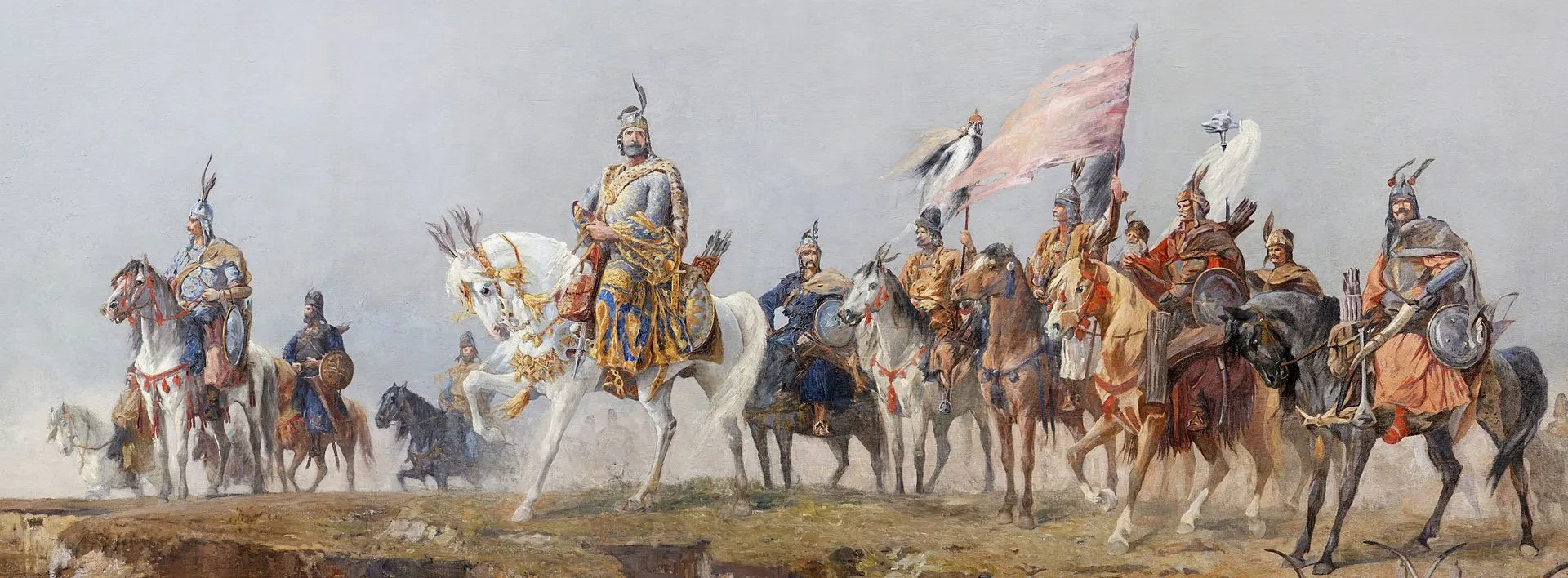
Árpád Feszty, Public domain, via Wikimedia Commons
The coming of the Magyars.
According to ancient, perhaps dubious, chronicles, the old Huns and the Magyars were bound to each other through mutual marriage pacts, they say...
Indeed, when Árpád was in full stride, he himself often called himself a descendant of Attila, King of the Huns—no, Hunnic King...!
Of course, that was more likely meant to tighten internal discipline and strike terror into the Franks than anything grounded in fact...!
So fearsome were these people, you see.
Though the light seldom falls on it so, from the Frankish perspective, it was much like a natural disaster.
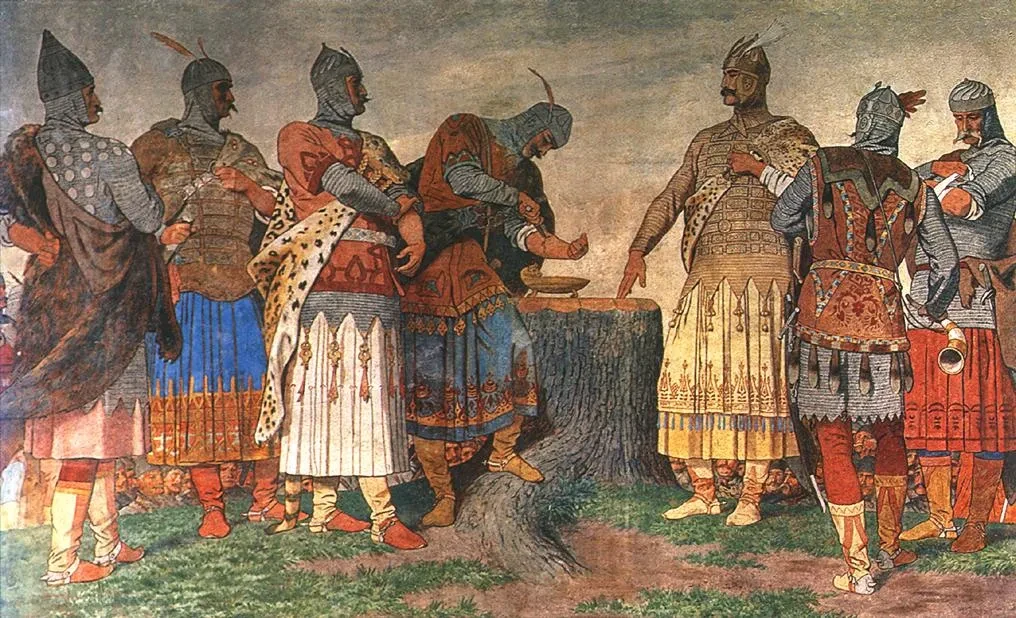
Bertalan Székely, Public domain, via Wikimedia Commons
The Blood Oath.
It is a ritual handed down in texts, but many scholarly views doubt whether it was ever truly performed.
However, the unity and cohesion of the seven Magyar tribes was, for its time, a truly singular thing when you look at the ever-dividing and coalescing Franks, Eastern Romans, Slavs, Khazars, and others...!
And above all, it was just too cool to pass up...! This is what romance is...!
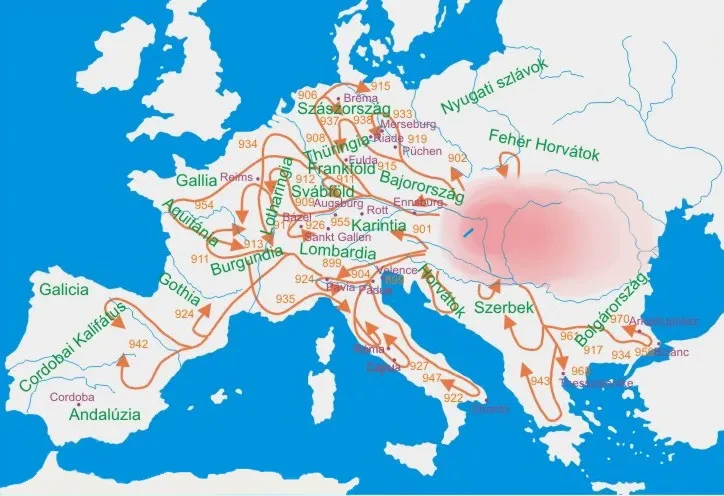
hu:User:Csanády, CC BY-SA 3.0 <http://creativecommons.org/licenses/by-sa/3.0/>, via Wikimedia Commons
This is the range of Magyar activity during its heyday (or thereabouts)...!
They rampage a little after the story's current year of 868, and there were circumstances behind it that one cannot but look upon without tears... but explaining that would add another thousand characters, so I am leaving it out...!
If the Vikings were the princes of the sea, then the Magyars were the princes of the land...
It was absolutely not that the Franks were weak; rather, the Magyars were strong...! To catch light cavalry that strikes and withdraws, there is no answer unless you have terrain features or guns...!
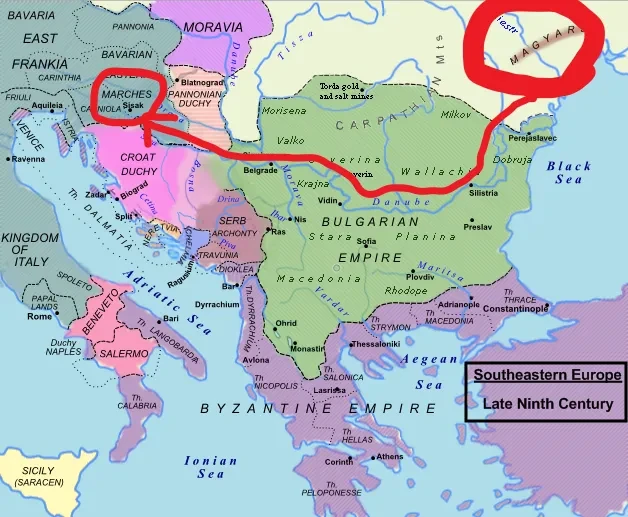
The original uploader was Hxseek at English Wikipedia., CC BY-SA 3.0 <https://creativecommons.org/licenses/by-sa/3.0>, via Wikimedia Commons
Árpád's Bizarre Adventure.
From the Magyar home base, busily sucking up the sweet waters of the Black Sea, they advanced westward along the Danube!
They passed through the Bulgarian sphere, but how, I wonder, did two nomadic peoples who were sworn enemies manage not to clash with each other...??? I am truly curious! (Eastern Rome)