
184. Do Not Welcome the New Shoots (2).
Discussing war was a difficult thing.
"Now then, if you haven't been there, don't speak. Do you think the Frankish lands are like Britain? Cut off their rear, you say? They have no rear."
"There was a reason Philkir emphasized the waterways. If things go wrong, we run, after all."
"That is exactly what I am saying! If we concentrate a bit more on Hamburg, the Obotrites will naturally—"
Wasn't it said that too many boatmen send the boat to the mountain? And when those boatmen were all figures of some renown, the boat might end up not on the mountain but in a deep, dark cave beyond it.
"Look at this intelligence sent by Jarl Haskuld! When spring comes, the Magyars will press in earnest, and their numbers are a staggering—"
"I am not sure how effective the Magyar attack will be, but in the end their aim is plunder. We are going to seize their lands, seize them!"
"Seizing or otherwise, I see that none disputes that East Frankish forces will be split in two."
However, because that great weight named me sat at the center of the council, no drawing of swords or exchanges of insults broke out.
What if the boat went to the mountain? What if it entered a cave? Then I would carry the boat up the mountain, and in the cave I would find underground water and slip out with a swish— like in a Caribbean pirate film.
In the end, no matter how many spoonfuls of ambition were added from here and there, the objective of this war could not exceed the line I had set.
Immobilize the East Frankish army at Hamburg, and annihilate the Obotrites.
"You have changed greatly, Lord Philkir."
The aged konungrs, who had set the mood and then withdrawn their bodies to the rear, sat side by side next to my seat at the head of the table and silently observed the conduct of their juniors(?).
Olaf, who had no Thostein here, with eyes that were a little amused. Bagsecg, who had bitter direct grievances against the Saxons and Obotrites, in a manner actively engaged in the council. Halfdan the Black of Kaupang, calmly watching how his own son Harald was conducting himself.
Yet what all these old-generation warriors felt in common was that the Norsemen— no, the military culture of the North Sea had changed.
"In the old days we gathered third sons, fourth sons of each house, men in need of coin, men who looked good in a fight, fellows half out of their minds, and boarded the ships. We set out along the waterways straight for places where there were rumors of silver. Looking back, we were truly without fear, without thought— but that is how it was back then."
The most composed of the three konungrs, Olaf, spoke as he combed back his white hair.
"But look at them now. In what way are those the eyes and bearing of men heading out to plunder? They are not after silver, livestock, gold ornaments from monasteries, or women. They are the eyes of men seeking something greater, something more precious. Joining Philkir was the best decision the Kingdom of the Isles and my son and I have ever made."
Olaf's eyes, reflecting something like regrets for the past, reached beyond the council hall that was growing ever more heated, touching somewhere else.
In the space measured by those eyes, there would be the great Frankish Carolus, and my own grandfather and father. Names that had shone most brilliantly but in the end left only traces.
Perhaps, through me, Olaf had opened his eyes to a new value.
"Since Carolus, the Franks have not changed. They have no central army like Philkir's. Carolus himself, I hate to admit it, wielded his comites and duces like his own two arms and legs through his fearsome renown and exceptional military ability. But for his sons, the story was different."
The Frankish Empire possessed no proper central army.
It was a little amusing, to be honest, to see that as a feature of a country bearing the name 'empire,' but in my view, while Charlemagne the Emperor still lived, it must have worked like a kind of Joseon-era Jeseungbangnyak strategy.
For example, when fighting the eastern nomads, he would lead the local forces of Bavaria; when fighting in the south against Italy, the local forces of another region; when assaulting the Muslims in the west, the local forces of yet another region.
Even for Charlemagne, who knew how to wring strength from every corner of that vast land, the uniquely Frankish law of partible inheritance was something he could never overcome.
Though he himself succeeded in bequeathing a great empire whole to his son, the ordained ruin arrived in the generation of his grandsons.
"That Louis of East Frankia— Ludovicus, are they calling him? That fellow faced a similar problem. At present, his second son nominally possesses the land of Saxony. They say he is likewise named Louis? They call him 'the Younger' Louis. But in practice, that land belongs to Bruno, a descendant of the Saxons.
Hamburg, their tangled base, is a masterfully positioned fortress tucked between two rivers, not a stronghold that can be taken in a single morning."
Unless, of course, Philkir himself were to take the field.
I showed a bitter smile at Olaf's laughing addition of those last words.
"Konungr Olaf. Even for me, breaching a castle guarded by sturdy stone walls, stout gates, and river waters is a heavy burden."
If I forced it through, there might well be a chance, but too many warriors of the North Sea would die in the process. Hamburg had to be squeezed to death.
"Then we must settle the Obotrites first, after all. Those Franks seem to think they can hold out no matter what as long as they have a river around them, but this time they will learn a hard lesson. They will realize that what they face now is not the famed Norseman raiders of the past generation, but Helgi, the Conqueror of the North Sea."
No sooner had Olaf's meaningful words ended than Oleg's voice, shouted at the perfect timing, rang out through the great hall and made it echo.
"In my judgment, victory or defeat in this war depends on how swiftly we knock the Obotrites out of the fight! Worry not, you jarls gathered here! Oleg, conqueror of Huntaun and Bekalati (the palisade fortress where the Karelian Finns once resisted), holder of the sword bestowed by Philkir himself, will sweep away every last one of those unrighteous savages!"
"Oh—! Well said! Jarl Oleg! Raise your cup!"
"We cannot be outdone! Hamburg shall bow its head under the name of Philkir and the North Sea!"
"...I was the one who received the sword, so why are you...?"
The lords who raised their cups in unison and cheered, and Ryurik staring at Oleg with a sour expression.
'At least their spirit is good. That's fortunate.'
Thinking that, I went over the broad plan in my head by myself.
The troops East Frankia had raised in its last war with Moravia numbered roughly 15,000. That was a figure drawn from a single territory: Bavaria.
Even considering that Bavaria was far more populous and advanced than Mercia, the heirs of Charlemagne who had secured the succession of the Western Roman position were indeed formidable.
If Saxony's land could muster at least the same scale, that alone made 30,000 at minimum. Add the Alemanni from the Italian side, and the total would be around 40,000.
The fortunate points: we had many allies, and the sons of East Frankish Ludovicus were rivals to one another.
And that Lotharingia, on East Frankia's western border, was practically the hidden hand behind this whole affair?
On top of that, the Magyars were planning a cross-Eastern-Francia journey?
Looking at it this way, the news was ultimately half full of hope, and half bleak.
In the end, you could not know until you clashed.
For war was difficult even to discuss, but actually waging it was far, far harder.
*****
Neustria. The western land of the Franks.
A word designating the land between the Seine and the Loire.
Recently, however, the meaning of this Neustria had shifted to the sense of 'the breakwater standing against the Bretons and the Norsemen.'
To that extent, the threat of the Bretons and the Norsemen was grave for the Frankish Empire. Robert the Strong used this opportunity to consolidate his influence in the western marches of West Frankia.
More precisely, in the region of Le Mans and its environs.
His loyalty to Charles, the Imperator of West Frankia who had lifted him from the bottom, had already evaporated long ago when that Charles betrayed him and made a secret pact with the former Breton ruler.
Power was hard to grasp, but once in hand, it was something not even blood could dare to divide.
Naturally, Robert could not possibly agree to the secret pact concerning control over this land of Neustria. In the end, Robert joined hands with Salomon, who at the time was merely an ambitious Breton noble, and raised a rebellion to install the Imperator of East Frankia, Ludovicus, as Emperor of West Frankia.
The result was the emergence of Salomon as the new Breton ruler and concessions from Charles, the Imperator of West Frankia.
After that, Robert crossed a river of no return with Imperator Charles, but he could not stop.
For now he had a family to protect.
Louis the Stammerer, son of Charles, who had planted his rear firmly in warm Aquitaine to the south.
Beside him, Imperator Charles, who wielded the mighty Welf house of Burgundy as he pleased.
Behind his back, political rivals who would thrust in at the slightest gap; before his very nose, Norsemen and Bretons who always attacked even when no gap was visible.
Though he had not wanted it, fighting without mercy had earned Robert the epithet 'the Strong.' He watched his son, who was earnestly swinging a sword in front of him to capture even a little of his father's attention.
'Odo, my son.'
Blond hair that took after him exactly; blue eyes that took after his beloved wife Adelaide exactly. The cheekbones, the jawline, the bridge of the nose.
The heavy heart and the weight of the flesh, welling up for some reason, were concealed with a forced chuckle. Robert rose vigorously, embraced Odo's small frame, which was swinging his sword down with cries of "Hup—! Hup—!", and held him.
"Odo. Your mother's death is neither your fault nor your little brother's."
"Father."
When I was your age, eleven years old, I was too busy running about the streets. I do not know if I am doing something terrible to you.
Unable to reveal his true feelings, Robert held young Odo in his arms for a long while, and before long he felt tears streaming from Odo's eyes.
Watching his young son choke down his sobs in silence for fear of troubling his father's heart tore at Robert's chest, yet at the same time it became a moment that steeled his resolve.
'I will certainly protect you. Odo, Robert. I will certainly—'
Reciting inwardly the names of his first and second sons, Robert pledged that he would surely protect his two sons and this land.
*****
"Le Mans must fall without fail."
In Roazhon (Rennes), the Breton frontier— one of the few remaining Celtic-descended strongholds on the continent and Salomon's precious home— a historic gathering was in full swing.
Of course, those assembled here might themselves have felt nothing special, yet gathered in this place were none other than envoys, or the persons themselves, of pan-Celtic rulers who had survived into the present age.
Fundamentally, this meant Salomon of Brittany, who could be called the protagonist of this attack, and Hásteinn of Nantes, of course.
Also, Dungarth of Cornouaille. And even Lord Arthur of Devon, attending as proxy for Rhodri of Cymru.
The three kingdoms that had cooperated with Lord Philkir of the North Sea the previous year and boldly plundered the Angle and Saxon kingdoms of Britain had decided to join forces once again.
"Is Le Mans not the land ruled by that Robert? We are well aware of the circumstances of Brittany and Nantes, but how about instead participating in the Seine campaign, following the North Sea's lead?"
Though Hásteinn had taken note of him early on, Arthur, newly settled in Devon, was indeed an outstanding figure. Not only did he fight well, but his ability to read the board was considerable.
"In the Seine campaign, the North Sea has no need of our help. No, to be precise, there is little we could do if we went there. Besides, would not Rhodri of Cymru want to gain some face with Lord Philkir of the North Sea?"
"That is true, but..."
Yet when personal competence clashed with a superior's intent, the latter always won. Salomon, from the same ruler's position, pierced straight through the circumstances of Cymru and Cornouaille.
Cymru's eastward expansion had been blocked by the emergence of a monster called the North Sea that they could not even dream of matching, so they harbored the sly notion of crossing the sea. And as for Dungarth of Cornouaille, whose power had originally been small, did he not wish to demonstrate his usefulness to Lord Philkir and raise his own value?
In the end, they would have no choice but to come together.
"It is true that Robert of Neustria fights well, but that is only possible when his rear is stable. A storm shall rage such that neither the Stammerer in Aquitaine nor Charles behind him will be able to spare even a thought for Neustria. In my judgment, opportunity lies clearly with us."
Bringing the Eastern Roman wine, which had crossed the rough seas of the North, to his lips, Salomon smiled.
☆☆☆☆☆Reference Material☆☆☆☆☆
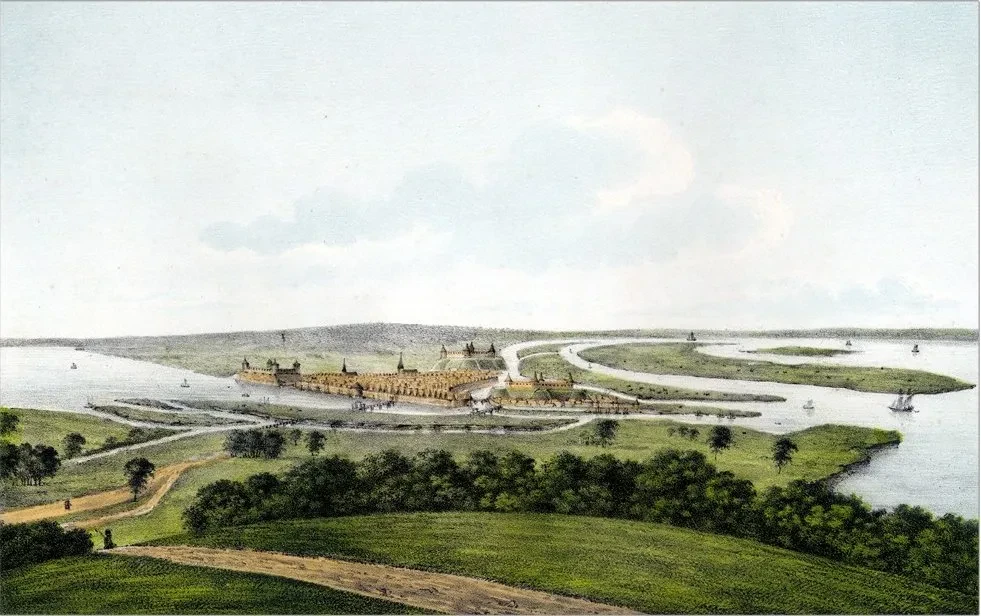
Peter Suhr, Public domain, via Wikimedia Commons
Hamburg in 1150. It shows the surrounding terrain well.
Hamburg was built nestled between two great rivers, the Alster and the Elbe...! Much like Jorvik on the British Isles...!
Charlemagne himself annihilated the Saxons completely and used the firmest ground in this marshy place as a foundation, piling up the fortress walls atop it...!
Naturally, it is difficult to attack, lol lol. To do so, you would have to block all the waterways and encircle both sides... but the Frankish forces in the rear are not to be taken lightly for that...!
Moreover, to the east there are even the Obotrites, the Franks' bosom neighbors (for now)...! These Obotrites can be seen as a tribal confederation that formed a kind of union kingdom...!
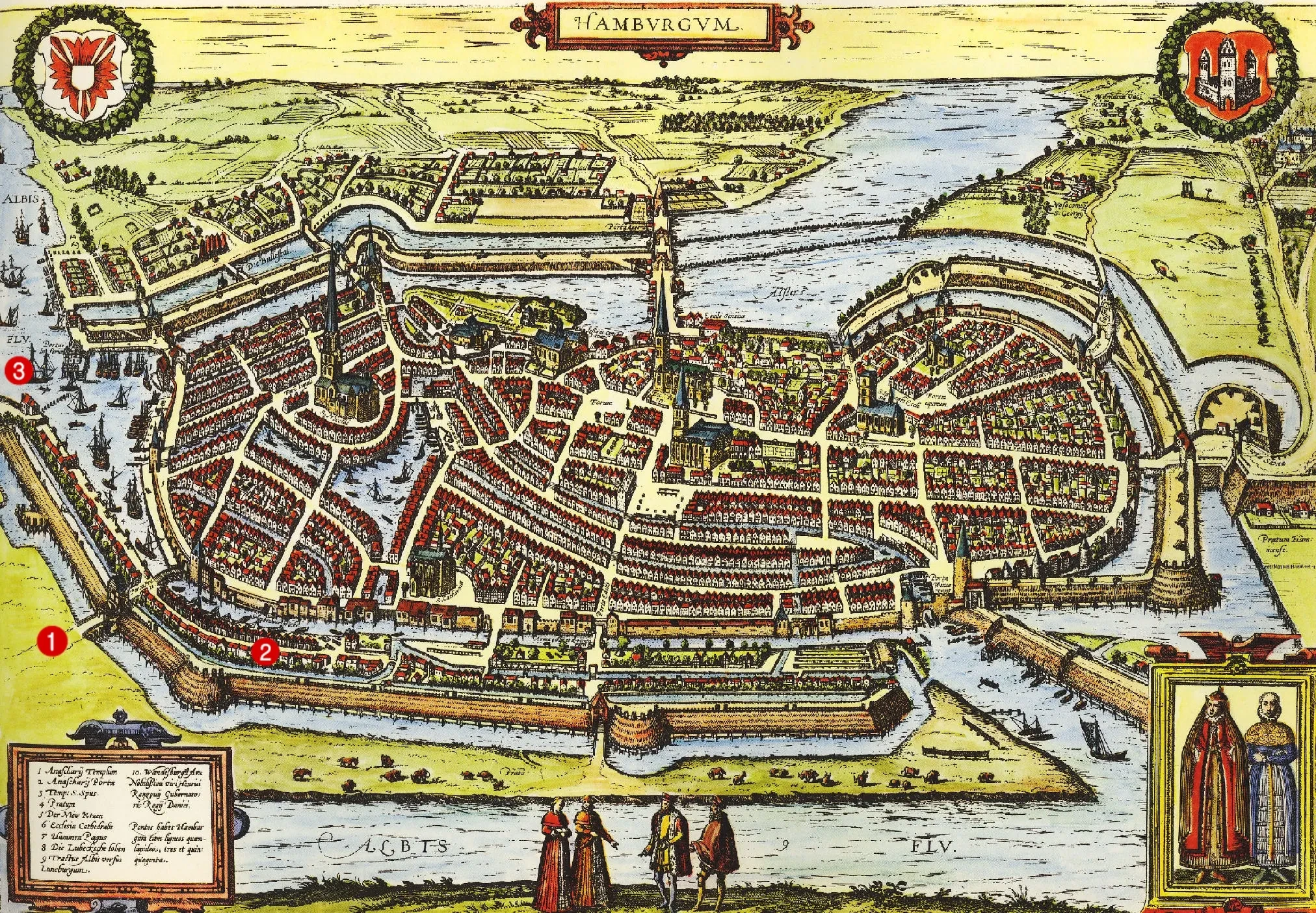
Georg Braun, Public domain, via Wikimedia Commons
This is Hamburg in the 1600s. It shows the city's potential well...! Just as a convenience store in a prime location has tremendous sales! Hamburg, too, would serve as the hub of North Sea trade and draw in a staggering amount of capital...!
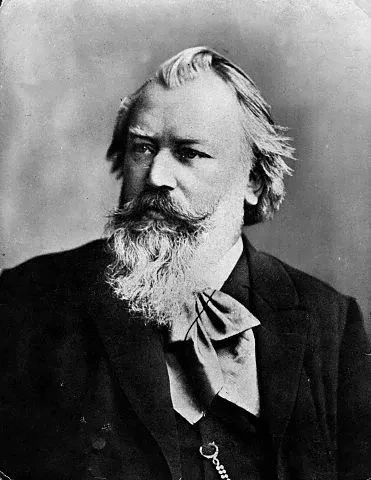
C. Brasch, Berlin (biography), Public domain, via Wikimedia Commons
This is Hamburg's famous figure, Mr. Johannes Brahms, haha.
He is a renowned musician, though unfortunately he never made it onto the Billboard charts... Give his music a listen on YouTube!
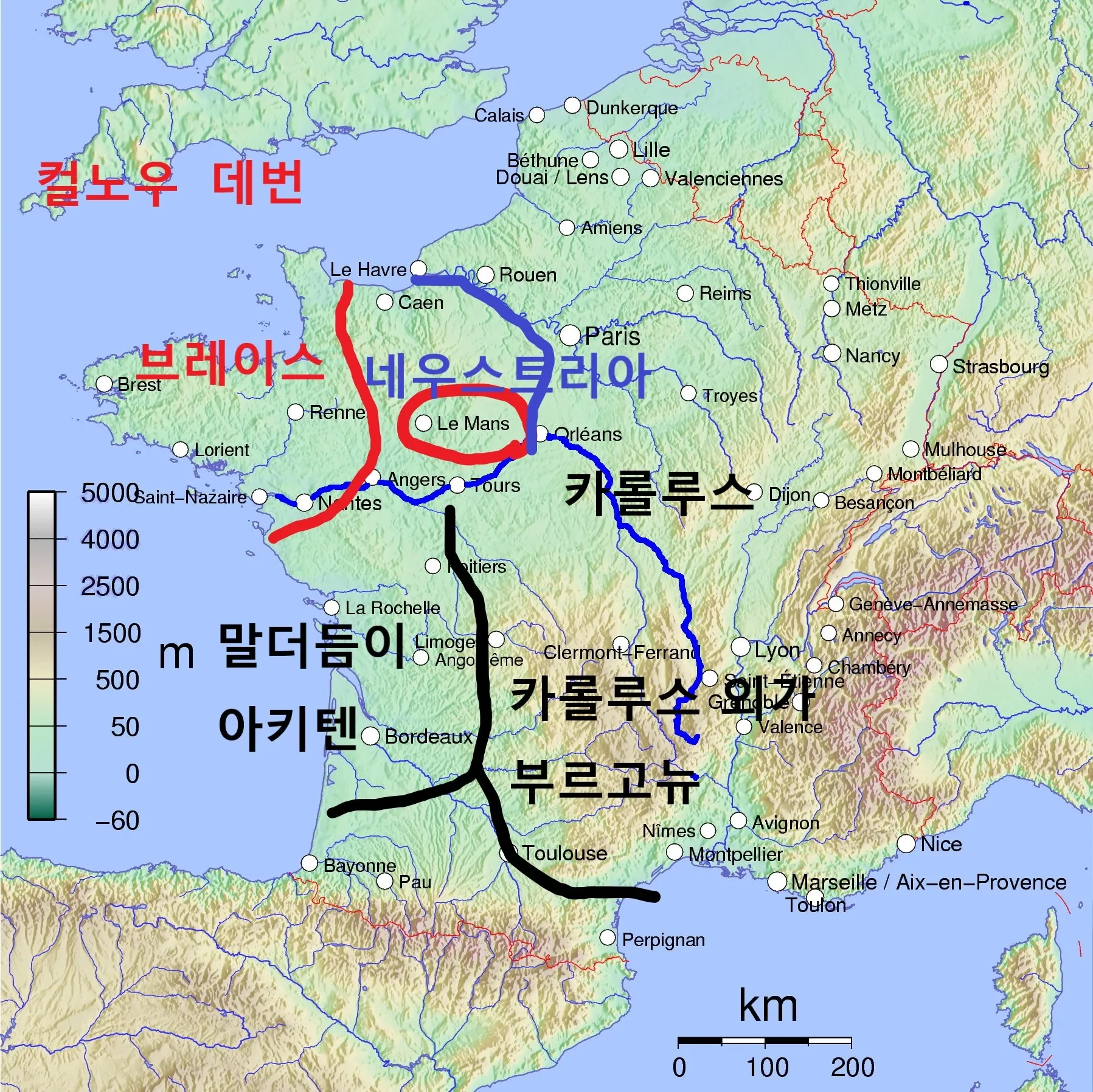
No machine-readable author provided. MatthiasKabel assumed (based on copyright claims)., CC BY-SA 3.0 <http://creativecommons.org/licenses/by-sa/3.0/>, via Wikimedia Commons
This is an overview map of western West Frankia!!! Neustria literally means the western land...! Robert is struggling mightily...!
The location between the Seine, which flows via Rouen to Paris, and the Loire, which flows via Nantes out toward Burgundy...!
The ancient grudges of the Celts are baring their teeth...!!!!!!!!! Brace yourself, Caesar!!!!!!
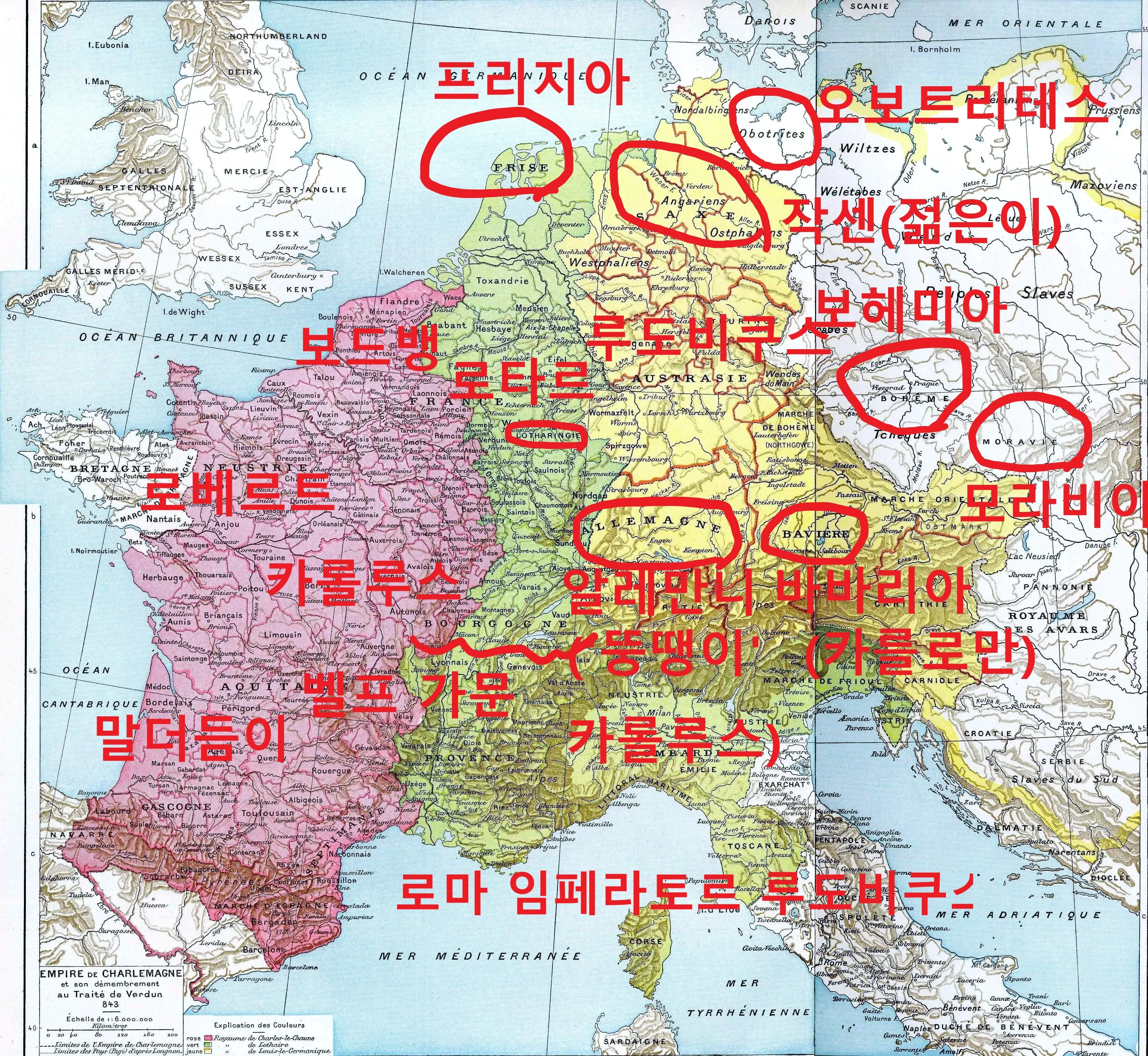
Scan made by Olahus, Public domain, via Wikimedia Commons
Ah, now that I've done this, the readability is...!?
Damn, ha ha ha ha ha ha
Sorry for the eye-bleed, I will make it cleaner, lol lol.
This is the approximate situation in Frankia! Dizzying~ isn't it? But actually, this is only the lesser part of it... as time goes on, it gets even more tangled...!!!!!
Ha ha, good heavens.