
Heading to a New Home (1)
The group now known as the Bone-wearer Tribe had left Ati of their own accord, even though the dry season had not yet ended.
Few believed they would survive the journey. The dry season was simply that merciless.
Several months passed.
In that span of time—short or long depending on how one measured it—a new culture began to take root in Ati.
“We have far too much meat for ourselves. So we will share it.”
“We also have more bones than we can use. We will share them with you.”
They began to share the fruits of their hunts and gathering without the slightest hesitation.
It had started, quite coincidentally, with Tall Bird’s group.
Tall Bird appeared to have taken my words deeply to heart. He spread what he had heard throughout his own people, and they began offering their grains and fruits to the other groups.
Those who received them shared their meat and bones in turn. The cycle continued, spreading through every group in Ati.
Because of it, even though hunting on the plains had not yet returned to normal, every person in Ati could eat until they were full.
Dozens, hundreds of groups sharing what they possessed meant no one needed to go without. The thought occurred to me that if they settled in one place, they might truly become a single civilization.
But such ideas were still too early, little more than wishful imagining.
As if to prove that the conditions for ten thousand people to live together had not yet been created, a new problem soon emerged.
“Don’t drink the water?”
The warning came from my mother.
“That’s right. You must not drink from Ati’s water now. You’ll get sick.”
I stared at the lake for a moment. I understood her words immediately.
“…When did it turn this green?”
The lake that had shone with clear blue water when we arrived was now covered entirely by a murky green film.
The reason required no long contemplation. I had just stepped on something warm and soft.
“Pretty Eyes, you stepped on poop.”
“…I know.”
How much waste could ten thousand people produce in a single day? I could not calculate it precisely, but even the most optimistic estimate was staggering.
Of course, these people possessed a basic sense of hygiene. They disliked fouling their living spaces, so they dug shallow holes or relieved themselves a short distance from their shelters.
Yet their preferred location was the waterside.
Flowing or standing water erased traces quickly, reduced odor, and made cleanup simple. As a result, they treated the lakeshore as the finest toilet available.
The problem was that Ati’s lake was virtually the only reliable source of water in the area. With nearly ten thousand people emptying their bowels and bladders into it daily, the lake’s decay was inevitable.
“…Then what do we do now?”
“Drink where the water enters the lake. Or wait. The rainy season will return soon.”
Now that she mentioned it, the time was indeed approaching. The air grew heavier each day. Moisture clung to the skin, and a damp scent rolled in from the distance.
The dry and rainy seasons arrived with almost miraculous regularity. Perhaps the unpolluted sky could not lie.
“When the rain comes, we will leave. No one can live here during the rainy season.”
At my mother’s words I looked at the lake once more.
The rain would fall soon. This place would flood, and every trace left by people would dissolve into the water—the feces and urine, leftover bones and rotting hides, campfire ashes and crushed grass.
Everything would melt, sink into the mud, and settle once more into the earth.
When the next dry season arrived, Ati would welcome new visitors as though nothing had happened.
And one week later, the first rain fell.
Beneath a sky of gentle drizzle, my father gazed at my mother with solemn intensity. In his arms he carried a leather bundle filled with treasures: ornaments fashioned from shells, an obsidian knife, precious horns, and bones.
He offered them to her without a word.
My mother stared at the gifts for a long time, then sighed.
“…Fast Foot.”
“White Wind.”
“Didn’t I tell you not to?”
“You did.”
“Then why are you doing this?”
When she glared at him, he answered with perfect confidence.
“It is only natural! Providing for one’s mate is a man’s duty!”
“…Aigoo.”
My mother pressed her fingers to her forehead as though nursing a headache.
“We’re traveling together anyway. Giving them now only adds to the burden.”
She was right. We had decided to follow my father’s group.
After watching what I had accomplished in Ati, my mother concluded that my education required more people, and that for me to survive in this world, I would need the protection of a larger tribe.
“I will give you more when we arrive! These are simply a gift in advance!”
My father, it turned out, was more of a devoted husband than I had realized.
The preparations for departure had been completed long ago, so there was no hesitation.
The people of Ati already understood. When the first rains fell, they must leave. No one had taught them this law, yet everyone knew it as instinctively as they knew to open their eyes at sunrise or seek food when hunger stirred.
Campfires were extinguished. Dried meat and hides were rolled tightly. Bone tools, stone knives, ornaments, and dried fruits disappeared into leather pouches.
Then the people began to scatter.
The great gathering that had seemed like one enormous tribe only the day before fractured, the moment the rain began, into dozens and hundreds of smaller bands.
Yet one group did not disperse.
“Pretty Eyes… we also want to follow you.”
It was Tall Bird’s people.
The Boisei had chosen not to return to their original forest. Instead they wished to follow me—and therefore my father’s group.
My father left the decision entirely to me.
“…I may decide this?”
“Of course. They wish to follow you, not me.”
I nodded slowly and studied Tall Bird’s group. They were short, with flat noses—faces entirely unlike those of Homo erectus.
Yet their joining us did not seem problematic at first glance. Our diets differed. While we ate meat, roots, and fruit, they excelled at gathering grasses, seeds, and tough plants. Competition for the same resources would be lower than expected.
Moreover, their plant-based diet seemed to give them gentle dispositions.
The real question was whether they could integrate naturally into my father’s tribe.
For my mother and me, acceptance had been easy. We were the same species, and my actions in Ati had earned us welcome.
But Tall Bird’s people looked different, ate differently, and spoke differently. Such differences could ignite conflicts more dangerous than hunger itself.
“Why do you wish to follow me?”
Tall Bird met my gaze, then answered as though the reason were obvious.
“We are weak. Finding food is hard. We eat grass… but other animals like that grass too. Same with fruit.”
“So you want us to protect you?”
He shook his head.
“No. We do not go to be protected. We want to walk together with you.”
As he spoke, he offered me something he had been carrying.
It was a basket woven from grass—exquisitely made. Not a crude bundle of stems, but a careful interlacing of thick and thin fibers at regular intervals. The handle had been braided in multiple layers to prevent tearing.
“Made from tall grass that grows by water. We are good at making these.”
Tall waterside grass. Papyrus, most likely. I had seen people chew its inner pith, but never watched it transformed into genuine tools.
Papyrus would one day become famous as the material for Egyptian paper, yet in truth it served far more purposes. Its tough outer bark made excellent rope and weaving material. The sweet, nutritious pith could be eaten. The fibers could be twisted into cord or woven into baskets, sandals, and hats.
Its only flaw was vulnerability to moisture and mold, but in this era that was no great drawback. Papyrus grew so abundantly by the water that if one rotted, another could be made.
The reason I had never properly utilized this versatile plant was simple: I did not know how to process it. Its high water content meant that simply cutting and weaving it caused rapid decay. Only proper drying, splitting, twisting, and weaving turned it into durable tools.
What Tall Bird offered was not a makeshift basket. It was technology.
His earlier words—that they were not coming merely to be protected—finally made sense.
I passed the basket to my father.
“Is there grass like this where we are going?”
“Plenty. We live near water, after all.”
My father’s eyes brightened the instant he examined the basket. As leader of the group, he instantly recognized its value. The others reacted the same way.
A basket might seem trivial, but on a long journey it changed everything. It could carry meat and fruit, hold tools, remain light enough for children to manage, and be remade if damaged.
And those who could craft them so skillfully wished to walk beside us.
There was no longer any reason to hesitate.
After a moment’s thought, I took Tall Bird’s hand.
“All right. Let us go together, Tall Bird.”
His face brightened visibly. He threw his arms around me in a powerful embrace.
“Thank you! Pretty Eyes! We will never cause trouble for your group!”
Though small in stature, his compact muscles squeezed my waist with surprising strength. I felt my breath leave me and patted his back.
“Cough—ugh… T-Tall Bird… let… go…!”
My abdomen felt crushed. Breathing became impossible. Yet Tall Bird mistook my desperate patting for encouragement and only tightened his grip further.
“Gurkh—!”
Accompanied by the sound of my choking, a new group was born—perhaps the first of its kind in human history.
A band in which different kinds of humans walked together.
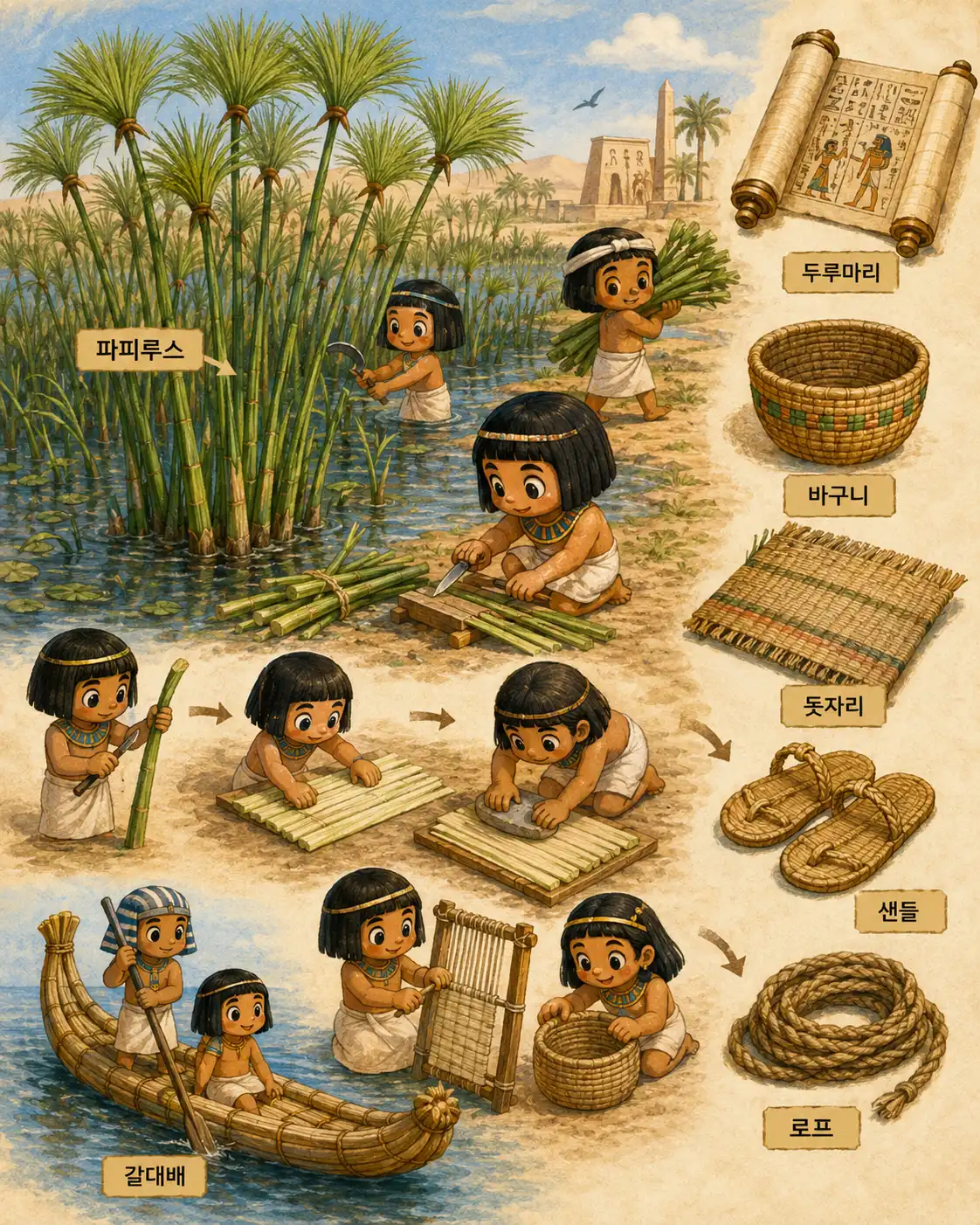
From ancient Egypt to the modern era, papyrus has been a beloved plant.
Papyrus was not used merely as a material for paper. To the Egyptians, it was a common plant growing by the water, a precious material that supported daily life, and sometimes a symbol carrying sacred meaning.
In Egyptian mythology, the world is said to have begun in chaos filled with the primordial waters called Nun. From those primal waters rose the first hill, Benben, and there life first bloomed. The papyrus that grows lushly along the water naturally became linked with images of birth and life itself.
Therefore, meanings such as protection, life, kingship, and youth became associated with it. The Egyptians wove papyrus into baskets, mats, sandals, ropes, and boats. They would slice the pith thinly, dry it, and use the sheets as scrolls for writing.
In other words, papyrus was a plant for eating, writing, weaving, and recording.
In modern times it is also loved as a representative souvenir symbolizing ancient Egypt. Truly, it is a plant with countless faces.