
The Weight of Gifts
A few weeks passed, and the technology I had shared spread through every corner of Arti far more quickly than I had expected.
In truth, it didn't even take a few weeks. If I said that most of Arti's people had begun carrying tools with handles within just a handful of days, that wouldn't be an exaggeration.
Of course, the cost was that the nearby acacia trees all but disappeared, victims of overharvesting. But then again, this was still an age when nature was stronger than people, so I figured we could let it slide.
Once the innovations of handles and adhesive spread, the first thing to change was—of all things—clothing.
You might wonder what tools have to do with clothing, but in fact, the connection runs deep.
The "clothing" of this era was made by roughly scraping animal hides, stretching and pounding them, then smoking them for processing. It was an utterly primitive garment meant only to cover the delicate parts near the reproductive organs.
There were methods of processing hides by piercing holes with bone awls and threading or binding leather through them, but nothing particularly refined.
But once the techniques I had spread were added to the mix, everything changed.
A knife with a handle allowed movements so precise they were incomparable to anything before, and thanks to that, they could now obtain hides that were carefully stripped rather than crudely torn.
And once those carefully obtained hides could be cut and pierced more easily, they used them to instantly create a new form of clothing.
A girl who looked about my age said this to me and handed over a garment made by weaving strips of leather.
It wasn't something made with needles and thread—a sophisticated thing. It was a one-piece garment cut and pierced with holes, with the holes tied together using cords.
"...Impressive."
I said that as I received it, fumbling.
It wasn't an empty compliment. Because until now, what I had been wearing was literally nothing more than a leather strip tied around my waist—pure caveman stereotype.
The fact that such progress had occurred in just a few weeks genuinely astonished me.
But then…
The thing was that the gift I had just received wasn't from just this one girl.
I sighed and looked toward the tree I used as my sleeping spot. There, a mountain of leather had already piled up, taller than my height.
The amount of hide in that pile alone was enough to feed an entire troop of baboons. And every single piece in that mountain was a gift someone had given me.
Now there were so many that I couldn't even remember who had given what.
'Sigh… I just want the gifts to stop…'
Deep down, I wanted to return every single gift, but I couldn't. Because of what Mother had said.
What Mother always said.
"…Why?"
"If you refuse a gift, it means I will attack you. It means you don't want to receive anything like gifts."
"No, but why…?"
When I asked with a baffled expression, she pointed indifferently—whether on purpose or by coincidence—at the Quick Foot group and Father's band, which had set up near the tree where we lived.
"That's how it's always been. Look at Quick Foot."
When I looked that way, I could see people offering meat and fish to Father.
Father accepted it as a matter of course, and in return, he gave back bones, hides, and the like.
The sight reminded me of a paper I had once read about gift diplomacy among the Indigenous peoples of North America.
For Native Americans, a gift was not simply a gesture of goodwill or a form of trade. It was, in essence, a diplomatic letter.
By sending a gift and receiving a return, they conveyed the message: "We have no intention of fighting you" or "We are your allies." To unilaterally cut off that gift exchange was treated as equivalent to a declaration of war.
Conversely, giving a gift the other side couldn't possibly reciprocate was tantamount to declaring, "You are beneath us"—and wars could break out for the very reason that something too fine had been sent.
The interesting part is that this gift diplomacy was not unique to North America. It appeared as a common cultural trait among most peoples forming tribal societies—from the jungles of South America to Oceania, to Africa.
This is called reciprocity. Put simply: if you receive, you must give back.
In modern society, you could brush past with a casual "thank you," but in a tribal society, it wasn't that simple.
A gift is not an object. It is a kind of relationship.
To receive a gift is to take the other person's extended hand. To reciprocate that gift is to promise not to let go of that hand.
And to refuse a gift?
'I will not take your hand.'
Or, going further:
'Before your hand wraps around my throat, I will bite your throat first.'
That is essentially what it came down to.
Though we were still far from a true tribal society, we were already halfway there—living in bands that were beginning to resemble one. So these concepts applied perfectly here.
'…No, the social pressure is way too intense.'
I looked at the girl standing in front of me.
She was looking up at me with eyes full of anticipation the moment I received the gift.
Eyes that were very pure—and very burdensome.
"…Thank you."
"Yeah!"
The girl smiled wide.
As if receiving the gift were the only thing that mattered.
For the record, I didn't need to reciprocate.
Well, before that— I had already given these people an overwhelming flood of gifts. So receiving all these gifts was basically the same as being on the receiving end of a gift offensive.
The fact that those bringing the gifts were my age was simple enough to explain.
"…."
"…?"
"…!"
No—don't blush!
I really wanted to shout that. But I didn't say it out loud.
Because the moment I said it, that girl would have blushed even harder. I already knew from experience how many times that had happened.
"…Yeah. I like it."
"Then that's all!"
The girl said that and then, as if fleeing, turned her body away.
And she really did run.
On all fours.
No—she was walking on two legs, then suddenly seemed to get embarrassed and put her hands down and scurried away almost like an animal.
I stared blankly at her retreating figure.
'…What was that.'
I had thought it was closer to diplomatic gift exchange, but…
What had just happened was less diplomacy and more…
Then, from behind me, Mother's voice came.
I slowly turned my head, sensing a bad omen.
Mother had been looking in the direction the girl had disappeared, then glanced at me with a very peculiar expression.
How to put it…
In modern terms, it was the face of a mother who had just seen her son receive chocolate from a girl.
"…Why."
"You're popular."
"No, I'm not."
"You are."
"I said no."
"It's a good thing."
"It's not a good thing."
"Why?"
Mother tilted her head as if she genuinely couldn't understand.
"Many people are giving you gifts. It means many don't want to fight you. It means many want to be by your side. That's a good thing."
"…That may be true, but…"
They might just want to get closer. They might be grateful for the techniques I taught them. Or they might simply want to show off their own craftsmanship.
Yes. It must be that.
But hearing Mother's words, I could only grip my face and scream silently.
---
How do I explain this?
I still sometimes got confused about how old I was.
My body's age was similar to the children of this era. But inside me lived one modern life and the life of a previous existence spanning more than a decade.
I couldn't help but feel a sense of "difference" from these people.
Partly because of my appearance, of course.
But the strangest thing was my body.
It had been the same in my previous life too.
I felt almost no romantic attachment toward the people of this era.
At first, I thought it was simply a matter of taste.
My aesthetic standards were calibrated for modern South Korea, so no matter how long I lived, I wouldn't easily be drawn to the faces and bodies of this era.
But now it was a bit different.
My body was growing. Muscles were developing, my voice was subtly changing, and the way my peers looked at me was shifting too.
Classic signs of secondary sexual development.
And yet I was strangely calm.
As if some switch that should have been inside my body had been deliberately removed.
Normally, the raging hormones should have shaken my reason to its core, but I remained as calm as ever.
'Is it because of my past life?'
I suddenly thought that.
Or maybe it was a problem with this body. This was already my second life in this world, and if you count the modern one, my third.
If there was such a thing as a soul, it wouldn't be strange if something was broken.
Whatever the cause, for me right now, gifts from girls my age were nothing more than a nuisance.
I was truly grateful that they liked me.
But there's a world of difference between being grateful and not feeling burdened.
"Why?"
"Because I don't have the thought yet. Mother doesn't have a mate either, does she?"
Of course, Father existed, but given her personality, it was hard to imagine her wanting him beside her as a partner.
Even now, Father came every day asking Mother to join his band, but she firmly refused each time, saying she would tell him when the dry season ended, and chased him away.
Mother answered very clearly.
Once the biological purpose of reproduction was fulfilled, there was simply no need to maintain the hassle of a relationship. It was a perfectly primitive yet efficient way of thinking.
The moment she said that, a loud commotion came from beyond the trees.
I didn't need to look to know who it was. It was Quick Foot—Father. He was leading more than ten sturdy men today, striding toward our tree with great pomp, kicking up a cloud of dust.
In his hand, he carried a wildebeest—big enough to match my entire torso.
It seemed he was bringing one of the gifts he had received as a return to us.
He flashed a hearty grin and held up the wildebeest with one hand.
Mother sighed heavily and waved her hand dismissively.
"Not needed. Quick Foot."
"Are you refusing my gift right now?"
"I don't receive anything like gifts from you."
Mother said that flatly, then looked at Father for a moment.
Father, despite Mother's reaction, didn't seem to care at all. He ruffled my hair, set the wildebeest down, and left with a refreshing air.
Mother stood there and stared at the wildebeest left behind.
Then she grabbed its leg and started dragging it over.
"…You said you wouldn't receive it."
"I didn't receive it."
"Then what is that?"
"It's the meat Quick Foot left behind."
"That's receiving it."
"No. It's just meat lying on the ground."
Honestly, was this primitive legal interpretation way too convenient?
I stared at Mother with a bewildered expression, but she didn't seem to care at all. She just kept dragging the wildebeest's leg and then gestured for me to come over.
"…We're going to eat it anyway."
"If you leave meat on the ground, beasts will eat it. What a waste."
I grumbled and started butchering the wildebeest with my stone knife.
While I was doing that, Father came back.
He watched us butchering the wildebeest with a very, very fond look, then as if he had forgotten something, shook his head and spoke in a surprisingly serious voice.
At Father's words, Mother also looked over with a serious expression this time.
"What is it?"
"They say the 'Earthquake' has been acting up around here lately."
At those words, both Mother and I wore very grave faces.
That was because the 'Earthquake' Father was talking about…
was a walking calamity that could uproot mighty trees, tear up the earth, and make even a pride of lions step aside when angered.
It was a creature known as an elephant.
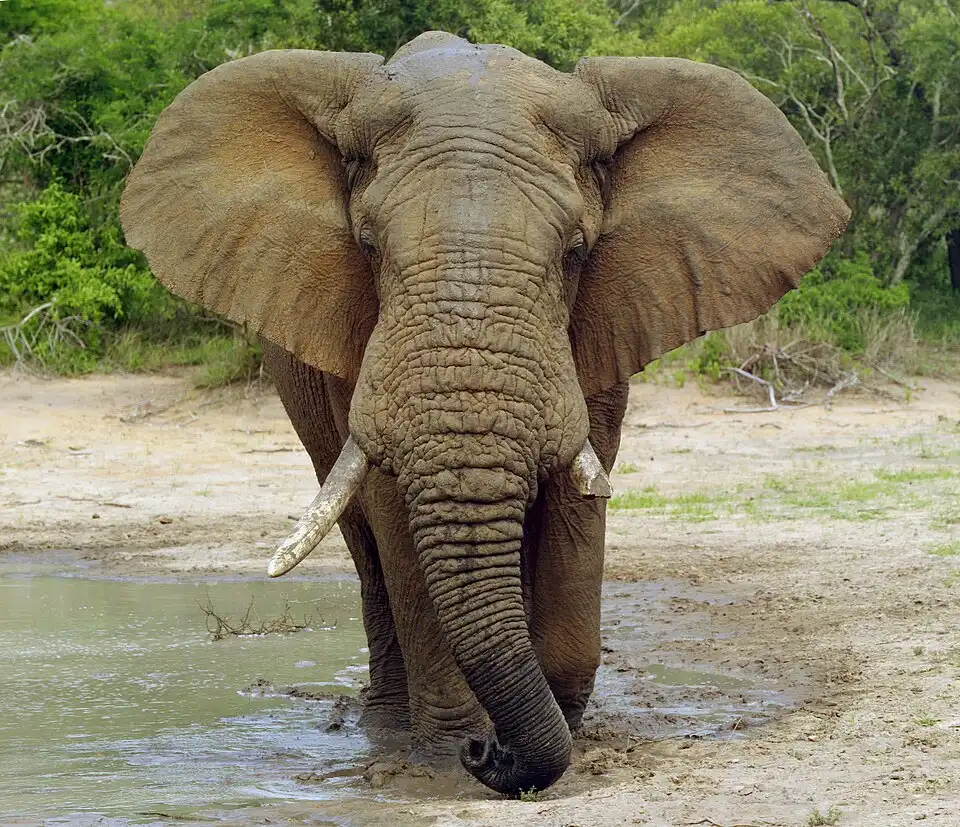
The African elephant is the largest living land animal.
A full-grown male weighs around six tons, and despite its massive build, it is said to be capable of charging at speeds approaching forty kilometers per hour when it senses a threat.
These creatures uproot trees, tear up the earth, and create paths and waterholes that reshape the surrounding environment itself. They are, quite literally, walking tanks—living heavy machinery.
Today, however, the African elephant is classified as an endangered species due to poaching for ivory and habitat loss.