
A Day in Arti (3)
When the next day came, I proudly showed the blade to everyone around me.
Maybe it was because my body was still young, but I couldn't help reacting so naturally.
And that reaction was explosive.
"Pretty Eyes! I'll give you this—teach me how to make it!"
A thick hand hauled in a pile of various stones and well-crafted tools. I sighed and pointed behind me.
There, a mountain of goods was already piled high.
The most common items were hides and cords—things of high value. Whole fish, meat, fruit—food enough to fill a basket—were spread out alongside them.
All of it was payment for teaching the art of the stone knife.
I hadn't asked for any of it. But the people who'd watched me use the stone knife to dismember animals more easily than anyone else had brought these things of their own accord.
"Put those over there. I'll teach you how soon enough."
I had no intention of monopolizing it. Monopolizing something would bring me no benefit, and in an age where I had no personal possessions—let alone a permanent home—hoarding wealth would only attract rats.
Still, I didn't refuse what was offered. Food was one thing, but the other items would be useful to have.
Hides could be made into clothing or shelter against the cold of night. Cords were never a bad thing to have plenty of.
Beyond those, there were good-quality stones and food as well, but I planned to share those with the people learning from me.
The thick hand hummed happily, dumped the stones among the goods, and then vanished. I let out a quiet sigh.
'I didn't expect a single stone knife to provoke such a response…'
It looked as though every Homo erectus in the vicinity had gathered just to learn how to make this blade.
"…Hey."
Someone tapped my back. When I turned, a stranger stood there.
His height wasn't much different from mine—a child's stature.
But his face was unmistakably different.
The first thing that caught my eye were the wide cheekbones that flared out on both sides of his face. His zygomatic arches spread wide laterally, making his entire face look compressed from front to back rather than elongated. Below that, his jaw was unusually thick and solid, and the area around his mouth was short but heavy.
His eyes weren't small, but they appeared deep, buried between his heavy brow ridges and the prominent bones of his face. His broad, low nose had almost no bridge to speak of, and his nostrils were plainly visible from the front.
His skull looked less round and more flattened on top, with a faint ridge visible near his crown.
It was a face built for crushing. The kind of face that could pulverize hard roots or chew through tough grass stems without flinching.
I swallowed hard the moment I saw that face.
'…Paranthropus boisei'?
Standing in the middle of a Homo erectus group was an entirely different lineage of hominin.
The facial reconstruction I'd seen in museums was now alive, looking up at me.
In his hand was a bundle—looks like tough leaves rolled into a sheath.
"We also want to learn. How to make that thing."
His speech was halting, but understandable enough.
It was probably due to the difference in oral structures between our species.
Inside the bundle he offered were hard seeds, packed tightly together.
Given that they were large-jawed, powerful-jawed hominins who likely subsisted mainly on nuts and wild grains, these were probably part of his food supply.
"This is delicious. So teach us how to make tools."
Before I knew it, I was nodding.
It felt like the scale of things was growing by the moment.
Half a day passed before something resembling instruction was finished.
I call it "resembling" for a simple reason.
I was supposed to be the one teaching, but at some point I felt less like a teacher and more like a spectator.
These people weren't complete novices with stone tools.
They knew how to knap stones, and they knew how to select sharp flakes from broken pieces. They could twist sinew into cordage or braid tough plant fibers into bindings.
What I taught them wasn't much.
How to trim one end of a stone longer and thinner so it fit snugly into a handle.
How to carve a groove in wood or bone so the blade wouldn't wiggle loose.
How to mix charcoal powder and soil into acacia tree sap to make adhesive.
But that small difference was apparently a big shock to them.
"It stuck! It doesn't come off!"
"It doesn't wobble!"
"My hands don't get cut!"
Excited exclamations burst out from everywhere.
Some gripped the stone knife and tried cutting dried meat, then immediately widened their eyes. It was clearly different from gripping a raw flake and sawing. Just having a handle changed the direction of the force, and there was far less worry about slicing fingers.
The moment they understood that, they didn't stop at copying the shape I'd shown them.
True to the survivors of this age, their rate of adaptation was staggering.
"Look at this! I made it longer!"
Someone shouted.
When I turned, a man was fitting a pointed stone flake into the end of a straight wooden shaft. The blade was still crude, and the binding wasn't perfect. But the shape was unmistakable.
A spear.
Not just a shaft hardened by fire, but a spear with a stone blade attached.
…That thing leaps ahead by hundreds of thousands of years.
As far as I remember, stone-tipped spears appeared around 500,000 years ago. This pushed the timeline back by at least a million years.
Some made handles too long, turning the knife into something more like a small hand axe. Others tried embedding the blade sideways, aiming to use it as a scraper.
They were still crude, broke often, and frequently ruined the adhesive before it set if handled carelessly.
But they were clearly learning.
By their standards, they were taking even my young words seriously and making them their own.
One person in particular caught my attention.
Well—person might not be the right word for him.
Regardless, it was the Paranthropus boisei who'd handed me the seed bundle earlier.
While most others were copying my stone knife—long and straight—this one was making a tool of a completely different shape.
What he'd made was hard to call a knife.
The edge was long, but the overall shape wasn't straight. It was crude overall, but one side was subtly hollowed inward, resembling the curved inner edge of a crescent moon.
His handle was shorter and thicker than the others', roughly shaped for a good grip.
I studied it closely and asked, "Is this… made for cutting grass?"
He nodded.
Then he grabbed a handful of tough grass stems nearby and pulled his tool through with force.
Snip.
The stems were cut clean through in a single stroke.
It didn't look very useful for thrusting straight or slicing thin things. But for gripping tough stems or leaves and pulling them taut to cut, it seemed quite serviceable.
A small sickle.
To be precise, it was too primitive and crude to call a sickle. But in terms of purpose, it was definitely closer to that.
I couldn't hide my admiration.
"Did you come up with this yourself?"
He glanced at me shyly, then scratched his head.
"I'm not good with my hands like you grassland people."
He spread his thick fingers for me to see.
They were definitely different from a Homo erectus hand—short, stubby fingers. They looked strong, but not well-suited for delicately shaping small stone blades.
"Straight knives are hard. They keep breaking. My hands keep hurting."
He showed me several failed stone flakes. Most were lopsided or had edges that didn't sit level. By Homo erectus standards, they were near-useless.
But he hadn't thrown those failures away.
He'd adapted the crooked edge to his own method.
"We don't eat much meat. We trade with you, or we only eat animals we find already dead. For us, this is better."
I was momentarily speechless.
Paranthropus boisei.
A hominin with massive molars and a powerful jaw.
In my memory, they had always been an "extinct species." A dead-end branch that never became the main line of humanity. Museum reconstructions. Skulls in papers. Small illustrations in textbooks.
And yet the one standing before me now was too vivid to be described by any of those words.
Paranthropus boisei were strongly herbivorous hominins.
They had evolved eating plants and hard-shelled nuts near swamps and forests, rather than on open grasslands.
Later, when the ice ages came and food disappeared, they would eventually go extinct. But even so, they demonstrated remarkably capable ingenuity for beings that were still human.
I had only taught them one thing—the stone knife.
And yet someone made a stone-tipped spear, someone made a scraper, and someone made something like a sickle.
I gave them a single piece of knowledge, and they were already arriving at different answers of their own.
They weren't stupid—they hadn't failed to advance for millions of years.
There simply weren't enough people for knowledge to accumulate, and they couldn't stay in one place long enough for the next generation to inherit their failures.
I scattered a small amount of knowledge among such people.
How much would that small knowledge change them?
As I watched that tool shaped like a sickle, a thought came to me naturally.
What if I taught them agriculture? Taught them how to raise livestock?
The idea had come out of nowhere, but after just a moment's thought, I understood why it wouldn't work.
The population was far too small for farming. The most numerous species in Arti right now was Homo erectus, and even we numbered fewer than a thousand. Adding all other species together, the total population here wouldn't reach ten thousand.
And even that number wasn't concentrated in one place.
They scattered after food, moved after water, migrated with the seasons. Farming requires staying in one spot.
But they wouldn't do that.
For them, nature was dangerous but gave everything freely. So they had no reason to change.
Or rather, if they gathered in large numbers, epidemics would surely wipe them out.
But change would certainly come. A million-year leap in technology couldn't fail to affect their lives.
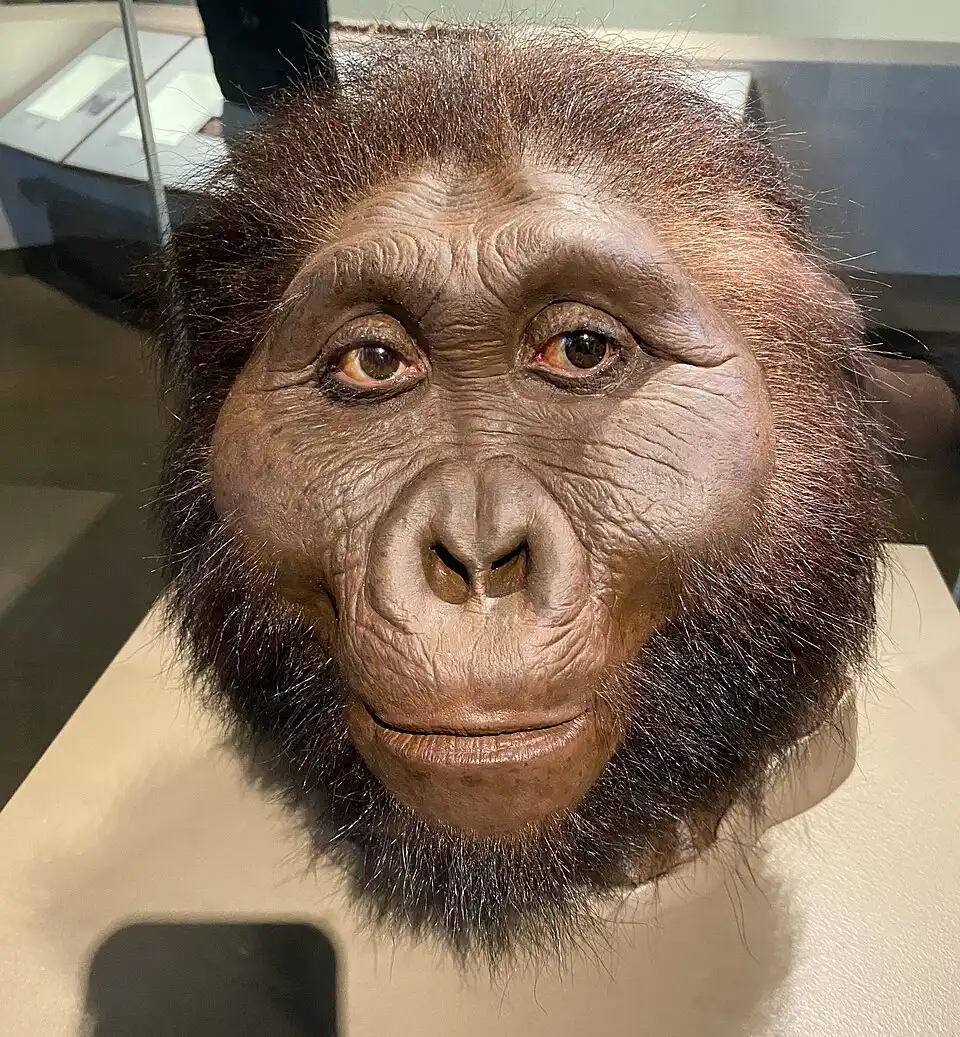
Known familiarly as the "Nutcracker Man," this hominin was probably not a strict herbivore, but is estimated to have relied heavily on plant resources.
Standing about 1 to 1.5 meters tall—smaller than the Homo erectus flourishing at the time—it exhibited marked sexual dimorphism with distinct differences in body size between males and females.
Its unusually robust jaw and teeth among the largest and widest known in any primate were well-suited for chewing tough grasses, roots, seeds, and hard fruits—allowing it to occupy a relatively unique ecological niche even amid food competition with other hominins.
However, recent dental microwear analysis suggests that rather than cracking hard foods like nuts, these hominins more likely subsisted primarily on coarse, fibrous plant resources such as seeds, grasses, sedges, and tubers.
Brain capacity was approximately 500cc—smaller than Homo erectus—but it would be difficult to definitively conclude that their intelligence was clearly inferior based on brain size alone.