
Are You My Father? (4)
“My… son…?”
Fast Foot seemed to ponder Mother’s words for a moment before nodding in acknowledgment not long after.
“Yeah, you’re my son!”
His reaction suggested it didn’t matter to him whether I was truly his biological child or not. Or maybe he just didn’t care enough to dwell on it. They did form pairs, but those bonds didn’t seem absolute or exclusive. By modern standards, it was pretty shocking, but for a people who lived scattered most of the time and only gathered during the dry season, such things probably didn’t raise an eyebrow.
He immediately started prodding me all over, then hoisted me up effortlessly. My body, barely scraping past 130 cm, felt light as a feather in his grip.
“Hm! Healthy!”
He nodded approvingly, set me down, and pointed to a tree in the distance.
“Run to that tree… What’s your name?”
“Pretty Eyes.”
“Right, Pretty Eyes. Give it a run.”
It felt like I was being tested, but there was no reason to refuse, so I followed his lead. First a few sprints, then hurling stones, even splitting one on the spot to fashion a crude tool. Once the tests wrapped up, Fast Foot bobbed his head vigorously.
“Hm! Just like my son! Excellent!”
From those words, I gleaned something telling.
…If I’d fallen short there, I’d have been disqualified as a son…?
No fixed pair bonds was one thing, but rejecting a child for not meeting standards? That hit harder.
Actually, lucky I’m not dead already.
Most animals that don’t pair off permanently and only mate during specific seasons commonly kill their own offspring to ensure their seed spreads effectively. At least their intelligence and semi-social nature spared us that horror.
“Come on! Family’s together—time to eat!”
Fast Foot—my father—boomed triumphantly and led us somewhere.
The spot Father took us to was the only patch in this muddy, grassy expanse utterly barren of even a single blade. From afar, it looked like a vast expanse of bare dirt. Up close, though, the reason became clear.
The ground was trampled endlessly, packed hard as rock. Elevated and dry, it had hardened into near-stone under relentless feet. Scattered everywhere: dried bloodstains, bone shards, charred remnants, animal fur—all mingled in the dirt.
A ton of people were there. “A ton” didn’t even cover it. At first, I thought it was just clusters of groups. But no—closer inspection revealed subtle differences in their builds. It was like everyone from the surrounding area had converged: folks of varying kinds bartering goods in small clusters, laughing and chattering. Some shared roasted meat while jabbering animatedly.
Like a market…?
Then something utterly alien caught my eye.
I first mistook it for a refuse heap—discarded tools and bones piled up. Wrong. Towering well beyond an adult male’s height, it was a mountain of stones: big and small, leaning into one another. Black ash and glowing red fissures peeked between them. The rocks were common granite-like stuff from around here, but all scorched black. Flames licked up from the entire mound.
Whoosh.
Each gust of wind sent tongues of fire surging from the cracks. No crackle of wood—just a deep, rumbling breath from the earth itself.
A mountain of blue fire, warping the air with its heat. People thrust meat or roots onto long sticks to roast, or lit bundles of wood to carry off.
As I stared, transfixed, Mother spoke.
“It’s been burning since time immemorial. Rain doesn’t snuff it. Wind doesn’t scatter it. Hunger doesn’t claim it.”
I looked back at the stone mound.
…Natural gas?
Probably a vent of seeping gas ignited somehow. The stones might be a barrier people piled to contain it or prevent spread. I recalled massive fields could burn for decades, even centuries once lit.
So this really exists.
I sniffed cautiously.
No gas smell.
The odor I knew was artificially added to household gas, so its absence made sense.
But the next instant—
“Ugh?!”
I pinched my nose, grimacing. Excrement, sweat, blood, charred meat, rot—overwhelming. Hygiene was millions of years off, so the stench blanketed everything. Mother and Father wrinkled their noses too.
“This is why I avoid this place.”
Father nodded in agreement.
“Yeah, stinks. Bad smell brings sickness. Pretty Eyes, hurry. We need fire.”
He grabbed my hand and pulled me toward the mound. His massive, unfamiliar grip felt awkward, but I didn’t yank away.
The heat intensified with every step, baking my skin. Mother bundled dry grass and twigs to a long pole’s end with leather straps nearby, then handed it to me and jerked her chin at the mound.
“Fetch the fire.”
That’s when it clicked: this was a rite of passage, a proof of belonging. Everyone around was watching me. Other kids my size gripped similar poles, staring at the mound. A ceremony.
Sharing the Eternal Fire—vital to survival—from the unquenchable source, accepted as kin, one of the group.
I swallowed hard, raised the pole high, and edged forward slowly. The heat stung my eyes up close. Blinking risked a fall—and worse—so I fixed on it minimally, approaching arm’s reach.
Thrusting it low seemed inefficient for such fierce flames anyway. No need to touch the fire directly. Positioning near a surging jet, radiant heat alone soon singed the grass black at the tip.
A bit longer.
No contact—pure heat—and flames erupted, birthing a long torch.
“!!”
The market din halted like a lie. Mid-bite on meat, mid-trade of stones, mid-cradling child—everyone stared.
At me.
Or rather, the torch in my hand.
Huh?
I froze. To me, it was obvious. Angling the pole—multiples of my height—over the mound instead of horizontal. Igniting dry grass with mere heat. Basic stuff.
Just that. A safer method.
But not to them.
A murmur rose.
“The fire…”
It spread.
“The fire went first.”
“The fire went to that child.”
“The fire reached out.”
“The fire chose.”
Instantly. Low buzz exploded into excited shouts.
“Whose child is that?”
“What’s his name?”
“Which group?”
“The fire chose him!”
The commotion swelled.
Something’s gone wrong…?
No, this wasn’t mystical. Radiant heat ignition. Campfire 101.
Then Father, equally thrilled, bellowed:
“My son!”
He pounded his chest, chest puffed.
“Me! Fast Foot and White Wind’s son!”
He strode up, clamped my shoulder hard.
“This boy! My son, Pretty Eyes!!”
Murmurs erupted.
Father nailed the finale:
“The fire chose Pretty Eyes!”
“Ooooooh!”
Cheers roared. Some drummed bones on ground, others thumped chests. Kids’ eyes sparkled in awe; adults eyed me strangely.
I glanced unconsciously at the torch’s blazing end. Orange flames from the blue source danced in the breeze.
…Ah.
I realized quietly.
In this life too.
Quiet living was off the table.
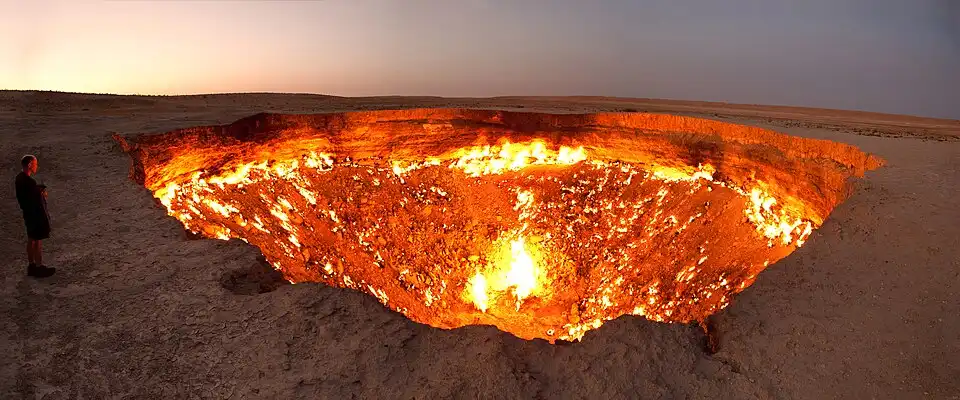
In the village of Darvaza in central Turkmenistan's Karakum Desert lies a massive fiery pit evoking the 'Gates of Hell.' This sinkhole, born of burning natural gas, has blazed untiringly for over 50 years. Vast gas fields like this can burn for centuries once ignited.
The burning stone mountain in the story shares this origin. A natural gas vent caught fire somehow, birthing an eternal flame. Witnessing the blaze, people hurled stones endlessly—perhaps to quench it or for ritual reasons—forming the fiery mound as it stands.