
Episode 2 - Are You My Father? (3)
Thanks to our diligent march, we reached the Unfading Land—Athi—in just three days. Vast grasslands stretched out against the backdrop of a massive mountain, fed by thick streams flowing down from its slopes. The river snaked across the plains, emptying into a enormous lake that spanned hundreds of meters at its widest. A breeze carried the fresh scent of grass mingled with damp mud. Animal tracks dotted the ground everywhere, and near the riverbanks, the air was thick with the mingled odors of hyenas, lions, and nameless herbivores.
But more striking than any of that was the sight that hit me first: countless others gathered by the water's edge. Some wove roofs from hides, leaves, and dry grass. Others lay in pit-like burrows they'd dug into the earth, while more huddled under the shade of low trees. Smoke rose high into the sky from amid their clusters.
“This... is Athi!!”
I couldn't close my mouth at the sight. I'd lived in the modern world; seeing people gathered together wasn't new to me. Honestly, the view of shaggy-furred folks covering only their privates with hides—or wandering around stark naked without a care—was a bit odd. But that wasn't what captured my gaze.
It was the diverse array of 'people' themselves, milling about the place.
They came in all shapes and sizes. Some looked like me and Mother. Others had massive jaws, short stature, and long arms. Some were exceptionally tall but gaunt. And though fewer in number, there were even those with thicker body hair and faces closer to apes.
It was a scene straight out of a gathering of countless human species.
Homo erectus!Paranthropus boisei! What are those two!? Lost high humans whose fossils didn't survive!? And the last ones—Homo habilis? They were still around!
Apparently, the soul of a paleoanthropologist still lingered in me. My heart pounded at the sight. Textbook phylogenies were always neat lines: one species emerges, another vanishes, another follows. But the real world wasn't lines. It was a web—coexisting, branching, going extinct, intertwining.
“Done gawking? Let's go.”
Mother, who'd watched me stare wide-eyed with evident pleasure, said it curtly and started walking.
From afar, they'd seemed somewhat mixed, but up close, I could see they clustered by kind. A few from other species mingled in here and there, but never more than one or two.
Mother led me to a group of our own kind. As we approached, a man perched on a rock, chipping at stone, waved welcomingly. His graying hair and fur, along with his deeply wrinkled face, spoke of his age.
“White Wind? It's been ages!”
“Strong Hand. Still alive?”
“Of course. I don't go down easy. But... who's that kid with you?”
“My child.”
Strong Hand's eyes widened at Mother's words.
“You birthed it alone?”
“Yes.”
“Tch. Most come back to the group to give birth. You're still so odd.”
“I can manage alone. That's why.”
Just as I thought. Mother was the weird one. I'd wondered if solo births were just the norm here, dangerous as they were even by modern standards—but no.
Strong Hand reached out toward me. I tensed slightly, but sensing no hostility, I stayed put. His callused hands kneaded my arms, shoulders, and legs a few times—like a hunter checking a beast's meat, or an elder examining a child's health.
“Sturdy. Takes after you. Who's the father?”
“Fast Foot. Probably.”
“Hmm. Probably right. He hung around you a lot.”
“Has Fast Foot come here?”
“Not yet. Soon, though.”
Mother nodded curtly at Strong Hand's words, then eyed the stone tools before him. His workmanship put mine to shame—blades uniform and straight, grips intentionally shaped for the hand.
“Hmm. This... for three roots.”
I flinched at Mother's bargaining. Trade! I'd thought it the exclusive domain of Homo sapiens, but here was Homo erectus doing it!
Astonishing, yet not really—smarter apes grasped the concept, and nature showed glimpses too. If my past life was like clever apes, this felt like a step closer to modern humans.
Strong Hand sniffed the roots, scraped their skins with a nail, then nodded.
“Good. Take it.”
“Good.”
And just like that, a handaxe and three roots changed hands. So natural it felt surreal.
Is this... a village?
I looked around. Fires, shelters, trade, each with their place. Speech was crude, clothes minimal, no laws or writing—but this was unmistakably a village form.
“Follow, Pretty Eyes.”
Mother tucked the new handaxe into her waist and spoke.
“Where to?”
“We have a home here too.”
She led me to a massive old tree. Hollowed by rot inside, it offered space enough to curl up in. Dry grass and leaves padded the floor; branches stuck into walls held hides and vines. Cleaner than expected—signs of regular use and care.
Mother unpacked there. I set down my small load beside her.
“This spot's been ours since my mother's mother. Remember it well.”
“Yeah.”
I scanned the hollow again. Mother's mother's spot—or older. The dusty traces of past dwellers suggested others respected it too.
...Yeah, they must have unspoken rules among themselves.
As I thought that, gazing at Mother, she was already prepping to head elsewhere.
“What now?”
“Hunt food. Follow.”
“Now!”
Thwack!
I thrust my spear hard, but the fish twisted mockingly free. A ripple spread, its silver tail vanishing into the distance.
“Ugh, way harder than I thought.”
In rivers, spearing upstream fish was easier. But the lake was still, and they dodged faster than my aim.
Stabbing's basically luck, huh?
As I crouched by the water, glaring at my spear tip, Mother chuckled lowly.
“Fish aren't the only food.”
She plunged her hand into the mud. Fingers stirred it. Moments later, a fat clam emerged.
“This is food too.”
“...How'd you find that?”
“It's here.”
So matter-of-fact. But how do you know it's 'here'?
She dipped in again, deeper this time—mud up to her wrist. Slowly probing... another. Then another. Clams surfaced like fruits from the earth.
I stared blankly, then tentatively sank my hand in. Cold slime oozed between fingers.
Feels like tidal flats...
Something hard snagged my fingertips. I gripped and yanked—a clam!
“Got one!”
I yelped despite myself; Mother nodded.
“Pretty Eyes, good.”
Such scenes dotted the lakeshore. Folks of all ages and kinds dug clams and speared fish, laughing joyfully. Hard to believe it was dry season—but that's why they'd converge here when true hardship hit.
Then, cheers erupted from afar.
“Uwaaaah!!!”
“Amazing!”
“Huge prey!!”
Amazement rang out, but no negativity.
“Hm? What? Something happening over there?”
I shook mud from my hands and turned. Mother tossed a clam into her basket and rose slowly, eyes on the commotion's heart. A strange spark lit her usually impassive gaze.
“He's here, I guess.”
Grabbing her basket, she looked down at me.
“Come, Pretty Eyes. Your father's arrived.”
Dozens approached from afar, dragging three massive wildebeest—spears in their throats—tethered by vines.
As all eyes fixed on them, their leader stepped forward from the front: taller than the rest by a head, Homo erectus like us. Spear in hand as a staff, he thrust both arms skyward and roared, strutting proudly.
“Uwoooooh!!!!”
The others echoed, arms raised.
“Uwaaaah!!!”
“Uwoooooh!!!!”
Savoring the cheers, he beckoned; his group dumped two wildebeest in our midst.
No strings attached—they shared huge kills freely, even with outsiders. Pure showmanship: proof of his iron grip on his band, and his prowess to claim more anytime.
“Long time, Fast Foot.”
The familiar voice calling his name turned his head.
“Oh! Long time, White Wind! But that little one beside you...?”
The great hunter's eyes landed on me next to Mother. Her voice stayed flat, expressionless.
“My child. And probably yours.”
“......?”
I've felt it since earlier. Man, how to put it—Mother drops bombs like it's nothing. Is this just default for folks here...?
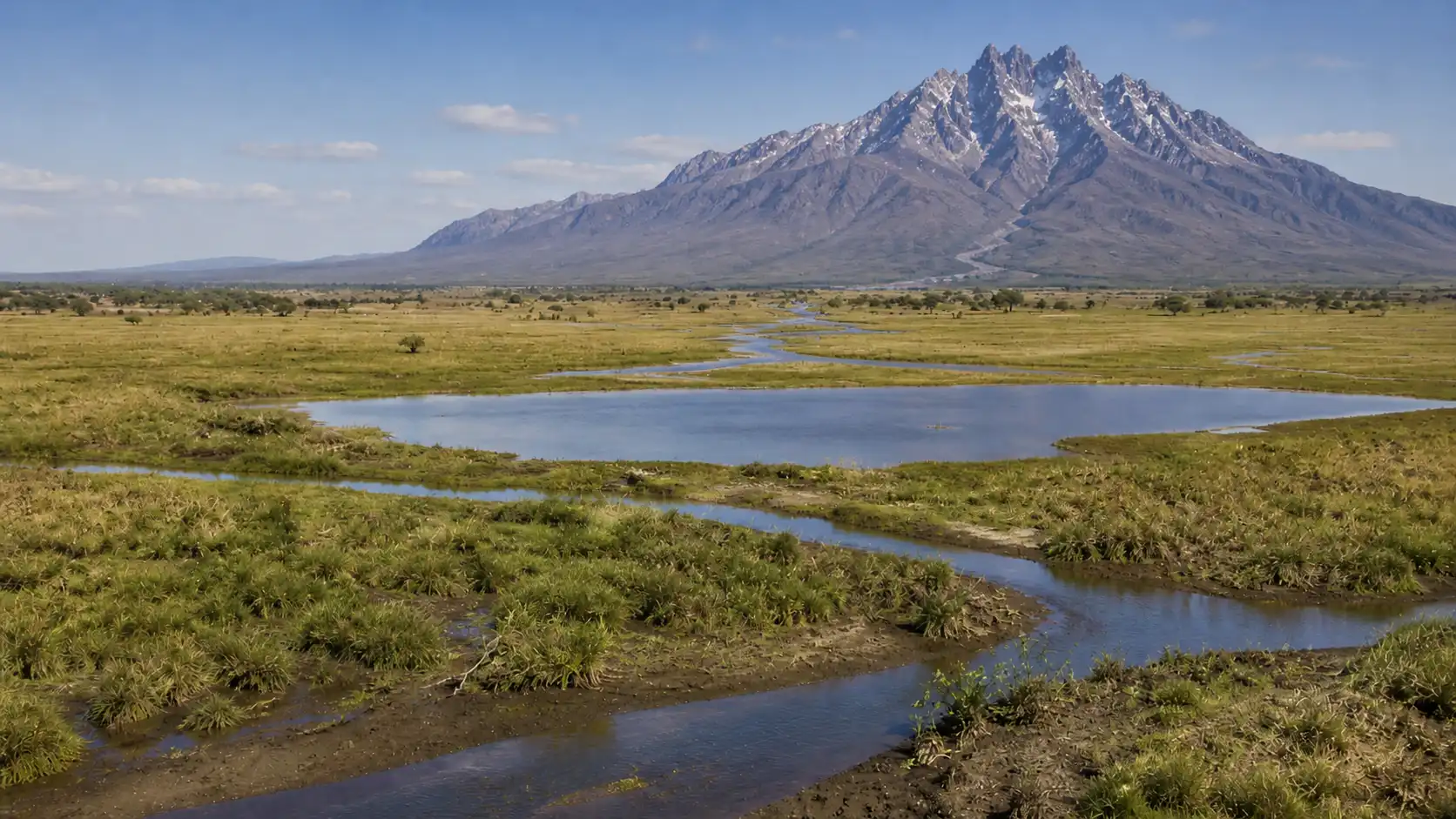
Floodplains are the cradle of civilization. They flood during rains—a drawback—but each deluge carries nutrient-rich silt from upstream, flushing excess salts and buildup from the soil.
That's why the world's great granaries sit on floodplains, prized as vital territories.
But they're not just valuable to settled folk. These water-abundant lands rarely dry fully even in drought, offering fertile soil and ample water—ideal for wild plants too.
Lush grass and plentiful water draw all life, making them prime hunting grounds.
Thus, in the story, even without civilization, early humans gathered here for survival, opting for uneasy coexistence. Homo erectus—master hunters and foragers—couldn't ignore such bounty.