
263. Crescent Moon, Cross, and Pure White Bones.
The 9th century and the 21st century.
Even a simple subtraction yielded a difference of twelve centuries. A century being one hundred years, that meant a gap of 1,200 years. Of course, that was still shorter than the span from the building of the pyramids to Cleopatra. But in any case, I had departed alone from some point in that impossibly distant time.
Yet the funny thing was that the way humans lived did not differ by 1,200 years. Perhaps that merely meant my sense of kinship with these Northmen had grown that strong, or perhaps there was some resemblance between the Northmen and the Koreans who had been my 21st-century identity that made me feel that way.
So what was alike? Did 21st-century South Korea, like the 9th-century North Sea, have a pirate king under its command, or was it overflowing with such a spirit of adventure that it staked its life to launch ships into that sea?
Naturally, much was different. First, skin color differed, hair and eye color differed somewhat. The experiences and ways of life from birth to death also differed enormously.
Yet they shared a common trait of diligence. And that was a very important part of a group's character. To be fair, in this harsh 9th-century world, one could not help but be diligent simply to eat and survive. But the Northmen's diligence was somewhat different in character from that of the people of the warmer southern countries.
Even now, the North Sea people were gradually and earnestly falling into the taste of the three great pillars—farming, fishing, and herding—where the returns were becoming reliably clear, but still my people did not hesitate to throw themselves into dangerous work that could not guarantee their lives, such as setting out to sea or joining the North Sea army.
Had not 21st-century South Korea been the same? Everyone was busy trying to eat and survive, and though it was far safer than the 9th century, men still went to the army without any guarantee they would return whole in body.
Perhaps such commonalities originated from the fundamental problem that the true homeland of the North Sea, Scandinavia, and the Korean Peninsula alike were entirely mountainous, with scarce usable land.
No.
In truth, such delusions might simply be thoughts stirred up by my unconscious mind, still longing for my homeland. But today, at least, I could not cast aside such futile thoughts.
Fylkirland. It was the name gloriously bestowed when the brave adventurer Flóki discovered a new island and dedicated it to me. Already all of Britain, as well as all of Árós, was astir with this astonishing news. And this news would cross the Baltic Sea, reach Novgorod, Polotsk, and Kiev beyond, and Rome, and touch the world beyond that as well.
A new land in the west.
And I knew this land's other name. Iceland. A land famous for its hot springs, as it seethed with blazing volcanoes despite being covered in ice. I, who had once been absorbed in an AOS game, remembered this place as where Worlds had been held. That a tournament of such scale had been held there meant it was a land fit for people to live in.
Though I paid deepest homage to Flóki and his crew for this staggering discovery, the reason my mind was now in a sort of floating haze was actually because of the land that lay beyond Iceland.
If I did not know it, I would not know it—but I already knew that America lay beyond it. I had only ever heard in my former life that America was large, and did not truly know how large it was, in truth. Beyond America lay the homeland of my soul. Beyond the long Japanese archipelago lay the Korean Peninsula.
I knew well that I could not go right now. In places like Scandinavia and Siberia, humans clung tenaciously to life—how much less likely was it that America stood empty? I also knew well that the moment I set foot in America, all manner of problems would come crashing down upon me.
But once I began to be conscious of it, I truly wished to set eyes on it at least once. The Korean Peninsula. The place where I had lived for nearly thirty years, after all. Though, considering the passage of 1,200 years, it would be more accurate to see it as an entirely different world.
How wonderful would it be if I could set eyes on it just once, someday, before I drew my final breath?
I knew well that according to the Julian calendar brought in from Rome, it was now 869 years after the birth of Jesus (A.D. Anno Domini). Still, would there not be even a single crooked pine tree remaining on that land? If I went to that land, would I not still let out a remark that the place was full of nothing but mountains, large and small, filling it on every side?
Such useless thoughts chained together endlessly, disturbing my mind.
[Ssegeun-ssegeun-sseok-sseok-]
And soon, Sigmarr's even breathing returned my mind to reality.
I moved my rock-like body as carefully as possible and approached Sigmarr's bedside like a cat. I sensed two cats in the vicinity raise their heads, but upon confirming that the identity of the ninja who had infiltrated the little human's bed at dawn was me, they lowered their heads again.
[Pushu-sseok-sseok-pushush-]
On that cute, lovely face, little round droplets of snot were strung like beads. That meant he was healthy, right? No one would believe me if I said even his snot was cute, but truly, even my son's sleep crust was endearing. Though his boogers and excrement were not endearing, but in any case.
Breathing in that lovely breath and lovely scent allowed me to bring my far-flung thoughts and the emotion of sinking into loneliness back up to the surface of reality.
I was Helgi Ragnarsson, a man of the North Sea, and the Fylkir of the North Sea Empire which I had built with my own hands. This child was Sigmarr, the son of myself and Inga, and soon a second child would come into this world.
Therefore, I would faithfully fulfill the duties of a father and Fylkir again today. With such thoughts, roughly tidying up my dawn Instagram-ready sentimentality, I took in the sight of Sigmarr's face smiling brightly in his dreams—delighted by who-knew-what—and quietly stepped out of the room. If I touched him for no good reason and woke him, the wet nurse, Inga, or the Huscarls would be the ones to deal with the aftermath.
Was winter already approaching? The dawn was unusually cold today. It was a day that made me crave a cup of coffee.
*****
[Jurureuk-]
"Huh?"
Oh dear, a nosebleed.
Refil dripped blood from his nose.
Cautiously lifting the blanket which skilled womenfolk had patched and trimmed here and there with wool and bird down, Refil rose from the bed as swiftly as he could.
[Kkigeuk-]
The sturdy wooden frame complained timidly at the thrashing about in the early dawn, but fortunately, the breathing of the woman lying on the bed remained undisturbed.
That was a relief.
Heh heh.
The sight of one's new bride, one that lifted the spirits just to behold. Refil felt as though he possessed everything in the world, and his junior again vehemently insisted upon its surging vitality, but—
[Jureuk- jureureuk-]
The nosebleed, spurred on by the blood rushing to his head, commanded Refil to move in haste.
Damn it.
As Refil hurried to where the water was drawn, the sweet days past, as if from a dream, surfaced in his mind. The wedding ceremony he could scarcely remember, and the first wedding night that had burned hotter than the wound on Örn's forearm where the blade had grazed him. And the next day, the merciless knocking of the little brats upon the newlyweds' door, after Refil and his wife had collapsed from exhaustion.
Over the roughly ten days of their honeymoon that followed, Refil fell ever deeper for his wife, and he was able to feel clearly the emotion of love, which until then he had known only in his head.
What did it feel like, this losing of emotion? Was the reason Father and my little uncle Ivar never remarried because they had loved Mother and my little aunt too deeply?
I had used the excuse of being busy and failed to even send parchment letters to Father all this while. Now, for the first time in a long while, I had private reason to lift a quill pen.
With such thoughts, Refil dipped a small bowl into the great water jar, then carefully wiped his nose clean.
The blood soon stopped, and so too did the thoughts that had been slinking back toward the business of Norrland.
"Refil. My husband. I still need your warmth."
The sweet fragrance of brown hair draped itself beside Refil's face, and a soft body pressed against his bare back in kind.
His wife, who had wrapped herself in furs against the chill, now spread a great fur over both her own body and Refil's.
What did it matter if the fur got a little wet?
The blood flowing upward had stopped, but the blood rushing downward surged all the stronger. Refil immediately turned, lifted his wife into his arms, and hurried his steps toward the bed where warmth still overflowed.
Whether the leaves withered or burst with life, the passion between Refil and his wife seemed as if it would blaze on forever in their own private world. Yet all things in this world must come to an end.
After a stretch of time so intense it felt as though steel pillars might melt, Refil at last strapped on armor that felt strangely unfamiliar and made his way toward Fylkir's Hill.
The expedition that had been away for nearly a year—Jarl Ivar and Stórolf had returned.
*****
[Swoosh— surururu— swoooosh— surururu—]
[Kee-ruk kee-ruk kee-ruk-ke-ruk— kaaak!]
The ceaseless sound of waves rolling in, the cries of gulls that had not flown south to escape the creeping winter, and even the calls of ravens—creatures of boundless cunning who also possessed considerable expertise in bloody territorial disputes.
As ever, the shores of Árós unfolded in a grand chaos woven not only of men but of nature and beasts alike.
[Bwoooooooong—!]
"Look! A ship is coming in!"
"Ivar hinn Beinlausi! The Boneless returns!"
"Ivar! Ivar!"
In the 9th century, where no entertainers existed, the place of fresh-faced, lively idols was naturally filled by the grim likes of Konungrs and Jarls—the lords of the land.
Explaining a nation's sphere of influence by likening it to an idol fandom certainly came with many difficulties and discrepancies. Yet in broad strokes, the comparison was rather plausible: supporting one's favorite idol (through taxes and corvée labor), fighting against the fandoms of other idols who insulted one's own, or whom one's own idol had insulted (through military service).
Of course, thanks to the absolute idol who had conquered all the idol world—Helgi Ragnarsson himself—no more internecine strife persisted. Still, my brothers, whether they knew it or not, each possessed a considerable following.
If I were to diagram it, it felt like a great circle with Helgi Ragnarsson as the common denominator, each of us carving out a small slice of the pie within it?
In the North Sea, we commonly called this 'honor.' The worth of this intangible asset could be said to far outweigh the concrete value of silver and land.
The North Sea people valued silver highly, yet honor was a thing valued even more.
Treating guests well, refusing to retreat in battle, striving to serve under a righteous lord—all of these were matters bound up in honor. In some respects, honor was a concept nearly synonymous with face.
For being acknowledged by others was a thing of true importance to humans, social creatures that we are. And this truth remained unchanged even in the distant future.
"Árós—! I have returned! Yaa-ha-ha-ha—!"
"Waaaaah! Fylkir! Father! Refil! I have missed you all so!"
Beside the dragon-head prow that surged forward boldly, two familiar faces appeared. One, of course, was Ivar approaching with the laughter of a conquering king; the other was Stórolf, his eyes welling with tears.
Oh dear, Stórolf. If I were you, I suspect I would not be quite so unreservedly joyful.
For among those who had come to the docks to greet you stood your father, snorting out fierce puffs of breath, and awaiting you were three betrothed wives who had waited only for your marriage, along with two sons and a daughter.
And for Ivar, too, this was no moment for unbridled delight—for my stepmother Áslaug stood behind me. Though her lips were indeed shaping a hohoho laugh, the energy she emanated... it was the very same aura she had radiated in the old days, when she had seized Sigurd as though catching a mouse.
Unable to bear that tingling, chilling pressure, I discreetly sidestepped out of the way—and only then, as if Áslaug had at last entered his vision, did Ivar's laughing face freeze just as it was.
"..."
"Waaaaah! The North Sea! Árós! My home! Brothers! Raise your voices in song! Let us offer due reverence to our ruler! Fylkir! Fylkir!"
[Bwoooooooong—!]
[Yaaaaaa! Fylkir! Helgi Ragnarsson! Fylkir! — — —]
Along with the thunderous blast of the horn, a roar resounded across all of Árós.
Yet to my ears, the sound felt almost like a funeral dirge honoring the dead.
My eldest brother Björn, standing beside my stepmother, had visibly shed weight. Ivar, who was already called the Boneless—might he not end up a mummy altogether?
And Stórolf—the father consumed by fury was trouble enough, but three wives and three children...
I could help him out financially, but the rest was entirely yours to bear, Stórolf.
"Fylkir!! Fylkir!!"
I found myself quietly turning my gaze away from Stórolf's face as he shouted 'Fylkir' at the top of his lungs.
But the news that Ivar and Stórolf had brought back from that distant capital of the Khazar Khaganate—that I could not turn away from.
☆☆☆☆☆Reference Material☆☆☆☆☆
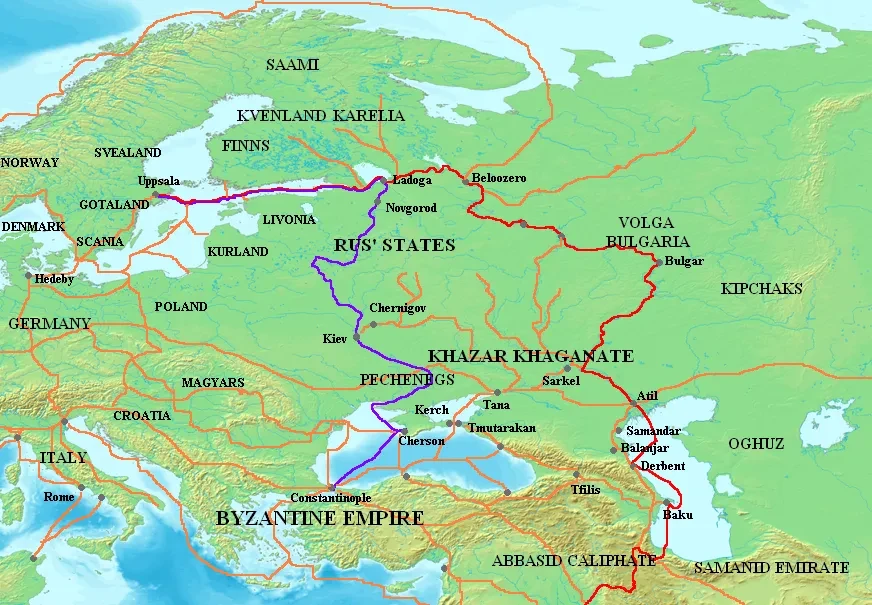
Briangotts, CC BY-SA 3.0 <http://creativecommons.org/licenses/by-sa/3.0/>, via Wikimedia Commons
Viking trade routes—a second look.
I can see Attila right there, just above the Caspian Sea beneath Örn...! Below that, the Abbasids and the Samanids of Persia lolol
There are many theories as to why the Khazar Khaganate converted to Judaism... but the most compelling explanation seems to be that they sought to balance themselves between the Cross to the west and the Crescent to the east...
Quite the fascinating state, isn't it...! A nomadic empire that once commanded not only the Pechenegs and Cumans but even the Magyars at one point. And Judaism. This corner of the world was probably far more flexible and far more brutal than we tend to imagine...! At this time, the Jews of the Khazar Khaganate were apparently in contact with Jews in al-Andalus and the Rus, as well as those in Syria, the Eastern Roman Empire, and the Caucasus Mountains...!
But in truth, Jews were a minority even within the Khazar Khaganate, and since the bulk of the population were nomads, it's also reasonable to assume that many of the various Jewish rituals weren't actually strictly observed...!