
237. White Branch, White Crow (3).
It was the season when the pure white ice atop the high mountains melted. At a glance, the valley flowed vigorously, gleaming like an emerald, and clouds, wind, the currents of the sea, and time flowed without pause, ceaselessly driving the world of men forward.
Joy and sorrow, too, eventually grew distant before time.
The feasting and laughter, the songs and mourning that had seemed as if they would last forever came to an end in less than ten days.
First, Ubba, who had told my stepmother Áslaug and me that he would arrange a marriage for me with a noble house of Mercia and then departed ahead of us, and later, Oleg, who arrived belatedly and held a separate triumph with my permission, left for Liubice; Rurik for Novgorod; Haskuldr for Kiyiu.
Björn and Björn's eldest son Erik, who was steadily becoming a master of administration, moved together to Rouen Fortress. Hamburg was placed under Sigurdeu, who would govern the northern Saxon region together with Halfdan directly above, and Harald, who had seized Verden below.
Roskilde, which Sigurdeu had previously ruled, had effectively become a satellite city of the ever-expanding Árós, so no separate ruler was needed.
The lords of the North Sea, having finished their rewards, promotions, and internal reorganizations under the pretext of the feast, bade me farewell and boarded their ships, departing for their own domains.
Since practical power was paramount for holding occupied territory, the two commanders leading the standing army of Norrland, Refil and Stórolf, naturally grew busy as well. Although they had not yet reached the shocking level of the Eastern Roman Empire's ten thousand elite heavy cavalry, the task of dispatching heavy infantry—which was gradually exceeding twenty thousand and approaching thirty thousand—to every corner of the North Sea fell to these two men.
According to my orders, men had to be sent to the relay stations built at every rapid point along the Dnieper River, and the Garmr Brotherhood naturally had to be dispatched not only to northern Saxony, which was quite familiar to the Jutes, but also to the newly occupied area around Rouen, which had been named Suðurland—South Land.
When the Konungrs and Jarls celebrated their triumphs, the rotation of the warriors who had remained in those regions had to be considered, and coordination was needed with Ubba, Sigebryht, and Ecgberht on the island of Britain.
On top of that, Refil, who had to marry as well, was busy enough to want to bite his tongue and die, but he would not be lonely with Stórolf at his side. Besides, Hrolf seemed to be helping him without drawing notice, so it would be fine.
In the midst of most of the problems being settled(?), this body seated as Fylkir of the North Sea also had plenty to do.
I had to spend time with Sigmarr, who always came running to me when he saw me, and I had to spend time with Inga, who seemed intent on filling every moment of my absence during the campaign. No matter how busy I was, family was the most important thing.
After that, the complicated matters gradually appeared before me one by one, as if they had been waiting.
Starting with reviewing the new script commissioned from Kyrillos, who now held the first rank of scholarship in the North Sea, the colossal task of collecting and organizing North Sea mythology that I had entrusted to Sigurdeu had to be passed to someone else, and the legal system, which had relied entirely on the pure memorization skills of the lawmen, had to be overturned as well.
Now that the North Sea was gradually taking on the appearance of a multicultural society, we could no longer forever solve all problems with local customary law, the honorable duels of warriors, and small pouches of silver secretly exchanged between sleeves.
There were too many unsettling aspects to pass this enormous task on to someone else.
From what I had experienced living in this 9th-century Europe, the things of the 21st century were not unconditionally superior to the present reality, nor did they always fit, but they could certainly serve as a kind of milestone toward which our North Sea should advance.
And the only person in this world who knew that direction, even if not perfectly, was me alone.
Thus, filling the great desk of my office, where pure white walls and pillars fluttered together with purple cloth and red cloth, were large tomes thick enough to be used as blunt weapons.
Corpus Juris Civilis.
The code of law established by the ancient Roman Emperor Justinian. This vast legal collection, comprised of roughly four parts, contained the thousand-year essence of the Roman Empire.
Yet there were many awkward points if it was to be applied directly to our North Sea. Moreover, the contents themselves were essentially techniques and justifications for making everything in the state an accessory for the emperor.
In addition to that, my desk was piled with documents organizing the slightly differing customary laws of each North Sea region; the Ecloga (eklogē, meaning 'selection'), which was the current law of the Eastern Roman Empire; the Farmers' Law; the Rhodian Sea Law; military law; and every kind of penalty.
The Eastern Roman legal team, which had arrived through my request via Damian and the emperor's active cooperation, became steadfast comrades in this hopeless journey, save for their strong Catholic coloring.
[seureuk- seureuk-]
"Traitors shall have their eyes plucked out and their manhood removed—"
"Look, this is not Rome but the North Sea. Leave the bit about the eyes, and instead of removing manhood, let's remove the head."
"Yes, that would be better!"
'Good? What's good about that, you sadistic Roman jurists.'
Perhaps because of the aftershock of the great rebellion of Basil only two years before, the punishments devised by the Roman legal scholars were chilling even by the standards of the North Sea, which would never lose out to anyone in brutality.
Anyway, I was thus working to create the most rational universal law possible, appropriately mediating between the sensibilities of the 9th century and the 21st century. Yet the deification of the Fylkir—that is, myself—the very source of all legitimacy and power in our empire, could not possibly be avoided.
Taking the immediate example of Kiyiu, at this feast I had subtly asked Haskuldr whether it wouldn't be better for him to move more independently and autonomously, as it was tiring and inefficient to come all the way to Árós every time for permission on an important decision.
This mad Jarl at once prostrated himself on the spot in a grand prostration one would only see in the Eastern Roman Empire, squeezed out forced tears, and put on a melodrama, asking how I could abandon them.
And then the chieftains of the Sámi and the Finns, who were watching for every opportunity to worm their way into the bosom of the North Sea, and the brothers Rurik and Oleg joined in and squeezed out forced tears—that spectacle was...
The reason all these people bowed their heads to the Fylkir of the North Sea and Árós was, ultimately, my physical and material power, decisively.
Thus, everything on the land and sea that had raised the flag of the North Sea had to be, in name, the property of the Fylkir.
I had no desire to reproduce on my own land the dazzling land-grabbing by those Frankish emperors (and their kin) and their subordinate lords across the sea. Nor was I interested in the folk sport of the Eastern Roman Empire, where co-emperors and powerful generals performed sword-dances every year.
If you wished to shelter from the wind and rain under the umbrella of the North Sea and myself, you must rightly offer everything to me. At times, even your lives. If you did not like it, then leave.
In the end, this would become the core of the law I established.
Looking back at human history and tracing the coming thousand-odd years of history in advance, there had never been an empire among those built by men that lasted forever. Like the cycle of seasons, or like life and death, everything that had a beginning had an end.
This empire called the North Sea was, when you thought about it, abnormal. For an empire of this scale to form, a tremendous amount of blood had to spill, yet my conquest process had not been like that.
Even Alexander had to squander his final years on countless revolts in his conquered lands, but the people of Britain and near the Dnieper River, who had newly entered the embrace of the North Sea, were now calling themselves North Sea people.
Would Suthrland (Normandy), deeply colored by Catholicism, and northern Saxony rise up in rebellion against me?
In any case, this abnormal empire was maintained solely because an abnormal person—myself—sat as its ruler.
If so, when the power of the blessing given to me weakened or disappeared in the generation of dear Sigmarr or his descendants, would people then still call themselves North Sea people and cling to the trouser-legs of the future Fylkir?
They would not. Therefore, I left room for that. If they did not wish it, let them leave.
Thus, the North Sea would hold a truly contradictory system: powerfully united under the name of the Fylkir, yet capable of leaving the empire according to the decisions of their own Thing (assembly) or Konungr or Jarl.
What I ultimately desired was not a mighty empire ruling the entire globe. What I truly wanted was for my family and descendants to survive, prosperously and happily, all the way to the distant 21st century and beyond, to a future I could not experience.
For that, I could let go of a giant empire without any lingering attachment.
If Lothar had resolved to burn the whole world for the sake of his son, I was someone who could let go of the whole world for my own son and family.
Of course, this was only my own thought. Sigmarr, whose teeth were just beginning to come in, or the descendants of this adorable fellow, might think differently. Problems I had not yet considered might spring up. In that case, I could simply change things again when the time came.
Nothing had been absolute except death; everything except death changed.
Wasn't that the phrase etched in the minds of those who followed the North Sea and Hel?
I was strong enough to split a huge boulder with my bare hands, but I was not absolute.
People called me a demigod, but I agreed that I was not a perfect, flawless god.
So, even if it was not perfect, I was going to do what I could.
So that my son and my family, and those who trusted and followed me, could live in an environment that was at least a little better. Even if it differed somewhat from the common sense of this world, I wanted to build them a sturdy branch from which they could soar high.
[seureuk- seureuk-]
"He who steals bread shall have a finger cut off for the weight of the bread—"
"Look, do you know the price of bread in the North Sea? I wonder why anyone would steal it, but the minds of criminals are hard to understand. Still, cutting off a finger for stealing one loaf is too harsh!"
"The law must be severe."
"The law has eyes too! If all judges were like you, the whole country would be filled with people without fingers and without heads!"
"You speak as soft as your protruding belly."
"What?"
"Enough! Enough! Where do you think you are! The Fylkir is present. Restrain yourselves!"
"Yes, Apo Hypatos (ἀπὸ ὑπάτων, apo hypatōn, former consul—by the 9th century in the Eastern Roman Empire it had become an honorary title)."
"I am ashamed."
As the tongues of the Roman ink-spillers, as sharp as the warriors' swords and spears, clawed and stabbed and wounded each other, an elderly scholar seated closest to my eagle—on the long rows of scholars flanking my great desk—glared with large eyes and mediated the quarrel.
This jurist from the Constantinople nobility named Theodoretos, though the title had become honorary, was still learned enough in law to receive the title of consul, and had been called by the emperor while training younger scholars in Constantinople and arrived here.
As a separate matter, the honorary rank Damian currently held was that of 'Emperor's Messenger' (βασιλικὸς μανδάτωρ, basilikos mandatōr), and though Damian himself complained to me that he was now a man with no power, the fact that every high-ranking Eastern Roman dignitary who stopped at Árós paid their respects to me and then immediately went looking for Damian's quarters suggested that this old fox still had his sharp fangs.
Anyway, amidst this peaceful atmosphere I picked up a parchment and had to ponder deeply the dispute over dolphin fishing and the ownership of its byproducts.
'This is ultimately a story of competition over fishing grounds among the fishermen of Britain, Scandinavia, and Suthrland. If each caught enough to live on, there'd be no complaints.'
Since legal matters were directly linked to tax matters, I would likely have to invite Mother, the High Priestess of the goddess Hel and the head of the Hel faith that was even now spreading across every corner of the North Sea, and Hrolf, the pinnacle of all North Sea administrators, to discuss them.
Something creaked and groaned, and the future was full of uncertainty, but the North Sea and I were clearly moving forward.
☆☆☆☆☆Reference Materials☆☆☆☆☆

Unknown, but surely dead since the text was published in 1583, Public domain, via Wikimedia Commons
Corpus Juris (or luris) Civilis.
It's a legal code also called the Body of Civil Law...!!!!!!
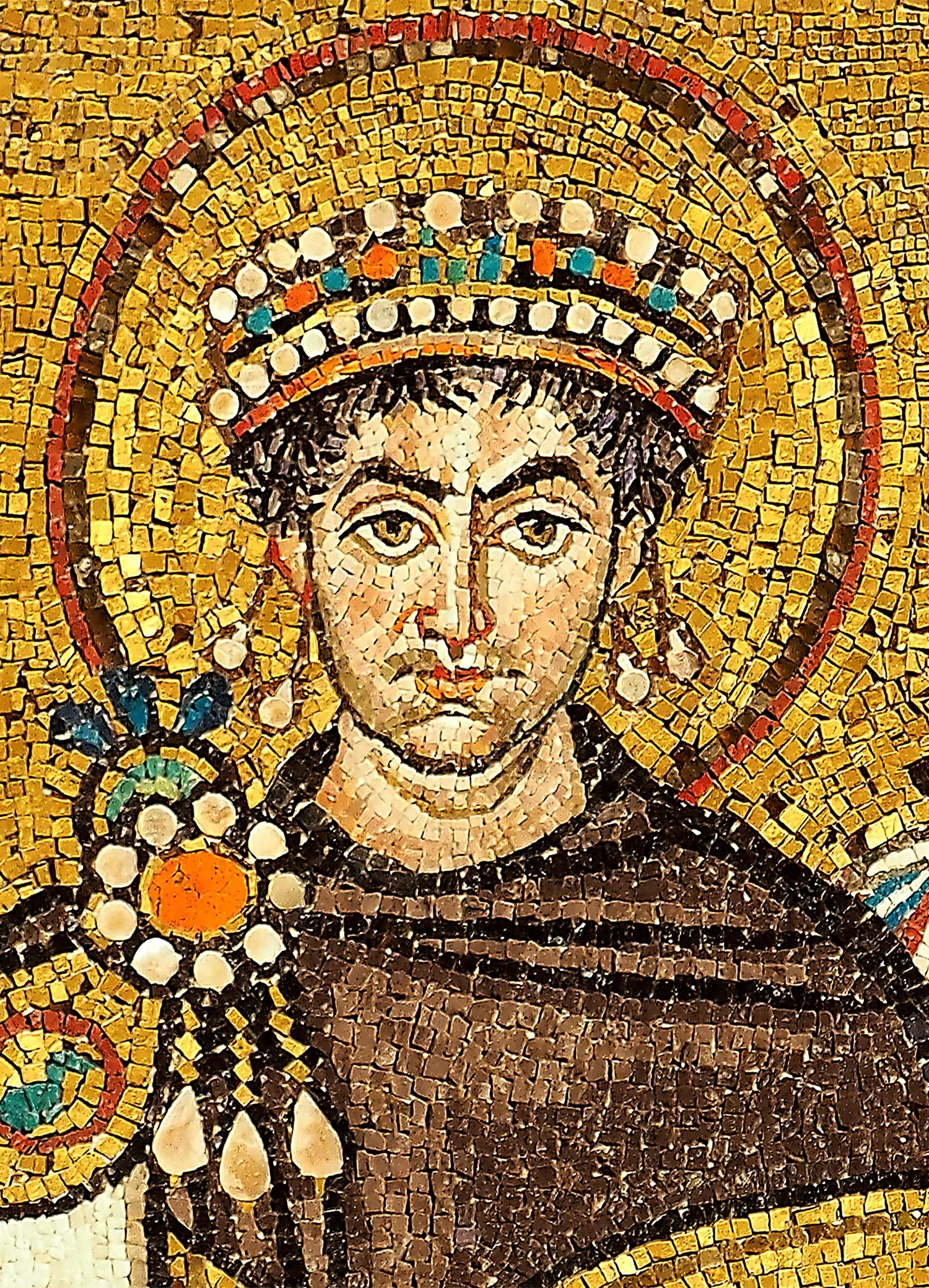
Petar Milošević, CC BY-SA 4.0 <https://creativecommons.org/licenses/by-sa/4.0>, via Wikimedia Commons
And the man who made it, Justinian. Justianus.
I know that Latin usually ends in ~us and Greek in ~os, though of course it's not absolute and depends. But up to Justinian, Latin was the empire's official language...
After Justinian, the Eastern Roman Empire gradually shifted to Greek, and by the 800s Greek was already mostly... Why am I telling you this?
Anyway
If we interpret it boldly and grandly, this legal code created by Justinian's order is the grandfather of all legal systems on Earth that have been influenced by modern Western law...
However, its content naturally differs from modern ones, and I understand that it's heavily mixed with justifications and reasons for the emperor Justinian, as well as religious perspectives.
But imitation is the mother of creation, so Helgi's high scholarship stat will make sure he puts it to good use lolol