
236. White Branch, White Crow (2).
Crete. Chandax.
Niketas Oryphas, the supreme commander of the Eastern Roman Empire, quietly gazed at the ranks of Muslims blocking the coastline.
Well-armed infantry had occupied the hill and, using ramps, looked down upon the imperial soldiers rapidly disembarking from their ships.
Soon, as expected, those turbaned pirates fired arrows to resist, but their numbers were not great.
Maintaining skilled archers had been no easy task, and above all, one could not obtain enough arrows on this island to stop the landing of a large army.
The proud sons of Rome raised the cross and eagle standards high, carrying out their duty without a single waver, and soon, along Crete's northern shore, a traditional Eastern Roman three-line formation began to stack up in orderly fashion.
[Bam-ba-bam-ba-bam—]
[Bwoooooong—!!]
On the flagship a little apart from the shore, Niketas, satisfied with the calm waves and mild weather, nodded to Nikephoros Phokas, the valiant soldier whom the emperor had his eye on.
Nikephoros, who had awaited only the admiral's signal, issued commands to the Scholai (the emperor's personal guard, the finest of the Eastern Roman elite) around him.
"We follow the plan! Once the vanguard pushes the enemy back and creates a space, we will approach at once and land!"
"Yes, droungarios (fleet commander)!"
The Eastern Roman Empire's bureaucratic and military organizations were as vast and complex as its long history, but what mattered here was that Nikephoros, who had assumed the position of fleet commander after Niketas himself—upon whom the emperor had personally bestowed the command of the Scholai and the post of supreme admiral of the imperial navy—was a far more outstanding soldier than Niketas had expected.
In the present Eastern Roman Empire, Emperor Mikhaíl's standing was no different from the famed emperors of old; because of the rebellion of the traitor Basil, even the high-nosed great lords of the east had sworn their loyalty once more, so strong was his power.
Of course, behind it was the incredible work of Örn Helgi Ragnarsson, the Fylkir of the great empire now called the North Sea—a rank roughly analogous to emperor, though difficult for Romans to grasp precisely—but in any case, the Eastern Roman Empire had now become stable to a degree rarely seen in recent times.
Furthermore, with the emergence of a powerful and overwhelming new alliance in the north, the Eastern Roman Empire was able to focus its strength upon a single point.
Niketas inwardly regretted that the Chandax expedition pushed forward three years ago when Lord Bardas was still alive had come to naught due to a disgraceful incident (assassination), but all the plans and intelligence regarding the enemy that had been prepared back then had survived intact.
In addition, Petronas of Cherson, at the apex of the Roman administrative system, once again demonstrated the statesmanlike skill he had shown with the Khazars, Magyars, and Bulgarians, drawing cooperation from the Frankish emperor in Italy.
'Augustus ImperaThor...? Emperor of all Romans? One should regard the Frank in Italy as having no intention of truly cooperating with us in the first place.'
How could those insolent titles be thrust upon the admiral of the Eastern Roman Empire, who was supposed to be an ally?
Because of such arrogance, the already unsettled feelings of the Eastern Romans—stirred by iconoclasm and the rivalry between the Pope of Rome and the Ecumenical Patriarch of Constantinople in Bulgaria and Moravia—were now turning outright hostile toward the Franks.
And the true Emperor of the Romans, Michael, naturally grew cold with anger, to the point where he ordered that all traditionally used Latin titles, salutations, and even words in official documents be changed to Greek.
The emperor who used to love drinking and chariot racing had changed after meeting the ruler of the North Sea.
Could he perhaps truly be, as the Patriarch had claimed, a figure sent by God for the sake of our Rome? A hero who should have been born a Roman, but by the mischief of Hel or the goddess Hera, was born in the north—a tragic hero.
In any case, after Helgi Ragnarsson departed, the emperor, who kept away from drink and racing, changed to the point where he devoted all his attention to state affairs except for time spent with his family.
As if he bore the weight of the already dead Bardas, Basil, and the mother whom the emperor had personally deposed on his back.
The will of a man who finally faced his duty astonished everyone around him, and Michael, truly reborn as an emperor worthy of a great empire, made plans with the era's outstanding generals—including Niketas—administrators, and the Patriarch.
That plan was precisely to eliminate the great scourge that had been gnawing at the empire's sea (the Aegean) for the past forty to fifty years: the threat of those turbaned pirates.
This beautiful island, originally ours, had already been turned into a forward base for all manner of pirates from Iberia, Egypt, and the Levant for half a century.
Yet now, all that wickedness was at an end.
[Bwoooooong—!!]
Through Niketas's musings came the sound of the Roman army's advance, having completed its formation. Not the lively sound of brass instruments, but the solemn, resounding call of horns.
After having taken the field alongside the Fylkir of the North Sea, the emperor, who had grown keenly interested in those valiant Northmen's ways, first adopted the Northmen's horns, and then recruited the Northmen warriors who came down along the trade routes on a large scale, eventually establishing a unit composed entirely of them called the Varangoi.
Look even now: the Northmen charging fiercely ahead did not fear death.
Rome's soldiers were the world's best, and Niketas's faith in his subordinates might impiously be greater than his reverence for the emperor, but even that Niketas sometimes felt a chill run down his spine from that blind charge.
[Valhalla! Fylkir!]
Their war cries, which reached even Niketas's flagship here at a considerable distance from the shore, had the power to make the blood of allies fighting behind them boil, and to make the eyes of the enemy before them tremble.
Shortly, the two colliding forces seesawed back and forth for a while, but soon the Muslims fell back before the mercilessly swinging axes, thrusting spears, and the capacity to push forward with innate physique and strength.
"Domestikos (commander of the Scholai, the position previously held by Basilikinos, now appointed as administrator of Cherson, meaning supreme commander of the emperor's personal guard—the Scholai)! They are routing! Give the order to advance!"
Nikephoros, who enjoyed the emperor's favor and whom Grand Admiral Niketas had singled out as his successor, and whom the Fylkir of the North Sea had early praised to the emperor as a man of spirit, shouted loudly as he pointed to the fierce battle raging on the coastal hill.
"Good. It is visible. The fleet will advance to the shore at once. Then we must disembark without delay and form a marching formation."
"Yes, Domestikos! Signalman! Hoist the advance signal!"
"Hoist the advance signal!"
"All hands to oars! Do not miss the signal!"
A faint smile appeared on Niketas's face at the sight of Nikephoros, who left the raised command bridge to run about on his own two feet and encourage the soldiers.
Word had it that he stood before the emperor's bedchamber with a handful of Scholai to block it when the traitor Basil launched his horrific attack, had he not?
'Just do that, Nikephoros. Before long, this position will be yours.'
As for rivals, there was the current lord of Cherson, the young Basilikinos, but that promising nobleman of Constantinople was now showing more interest in a bureaucratic career.
That Cappadocian soldier, busily running about on the wide ship, might achieve far more than he himself imagined.
[Bwoooong-!!! Flap! Flap!]
"Advance!"
"Row the oars!"
With the vigorously blaring horns, the dromon (Roman ship) cut through the waves and advanced.
Amid the bustling, shouting, sweating soldiers, the old soldier who had experienced all the bright and dark sides of Eastern Rome recalled the strategic objectives of this war he had discussed with the Emperor.
'Even though the Empire's food situation and finances are better than expected thanks to the unexpected bread and meat from the North Sea, the wounds left by Basil's rebellion are still deep.'
For a rebellion that entangled two or three Themes, the Fylkir had crushed it easily, but raising an army was no different from pouring silver coins and food into the sea.
Therefore, an operation requiring a long time was impossible. As the Muslim fortress of Chandax was famous for being impregnable, the Emperor and Niketas did not hope for much.
'Here, we will advance to Chandax and examine the terrain, walls, moat, surrounding villages, and all possible routes for their reinforcements.'
Then they would return here more thoroughly prepared.
So then, was this war meaningless?
It was not.
'Edmund of East Anglia.'
Although he had been defeated by the Fylkir, losing his homeland and rights and driven all the way to distant southern Italy, who could guarantee victory against that Fylkir?
Against a commander who shattered a Roman army entrenched on a hill with a single charge, the best course was simply not to fight at all.
Edmund, whom he had confirmed through Nikephoros, was wiser than expected, far humbler than those Frankish bastards in Italy, and possessed resolve.
'The imperial city of Syracuse still holds out on the island of Sicily. With the Pope, Benevento, and our support, Edmund and his Anglian warriors can certainly seize Calabria.'
The invasion of Crete was for that purpose: to draw the Muslims' attention. Even at this very moment, messengers from Chandax would be moving east, south, and west.
They always did.
But now the Empire was no longer divided, and it had even gained the distant yet powerful ally it truly needed. Not the arrogant Frankish bastards, but the dependable Northmen.
Starting with Calabria, they would link up with Syracuse to contain the Muslims in Sicily and beyond in Iberia. Then, ultimately, the enemies the Empire would have to face directly here in Crete were Egypt, the Levant, and the Abbasids beyond.
Soon the Empire would move in earnest.
Together with the Khazars, the Empire's old allies.
Of course, for now, as a Roman general, he merely focused on doing his utmost to capture Chandax.
The gradually nearing coast of Crete felt to Niketas like a good omen.
*****
"Allahu Akbar!"
"Allāhu allāh!"
"Yaaaaa!"
[Dudududududu-]
"Shields!"
"Raise shields!"
"Hold! For Saint Edmund! For our Cyning!"
"Do not give the heathens an inch of ground!"
"We have nowhere to retreat!"
"Uaaaaa!"
Southern Italy. The toe of the boot. Calabria.
To the north, the city of Reggio (Ρήγι), nestled against Italy's characteristic high and rugged mountains.
The largest remaining city of the Eastern Roman Empire on the Italian peninsula was elated to welcome its long-awaited imperial liberator, and Edmund's gaze, as he stood among the shield wall of warriors who were now like family, calmly staring at the Saracens, shone with cold resolve.
The second chance he had so desperately awaited was now placed in Edmund's own hands.
The Augustus Imperator of Italy had half-abandoned the siege of Bari and entered a power struggle with the lords of southern Italy, but Edmund himself had now taken up the sword on this very spot, with the support of the Pope, the Eastern Roman Emperor, and Benevento, to carve out a new home.
The very color of the sun was different from his longed-for homeland, and the perpetually bright weather here was so unlike the always damp and rainy home that he could never adapt to it, yet—
For his family and followers who had believed in him, unworthy as he was, and followed him to this distant land. For their sons and daughters, grandsons and granddaughters.
The Cyning of East Anglia had resolved to become the Rex of Calabria, and though those Saracens shouting "Ali" charged valiantly, they posed no threat to Edmund and his Anglian warriors.
Their weapons were sharp, their armor neat, and their spirit fierce, but—
You are not warriors of the Fylkir and the North Sea, are you?
"Warriors of the Angles! Not a single step backward!"
"For God! For Edmund!!"
[Bwooong- bwooong- bwooooooong-]
[Dudududu- Kwang! Kwakwang!]
"Aaaagh!"
[Pook! Seogeok! Kwak!]
"Keok!"
The clash with the Saracens who charged the moment the horns sounded.
After the initial shock passed, the Anglian warriors even smiled as they pressed the enemy back.
☆☆☆☆☆Reference Material☆☆☆☆☆
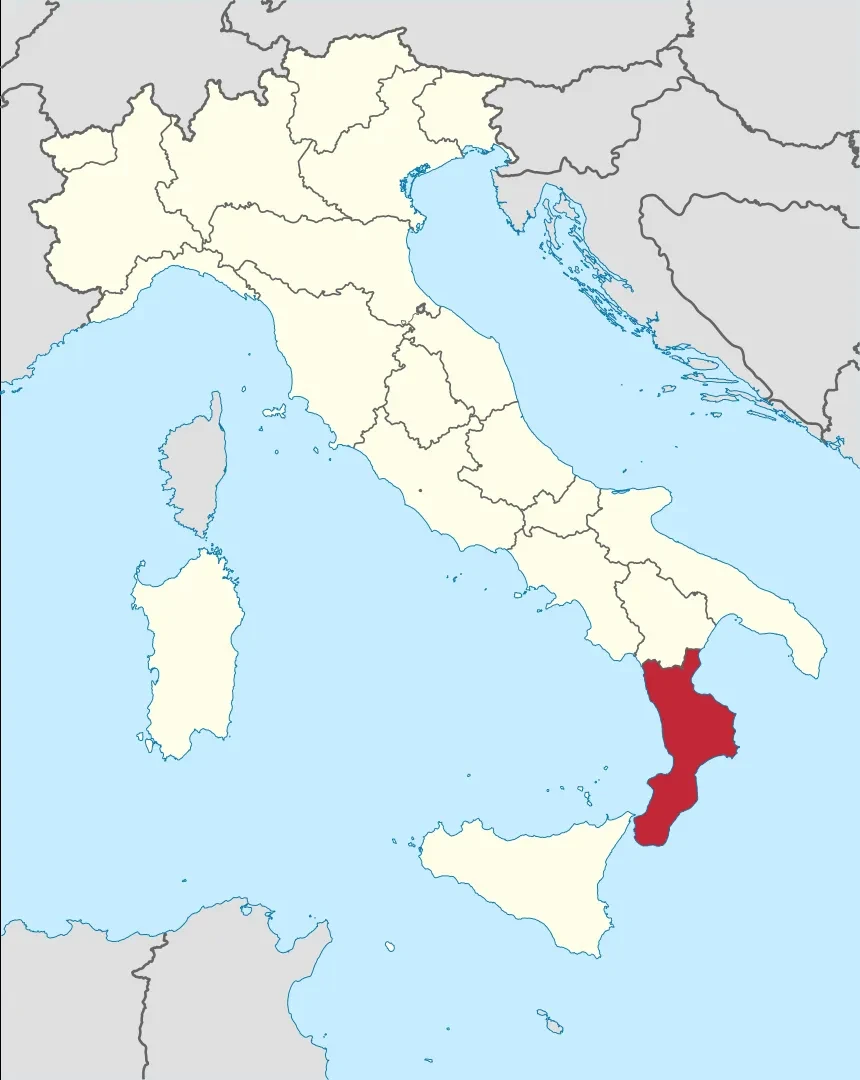
TUBS, CC BY-SA 3.0 <https://creativecommons.org/licenses/by-sa/3.0>, via Wikimedia Commons
Southern Italy, the toe of the boot. Calabria.
Right next to it, you can see the island of Sicily...! This truly is Calabria, the very headquarters of the Eastern Roman Empire's influence in southern Italy in the early Middle Ages...!
At this point in the story, just like the precarious Syracuse in southwestern Sicily, Eastern Roman rule is being shaken by Saracen invasions...!
The Muslim pirates based on the island of Crete to the east came swarming in from Iberia, Egypt, and the Levant—from east, west, and south—and they truly gnawed away at the Empire, Italy, nay...
the entire south of Europe...!!!!!!!
If the north had the Vikings, the south had the Saracen pirates...!!!!!!!
What an astonishing fact...!
Moreover, these legendary pirate groups even encountered each other...! If I have the chance later, I'll write about that meeting too lol
Anyway, the much-suffered Edmund is fighting for Calabria... Behind the scenes, all sorts of interests and conspiracies surrounding Italy are running rampant, but...
That's none of Edmund's business...!
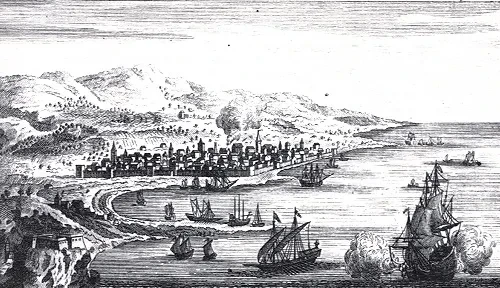
Wikimedia Commons, public domain. Reggio Calabria Incisione Regno di Napoli
The capital of Calabria, Reggio...!
Of course, this is an image from a slightly later period, but it was a quintessentially Greek-style city in southern Italy up until the 14th and 15th centuries, playing a key role in infusing southern Italy with Eastern Roman (Greek) culture...!!
This place is really important, and I'll get into it gradually later...!!