
216. People Dancing in the Meadow (2).
Alfred's low voice sounded like the great bell in a church bell tower.
Grant me permission— permission— permission—
A resonance that lingered in the ear like waves of sound spreading faintly.
In an instant, everyone inside the tent lost their words, and as they looked at each other's eyes, gauging reactions, I had no choice but to ask Alfred.
"What do you mean, grant permission to call me Bretwalda? What does that mean, Alfred Cyning?"
"It is as you heard. My father and elder brother were called the ruler of Britain, Bretwalda, by the Angles and Saxons on the island of Britain, but not now."
On Alfred's face, calmly choosing his next sentence, there was no trace of intrigue or scheming.
"No matter how much the Bishop of Kent voices his concerns, the power of the Fylkir, who seized Mercia, East Anglia, Northumbria, and beyond within a single year, will not vanish. And people have already begun to accept the rule of the Fylkir and Hel. They do not persecute those who believe in our God, and last winter, no one starved to death in the lands the Fylkir ruled. In some ways, it is only natural."
As if making a confession, Alfred continued to murmur the current situation of Britain in a low voice, his expression a mixture of half resignation and half hope, becoming unreadable.
"After losing Devon, Winchester had to endure a harsh winter. If the North Sea merchants had not come and gone, it is difficult to easily imagine how many more graves of Catholic brothers would have filled the cemeteries of Winchester. And so, I intend to bow my head to you, Bretwalda. Just as the Catholic faithful around the Holy Island of Northumbria are assimilating with the believers of Hel, Wessex wishes to remain Catholic yet become a part of the North Sea. I beseech you to grant this, Bretwalda."
I had once asked the bishop who governed the faith in that region when I entered Bamburgh in northern Northumbria.
Whether the coexistence of Catholics and Hel believers was possible.
That old bishop had not given a hasty answer, suspicious of my intentions, but apparently he had found his own answer and was proceeding.
Alfred had truly made a great resolve. Would the Pope of Rome or the Bishop of Kent ever tolerate bowing their heads and living under pagans? And what if the direction of faith or doctrine changed slightly in the midst of it? Would they not be branded heretics and excommunicated immediately?
'Interesting. Amusing.'
Mischief glimmered in my eyes as I took in Alfred's appearance.
I could guess a little of Alfred's inner circumstances. Seeing the North Sea attack West Frankia this time, Alfred must have agonized greatly.
Should he throw down the gamble of a lifetime? Or wait for a better chance?
But even as such a massive war was underway, seeing that the Northumbrian army, the core military force within Britain, did not move an inch, his head must have spun.
Just as Carolus of West Frankia had kept strength in reserve, the Fylkir of the North Sea was also holding power back!
Was that why he made this decision?
Perhaps all of this was a process for betrayal, or there might be other circumstances.
But I was confident.
"What is there to grant or not grant? Alfred Cyning. Bretwalda is an honored title of Britain that traces back to the distant past, so I shall accept it with a heavy heart."
In the blink of an eye, after weighing various thoughts in my head, I nodded and spoke, and Alfred once again bowed his head.
From the clasped forearms, I felt firm resolve and strength; I would watch this man's future with keen interest.
*****
Northern Italy. Pavia.
Since Charlemagne, the Frankish emperors each held legitimacy and authority. But if one were to quibble, the Imperator Augustus of Italy, Ludovicus II, could be said to be the most legitimate emperor.
Raised under his grandfather, Louis the Pious I, he naturally held the imperial title of Italy.
That lofty authority had acted as considerable pressure even on his father, Lothar I, and the one who ascended to the position of co-emperor from childhood was none other than Ludovicus II of Italy.
However, his uncles in East Frankia and West Frankia, like sly snakes, shifted their words this way and that, refusing to acknowledge Ludovicus's dominion.
"To my elder brother Ludovicus, Imperator Augustus of the Empire."
And so, now, perhaps Ludovicus gazed at the letter fluttering between his soft fingers with a satisfaction greater than anything.
Unlike his father or his two uncles, his younger brother Lothar had always followed him well, despite their ten-year age gap. This continued after their father's death, and when the youngest sibling of Provence sadly died at too early an age, had not Lothar, shut up in Aachen, fervently declared that Provence was Ludovicus's own?
In reaction, the unworthy uncle of West Frankia, holding a grudge, seized upon Lothar's divorce issue and manipulated the previous pope and bishops at his whim.
It was a truly shameless and low tactic, aiming at the coincidental fact that both Ludovicus himself and Lothar lacked a proper heir.
This weak younger brother, tormenting his pitiful wife, had finally received an answer that they would divorce by agreement, but what did that matter? When the Imperators of West Frankia and East Frankia did not agree?
Ludovicus himself had once raised troops and besieged Rome, where the pope resided, to aid his brother's divorce, but ultimately failed due to the obstinacy of the previous pope, who believed all emperors and their vassals should be in his grasp.
"The situation has become truly interesting. Has it not, Your Holiness Adrianus?"
At Ludovicus's words, filled with the unique ennui and authority of one who had possessed everything since birth, Adrianus, who had stood silently in holy vestments, nodded.
"Indeed, Imperator. The previous pope was harsh towards Lothar. The will of the married couple is firm, and the bishops of Lotharingia have agreed as well, so it makes no sense for the bishops of West Frankia and East Frankia to raise objections."
What the pope could gain from this were reinforcements from Lotharingia to attack the Saracens of Bari and the Saracens of Sicily who ran rampant in southern Italy. And the realization of the Eastern Roman Emperor's offer of cooperation, conveyed through the Ecumenical Patriarch of Constantinople.
What the Imperator Augustus of Italy could gain were reinforcements from Lotharingia, of course, but also the ability to check his uncles of West Frankia and East Frankia, while sweeping the Saracen raiders, those thorns in the eye, from southern Italy and consolidating the emperor's dominion over that region.
And above all.
Though Ludovicus himself still had no news of an heir and some time remained, the future was never certain.
'Was it Hugh? Lothar's child?'
"Once all this is finished, tell Lothar to come here with Hugh. Tell him I wish to see him. We brothers have not met for far too long, burdened by the duties of an emperor."
"I shall certainly convey that, Imperator Augustus."
"My heart is uneasy, as if I am dismissing one who has come such a long way without a grand welcoming ceremony, but Lothar's heart must be more urgent, so take heart, Bishop Günther."
The voice of the Frankish emperor was still filled with ennui and an unknowable power, and within those words, Günther, feeling that the chains of excommunication laid upon him were at last loosened, glanced at the pope with trembling eyes and then bowed his head.
"I have already been received with overflowing hospitality. I shall move with haste."
As he watched the retreating right-hand man of Lothar with a respectful manner, Ludovicus spoke lowly to his subordinate, who had stood like a solid rock throughout the audience.
"Inform the Eastern Roman naval commander that we are ready. And convey to Edmund Cyning that I seek his counsel regarding this campaign."
"Yes, Imperator Augustus."
Hearing the footsteps of his subordinate, moving like a shadow as much as his low voice, several of Ludovicus's next actions flickered through his mind and then vanished.
'My brother, who had been holed up only in Aachen, moving so boldly. What on earth did that fellow Lothar see in the ruler of the North Sea?'
Fortunately for Ludovicus, there was now one man in Italy who knew their Fylkir better than anyone.
*****
[Pfuruk! Pfuruk! Pfuruk!]
At first glance, like birds flying low, a line of mounted riders dashed across the green-filled plains.
The vigorous steps seemed to have no particular destination, and the warriors charging in disorder resembled something of uncontrollable wildness, yet all their gazes and steps were fixed upon one man dashing at the very front, a splendid feather ornament fluttering.
"Whoa— whoa—!"
The Magyar riders had been moving northward after lightly clashing with the East Frankish forces. With villages sparsely dotting the area, offering little to plunder, the rations each had brought were now reaching a precarious limit for the return journey.
Árpád had to decide soon, but his countenance was surprisingly calm.
'What are those ones?'
Before the threatening advance of the Magyars, spreading wide wings across the broad plain, some people had formed a camp. Their appearance was somewhat similar to that of East Frankia, yet their features seemed slightly different.
'Are they lackeys of East Frankia?'
As he silently stroked his well-grown beard, he saw that they did not exude the blade-sharp spirit felt from East Frankish warriors.
Rather, it was a feeling of sizing up the opponent, much like Árpád himself.
'I'll know once I go!'
"Bring the prisoner and follow! Chu! Chu!"
[Pfuruk! Pfuruk! Dagr-dak- Dagr-dak- Dagr-dak-]
Behind Árpád, who dashed powerfully forward, dozens of guards and, surprisingly, a single prisoner who spoke the nomads' tongue followed their Gyula.
Árpád, deliberately drawing a gentle curve to approach while considering the enemy's arrow range, soon confirmed a man walking out from the enemy's solid formation. He had a firm brow and a straight, prominent nose that left an impression.
[Dagr-dak- Dagr-dak- Dagr-dak- Pfuruk! Chalgeurak!]
Driving his horse slowly to the front, Árpád finally planted his feet on the grass.
Árpád was somewhat shorter in stature, but the refined ferocity in his aura was such that everyone around him could feel it, so no one sensed that Árpád's frame was small.
"Send the prisoner forward."
"Yes, Gyula!"
[Tteok! Euk!]
With a potential enemy before their eyes, Árpád's escort, whose tension was boiling over, pushed the prisoner forward with somewhat rough hands. The unidentified man, who had been watching indifferently, spoke first.
"I am Rastislav, King of Moravia and Doux of East Frankia. Is it true that the one standing before me now is the one who once fought against Carloman of Bavaria?"
The voice, as steadfast as his robust impression, reached Árpád through the prisoner's interpretation, and Árpád smiled as if finding the situation amusing.
"The King of Moravia and Doux of East Frankia? I do not know well the names of Bavaria or Carloman, but it is true that I fought a battle with the forces of East Frankia. I am Árpád, Gyula of the Magyars. Rastislav. Do you intend to take the revenge of East Frankia upon me?"
As Árpád's words continued, facing the murderous air rising from the escorts, the Moravian warriors also lit fire in their eyes and tightly gripped the weapons in their hands.
But all that tension vanished with the words Rastislav spoke next.
"That I do not, Gyula of the Magyars. I bear deep resentment towards the Imperator of East Frankia, so rather, if I could, I would wish to strike them down alongside you."
Beyond the irrepressible caution, a deep resentment blazed.
Having seen a similar look in the eyes of his uncles who fought the Khazars alongside his father, Árpád soon burst into laughter, as if he could no longer endure it.
☆☆☆☆☆Reference☆☆☆☆☆
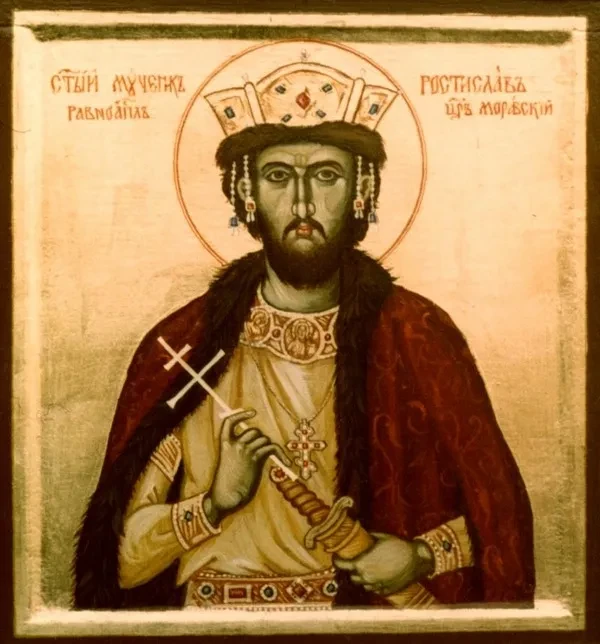
unknowb, Public domain, via Wikimedia Commons
Rastislav, absolutely furious.
This man is truly a stormy figure... The tangled circumstances are not simple...!