
174. The Kings' Hearth Fire (4).
The Gyula (war leader, military chief) of the Magyar tribe, Árpád, was a young ruler who would turn twenty-three the following year.
His father was Álmos, the Kende (supreme leader, celestial prince) of the Magyar tribe.
The allied tribes that had opposed the Khazar Khanate together pointed at that father and considered him the reincarnation of the Turul (a bird resembling an eagle, a nomadic sacred bird).
In truth, as far as Árpád was concerned, his father resembled a strong horse more than a bird of prey, but—
Árpád himself, whether riding or walking, truly possessed a bearing like a lone eagle, and despite his youth he had seized the position of Gyula in a single breath.
No matter how much bloodline mattered in a nomadic society, it was a brutal place where you could not survive without real ability in the end.
Especially with powerful tribes like the Bulgars and the Khazars all around, the Gyula of the Magyars had to be a strong man without fail—and Árpád was a magnificent warrior who more than fulfilled the tribesmen's expectations.
Before the true winter arrived, Árpád rode out on a great hunt with his warriors, while inside his heart another steppe spread open.
'Have I no thought of facing East Frankia?'
[Dagak-dagak-dagak- Dugu-dugu-dugu-]
"Chu-! Chu-! Hya!"
"Hya!"
Horses that raced like the wind without any visible effort, and riders whose sharp eyes flashed this way and that atop them.
Trampled grass and air held their breath before that force, and when the herd of deer fleeing with all their might at last split apart—inside his head Árpád recalled the Kievan envoys who had visited days before and unconsciously drew his bowstring.
[Dagak- da- gak- da- - gak - -]
'Life is something that sways up and down from the beginning...'
"Huuu-"
Recalling the words his father always spoke when they rode together, he matched his breathing and released smoothly the bowstring of the composite bow he had drawn thousands of times.
[Pyung-! Ssss-]
As the trembling string released, the feathered shaft shuddered and soared vigorously forward, and Árpád's sharp eyes, which seemed to gaze upon the future itself, knew that his arrow would pierce its mark.
[Swaaaaaek- Pak!]
[Dagak- dagak- dagak!]
"Seup-"
He drew back in all the breath he had emptied, and the deer, shot so deeply that even the fletching buried into it, could not walk a few steps before collapsing in a heap on the spot.
"Another hit! Gyula!"
"Haha! We shall eat our fill tonight!"
As Árpád at the head gradually slowed and turned, the Magyar warriors who had closed in close bared their teeth in fierce laughter.
Hunting was akin to battle. They were surely feeling the same exaltation as when shooting and cutting men.
"I knew it had struck the moment I loosed. The bowstring draws well today."
"Are you not the Kende's own son, Gyula! You are of the Turul's bloodline!"
In the warriors' eyes, which looked at him with keen, shining gazes, there lay deep trust. It had been well over ten years since the seven tribes, the Magyars first among them, had escaped the Khazar grip through his father's decision.
In that span, countless battles had of course taken place, and Árpád, who had fought at the front lines from the day he turned sixteen, held meaning for the Magyars far beyond a mere heir or war leader.
Árpád was hope to them—hope that they could endure these hard times.
[Pureureuk- Seuk- Cheok!]
And that hope of the Magyars dismounted from the saddle with light movements and looked down upon the game that had already breathed its last, together with a little blood.
'Arrows, once loosed, may hit or may fly astray. But this offer of Kiev's—no. How shall I receive the offer from Helgi Ragnarsson that lies behind it?'
He did not know.
Helgi Ragnarsson. A warrior he never wished to face on the battlefield.
A name that anyone who lived off the Dnieper region could not possibly fail to know. The fundamental reason the Magyars, who should have been steeling themselves for a raid deep into Viking lands around this time of year, had finished their winter preparations without fear of hunger.
The reason the quiet Khazars, when their supply of slaves from the west was blocked, turned their eyes east and south.
Kiev, which had entered under those vast wings, so absorbed the surrounding people and goods that it could no longer be recognized as the small, modest stockaded village of just a year ago.
Already, Álmos, his father, was deeply entangled in the Dnieper trade.
Because the offer came from such a man of power, Árpád and his father had to be cautious.
"Gyula. The blood will cool. Allow me to finish it."
Worried that Árpád was standing there all alone before the deer, his escort offered to finish the work, but Árpád quietly shook his head.
"No, I thank you, but I will do it. Did I not catch it myself? Or have you taken a fancy to it?"
"Haha! How could that be! Only give me the chance, and I will show you that my skill with the bow is no less than the Gyula's!"
He gave a pat to the shoulder of the guard who was practically snorting with enthusiasm, then Árpád crouched down and drew a dagger from inside his coat.
'They say East Frankia fought Moravia once in a great battle. Should we join hands with Moravia?'
Beyond that great mountain range lay the coveted Carpathian Basin. Moravia and East Frankia were hateful sights, as disagreeable as the Khazars or Bulgars.
If there were a way to make those bastards miserable, Árpád would bolt upright even in his sleep and ride out at once—but meddling directly with East Frankia was a matter that would require all seven Magyar tribes to take part together.
'First, I must learn the circumstances in greater detail. What it is that the Víkingar of the Northern Sea truly wish, and what we shall gain. I shall go and ask.'
"Tengri (Sky God). Árpád offers his thanks."
[Puk!]
With a thrust into the throat of the already dead deer, Árpád finished it clearly, and only then summoned his escorts and ordered them to collect the game.
"A very stout one! Gyula! Where shall you go now!?"
As they each rubbed their horses' necks or briefly removed their helmets to scratch their own heads, their gazes never left Árpád.
Árpád, who accepted that blind loyalty as if it were only natural, spurred his horse's flank and rushed onward.
"We ride to Kiev!"
The sight of him charging forward, the long feather on his helmet streaming, was more than anything completely free.
*****
Bulgaria. Vidin.
The dwelling of Knyaz (king) Boris-Mikhail.
Only three years earlier, Boris, who had cast aside Tengri and taken up the cross, had slaughtered all fifty-two Boyars (lords, tribal chiefs) and their families.
His purpose was one alone: the survival, prosperity, and victory of the Bulgars.
To the north stood the thorns in his eye—Magyars, Moravia, and beyond them East Frankia. To the west were the Serbs and Croats, who had repeatedly thwarted him.
Yet the threat greater than any of these lay to the south: the Eastern Roman Empire.
Already more than ten years earlier, Boris had been forced to lose the Black Sea ports and the lower Danube region to the current Eastern Emperor Michael and his uncle Bardas.
It must have been around that time that Boris's thinking began to change. The war against East Frankia, which he had attacked together with Moravia, ended in defeat, and those insolent Croats and Serbs, prompted by East Frankia, harassed his rear.
In the campaign he had launched to punish them he was defeated again, and in the end he took a decisive blow from the Eastern Roman Empire.
I cannot win alone! At least one side must be made my ally!
It was for that purpose that the conversion was chosen. He could have balanced longer between the Roman Pope and the Eastern Patriarch, but as the situation in the Eastern Empire shifted drastically, that balancing act also ended.
Boris remained waiting for his moment.
'I gained much through the religious reforms. I purged the Boyars who opposed the Knyaz's authority and secured the goodwill of both the Eastern Empire and the Papacy.'
Of course, many among the warrior class died in the process, but that was nothing more than a necessary sacrifice. With the passage of time, the Bulgars would only grow stronger.
Stronger—strong enough at last to vie with the Eastern Roman Empire for supremacy.
Into such ambitious Boris's plans, an unforeseen obstacle appeared. That obstacle was none other than his eldest son, Vladimir.
In the past, when Boris waged war against the Serbs, he made the mistake of letting Vladimir, who was far too young, take part in the attack, and as a result his son had been taken captive by the cunning Serbs.
Whether because of that painful childhood memory—this son, who was also Boris's tenderly favored weak spot, was devoted exclusively to strength and might, and showed little interest in the faith of the Cross, which was a problem.
Of course, for a royal, especially one destined to become king of the Bulgars, it would be desirable to regard religion not simply as faith but with an eye attuned to the logic of power and diplomacy. Yet Vladimir displayed not the slightest interest.
Neither when he received baptism in secret alongside Boris himself, nor afterward when the rebel Boyars were all put to death beneath the horses' hooves.
Now he was become a strapping young man of seventeen, the Kanas ubigi of Bulgaria (Khan; the title Boris used before Knyaz, given to his heir).
The boy's gaze was fixed solely northward, on the Víkingr of the Northern Sea.
The sudden emergence of the Northern Sea was naturally something Boris, who bordered the Black Sea and the Danube, could not fail to notice.
A mere three years. In just three years since he truly made his name known, that man had subjugated all those rugged Slavic tribes along the Dnieper basin.
Rumor had it he was the overlord of all Norsemen. Some called him the strongest of all. That title, so overflowing with self-assurance, drew a hollow laugh, yet the scale of the trading fleets that endlessly went up and down the Dnieper drew every onlooker's eye like a great flame in the night sky.
Being the master of such a place, he could not be an ordinary figure. But was it not a problem that Vladimir's demeanor looked exactly as if he had just heard for the first time the hero-tales read to him as a child?
"Huu—"
[Tadak- tadak-]
Thinking of his firstborn, who so rarely moved as he wished, Boris gazed at his third son, who lay fast asleep beside the brazier, which worked the cool air into cozy warmth.
A beloved face that released breaths as small as his small face.
His firstborn had been like this, too. When he heard the news that the little one had been taken captive, he had truly been ready to fight the Serbs to the death.
Fortunately, the prisoner exchange had been concluded smoothly, but Boris and the Bulgars would never forget that grudge.
"Your elder brother has set out for Kiev. They say he will board a ship, pass through Cherson, and ascend the river—I cannot help but wonder if he might be taken captive there, too."
He said it was to expand trade, or something to that effect. As if he could fool his father's eyes. He had most likely gone to hear more news of that Helgi Ragnarsson whom he so admired. And to meet Jarl Haskuld of Kiev, who had become quite close.
"Close relations with Kiev are good, so I allow it. Still, I worry constantly. You must never grow up like him."
Simeon. My third-born.
*****
North Sea. Árós.
The second month of winter.
It had been only a week since the first snow fell.
The great festival had ended, and now, like bears settling into hibernation, people had been planning to eat and loaf inside their warm houses and attend to odd jobs—then, as they saw the renowned Konungrs and Jarls gathering one by one, they harbored expectations: "Is another festival opening!?"
But those expectations soon vanished.
In their place came the tension that showed on the sternly set faces of the Jarls, and the excitement they could not quite conceal.
Though Norse society was changing swiftly under the Víkingr's care, there was something that survived and, rather, grew ever stronger—
That was the heart of the warrior who thirsted for honor and glory.
A transitional era when the worship of Odin, Valhalla, Thor, Tyr, and Frey gradually shifted toward Hel, the goddess, and her great warrior Helgi.
The warriors of the North Sea who would gladly lay down their lives for the half-god of the North Sea, Helgi.
Though it was not a festival like the athletic contests they had imagined, it was unmistakably true that another kind of festival was approaching.
In the blowing wind, in the flowing waves, people could feel it instinctively.
☆☆☆☆☆Reference☆☆☆☆☆
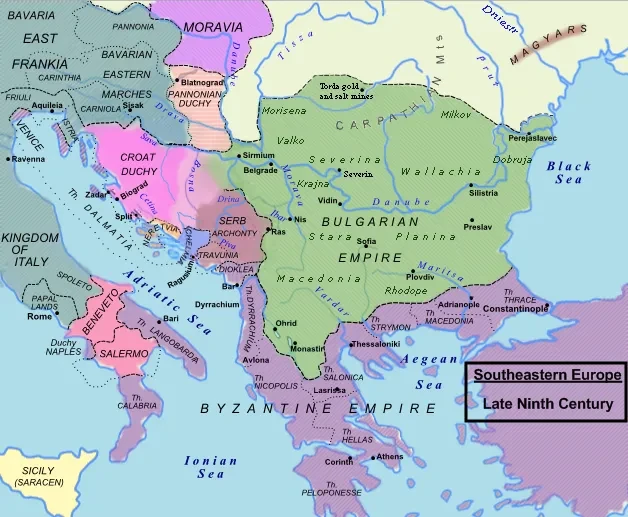
The original uploader was Hxseek at English Wikipedia., CC BY-SA 3.0 <https://creativecommons.org/licenses/by-sa/3.0>, via Wikimedia Commons
The Balkans in the winter of 867.
On the left you can briefly see a glimpse of Italy too. It says Sicily is entirely Saracen, but actually Syracuse is still holding on...!
And Calabria, that land at the front of the Italian boot, is actually under Saracen control ㅠㅠ
Anyway, the point of this map is Bulgaria.
It looks like a Balkan superpower, but surprisingly, right now it's being cracked in various places... Boris carried out that power purge, and even before that, they were nomads so their numbers weren't actually that large...!
Can you see those Magyar friends on the upper right? That place is pretty chaotic too...