
173. The Kings' Hearth Fire (3).
The first month of winter. Gormánuður. The month they called the slaughter month had already passed its midway point. By the solar calendar, it was probably mid-November.
My colors.
My city, where the traces left by the stranger from the 21st century were most vividly revealed. In Árós, they had now finished the grand harvest festival and begun preparing for the second month of winter, when Odin was said to roam the earth bestowing gifts upon children who had placed straw in their socks.
They checked the household's food stores and firewood, clothing, and the jars of silver coins buried in the front or back yard. They confirmed whether the children were diligently attending the lessons held at Hel's temple, which taught common knowledge of combat, farming, social structure, and faith.
Even amidst all those tasks, in the evenings husbands and wives fostered intimate atmospheres, and trials were held for those requesting division of property due to discord or unsavory matters.
People lived fiercely, doing their utmost with the lives granted to them by their gods.
In a place overflowing with life, if one turned their gaze even slightly, there death was sure to be found.
Because many had perished or been wounded in the great battle, at the site of Hel's great temple, entire massive boulders had been moved and carved with rune letters to soothe the dead.
The rune letters, recording line after line of the myths of Valhalla and Helheim—the lands ruled by Hel—were engraved so meticulously that a stranger seeing them might exclaim 'Wow, amazing-!' and yet the North Sea men who visited this space never laughed, nor did they weep easily.
A place where even children and unknowing beasts caught the scent of death and sorrow and held their breath.
Before that great granite stone, I stood between my eldest and my elder brother.
"It resembles the place in Jorvik in Northumbria. It makes me think of Father. I ought to visit once before it grows colder."
"Let us go together. On the way, we should see Ubba's face as well."
The ever-solemn Björn actually looked composed, while the ever-mischievous Ivar appeared strangely dispirited.
No matter that we were Jarls, Konungrs, and Fylkirs who lived by the sword. The weight of past deaths never departed; it always lingered nearby.
This was not a matter of how strong one's faith was, but something etched into the soul itself.
All that clamor about Valhalla and a warrior's honor was perhaps created because, without such tales, warriors facing death or experiencing the death of comrades simply could not endure it.
Like the great stone placed here—a sort of consolation, that is.
"I have heard the news."
After a moment of silence, Björn's voice disturbed the already dreary space. A moment so still that not even the sound of an insect could be heard, as my Huskarls, who boasted such fierce, blazing eyes their very pupils seemed to crackle with flame, stood guard like an iron wall.
"A man came, I'm told. Hrolfrek Konungr of Dorestad. Noble-born among the Dane. A famed warrior. So that man was still alive after all."
"I heard he does nothing but fish all day on Munsö Island. Where does he go hearing such things?"
"Hrólfr."
Ah—
Having conveyed everything to me in a single word, Björn turned his solid frame to face me, just as he had done in Northumbria, and spoke.
"Helgi Ragnarsson. My brother. My Fylkir. Ruler raised aloft by our own hands. May Your Grace do as you wish to do. If called upon, Björn of Munsö Island shall ever stand at Your Grace's side."
No matter how the world changed or how the years flowed, Björn was like steel. His erect bearing was filled with strength and authority, yet was not arrogant. If ever a man was born to be king, it would surely be this man.
Yet this elder brother of mine neither conveyed his own opinion to me nor offered any potentially helpful counsel. He simply stated that he would follow.
"What, why are you setting the mood all solemn again? What about when you ran away to the island saying you didn't want to work?"
The expression of Ivar, who cut in from the side, once again wore a mischievous smile, but Björn merely stared at me silently, as if utterly unaffected.
"Helgi. Do not let your heart be too troubled by the words of old men. Seeing the city you have built and the state of the North Sea, it seems the gray-haired men whose days grow short have grown impatient. The decision is entirely yours. For others will never care for, know of, nor feel the weight of responsibility you must bear. I, too, if you need me, shall gladly stand at your side."
The manner of conveying their intent was stubbornly marked by each man's individuality, but in the end, these two wished to lend me their strength. For they were elder brothers who had watched my growth since before I had struck the sword from Hrólfr's hand.
'How fine it would be if we could always be together like this.'
"Thank you. Björn, Ivar."
At my quiet gratitude, the two brothers nodded their heads lightly.
I was grateful, but my eyes possessed the power to ever strip away falsehood. Was it a problem that I could read the inner thoughts of the two brothers so plainly?
Beyond those two pairs of steadfast green pupils, a newly kindled spark had taken root within each of them.
And my own figure reflected in their eyes was not much different.
'Striking West Frankia through Frisia. Methods to utilize Breis. Rurik of Novgorod—no. Could I check East Frankia by making contact with Árpád of the Magyars?'
Since falling asleep beside Inga the night before, my brain, which had kept spinning entirely of its own accord, had been sketching out plans with these themes.
The troops I could mobilize. The objectives of the war. The possibility of Lothar II's betrayal. How to ascertain the military strength of West and East Frankia. Elements of instability in Britain. Plans to bring in the warriors of Cernyw and Cumbria.
And plots to make contact with Louis of Italy through Eastern Rome, and so forth.
The calculator in my head churned out all manner of methods, and I examined my hand this way and that as if playing a card game.
'Since I can pull out at any time if things go wrong, shall I give it a try?'
A selfish war that could force only losses upon the enemy. So long as I had the sea and the waterways, I could fight like a nomad.
I could probably even manage to prepare a wedding gift(?) for Lothar's divorce...
*****
Eastern Rome. Constantinople. The Palace of the Bull and the Lion—Boukoleon.
Or the Palace of Justinian.
The Emperor Michael gazed upon his son Leo, soundly asleep in the arms of the Empress Eudokia.
[Ppeokkeum- ppeokkeum- bogulbogul-]
The boy, having eaten his fill, had drool smeared all around his mouth and went through the motions of eating something even in his dreams.
As he carefully wiped the boy's mouth with his sleeve, Michael smiled gently.
"A truly healthy fellow. He shall be strong as a bull and brave as a lion."
It was wordplay drawing from the palace's name, but words imbued with Michael's hopes. As a rather chill wind blew, the portable brazier brought indoors crackled—tak tak—and cast sparks, as if in agreement.
"Eudokia, I shall see you in the evening then. Leo, take good care of your mother."
"Go safely, Basileus (Your Majesty, the Emperor)."
The daily life of the Emperor was beginning and ending each day amidst throngs of servants, eunuchs, and officials.
Naturally, even at this early morning hour, countless people were preparing water for the imperial couple, dressing them, checking and reporting on their movement routes and schedules, so that even a casual remark could not be made carelessly.
It was a suffocating routine, but people somehow adapted as they lived. He had worried whether Eudokia, having been born into a Varangian household and possessing a free-spirited disposition, would be able to adjust well, but she seemed, contrary to his expectations, to be enjoying the current situation, which set his mind at ease.
He should have married her formally long ago. He should have done so the moment he escaped his mother's regency.
If he had, would Basileios not have revolted?
Though he no longer enjoyed drink, the traces of his old rakish ways had not entirely vanished. Regardless of who watched, Michael stole a kiss from Eudokia's lips, stroked Leo's soft chubby cheek one last time, and then left his son's chamber.
The season when Christmas was drawing near.
In Rome, amid the unrest following the Pope's final breath, Patriarch Photios surprised those around him by walking about laughing genially, like a man suddenly granted great wisdom. The Emperor knew well that such eccentric behavior from Photios was an attempt to conceal an uncontainable happiness.
For the former Pope and Photios had been famous as bitter enemies.
'The deeds of those said to be closest to God are, I swear...'
The faith of the Patriarch or the Pope was, beyond doubt, lofty and firm. Yet the ironic thing was that those who reached the zenith of faith were all the more incapable of indifference toward worldly interests. The rift between Rome and Constantinople, originating from Iconoclasm—or having begun even earlier—had, in Michael's view, long since crossed a line of no return.
There was but one way to restore it: increasing the Empire's influence in Italy.
'If that is achieved, then the Frankish Emperor Ludovicus cannot dare call himself Emperor of Rome.'
Ludovicus's ambitions had already been grasped by Kyrillos, who once stayed at the Pope's side at Rome's invitation.
Ha! As if it were only Ludovicus of Italy? The Frankish chieftain of East Frankia and the Frankish chieftain of West Frankia, who bore the same name, were all equally men swollen with ambition.
Now that the mighty Muslim empire of the East had fallen into a long and deep quagmire of civil war and grown somewhat quiet, the Muslims of the West and the Franks were making an uproar.
The reality of the Roman Empire, surrounded by enemies on every side—east, west, south, and north—grew more dismal the more he pondered it, but there was always hope.
[Seureuk-]
He had been scolded by Eudokia, asking if he meant to bring it into bed, but Michael had found a second soulmate after the wine that had been his first. It was the sword now wrapped around Michael's left hip.
'A sword descended from the heavens...!'
In his heart, he wished to draw it at once and behold that dazzling green blade, but if he did, Rentakios, who was sticking right beside him, would surely be horrified. So he reined in his excitement.
"Basileus. The Strategos of Cherson, Basiliskianos, has sent a reply. The pozzolana and marble artisans Your Majesty spoke of have reportedly set out for the Septentrionalis Oceanus—the North Sea."
The mighty new ally that had appeared in that far northern land. To the Emperor personally, though not bound by blood, the land of Helgi Ragnarsson—whom he considered a comrade closer than a brother, with whom he had crossed the line of death together.
The homeland of the Varangians. A blessed land where fearsome warriors sprouted like new shoots in a wheat field.
At first, they had attempted to call that sea Mare Germanicum—the Germanic Sea—or Mare Friscum—the Sea of the Frisians—but the Emperor had rejected them all.
The Emperor harbored a deep grudge against the Franks and the Pope of Rome hiding behind them, and he had no wish to give them even the slightest pretext.
Thus the word he ultimately selected was Septentrionalis Oceanus—literally, the words for 'Northern Sea.'
Of course, this was limited to official documents and settings; the citizens of the Empire, who preferred something more intuitive, called it 'Mare Herae'—the Sea of the Goddess Hera—or 'Mare Fortis'—the Sea of the Strong.
In truth, Michael used those names in private too, but the rigid Rentakios always maintained proper conduct and speech before the Emperor.
"I wish to express a little more gratitude to the Fylkir, but it is regrettable that winter is soon upon us."
The word Konungr was difficult to pronounce, but Fylkir felt somewhat easier on the tongue, as it were. The Emperor stroked his neatly trimmed beard as he recalled the fearsome figure of Helgi Ragnarsson.
He quarried marble, did he? Árós. What form would the city built by the man hailed as the second coming of Heracles take? Would bloody gladiatorial combats be held as in the old empire, and would evenings pass filled with song and drink as befit the Varangians?
'I long to see it.'
But it would not be possible.
For the Emperor of Rome, was Constantinople not both a blessing and a shackle?
In the young Emperor's heart, the sense of adventure and the hot blood he had once found only in drinking gatherings briefly returned, but the Emperor, who had already endured countless scenes of chaos, was no longer swept away by momentary emotions.
"Admiral Niketas?"
"Treasurer Petronas, Admiral Niketas, the commander of the Scholai Phokas, and His Beatitude the Patriarch are all assembled in the council chamber."
Rentakios answered the Emperor's sudden question without any hesitation.
Now that the powerful lords—the Strategoi—of Anatolia were lying low in the aftermath of Basileios's rebellion, it could boldly be said that the Emperor's power held the highest authority it had possessed in nearly a hundred years.
The support of the citizens, a powerful central army, an even mightier ally, and the loyalty of the Senate—the nobility.
Having grasped all these currents in one hand, Michael's gaze shifted away from the quiet east and north toward the west.
"I am a little late."
Hurrying his steps, Michael entered the grand assembly hall, originally created as the council chamber of the Scholai. Those seated in the costly chairs rose as one to greet their Emperor.
"Basileus." "Basileus Michael."
An assembly hall where even a sense of rhythm could be felt. Considering that the man he had been around this time last year would already be drunk and watching chariot races, truly many things had changed.
Unfastening the sword at his left hip, which was like a talisman of luck, courage, and power, Michael spoke quietly to those who took their seats after him.
"Forgive me for keeping you waiting so long. Now then, let us discuss the plans for war."
☆☆☆☆☆Reference Materials☆☆☆☆☆
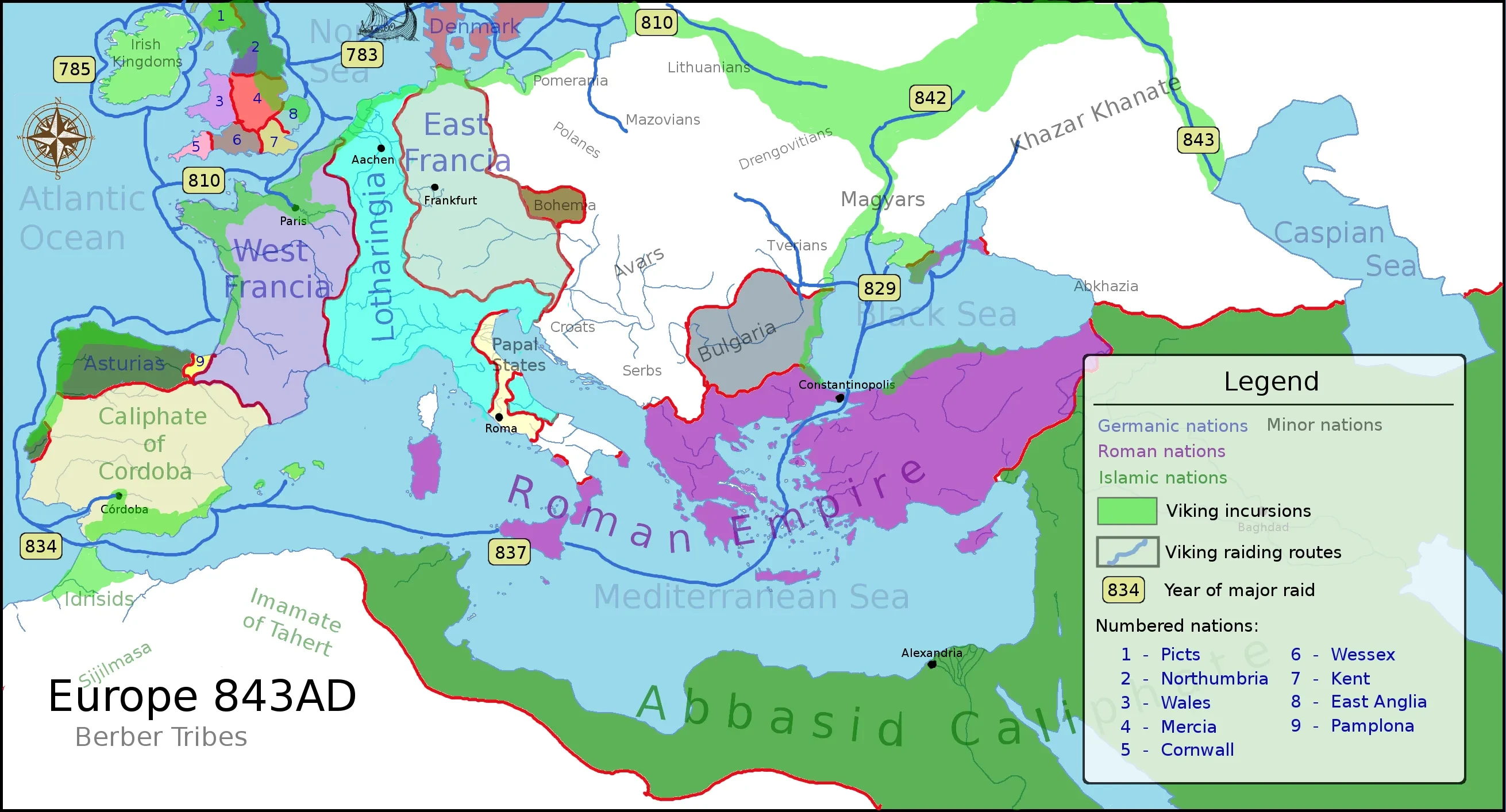
Adhavoc, CC BY-SA 3.0 <https://creativecommons.org/licenses/by-sa/3.0>, via Wikimedia Commons
I found a resource like this while searching...! These are the raiding regions of our Viking friends...! The only region that hasn't appeared in the story is Iberia...! You can basically think of them as having wandered all over Europe... Truly amazing...
Is this the power of desire...?
But my eye keeps being drawn to the Abbasid Caliphate on this map lololol What on earth was that? You can get a sense of just how great the Crescent's power was... Though by the story's current time of 867, it's already becoming crippled...
Especially its influence in North Africa, which it had already completely lost...
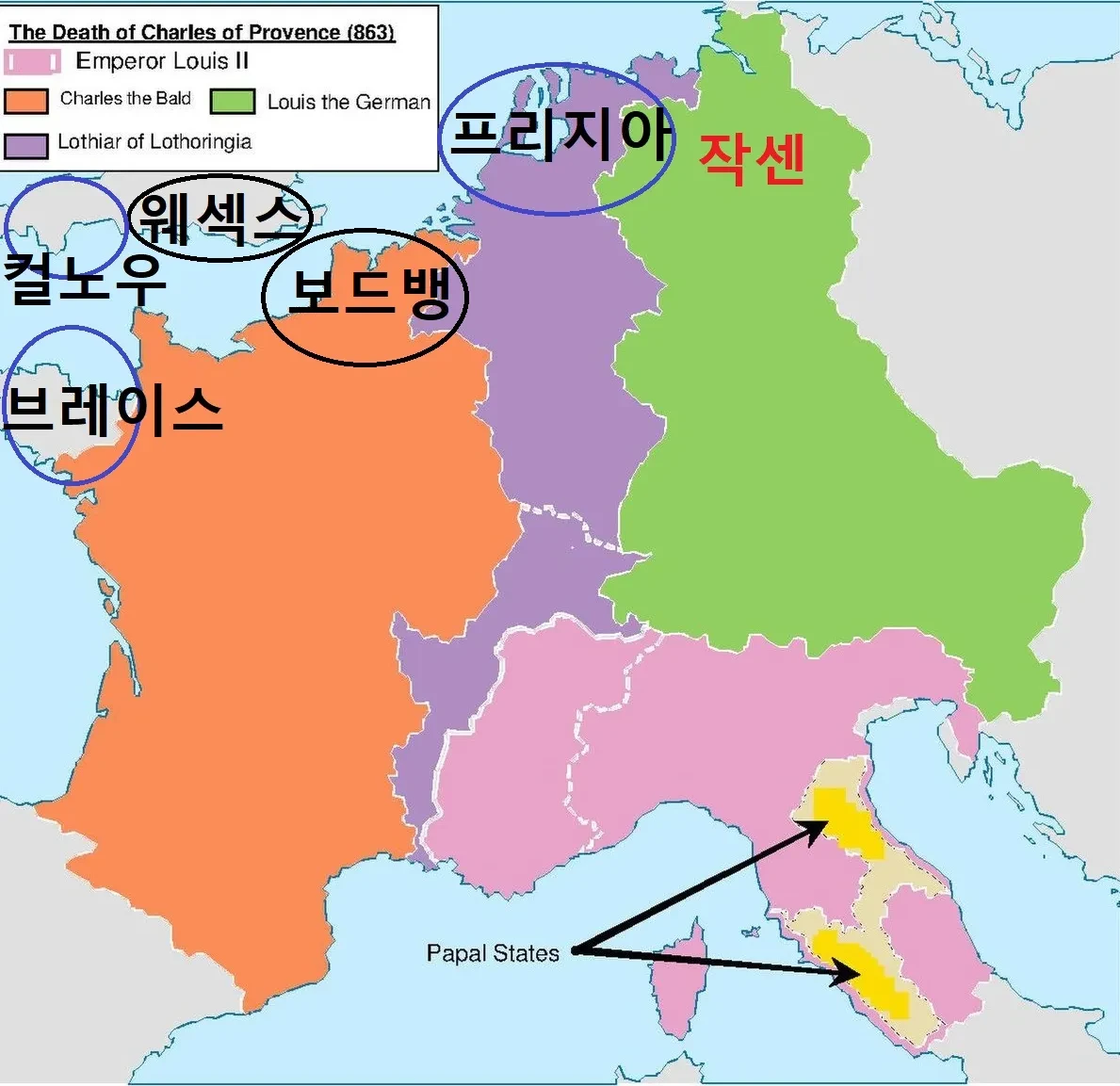
Gellie09, CC BY-SA 4.0 <https://creativecommons.org/licenses/by-sa/4.0>, via Wikimedia Commons
The situation in the lands of the Franks in 863, four years ago from now, after Charles—the brother of Lothar II and the lord of Provence—died...!
There haven't been any major changes through to 867...! Lothar II, looking like he's about to be sandwiched...! Back in his father Lothar I's generation, they also held Italy, so they could strike both sides... but now there seems to be no hope...! So in the end, he goes dark...!
Saxony is an important region going forward, so I've specially colored it red...! Essentially, the entire northern coast of the Frankish Empire was used as forward operating bases... There was just no way to go in and govern properly...! The local sentiment is hostile, and also, the Nosquito(...) Vikings are popping up everywhere, so they had no choice but to pay them off and negotiate...!
In this chaotic situation, the hegemon of the North Sea emerges! And Italy is in its own weirdly complicated and bizarre situation...!
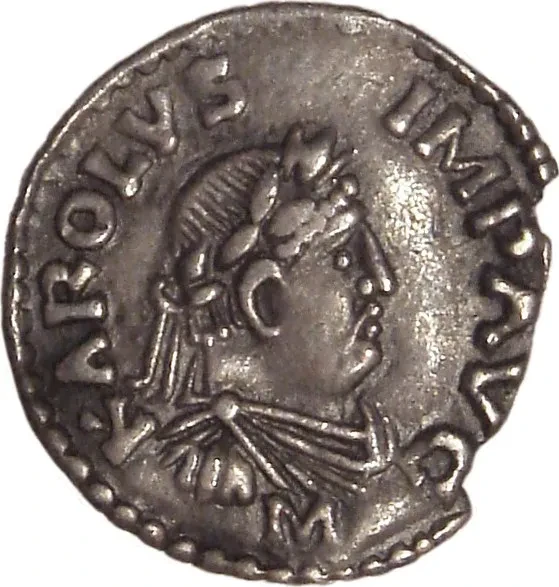
PHGCOM, Public domain, via Wikimedia Commons
The Emperor of the Frankish Empire to whom the Pope himself offered the crown. Carolus, Charles, Karl.
He fought against Saxony and the Saxons for a staggering 30 years...! Much death, killing, slaughter, and burning. Being the protector of Christendom is no small thing...!
Surprisingly, against the Muslims of Iberia, he couldn't avoid a struggle... Slightly different from his grandfather...! Though just crossing the Pyrenees for large-scale expeditions is already incredible...!
This Demon King has so many tangled stories, I'll cut it short here...!