Where Is My Spear?
It had been a few weeks since Father and Telekles marched off to war.
And in the meantime, I had to look after my own meal ticket before worrying about anything else.
"Don't even think about coming home until you've settled the family's business."
That was what Mother had said. At first I took it for a joke, but when her expression didn't flicker so much as once — even at the moment I climbed into the cart — I knew for certain. My mother had been dead serious.
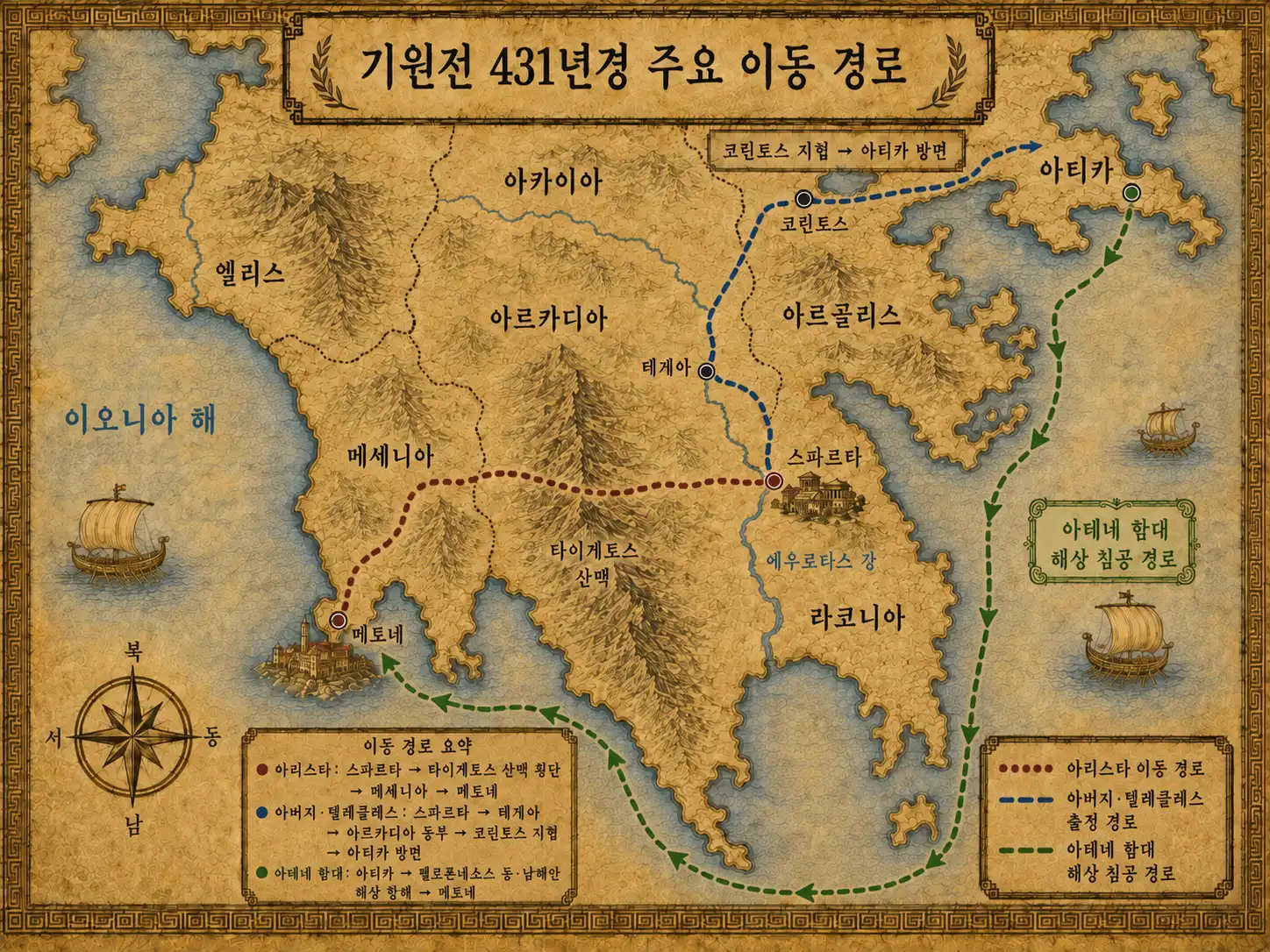
And so here I was, all the way out in Methone, a long haul from Sparta, doing work that seemed to have absolutely nothing to do with the war.
"So."
I pointed at the jars stacked in front of me. "You're telling me there's supposed to be more than this?"
"That is correct."
The escort standing at my side answered. To be precise, he was a household retainer Mother had assigned to me — a man far older than I was, and one who knew this place far better than I ever would. And yet, somehow, the fixing was my job.
When I asked why, Mother's answer was simple.
"Because it's something you'll need to know, going forward."
Just thinking about it wrung a sigh out of me. Was this Sparta's idea of field training?
"So how short are we?"
The man answered. He gave me a figure, but it told me nothing — I still wasn't fluent in this era's units, for one thing. What I did know for certain was that it was no small amount.
Mother managed a few plots of land near Methone. Part of the grain and oil those fields produced was collected and stored here, then drawn out as needed or traded for other goods — so I'd been told. The problem was that the quantities in the ledger didn't match what was actually on the shelves.
At first I'd assumed the war had delayed shipments, but now that I'd seen it with my own eyes, that theory fell apart too.
"Damasios."
At his name, the man standing outside the warehouse flinched and turned. The steward in charge of everything stored here.
"I'll ask one more time. Where did it all go?"
Tapping a knuckle against one of the jars, I got a trembling reply.
"Did I not tell you? The damp got in. Some of it spoiled over the winter."
"The grain spoiled? The oil too?"
I rapped on an oil jar sitting nearby. "Did the damp eat this one as well? Or did a goat drink it?"
Behind me, one of the retainers strangled a laugh. Damasios's face went red.
"You do not understand the situation here, my lady."
Fair enough. I'd only arrived a few days ago — which was exactly why I'd spent my first hours here questioning everyone in sight. How last year's harvest had fared. How much rain had fallen over the winter. When the warehouse roof was last repaired.
Even when the goods Mother had shipped had arrived. I asked each person separately, the same thing we'd done in the army whenever an incident blew up. We never closed a case on one man's word alone; pull the witnesses aside one by one, and their stories always diverged somewhere. This place was no different.
People really are the same everywhere.
I heaved a long sigh, staring up at the warehouse ceiling.
"The roof was repaired before winter, you said. And the workers here told me it's never once leaked."
"Even so, some spoilage is possible."
I nodded along. "Some spoilage is possible. Some. So all you have to do is bring the rest back."
"My lady—"
"Or you're welcome to go explain it to my mother in person. What'll it be?"
The moment Mother's name left my mouth, Damasios's face set like stone. A few days of living under her roof had taught me one thing: she wasn't terrifying only to me. Her name also happened to make an excellent instrument of intimidation.
Long live Mother.
In the end, Damasios opened his tightly sealed mouth.
"...I'll have everything accounted for by tomorrow."
"By today, please."
"Today is impossible."
"I don't much want to stay here either."
Father and Telekles had marched north behind Archidamus — Attica, Athenian soil. And me? The war had begun, and I was counting grain in a warehouse. It struck me anew how profoundly unfair that was.
"It will be ready by sundown."
"Good."
Damasios nodded and shuffled out of the warehouse, and I let out a long breath.
"So it's settled?"
"Assuming he actually delivers, my lady."
The retainer spoke up, and I turned to him. "And if he doesn't? Do we drag him to Mother ourselves?"
"He looks heavier than I am."
The man chuckled as he said it, and I laughed along with him. Finally, I felt alive again.
Well — this will wrap up sooner than I expected.
If all went well, I'd be on the road home tomorrow.
That's what I thought. And that thought was the problem. Whenever I let myself get comfortable, the universe took it personally.
Methone was peaceful to an unsettling degree — so much so that the war's beginning felt like a rumor.
Fishing boats came and went on the water, people hauled their goods through the streets, children chased each other down the lanes. Of course, word of the war had spread quickly here too: that Archidamus had gathered his army, that the Athenians wouldn't dare come out from behind their walls.
Everyone had an opinion to offer, yet not a single face suggested anyone believed the war might fall on their heads. Why would they? Athens was the enemy, and Father and Telekles had gone north. Methone was in the south. As far as I knew, the center of the Peloponnesian War lay between Sparta and Athens — not here.
...And yet, was that actually right?
Not remembering it precisely nagged at me. I pushed the strange feeling aside. It wasn't as if brooding would accomplish anything, so I decided to walk the town instead. Then, at some point, my feet stopped on their own, and I found myself scanning my surroundings.
The walls. I hadn't given them a second thought when I first arrived, but after a few days of looking at them, something was off.
"That thing. Is it supposed to look like that?"
"What do you mean, my lady?"
When the retainer asked, I pointed a finger at the wall. "The wall. It's absurdly low. Someone could practically walk right over it."
The man answered as though it were nothing. "Methone is not a great city, my lady. The soldiers will think the same."
"Now that you mention it, I don't see anyone guarding it, either."
"If it became necessary, the people here would take up arms."
My expression stiffened. Something was wrong with this picture. "There's no standing garrison at all?"
He considered for a moment before answering. "Not many."
What a telling turn of phrase. In army-speak, that translates to: effectively none.
I walked toward the wall. It was low, and it wore its age openly — patched, cracked, ancient. It wasn't so dilapidated that it would collapse on the spot, but it fell far short of anything I'd have called a fortress. And above all, the sea lay directly before it.
This is bad.
My gut felt wrong. Back in my old world, the first thing I'd have done was pull up a map. I'd need to know where the nearest friendly forces were stationed, how long it would take reinforcements to arrive. But here there was no radio — not even a telephone. I looked out over the water again, and beyond that horizon I couldn't even begin to guess what might be happening.
"Athens has a lot of ships, doesn't it?"
The retainer nodded, eyes on the sea. "Even the children know how well the Athenians handle ships."
In that instant, an odd prickling crawled up the back of my neck. I stared at the horizon, and there was nothing to see — just empty water.
Am I being paranoid?
It would be absurd for the enemy to show up here mere days into a war. Father's column had gone for Attica, and the enemy would be waiting there for them. I reached that conclusion on my own, turned away from the sea, and said, "Let's go. We're done here."
It didn't take long to find out just how wrong that judgment was.
"Ships! Ships coming!"
The shout reached us in the afternoon. At first, nobody so much as jumped. How remarkable could a cry about ships be, in a town by the sea? I, for one, was busy checking the goods Damasios had finally hauled in.
"It's all there this time, right? You did bring everything."
"Everything."
My counting hand stopped mid-tally, and I just stood there. Then the cry came again, and I tilted my head at the strange note in it.
"Ships! I said ships are coming!"
The raw urgency made me hesitate a beat — then I stepped outside. People were starting to move, streaming toward any point with a view of the water. Children among them, and old men too, some shading their eyes against the sun to peer at the horizon.
I elbowed my way through the crowd. "What is it? What's happening?"
It wasn't a question aimed at anyone in particular — just a plea for somebody, anybody, to answer — but no one did. So I shoved forward and looked for myself.
The specks on the horizon began to multiply as I narrowed my eyes. One, two, three — then ten. Then past twenty.
Goosebumps rippled up my skin.
"Do merchant ships really sail in packs like that?"
The murmur slipped out before I could stop it.
"No."
Someone had answered, voice trembling. This time the wind blew our way, and the distant ships sharpened into focus, little by little. Long, low hulls. Countless oars churning the water. It didn't stop at one vessel — behind it came another, and beyond that, farther out, more still. From the horizon inward, the sea was filling up with ships.
The crowd that had been chattering only moments ago went quiet, and an alarm began shrieking in the back of my skull. That was a lot of ships. Far too many — and none of them merchants.
That was an army.
"It's the Athenians!"
With that one shout, everything around us detonated into noise. Screams erupted; a woman with a child in her arms spun on her heel and ran. People began sprinting, crashing into one another — some toward the city gate, some toward their homes. The street that had been calm minutes ago turned inside out in an instant.
I couldn't move. I just stared at the horizon while the warships kept closing.
This is insane. It's actually insane.
Only then did it come back to me. Just because Father had invaded Attica didn't mean the Athenians were obliged to sit there and take it.
Fuck.
Why had the obvious taken this long to occur to me? I looked at the sea again, and the ships kept multiplying.
"Arista! We have to get out of here!"
The retainer's shout finally jolted me back to my senses — and I shook him off on pure reflex, shouting back, "Run where?"
"Sparta!"
I turned my head and took in the street: bedlam. A cart tried to move and couldn't, hemmed in by bodies. Children wailed; someone was hauling livestock out by force. Everyone trying to escape Methone had converged at once.
Out on the water, a handful of fast ships had already broken from the pack. They were nearly on the shore — already landing men. We were short on time. And into my head, unbidden, floated the image of Methone's weak walls. No standing garrison. Low ramparts. Every Spartan soldier positioned to the north.
"Fuck."
The curse spat itself out of my mouth. Of all the coastline in Greece — why did it have to be the patch I was standing on? Days ago I'd been sulking because I couldn't get anywhere near a battlefield. Now, watching hundreds of oars bite the sea as they bore down on us, my fingertips went ice-cold. The men climbing off those ships would not be training partners. There would be no instructor telling me to run the drill again after a mistake.
This time, dying was real.
Only then did an old saying surface from years back: those who've never fought a war are the ones who love it best.
"Arista!"
The retainer's bellow cut the thought short. I drew one slow breath and said to him:
"My spear."
"What?"
"Where's my spear?"
The man's face went rigid, and from far away a wall of shouting rolled in. Men were leaping down from the ships that had touched the shore first — their shields, their spears, their armor plain to see. There was zero room left for wishful thinking.
It was the Athenian army.
I wasn't laughing. I wasn't thrilled. Men kept pouring out of the boats and onto the sand.
So the war really did come to me.
Days ago, I'd raged that I couldn't reach the front. As it turned out, I'd never needed to go looking.
The war had come looking for me first.