
Old Testament: The Book of Evaristo (1)
The word strongest has always carried something in it that stirs the human appetite for romance.
Scratch even lightly at the history of war, and the arguments come spilling out — who was stronger, and by how much. Set two champions against each other and the question draws people in without the least regard for age.
To borrow a line from one scripture or another, there are few better ways to kill an idle hour than asking who would win, Sylvester Stallone or Jean-Claude Van Damme.
Press the matter in earnest, of course, and nearly every such debate closes on the same verdict: it depends on the circumstances. Which is why, even when the word strongest is brought out, of the age is fastened on in front of it, and the honor is never, in practice, settled on a single name.
So it had been with the Red Bishop of the Congregation for the Causes of Saints. So it had been with the greatest holy knight. So it had been with Leviathan in his prime.
The Guide. The Mold, Yoo Hye-rin Agnes. Or Saint Bartholomew. She, too, had been one of those.
And so, when she vanished in the middle of an operation, hardly anyone was much concerned. They only laughed it off, certain she would batter down every obstacle in her way and come back, as she always had.
It was something nearer to faith than to trust. Even so, the human being called Bartholomew was formidable enough that the feeling was still reckoned a rational, clear-eyed judgment.
The body of Bartholomew Agnes was found in Aksai Chin, in Kashmir, four hours after she disappeared.
Strangely, the corpse bore not a single external wound. The shock of an Apostle's death held them only a moment; the upper ranks of the Church, agreed that the situation had to be grasped before anything else, moved at once to an autopsy.
No clear cause of death could be found inside the body either. The finding was simply that her heart had stopped, without warning, and she had died.
Anyone else, perhaps. There was no world in which that Bartholomew had suffered cardiac arrest. Yoo Hye-rin Agnes was precisely the sort of woman who, if her heart happened to stop, would slam a fist into her own chest and drag herself back on raw fighting spirit.
Something had gone badly wrong. Everyone was thinking it when an investigator from Oracle arrived.
Psychometry — in short, one with the power to read the past dwelling in things. The investigator had been summoned ahead of time, against the chance that an autopsy would not be enough to settle the matter.
And died on the spot. Cardiac arrest.
It did not take long to understand that the observation of something had been the cause of death.
Nor was the Church without preparations for exactly this. To die by looking alone was a motif that had repeated itself from Huwawa to Medusa, and on to the modern internet's pictures that kill you if you view them enough times.
The barest safeguards had, of course, been set upon prophets and the other sources of intelligence. That the death had come so vainly all the same meant its cause held a rank higher than anything the Church's countermeasures could meet.
That can't be. Someone murmured it — not because the situation defied understanding, but because they had seen it sooner than anyone else nearby, and could not bear to grant what they saw.
Someone else murmured a name. It was not the saint who had also been the fifth pope. Nor was it the author awarded a literary prize that year.
It named the one who had taken a baptismal name from that saint: the man who had been Bartholomew of the generation before.
An old man who had lived out the full measure of his years and, several years past, drawn his last peaceful breath. Styled, in address, the greatest holy knight.
It was not a name to be taken out lightly. But the traces left on the corpse — no, the traces that had not been left — resembled far too closely the feats he had accomplished in life.
Above all, if the Church's own defenses, which were given precedence over those raised against other anomalies, had been pierced this easily, then it could only have been the Church's own power.
It would not be. It must not be. While most of them were praying exactly that, the holy knights mobilized in haste at last reported that the tomb of Bartholomew Evaristo stood empty.
That day, the Gravekeeper once called the greatest turned his back on his charge and rose from the grave.

"Nonsense."
Giacomo Marchisio murmured it before he could stop himself.
"I'm sorry, but it's the truth."
"…"
There was not the slightest color of a lie in the voice on the other end of the line, and Giacomo was not a man who would miss that. He simply could not accept it. More precisely, he did not want to.
Bartholomew Evaristo, resurrected. Resurrected — and turned upon the Church.
Even Butch and Sundance can't have been this shaken at the end, he thought.
Even so, he forced his heart down somehow, let out a long breath, and apologized.
"…First, I beg pardon for the discourtesy, Your Holiness."
The man beyond the phone was successor to the chief Apostle, sovereign of Vatican City, Pontifex Maximus Dionysius II. They had been friends once, but the office still demanded the reverence due it — all the more now, when the Pope meant to give instructions to an Apostle. Dionysius himself would not have minded in the least, and would rather have preferred that Giacomo speak at ease; but in matters of this sort Giacomo was exacting about the line between office and friendship.
"But is that information truly certain?"
"Even taken by surprise — do you really believe that Yoo Hye-rin could die from a single blow?"
"…No. I should think not."
She had not been counted, alongside the Dragon of the Congregation, among the strongest monsters of her age for nothing. Yoo Hye-rin Agnes was a woman of whom it was no exaggeration to say she stood at the summit of force a single member of humankind could reach, and to imagine her dying easily was difficult. A feat of that order would require, at the least, someone of equal rank. The Prefect of the Congregation would never have turned traitor, which left only one possibility: the raising of some champion of the past who was already dead.
"We sent people to confirm it. Evaristo's tomb was empty. Faint almost to the point of nothing, but there were traces of the grave having been dug up."
"You take it to be the Necromancer?"
"Most likely."
Even granting that Evaristo's corpse had never decayed in the slightest, and kept its original form without any embalming at all, those with the art to raise a body still imbued with the miracles of a lifetime were hardly common. That alone narrowed the suspects well enough, and if one asked further who would actually commit such an act, the number shrank again. Giacomo had simply named the ablest among them. He had fallen into the habit of suspecting that maniac first whenever the dead were raised in a form that dealt the Church a meaningful wound — and nine times out of ten, the Necromancer had in fact been guilty.
Unlike that habit, however, the papal side would have reached its guess on grounds of its own. Giacomo held his silence, and by the silence asked to be told.
"A great many incidents of Scenario scale — or quasi-Scenario scale — have broken out across the world of late. We compiled the intelligence. The Necromancer was behind most of them."
Even counting only what Giacomo and his company had lately stepped into, there were three Scenarios: the civil war in China, Operation Latch, and Operation Saint Barbara. He had at least heard that crises of one kind and another had arisen across the world, and not in the Far East alone.
"I think all of it was for this."
The conjecture that those numberless intrigues had aimed at nothing more than spiriting away a single corpse. Giacomo could not dismiss it. Even if the Necromancer had poured out every last reserve of ability, it seemed to him a winning bargain, if what came back was the power to command that Evaristo.
"And the present location?"
"I'm told the estimate places it at the Siachen Glacier."
"…Why there?"
"It was an ambush, granted, but it seems Agnes managed to strike back, if only for an instant."
The claim struck him as too absurd to be funny, and at the same time he thought that monster might well have landed at least one blow. He did not trouble himself over the distance between Aksai Chin and the Siachen Glacier — a hundred kilometers at the least. By his own reckoning, had a true fight broken out for even a short while, that much ground would have been flung across lightly.
"And the subjugation?"
"We're preparing to issue a Bowl-class special measure of the Holy See. The intent is to strike with every person we can gather."
What was meant, here, by every person they could gather was a team drawn from those who might be committed alone even to a scene of no small weight, and who in ordinary times moved as a scant elite. The foe being the foe, any rabble scraped together would meet nothing but a wasted death.
"Might we not be too late? As I understand it, everyone is occupied putting out fires in every quarter."
"It can't be helped. This isn't a problem solved by throwing in an Apostle or two."
He was not wholly without misgiving. In the end, though, Giacomo could only nod.
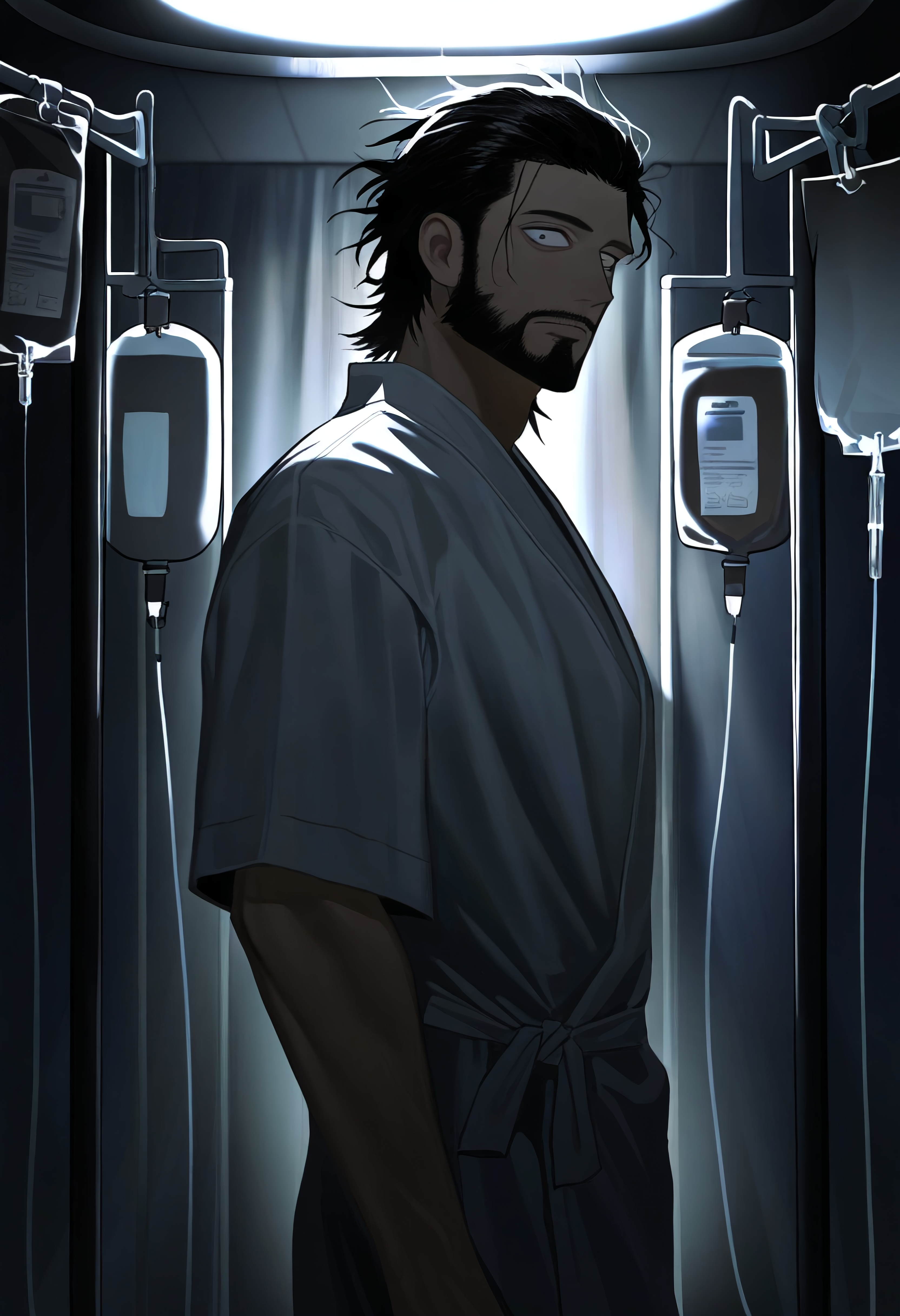
"—No. Too late."
"Jihan?"
Their other old friend, it seemed, was of another mind. Han Jihan came in hauling an IV stand behind him, the bag of fluid swaying from its hook, and spoke in a voice gone cold.
"Giacomo, the phone, if you would—"
"I've put you on speaker. Please, go ahead."
"Yes. Thank you. …Jihan. You know there's a limit to who can move at this moment, don't you? The only strength that would truly matter is the two of you."
"Then we go. Just us."
And you can hardly call the pair of you whole, Dionysius had meant to answer. The thought that came on its heels left him no choice but to shut his mouth again.
"Jihan. You've… already made a contract with a demon."
"Yes."
Between his various contracts and the sorceries laid on him, he could, as a rule, take no action at all unless the matter concerned vampires. There was a single loophole in that law, and it was the pact with the demon Glasya-Labolas — twenty-fifth of the Lemegeton, called also Caacrinolas, and the President of Slaughter. By the old accounts, a contract with that demon bought power at the price of a human life, one the demon himself named, and so ought by rights to have been a high-risk, high-return devil to bind.
Han Jihan had simply found a use for each half. The return he spent on strength enough to meet vampires; the risk he spent on those peculiar hours when he was required to face an enemy who was not one. Even he, once the pact was sealed, had no choice but to move — and to move in order to kill what was not a vampire. So it would have been this time as well: a contract to kill the Necromancer, or Evaristo. And if it was already done, it could no longer be undone.
"That Necromancer can't be left any longer. Miss this, and there's no telling when the chance comes again."
"…Very well."
Beyond that, there was nothing left for him to say, even as pope. What the Necromancer was to that man, and why he clung so to vampires — others might fail to know, but the two friends in that room did not.
"Then at least follow my instructions. I'll put a scheme together — enough, at any rate, to give the operation a shape."
"If it sounds like it will work."
"Which is to say he'll comply. I have yet to meet anyone as cunning as His Holiness, our Pope."
"We'll be going to see him soon enough." Giacomo added it with a pleased smile, as if it were only a joke.