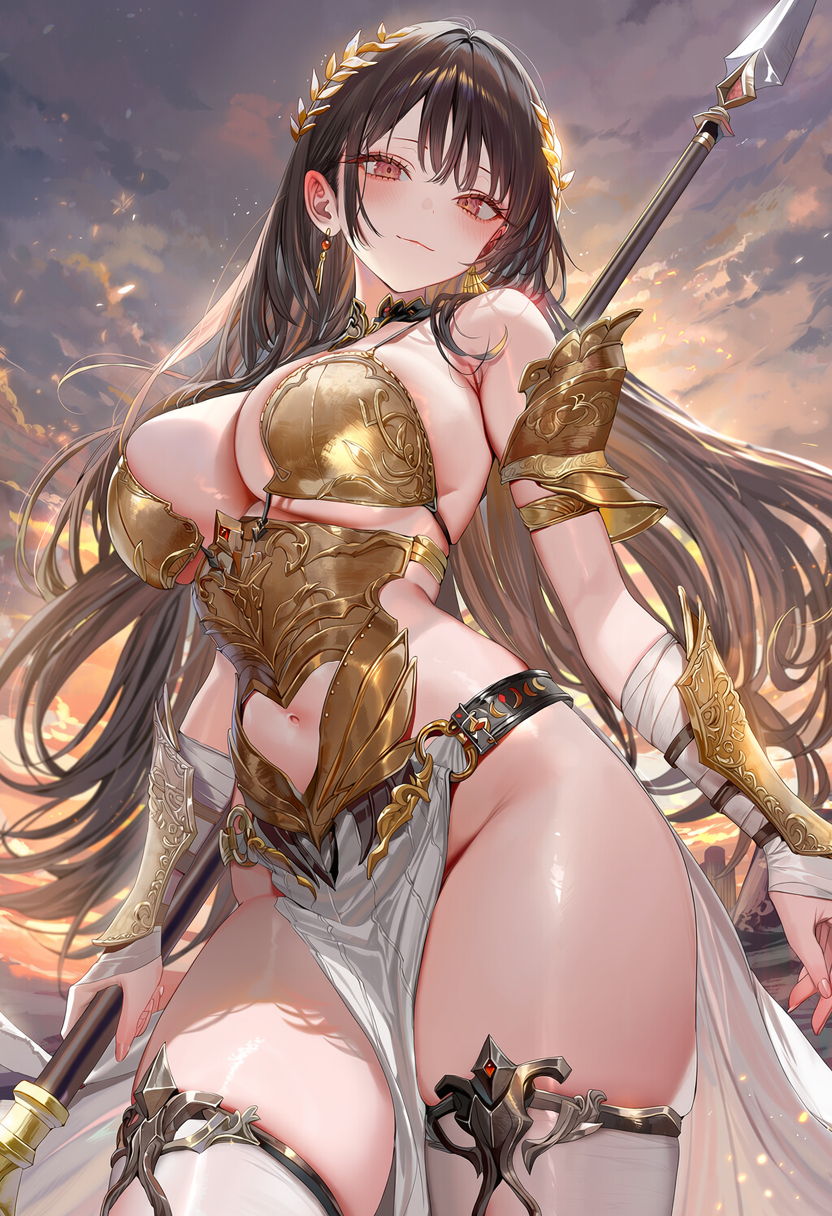
Must the Root Sin Be Judged First, or the Murder Born of It?
Should the root sin be judged first, or the murder that sprang from it?
From where he stood upon the altar, King Minos let his gaze sweep once across the crowd, then drove it straight into me and Daedalus.
The lips of the man clad in borrowed armor of the goddess Athena parted slowly, and a voice rolled out to thunder along the banks of the Kairatos.
"Two stand today in this seat of judgment. Asterion, son of Minos and Pasiphae—and that Daedalus, called the greatest craftsman of the age."
King Minos extended a hand and pointed first to Daedalus.
"Let us fix the point at issue before we proceed. Last night Asterion broke the Labyrinth and came out, and he killed one of the guards keeping watch beyond it. That is murder, plain and undeniable."
A murmur spread through the crowd. Furious stares, hungry to see a killer's head struck off at once, poured down upon me. But King Minos raised a hand and crushed the uproar in a single stroke.
"And yet I will trace this sin to its root. What King Minos commanded of that Daedalus in the beginning was this: build a prison that no monstrous strength could ever break, a prison from which, once entered, no one could ever escape by his own power."
The king's logic began, deftly, to change direction.
"Suppose Daedalus had obeyed King Minos's command in full and built a Labyrinth that could never be broken. What then? Asterion could never have come out, and the soldier who guarded that gate would never have lost his life at all."
"Uh...?"
Daedalus, kneeling beside me, let out a dumb, startled sound.
"Where, then, does the fundamental cause of this tragedy lie? It lies in the arrogance and the negligence of the architect Daedalus, who failed to carry out the king's order to build a prison that could never be broken!"
Unhesitating certainty rode the king's voice.
"What is more, when King Minos confined Asterion in the Labyrinth five years ago, he never explicitly commanded him not to escape! A prisoner thrashing to live, breaking walls to survive—that is an instinct every living thing possesses, beast or human. No order was given. Therefore the act of breaking the Labyrinth and escaping cannot itself be judged a crime."
Sophistry. And yet the authoritative rhetoric pouring from the king of a nation, from its supreme judge, carried a strange persuasiveness.
"What remains, then, is Asterion's sin of killing a soldier, and Daedalus's sin of building a shoddy Labyrinth and thereby furnishing the cause of all this tragedy. The sin of murder is by no means light. But can the fundamental sin of that architect—who mocked a king's command, did negligent work, and threatened the safety of the state—be called any lighter? Must the root sin be judged first, or the murder that branched from it?"
When the king's fervor ended, the crowd began to murmur.
"Hearing it like that... isn't the king right?"
"Yeah. If the Labyrinth had never broken, the soldier never would have died!"
"Prince Asterion only broke the wall because he wanted to live. Maybe he just ran into the soldier outside and killed him before he knew what he was doing."
"That's right. That bald inventor skimmed the king's treasure and threw the Labyrinth together like a fraud. He's the root of every evil!"
In an instant, the crowd's opinion swung into fury aimed at Daedalus.
Watching it happen, Daedalus sank into despair and drove his forehead against the cold earth with a dull thud. "I'm finished..." Face pressed to the ground, he muttered his resentment low.
"This is nothing but a pretext. The king isn't angry about shoddy work. In the end... he's made a place to execute me so he can collect the debt for that wooden cow I built and offered up for the queen, all those years ago..."
Daedalus turned his head a fraction and glanced at me. His eyes were full of hollowness and a bitter taste.
"Congratulations, you horned brat... Seeing as you're his son, a prince in name, he's straining every crooked argument he has to keep you alive somehow. Your luck is good. You've got a father watching your back."
That resigned congratulations gouged my chest like a blade.
Amid the crowd's whispering, I slowly lifted my head and looked up at King Minos on the altar. A man standing magnificent in Athena's armor. Wrapped in the very symbol of wisdom and justice, he was defending me now out of an utterly private father's love. Ready to take the world's condemnation upon himself, he was twisting logic however he must, struggling to save the monster son born of adultery.
It was a love so pitiful it could draw tears, and so noble. And at the same time—
Wearing the goddess Athena's armor... this is something that must not be done.
If I simply kept my mouth shut, then just as Daedalus said, I might survive by luck. Or the sentence might be lightened to exile, and I might even walk away free. But could a being who would not answer for his own actions truly be called human?
"......No."
The voice that slipped out past my lips, before I even knew it, was calm enough to startle me. At that single short word, the murmuring that had filled the riverbank drained away at once. Thousands of eyes swung together toward the enormous Half-man, Half-bull kneeling bound in rope.
King Minos, too, flinched upon the altar and looked down at me. I straightened the back I had bent, met the king's eyes squarely, and spoke.
"Great King of Crete. That night, of the two who were keeping watch outside, I killed one."
"No! Don't do it, Asterion! Don't say a word! Please!"
The instant the words left me, a woman's scream tore through the suffocating silence from the very rear of the crowd, as if it might rip her throat. I turned by reflex. There stood a woman half out of her mind, hair unbound, both hands flung toward me as she wailed.
"M-my lady! You must calm yourself! You cannot do this!"
The maids seized her about the waist in a panic and tried to hold her back, but the woman went on crying my name.
Mother.
It was Queen Pasiphae. My birth mother—the woman who bore me, and who, unable to endure the curse and the shame, had gone mad in the end. Who, even out of that broken mind, had come running to watch the execution of the son dragged out to die.
Mother...
The moment I heard her voice for the first time, a corner of my heart throbbed as if a shard of glass had been driven into it. But I forced my gaze away and faced forward again. I could not waver. If I stepped back here—
She'll be left as nothing more than the woman who bore a monster.
I hauled a breath up from deep in my chest and lifted my voice until it seemed the riverbank itself might rise and leave.
"The breaking of the Labyrinth and the fact that I killed a man are wholly separate matters, and they must be judged apart!"
At the iron in my voice the crowd drew a sharp breath, unable to hide its shock.
"The moment I broke out of the Labyrinth, I took two soldiers into my eyes. One was asleep. One was awake. Once I was out, I could have fled straight into the mountains. I could have struck them senseless and done no more than restrain them. But I could not master my rage, and by my own will I chose to smash one of their heads!"
I dissected my sin down to the bone and flung it before them.
"It was not an accident I could not avoid! It was not some inevitability that followed because the Labyrinth fell! It was a chosen murder, carried out entirely by my will and by my fist! And so I must receive a just judgment for the murder itself that I committed!"
"Noooooo!!!"
Queen Pasiphae's grief-stricken cry tore the riverbank once more. But my confession did not stop. This was the only proof by which I could stand in this world as a human being.
"So do not lay the blame for my blood upon that old architect! The sin of the murderer Asterion belongs to Asterion alone!"
When I had finished, I slowly bowed my head and set my forehead once more against the cold earth. The riverbank went still as death.
Daedalus, prostrate right beside me, stared at me blankly with his mouth hanging open, as if he had seen a ghost. King Minos upon the altar froze as well, his face seized by shock. The sophistry he had wrung out in desperation to save me had been shattered to pieces by none other than the mouth of the son he meant to save.
From behind me, where Deucalion stood at the head of the soldiers, a trembling mutter reached me faintly.
"To take the sin upon yourself... What are you? What in the world are you, Asterion...?"
Even in the moment when everyone was too stunned to breathe—scrape. Scrape-scrape. Scrape. Through the stillness, that utterly alien sound cut into my ear once more. To my ear alone it was far too clear: the sound of a sharp stylus endlessly scoring a clay tablet. Somewhere, the Muse of epic poetry was surely recording this impossible trial in a frenzy.
Scrape, scrape-scrape, scratch-scratch-scratch! The scoring of the tablet grew fiercer and faster. And then—drip. Drip, drip. From somewhere, the sound of clear drops of water began to fall. At first I thought it was only spray leaping off the river. But the sound swelled, and grew clearer, until—
A roar of water. The current of the Kairatos began, unnaturally, to run backward and surge upward. And behind King Minos, where he stood upon the altar, a shape rose slowly out of the river and walked up onto the surface.
"Wh—? Wha—?!"
Screams burst from the crowd. The one who had walked out of the water was a woman. Her whole body was drenched in the river, and yet the blinding radiance pouring through her wet hair could not be warped at all. Blazing armor encircled her body, and a spear rested in one hand. It was the same as what King Minos wore—no. This was an armament beyond all comparison, pouring forth the grandeur and the sacred power of the true thing.
"Hhk—!"
King Minos turned in horror. The true goddess Athena, wet from the river, was looking coldly down upon the king who had been spinning sophistry in counterfeit armor. The goddess flicked her fingers once, lightly.
A crack. Then a shattering crash.
"Gyaaaaah!"
At that small gesture, the armor King Minos had worn so proudly burst apart in every direction. Stripped in an instant of the armor that had symbolized Athena's authority, he was reduced to a shabby, aged old man and toppled gracelessly upon the altar.
"Your Majesty!"
"Goddess...!"
But not one person dared leap onto the altar and throw a cloak over the king's bared body. The people, the armed host, even Deucalion himself were crushed flat by the pressure pouring from the goddess, and none dared so much as lift a head from the dirt. For into that counterfeit court, where humans had been trading their thin sophistries, the true goddess who governed justice and wisdom had descended in person.
The goddess Athena paid no mind to King Minos, trembling where he lay upon the ground, and slowly turned her gaze down from the altar. Beneath her helm, shining eyes fixed precisely upon me, kneeling with my wrists bound in rope. Even before the gaze of a god, I forced my head up and met it.
Within the goddess's eyes as well—
—I was held.