
Mary's Treasure Crab and Seafood-Filled Bouillabaisse
The horizon of Iceland stretched out under a pale sky.
In Obsidianberry, the handful of high-class inns equipped to receive the few high-ranking nobles who passed through offered every comfort and service a guest could desire. Inside, bards sang, storytellers spun their tales, and troupes performed; outside there were city tours, fishing excursions, and countless other diversions. For those guests who preferred to cook for themselves, some rooms even came with private kitchens—and the lodgings where Catherine was staying were precisely that sort of place.
Karem, meanwhile, had been given one of the small servants’ rooms attached to the inn. The disparity in treatment might have rankled someone else, but Karem paid it no mind at all. Right now the only thing that mattered was the kelp.
Treating kelp like a common weed? For a moment he almost lost his temper. The flash of indignation, however, faded as quickly as it had come. Even in his previous life, the people who actually cooked with kelp and seaweed had been limited mostly to the three East Asian nations. In the West, even the nations that happily ate cephalopods—creatures once regarded as devilish—had lumped every form of seaweed under the single dismissive label “sea weed,” and that attitude had lasted well into the modern age.
In the East, though, seaweed was anything but a weed. They dried it, roasted it, simmered it, fermented it, pickled it—there was no end to the ways they made it delicious, and Karem’s previous self had been no exception. No matter how much someone claimed to dislike seaweed, birthday miyeok-guk and the dried flakes that went into a pot of ramen were things almost everyone ate without complaint.
And among all those seaweeds, kelp reigned supreme.
Carefully wiping the dried kelp the shopkeeper had thrust into his arms with a bewildered expression, Karem thought back on the exchange.
“Will you be able to carry all this?”
“Well, the luggage is a bit—”
“We can deliver it.”
“Karem Hubae! It isn’t that much at all!”
No, not that part. Anyway—kelp.
Vinegar pickles, wraps, seasoned salads, bugak, or simply dipping the raw strips in vinegar-chili paste. Like every other seaweed, kelp had countless preparations and uses. Above all, when handled and seasoned correctly, it produced a traditional base stock that could go into virtually any savory dish. In short: natural MSG.
“Karem Hubae. So what outrageous thing are you planning this time?”
“Outrageous? Mary, what on earth are you talking about?”
“It is outrageous, and that is that.”
Mary, who had already claimed one corner of the kitchen, lifted her knife. With a single sharp crack she severed the head of a cod resting on the cutting board.
“First you eat a northern poison weed out of nowhere and make it fashionable; now you want the weeds of the sea?”
“That ‘poison weed’ isn’t poison anymore, is it? At least not in Coldon.”
“The weather has warmed, so it will spread to the surrounding regions soon enough. So what do you intend to do with it? Kelp, you called it? I have never heard the name.”
“I’m going to make stock.”
“Stock?”
Mary sounded skeptical, but Karem ignored her and reached first for the dried anchovies whose guts had already been cleaned. They were four times larger than the soup anchovies he had used in his previous life, yet with the innards removed they were perfectly serviceable for broth.
He set a large pot over the heat and let the anchovies’ oil react. A soft sizzle rose as pale smoke curled upward. Once the anchovies had turned crisp and begun to shed tiny flakes, he poured in water and added the hand-sized pieces of kelp he had broken off.
“You said you were making stock.”
“Yes. I’m making it right now.”
“You just turned off the fire.”
“I’m going to leave it alone for a while.”
Mary had watched Karem steal pieces of her work before, yet she still found him impossible to predict. Even so, her hands never stopped; the fish on her board were already separated into clean flesh and bone.
“Do the mussels and clams need to be purged?”
“They were already purged when we bought them. I scrubbed the shells with a brush ages ago.”
“When did you even—?”
“While you were caressing that dried sea weed, Karem Hubae.”
Mary opened a crate sitting to one side of the kitchen and lifted out the treasure crab. What followed happened in a blur.
Crack! Thud. Crunch! Thud! Thud!
Bare-handed, she tore the massive carapace free, drained the blood with practiced ease, quartered the body in one motion, and separated the claws and legs. Karem’s mouth fell open without his noticing.
He might have been startled by the raw power hidden inside Mary’s slender frame, but he had grown used to that over the winter. What truly shocked him was something else entirely.
The treasure crab.
The meat packed inside was denser and more abundant than any snow crab, king crab, or lobster he had ever tasted in his previous life. The body alone was larger than an adult’s head and stuffed full of pure white flesh; the claws and legs, glimpsed through the shells Mary had just cracked, were the same. Best of all, the moment the carapace split, a delicate fragrance rose from the roe and tomalley and filled the entire kitchen.
Soft golden meat, deep orange roe and innards—a stark contrast to the rotting-wood-like shell studded with barnacles.
“So that’s why they compare it to a treasure chest.”
“Indeed—hm? Oh. So the stock really does come out from nothing more than that.”
“Yes. Ah.”
Just as she said, enough time had somehow passed that the pot containing the anchovies and the now-swollen kelp glowed a pale barley-tea color. He could have steeped it longer, but there was no guarantee it would stay fresh. Karem relit the fire beneath the pot and, the moment the stock began to boil, lifted out every last scrap of kelp.
Mary, who had stopped cutting at some point, watched with open curiosity in her otherwise expressionless eyes.
“The aroma is quite convincing, and the color looks appetizing.”
“It would taste good even if you drank it as is.”
“The taste… I cannot quite imagine it.”
A gentle, seamless fragrance of the sea brushed Mary’s nose. The stock was finished. After straining out the swollen anchovies and every flake and crumb, Karem poured a little into a small bowl and held it out to the brownie who made no attempt to hide her interest.
“Talking about it won’t help. Taste it yourself and judge.”
“Very well. Mm… mmm?”
She set down her knife, accepted the bowl, and took a careful sip. The moment the amber liquid touched her tongue, an intensity of umami she had never experienced flooded from the tip of her tongue all the way to its root, like water soaking into dry earth. Before she could savor it further, her brownie instincts swallowed every drop. Yet the deep, sea-borne savor that had swept through her remained, brushing her nose with every breath.
“J-just sea weed and dried anchovies… and it tastes like this…?”
“Hmm. Both the kelp and the anchovies must have been salted while drying. No need to season the stock itself. When we cook with it we’ll have to adjust, of course.”
Karem tasted the stock and completely lost control of his expression. MSG, after all, was the bringer of peace to every household table. A cook who could resist this was no cook at all.
Mary, still clutching her knife, stared blankly into space and drew several long, steadying breaths before shaking her head clear.
“This—how can something so simple produce—!”
“If you wanted this level of umami from ordinary ingredients, it would take a long time, wouldn’t it?”
“Of course it would!”
Making a proper stock easily took hours, and even then the yield was pitiful compared with the ingredients used. The only consolation was that you could throw in leftover vegetables, scrap bones, and cheap cuts. Kelp stock was different. All it needed was kelp and a few kinds of dried fish. Even the cold-steep method that brought out its true excellence was simpler than boiling a stock—anyone could drop the ingredients into cold water and leave them overnight, though a skilled cook would still produce a better result.
“So what do you intend to make with this kelp stock?”
“Pardon?”
“Something this fine reduced to mere stock? You must be planning something extraordinary.”
Mary tapped the cutting board. There was no need to describe the look in her eyes.
Even so—
“I haven’t decided anything yet.”
“What?”
“I mean it.”
His eyes had rolled back the moment he saw the seafood. Then the treasure crab—larger than any crustacean he had ever laid eyes on—had short-circuited his brain, and the kelp had finished the job. Honestly, Karem had not decided a single thing.
Mary’s brow furrowed as if to ask what nonsense that was; then she realized he was telling the truth and let out a long sigh.
“Then I shall cook today.”
“Hm?”
“With stock and seafood of this quality, bouillabaisse would be not merely abundant—it would be pure extravagance. It is a fisherman’s dish, of course.”
Before Karem could get a word in, Mary was already moving.
“Bouillabaisse?”
“Hm? Ah. You would not know it. It is a home-style stew made by the fishermen along the coast of Versengetto. Originally it is a seafood stew made from leftover scraps of fish.”
Karem knew perfectly well what bouillabaisse was. Calling it a French seafood stew sounded elegant, but stripped of pretension it was simply French-style haemultang—nothing more, nothing less. Without tomatoes it might literally become haemultang depending on the ingredients. And like every seafood dish, its quality rose or fell dramatically with the quality of those ingredients.
Having reclaimed the kitchen for the first time in months, Mary wielded her knife with a speed that bordered on manic joy. There was not the slightest opening for Karem to intervene. Carrots, onions, green onions, and garlic flew under the blade and tumbled into a large pot slicked with oil. Once the vegetables had softened, she added the treasure crab, then the shellfish, then the fish, poured in the stock, and seasoned with the spices already waiting in the kitchen.
“It looks like you’re layering the seafood in order.”
“Different ingredients cook at different rates, but more importantly, the treasure crab’s shell keeps releasing flavor the longer it simmers.”
That made sense to Karem. Whether it was a seafood stew or a meat stew, the longer it boiled the more the meat’s flavor migrated into the broth. But something that kept giving and giving? That almost felt like cheating.
Then the pot came to a rolling boil and the aroma spread, and Karem’s eyes went soft and unfocused.
Knock-knock-knock.
Someone was at the door. Mary was watching the fire, so Karem rose. Catherine would not knock on her own rooms; perhaps it was Olivier?
“Lady Atanitas is not presently—”
“Hm? Ah, Karem. Do you remember me? Victor.”
“Sir Victor?”
The familiar voice drew Karem’s eye to the peephole. A dignified face, black hair and beard already fading to gray. He opened the door and found Victor—Godwin’s long-time attendant whom he had often seen in Winterhome—smiling in greeting.
“It’s been a while, my lord. What brings you—?”
“The first and second young masters received an invitation from Lord Atanitas and are on their way here now, but good heavens, this aroma…”
Mid-message, Victor closed his eyes, gathered every sense he possessed, and drew a breath so deep it seemed ready to suck out Karem’s soul.
“Treasure crab, without a doubt. Yet there is a depth here that crab alone cannot explain. What is it?”
“Ah—please, come inside first.”
Victor, who had intended only to deliver news, took one look at the bouillabaisse boiling furiously under Mary’s care and squeezed his eyes shut.
“So the man who constantly threatens Young Master Godwin’s position as the family’s walking library remains as dangerous as ever!”
“That is entirely the young master’s fault, not mine. And for the record, I didn’t even make this.”
Karem protested firmly that the accusation was pure slander.
Seafood stew prepared by Mary using Karem’s dashi
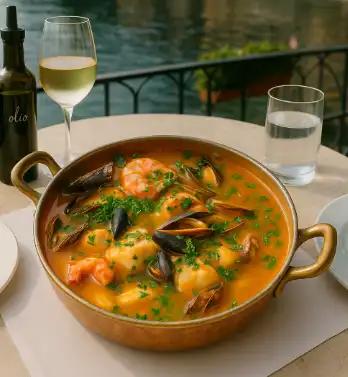
A picture drawn by ChatGPT.