
Luxurious Brisket Doenjang Stew
When it comes to cooking, food waste is a constant. In professional terms, discard is inevitable—it will always happen.
A little during prep. A little more whenever someone makes a mistake. A little again when finished dishes are left unfinished or go uneaten.
Those little bits pile up, and every day a mountain of waste is produced. Discard scales with the volume of cooking, which is why waste management is critically important in the food service industry. It is the difference between profit and loss.
Nowhere is that clearer than in a buffet, where hundreds of people come and go each day and any prepared dish that cools is already headed for the scrap heap. From the moment service begins, waste is being generated. So the quiet practice of saving perfectly good leftovers, reworking them right up to the limit before the next service, and sending them back out under a new face is an open secret.
Naturally, they are cooked into something that looks entirely different. Yesterday’s leftover grilled meat is trimmed and simmered with greens—or just vegetables and spices—into today’s soup. Seafood balls and fried toast get their filling from sushi or fritters that have gone cold or dried out overnight, mashed into paste. Hardened table bread is, of course, turned into breading.
The same thing happens in royal and noble kitchens. Of course, as mentioned before, the finished product is never meant for the employer. (No one can say what would become of the fool who served a reprocessed dish to a king or high noble.)
First it goes to the low-ranking staff who work the estate. Whatever remains after that is offered, cheap or free, to the nearby poor and underclass. This is not unique to Iceland; it is a daily reality across Europa and every other land.
In that sense, the lower classes of the Hadrian Margraviate—specifically those around Afterglow Fortress—are luckier than most. The luxury of eating meat at least once a day is rare outside places where great nobles reside.
And the ones usually charged with that work are the junior cooks.
Today, one such junior approached the senior who was still butchering beef for the gracious cheap stew that would feed Present’s poor and underclass. The junior’s face twisted the moment he saw the state of things.
The carcass was barely half finished. Worse, the biggest cut of all was nowhere in sight.
“What, the butchering still isn’t done? Where’s the toughest, biggest piece? Don’t tell me you pocketed it.”
“...”
“Hey. You listening? You dead?”
“Gah! Give a man some warning before you scare the life out of him!”
“Whether you jump or not is none of my business. You hurt somewhere?”
When the senior shot him a look that asked what he was on about, the junior jerked his chin toward the unfinished meat and the nearly empty scrap bucket. Ah. The senior let out a small sigh of understanding.
“My mistake. The plate went to a guest.”
“...I keep telling you not to use those fancy words. Wait—brisket? That huge scrap cut? What for?”
“How should I know?”
“You have any idea what he’s planning to do with it?”
Go look yourself, the senior’s silence said as he pointed his butchering knife toward Karem, who was already working the brisket.
Karem had separated the tough lean meat of the brisket and was now slicing the fatty portion—chadolbagi—into several thick slabs, then shaving them paper-thin.
“Why would anyone take that tough cut and—wait. Sliced that thin...”
“The toughness turns into chew.”
“With that thickness you wouldn’t even need a long braise. You could just grill it. Even a quick boil would finish it fast.”
“Ha. Right. If it’s tough and hard, just slice it thin. Such a simple idea and I never thought of it.”
“Looks almost like a leatherworker peeling parchment.”
“You actually know that?”
“My people back home were tanners, thank you very much.”
“Well now! Knowledgeable under that rough exterior, are we?”
The junior had nothing left to say. They both looked like the same muscle-bound, mountain-bandit, mustachioed barbarians—who was calling whom rough-looking?
While the junior debated whether to smack the senior upside the head, the senior went back to his knife and watched Karem with growing curiosity. The thin sheets, only a little thicker than parchment, were stacking into a neat little hill on one side of the board.
“You know what brisket tastes like?”
“I eat the stuff every day. Of course I do.”
The junior frowned as if the question were ridiculous.
“You never tried it?”
“I’ve got money. Why would I bother?”
“Fair enough.”
The junior scratched his head in agreement.
“It’s not bad, mind you. When you make stock with brisket you get a rich broth. Trouble is, to make the meat itself edible you have to boil it forever.”
And by the time it was soft enough to eat, every last bit of flavor had leached into the stock, leaving the meat literally tasteless.
“So can you guess what that meat over there is going to taste like?”
The junior answered with a shrug. Even the same cut could taste completely different depending on how you sliced, cooked, and seasoned it. Until now he had almost never eaten brisket any way except long-boiled and drained of every scrap of flavor.
“I grilled a piece first because you ought to know the taste before you cook with it...”
“So you did try it.”
“Meat’s so dense it’s not really something you want to eat that way.”
“Then if you slice it thin like that—”
The senior never finished the sentence.
“What’s going on? The butchering should have been finished by now. Why am I still looking at meat hanging off the bone in chunks?”
Interrupted mid-word, the senior simply pointed toward Karem the same way he had pointed for the junior. Head Chef Borgo’s face twisted as he turned—and a rich, unfamiliar aroma he had never smelled before drifted past his Kaiser mustache. Strange, yet not at all unpleasant.
“Been a while since I made this. Doesn’t seem all that different, though.”
It had been made with doenjang fermented from pea meju blessed by the Three Gods Sect prayer-meta, yet the smell alone was almost identical to the doenjang stew of his previous life.
Karem stirred half a spoonful of the red witch’s finger powder kept in the kitchen into the stew and reached for a taste—
“Ah, right.”
He had nearly forgotten the most important part.
He scooped a generous handful of the piled chadolbagi and dumped it into the pot. The slices were a touch thicker than restaurant standard because they were raw, and he had put in far more than usual. For a moment the meat seemed to resist; then the fierce heat turned it the color of the stew in an instant.
In that short span the beef fat bloomed red. The moment the chadolbagi went in, the aroma deepened. Finding the sensation close enough to his previous life, Karem quickly ladled a little and tasted carefully.
The seasoning was fine. After years of cooking—this life and the last—getting the salt right was the least he could do. The real issue was...
“...Tsk. That’s not quite it.”
It was the taste he remembered, yet something subtle left him unsatisfied. Specifically, it was missing about two percent.
The doenjang stew resurrected across dimensions was definitely delicious. The distinctive earthiness came through even though it had been made from peas. The clean heat of vegetable stock and dashi, the harmony of the chadolbagi’s richness and meaty fragrance—all of it worked. The absence of tofu was a minor quibble he could overlook. What was missing was that addictive, spoon-after-spoon umami that still lived so clearly in his memory.
Even if I used kelp, I guess modern MSG still wins in the end.
He tasted again. Everything else was good; the two-percent shortfall remained.
“Hmm... well, nothing to be done, I suppose.”
Half success, half failure. He had expected as much. Different world, different ingredients. Managing to ferment meju and make doenjang at all was already more than enough for a cook.
If he had been a chemistry major he might have known how to extract pure MSG from foodstuffs, but Karem certainly did not. Chemistry? He barely remembered the subject.
Even so, the achievement alone was enough to leave people speechless, and yet the lingering disappointment was hard to shake. Besides, he had chadolbagi—if only there had been rice...
A prickling gaze stabbed into his back.
He turned.
“...”
“...”
“...”
Karem locked eyes with a crowd of cooks—including Head Chef Borgo of the Afterglow Fortress kitchen—all of them watching with open curiosity, noses twitching.
In the awkward silence Borgo wiped his bald head with a handkerchief and stepped closer.
“Ahem. Ahem. My apologies. That aroma was simply too interesting.”
“...There isn’t enough for everyone to try. I’ll have to make another batch.”
“Naturally. Just say the word for whatever ingredients you need.”
The volume of stew that needed cooking more than doubled on the spot. Still, preparation did not take long. Karem returned to his room for more kelp. By the time the dashi had fully extracted, the free-handed cooks had finished their prep and begun cooking as well.
Ingredients went into the boiling stock in proper order; at the end the chadolbagi was scattered across the surface and the pot was brought to a final boil.
Even for Icelanders working in a great noble’s kitchen, a stew made with bean-based garum—doenjang—and chadolbagi was something they had never tasted. The flavor was so foreign, so utterly unlike the familiar Europa dishes that otherwise resembled Western cuisine, that the cooks’ reactions split sharply after the first bowl.
“Earthy and a little spicy, yet so deep it sticks to the mouth.”
“Even with brisket, in a pot this size, with that many vegetables—how can it taste this rich? This actually works?”
“...Garum made from beans? Is this the bean flavor I know? I... I can’t even tell. Beans?”
“Hmm. Ho. Hmm. This is a bit addictive. I could drink several bowls.”
Those were the positive ones.
“Everything’s fine except the finish. That lingering dryness is unpleasant.”
“Ugh, what is that smell? Musty, I guess?”
“It’s deep, sure, but isn’t it too light? Too light to make a meal of by itself!”
“Mm. Definitely beans. I don’t like beans.”
Those were the negative ones.
“Sliced thin like that, the flavor comes out even without a long simmer.”
“More than that—cut this way it’s actually tender.”
“For a stew the seasoning and kick are pretty strong. For a main dish—got any leftover bread—?”
“No. This doesn’t go with bread. Butter’s no good either. Something denser—”
Those were the analytical ones.
Among them, one suggestion struck a chord.
“What about pasta instead of bread?”
The man who had said it didn’t go with bread looked up. Borgo blinked.
“Pasta?”
“Yes. Not the fancy shapes—the long ones.”
“Flat kinds like fettuccine?”
“I was thinking spaghetti. That would work too.”
There was no rice, but there was flour and eggs. Which meant they could make noodles.
Doenjang stew went beautifully with rice, but it also paired well with noodles. Ideally somen or knife-cut kalguksu—
“Since we’re already here, let’s make all of them and try.”
Fresh pasta was similar to kalguksu in certain ways. At the very least, after a long boil and soak the textures converged.
There was more than enough doenjang.
Attached Material
— Brisket Doenjang Stew —
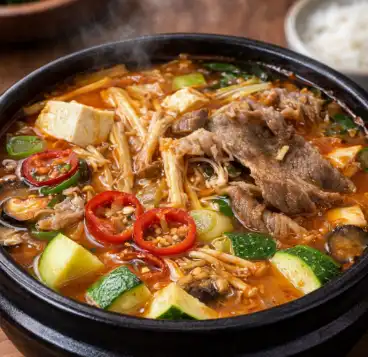
This is a picture drawn by ChatGPT.