
The Owners of This Land (1)
The hunt unfolded with a wild, rhythmic energy.
“Woo-ah! Woo-ah! Woo-ah!”
Hunting in this era took many forms. The simplest was to crouch hidden in the bushes, waiting for prey to draw near before thrusting a spear. Another was to relentlessly pursue an animal until it collapsed from exhaustion.
But here, among those other tribes called the “Plains Rock People,” the method was different.
“Woo! Woo! Woo!”
They advanced deliberately, making as much noise as possible.
Their faces and bodies were painted with bright dyes of many colors. Rather than hunters, they looked like participants in some vivid ritual. When such a noisy, colorful group approached, the ever-nervous gazelles could not possibly stay still.
Tap-tap-tap!
The herd burst from the undergrowth all at once. Startled, the gazelles instinctively fled toward the quietest, emptiest-looking direction.
At that exact moment—
“Block the front!”
At the shout, men clutching spears sprang up from the bushes. They wore masks woven from grass, and long leaves and twigs were tied thickly across their shoulders and waists.
From a distance they looked like nothing more than swaying vegetation, but up close they were unmistakably human. When the bushes suddenly transformed into people right before their eyes, the gazelle herd froze in terror.
Run.
But the way ahead was blocked.
From behind came a thunderous clamor. When they tried to slip sideways, more grass-like figures stood waiting there too. The herd lost all sense of direction in an instant.
In that brief moment of confusion—
“Throw!”
Whoosh!
Bolas and nets that had been spinning overhead flew in from every side.
Heavy stones tied to cords sliced through the air in wide arcs. Several of them wrapped around the slender legs of gazelles trying to flee.
Thud!
One animal went down, and those behind it panicked and veered sharply.
But it was already too late.
The hunters had blocked the retreat from the beginning and guided the prey’s movement. The moment the herd failed to escape that first trap, their fate was sealed.
By the time the hunt ended, the gazelles lay bound by bolas around their legs or bodies, uttering only pitiful cries.
Kiiiieeeek—!
Meeeeeeeek—!
The noise was ear-splitting, yet so familiar that it no longer bothered anyone.
“This hunt was a great success,” someone said.
I nodded. Game had grown scarce around here lately; a large herd like this was rare indeed.
“Only take the big ones. Release the females and the young.”
At my words, the hunters nodded as if it were obvious. Even if they killed them all, there was no way to carry so many, and with this many gazelles the meat would already be more than enough.
Kieek…!
Soon came the final cries, and the metallic scent of blood filled the air. A short distance away, the released gazelles glanced back once before bolting into the distance.
I watched them for a moment, then turned and shouted.
“Let’s head back!”
When we reached the nesting site nestled in a basin of massive boulders—now more like a half-formed village—people were clustered in one corner, drying papyrus and shaping clay into pottery.
A few years ago they had been the group led by Tall Bird, but now they lived among us, weaving grass into all sorts of objects, wandering the forest to gather fruit and edible plants.
As we returned carrying the successful hunt, heads began to lift one by one. Children ran forward first, followed by adults waving and smiling.
Among them, Tall Bird was waving too.
He looked even smaller than before.
Or rather, I had grown much larger.
Five years.
A long time, or a short one, depending on how you saw it.
In that span I had shot up. I had always been tall for a Homo erectus, and thanks to never going hungry during my growth years, I now stood a full handspan taller than my peers.
When I remembered how, in my previous life, I had been smaller than others my age, the contrast filled me with deep emotion. I waved back at Tall Bird.
That was when I heard it.
“Pretty Eyes.”
I turned toward the voice and saw my father approaching.
He limped slowly on one leg. After injuring it badly during a hunt two years ago, he had aged noticeably fast.
Almost as if he had already finished everything he needed to do.
My mother stood beside him. She too looked far older than before. Seeing them both made me wonder whether aging among Homo erectus struck all at once after a certain point.
Given that our average lifespan hovered around thirty and my father was already nearing fifty, it was hardly strange.
“Did the hunt go well?”
“Yes. We caught six.”
I held up six fingers. Father nodded, satisfied.
But his gaze soon drifted past me, toward the basin as a whole.
“Ahahaha!”
“Kyaaaruk!”
Children’s laughter filled the entire hollow.
There were so many of them. Truly so many.
Most had been born in the last five years. After hearing my father’s words that day five years ago, I had shared everything I knew with the tribe as much as I could.
This was the result.
The sleeping area beneath the rock overhang, which once let wind and rain pour straight in, now had earthen walls that made far more comfortable beds.
On one side, people were carving atlatls and fletching throwing spears. In another corner of the basin sat baskets of sand and gravel for filtering water. Nearby, freshly fired pottery glowed red in the sunlight, and children laughed as they packed them with dried meat and berries.
The things I had learned, imagined, and seen in the modern world. The Paleolithic technologies that could somehow be reproduced with this era’s materials and hands.
They had absorbed it all with astonishing speed.
Fewer days of hunger. Fewer deaths from injury. Children who once died easily from rain and cold began to survive.
As a result, the tribe had grown rapidly.
The sound of children laughing was undoubtedly joyful. It was proof that we had survived, proof that we were moving in the right direction.
Yet Father did not seem to hear that laughter with pure happiness.
He gazed at the children with a bitter expression, then spoke in a low voice.
“…This land can no longer support us.”
I could say nothing.
Because I knew he was right.
Originally, Father’s Fast Foot Tribe had numbered about forty. Even that had made them one of the largest groups at Ati.
Then Tall Bird’s twenty Boisei had joined.
Even then it had already been a lot. Normally the tribe should have split in two.
But the difference between Homo erectus and Boisei had allowed that precarious balance to hold.
Erectus mainly ate soft fruit, plant leaves, and meat. In contrast, Boisei could chew hard seeds, grains, tough roots, and stems without trouble.
Their diets did not completely overlap. Moreover, the Boisei were dexterous and especially skilled at working with grass and tree bark.
Thanks to that, the two groups had coexisted without conflict. Each filled what the other lacked.
But even that had its limits.
Nature is not infinite.
The trees that bore fruit were fixed. The paths beasts traveled were fixed. The ground where roots could be dug, the shallow waters where fish could be caught—everything had an end.
At first, walking a little farther had been enough. Then it became another full day’s walk. Now, even after two days of travel, they often returned empty-handed.
The hunters had to range ever farther. Those gathering plants and roots had to venture deeper into the forest. As more children survived, more mouths needed feeding.
Originally this should never have happened.
In the dry season they returned to Ati. In the wet season they moved to other lands. The earth rested after people left and gave food again when they returned.
That was how things worked in this era.
Yet for three years now we had been unable to leave properly—not for Ati, nor for any other territory.
“…Chief! Chief!”
At that moment, an urgent voice burst from the entrance of the basin.
I turned to see a man running toward us, face full of panic, gasping for breath.
“Those bastards are back again!”
I frowned.
“Where this time?”
“The Mountain Cave Tribe! They entered our hunting ground again! They took every rabbit we released!”
At those words, the expressions of those around us hardened.
That place was a small valley we had deliberately chosen. Surrounded by rocks and thorny bushes, it kept the released rabbits from escaping easily. We had been saving it so that when their numbers grew we could harvest them properly. Yet they had raided it again.
A sigh rose in my throat.
“Chief! Chief! Th-those guys, they’re back again!!”
This time a Boisei came running, panting.
“…The Stump Tribe on the other side?”
At my question, he clapped with a bright face.
“Yes! Chief is smart! They dug up every root we planted!!”
Another sigh escaped me.
That was a patch we had prepared with hardy, edible root plants. They had stripped it clean too.
“Haaaa…”
The reason we were trapped on this land.
It was because of the two tribes that had settled around us.
The Mountain Cave Tribe.
And the Stump Tribe.
They had each taken over two of the other seasonal shelters we used to move between, claiming them as if they had always belonged to them. They greedily eyed everything nearby and constantly watched for chances to strike at us.
“Any injuries?”
“None. If the numbers are equal, we are stronger!”
“But those guys keep moving in big groups. We don’t travel together that much.”
“If the numbers are equal or they have more, they run. Cowards.”
I sighed again.
When we tried to fight, they simply fled. Armed with simple stones and wooden spears, they escaped before we could catch them.
The one small mercy was that they did not possess advanced tools like stone-tipped spears. That told me they were not among the groups that visited Ati.
The people at Ati had all learned from me how to make adhesive and craft stone knives and spears.
Yet ignoring them was impossible. They continued to harass us in small ways, entering our territory to hunt and gather plants excessively.
The same reason prevented us from leaving for Ati.
For some reason they coveted this land. Once, when the dry season grew too severe and we tried to head for Ati, they had swarmed in during that brief window and nearly triggered a major battle.
Abandoning this land carried too great a risk of failing to find new territory, and fighting would bring heavy losses. We were truly caught in every direction.
In some ways, it reminds me of my previous life.
Back then the Red Face Tribe had attacked us. But that had been because of an extreme dry season.
Water had dried up. Food had vanished. To survive, they had to push others out.
That fight had had a reason.
This time was different.
They did not look starved. The lands they occupied should have provided enough food. Yet still they provoked us.
They raided our hunting grounds. They dug up our root patches. Little by little they dismantled what we had built.
What drove me crazy was that I could not understand why.
And what drove me even crazier was that, until I understood the reason, I could not fight them properly.
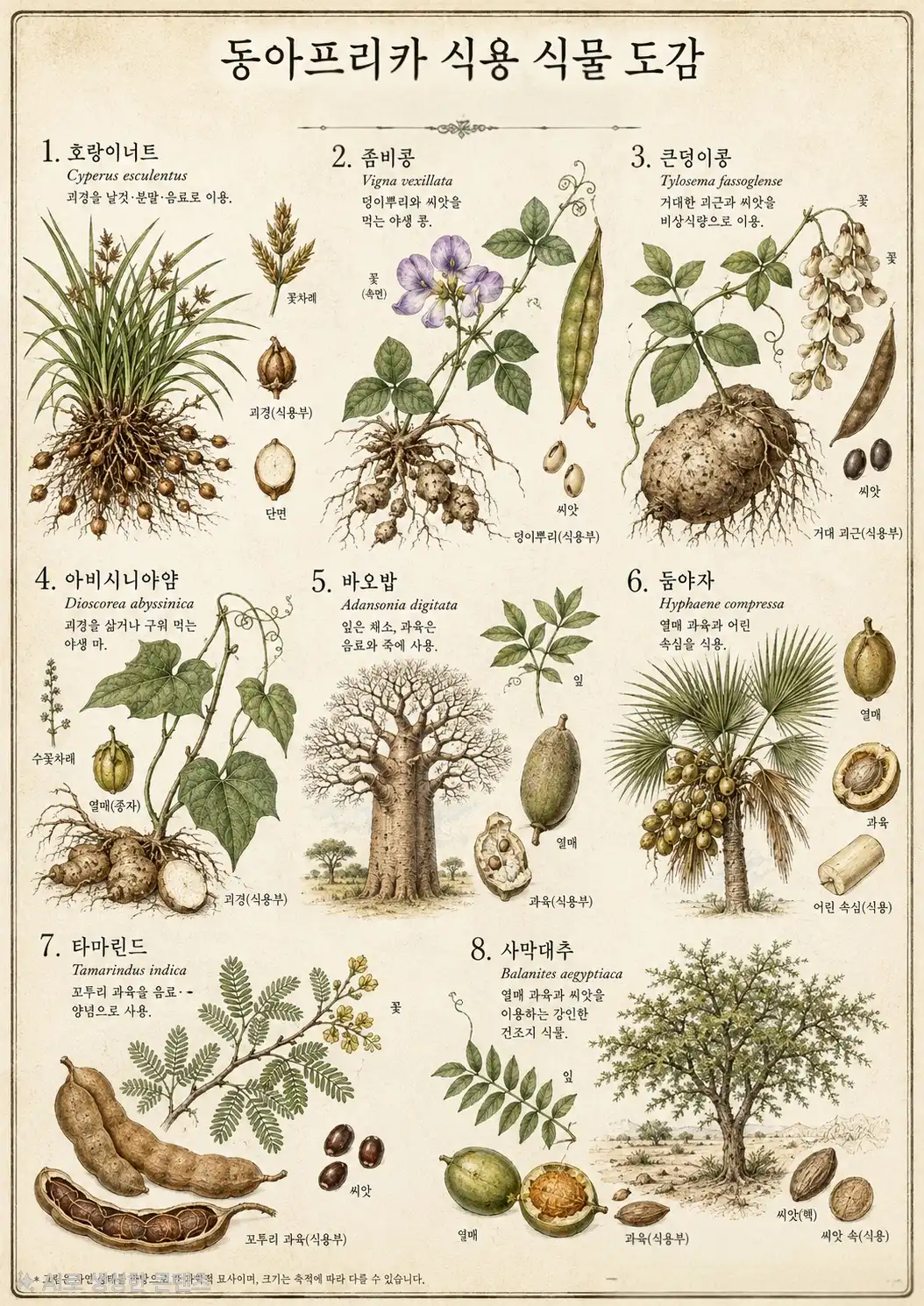
When people think of Africa, crops like cassava, yam, and taro often come to mind first.
Interestingly, most of them are not actually native to Africa. Cassava originated in South America, taro in Southeast Asia. Yam is African in origin but developed mainly in West Africa, so it will be some time yet before our protagonist encounters it.
As the image shows, however, many edible plants have grown wild in East Africa since ancient times, simply overshadowed by those more famous crops. They are still gathered or cultivated in some regions today—old, resilient foods that have clung to life even in dry soil.
That is why most of the plants the protagonist eats consist of such fruits. Or they might enjoy sweet, delicious things like marula or wild figs—but those are not only delicious to humans.