
The Giant of Africa (2)
It wasn't as though elephants had never been hunted by humans before.
Hunting a full-grown elephant was extraordinarily difficult and dangerous, but the reward that followed was sweet beyond measure. There was more meat than anyone could count, and the massive bones and ivory were excellent materials in their own right—prized resources and trophies alike.
But the elephants that fell to such hunts were never the ones who led the herd—strong matriarchs—or the young bulls that roamed on their own. Provoking a herd was madness. A matriarch would fight to the death for her calves, and a lone bull was a monster that charged without reason.
So the occasional elephant that was hunted was always one of two: a calf that had somehow become separated from the herd, or an old, sickly individual too weak to protect itself.
These were the ones brought down by humanity's frail arms, their spears, and their stones.
Even so, it was a perilous undertaking, and many lives could be lost. Most herds were smart enough not to even consider confronting elephants. Proper elephant hunting only became feasible once stone tools had advanced and Homo sapiens, with stamina that surpassed every other animal, came into their own.
While I was lost in such thoughts, the meat had already been fully butchered, and the smoking was mostly finished.
We ate one leg right there on the spot.
When the meal was done, I stood up.
"Hmm? Where are you going?"
"Just taking a look around."
I had a lot on my mind, and I was curious about the current situation, so I thought I'd wander a bit.
"Alright. Be careful. Come back before sunset."
"Yeah."
---
Arti was a gathering place where different species converged around the central lake, and from there, the various groups fanned out to settle in their own territories.
The shelters came in many forms. Some dug shallow pits into the ground and covered them with branches and leaves for roofs. Others simply spread dry grass beneath trees or rock overhangs where they could shield themselves from wind and rain.
It was mildly entertaining to observe the different sleeping arrangements across species and cultures, but the atmosphere here was far too heavy to enjoy anything purely for its own sake.
"…"
Everyone was hoarding food. Fish were being smoked, fruit was being hidden away.
People dug holes beneath their shelters and buried provisions, afraid someone would steal them. Groups patrolled with spears, guarding what little food they had.
It was a strange scene.
I hadn't been here more than a few weeks, and yet this place had been abundant—overflowing with food. The vast lake offered more fish than anyone could see the end of. The fertile floodplain soil and the tender grasses that grew from it drew countless herbivores. And because of all the water, the forest just beyond the grassland never dried out even in dry season, so fruit could still be gathered.
All of it had frozen solid the moment the elephant herd appeared and began threatening people.
But if you thought about it for even a moment, it wasn't so strange. Plenty meant plenty only as long as you could use it freely. No matter how many fish filled the lake, if too many people came to fish, the fish would simply retreat to deeper water. No matter how much fruit hung in the trees, if elephants trampled their way through or lingered nearby, no one dared reach up. No matter how many prey animals roamed the grassland, if they fled from the elephants and the elephants drove away the hunters, there was no way to catch anything.
The abundance remained, but before the overwhelming force of nature called elephants, it had all turned to mirage.
"…This is a real mess."
Well, maybe this wouldn't last long. Even if the elephants were furious, they might calm down after killing a few people and some time passing.
But before that happened, I suspected people would start fighting each other first.
Even now, unable to hunt, people who still had food left were too distrustful of one another to stop hiding what they had. If this dragged on for even a few more weeks, it was obvious that suspicion and violence over stolen food would erupt. And on top of everything, there was almost no way to store food, so nothing could be preserved for long.
So—was there any way to resolve a situation like this?
I almost laughed at myself for thinking that, but somewhere in the back of my mind, a sense of responsibility had taken root, thanks to the memory of having once lived as a leader in a previous life, even if only briefly. There was, in fact, a very simple solution.
An utterly primal act, so deeply woven into the human experience that it was less a choice than a part of life itself.
Hunting.
Hunt the rampaging elephant herd and drive them away. Then the abundant meat and bones and ivory would be ours, and we could enjoy this land's rich nature again until the next flood came.
Theoretically, the method wasn't all that difficult. There were nearly ten thousand people here who knew how to throw stones.
No matter how mighty an elephant was—the strongest land animal—ten thousand rocks falling at once would change the equation. If even a few hit their marks, eyes could be torn open, legs broken, and wounds could accumulate across the body and head.
If strength wasn't enough, you pushed with numbers. That had always been humanity's way.
But.
"…That's ridiculous."
I shook my head immediately.
Just because there were ten thousand people didn't mean they could move as one body.
Right here, there were groups that didn't even speak the same language. And even among those who did, there were groups that didn't trust each other. Members of the same species were hiding food and watching the neighboring groups for any sign of trouble.
You wanted those people to pick up stones and charge at elephants?
They probably wouldn't even follow my words. And the moment they faced the elephants, they'd scatter—if they were lucky.
And elephants were not stupid. Especially the old matriarch leading the herd—she was even smarter.
She knew how to protect her calves, how to read threats, and how to trample anything weaker than herself.
If ten thousand poorly coordinated people rushed in and threw stones, the first few might get hurt. With luck, maybe one elephant would go down.
But then what?
In the end, we might win through sheer numbers.
But there was no way to push them into a battle where hundreds would die and thousands would be wounded. Especially with species like Paranthropus boisei in the mix, who were useless in combat.
So in the end, there was only one method left.
"Drive them away."
Not kill them. Drive them away.
Once I thought of it that way, the tangled thread in my mind began to slowly unravel.
If you couldn't match elephants head-on in strength, then you simply didn't fight them head-on.
Sound, fire, smell. Mobilize everything at your disposal and force the creatures to leave.
And I knew how to do it.
It was when I had been traveling through Africa with Professor Park. We had no research budget and no time, so the two of us had bounced around in an old car.
One night, we had stayed overnight in a tribal village. Not the kind of primitive settlement I'd imagined—there were modern buildings, solar panels, and children playing with worn-out balls. It looked much like a rural village back in Korea.
But when night fell, a sight unique to that place unfolded before us. The villagers were chasing elephants away from the fields.
The village chief told us: elephants were too clever for the same method to work for long. But among the ways to scare them off without hurting them, after using real bees, one of the more effective methods was—
He swung a object tied to a cord in wide circles through the air.
Bung, bung, buuuung.
A low, trembling sound filled the night air.
It sounded like wind at first, and also like a swarm of bees approaching from far away.
The moment that sound rang out, the elephants lingering at the edges of the field froze. They raised their long trunks to sniff the air, flapped their ears, surveyed the surroundings, and after only a short while, they slowly retreated.
Elephants instinctively avoid bees. Their thick layer of fat ignores bee stings, but they despise small insects flying near their eyes or ears. Even the sound of small wingbeats is enough to make them flee.
And there was a tool that could produce exactly that sound.
Humanity's first communication device, and also its first instrument.
The bullroarer was the answer.
If I had that, it might be possible.
The problem was whether the groups here would listen to me.
This method could absolutely not be done alone. At minimum, several dozen people, and for real effect, a hundred would need to gather and move together.
Actually, I wasn't even sure they'd understand me if I tried to explain. My head was starting to ache just thinking about it.
Dung. Dang. Dung, dang.
An odd sound came from somewhere nearby.
Something hard striking against something else, producing a strangely clear tone. I never would have expected to hear a sound like that in this era.
I turned my head reflexively.
There, in front of a burrow that looked like a shelter, sat a young child. The child was tapping a row of bones laid out in a line with a thin wooden stick.
The bones the child was striking were strangely varied in shape. Some were long and straight, others curved, and some still seemed fresh—smooth, with a soft, pale glow, as though the ends hadn't fully hardened yet.
The size was… peculiar.
Too thick to be deer or gazelle bone, yet too narrow to be hippo. I'd seen countless kinds of bones in my life, but I'd never seen bones like these before.
"…What is that?"
The moment I took a step forward, the child spotted me and gripped the bone stick tightly.
Then two adults emerged from inside the burrow.
Small bone fragments were strung along their necks and arms. They were a bit crude to call ornaments, yet strangely well-polished to be mere trophies. I imagined it was their culture.
They regarded me warily, then quietly took the child by the shoulder and led them back inside the burrow.
Dung.
The bone that had slipped from the child's hand struck the ground with a clear ring.
I watched that scene for a moment, and a thought flickered through my mind. The child striking the bones reminded me of a percussion instrument.
'…I could try making a drum.'
It would be difficult, but there was no reason I couldn't. The buzzing of bees. The smell of fire. And the deep resonance of hundreds of people striking drums at once.
If I had that, it might be enough to threaten the elephants.
And more than that—I thought it might be possible to bring the various groups together under one purpose.
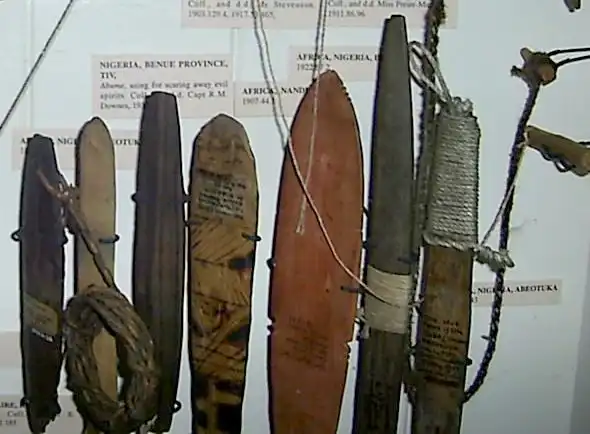
Bullroarers in various forms at the Pitt Rivers Museum
The bullroarer—a wooden or bone oval tied to a long cord—produces a low, long cry, just as its name suggests. The sound spread widely and was used as a signaling device, and in some tribes it held religious significance.