
Episode 1 - Drought (3)
Everything was already prepared, so finishing up took only a moment. We had rations that could last a few weeks if rationed carefully, and several waterskins made from dried animal intestines. Stuffing them into grass baskets and slinging them on our backs was all it took.
"Let's go."
I said it and started walking. The whole group fell in silently behind me. The seasoned old males guarded the rear, the young ones and females stayed in the center, and the young males flanked the sides and front, gripping wooden spears hardened in fire. It wasn't a perfect formation. But it was the best we could manage right now.
I led from the front, scanning our surroundings slowly. The forest was far quieter than before. No bird calls echoing from the trees, no rustle of small animals in the underbrush. Just the harsh scrape of dry leaves clashing in the wind, crackling from every direction. The world was drying up, bit by bit.
The ground had hardened to stone, cracked earth where there should have been mud. Dust puffed faintly with every step. Places that once held even a small puddle were bone-dry now, no trace of moisture.
"Chief."
Caesar, walking beside me, spoke low.
"Where to?"
I stared ahead without answering for a moment. No exact destination. Keep heading south? Seek a denser forest? Follow the scent of water? No certainties. But one thing was clear: stay here, and we die.
"Somewhere with water."
"How you know?"
"Don't."
Caesar shut his mouth at that. Truth was, I had a vague hunch. If this was near the jungle I'd explored with Professor Park, then we were around the Moyowai Game Reserve in Tanzania or close by. Head north from here—farther than the Red Face tribe's territory—and you'd hit Lake Victoria.
Of course, Lake Victoria wouldn't form until around 500,000 BC, so right now it was probably just rivers and wetlands in a lowland basin. Problem was, all that hinged on my memories and gut feeling. 2.5 million years ago, at minimum. Volcanoes could erase or birth mountains in that span; the climate was nothing like modern times. The terrain wouldn't match any map of Tanzania I knew.
And the journey there? Brutal. The Moyowai reserve alone was ten times the size of Seoul.
We kept walking. Fine until the sun climbed overhead. Air still breathable, baskets' weight tolerable. But as time dragged, things worsened visibly. We'd always lived near damp nests; hadn't realized how the bone-dry forest air sapped strength so fast.
If it's this bad in the woods, the open plains...>
That'd be true hell.
About three hours in, we stopped to rest. No walking at noon. Suicide. Not for nothing did modern African cities shut down from 1 to 2 PM. Impossible to move in that heat.
We found a spot with scant shade and halted. Didn't help much. Wind scorched even under trees; heat rose from the earth. They dropped packs one by one, heaving ragged breaths. Some lolled tongues, others licked cracked lips—but saliva barely came, faces twisting in frustration.
I pulled out a waterskin, shook it. Still plenty; we'd sipped sparingly. I wet just my lips and passed it around.
"Small sips. One mouthful each."
The one who'd lunged for a gulp froze at my words, took a tiny sip like me, and passed it on. Not abundant, but enough for one each.
We hunkered in the shade, waiting for sunset, when Caesar sidled up.
"Chief."
"What."
"Water really there?"
Couldn't answer. No certainty, honestly. Just old maps in my head, faint terrain sense, a probably this way hunch. But hesitate here, and they'd sense the doubt. So I feigned calm, gazing afar.
"...Got to go either way."
Staying meant death by inches.
I scanned around. Even insects scarce under shade. Should've been worms wriggling by rotten logs or damp soil. Now? Too dry. Flip earth, just dust; peel bark, no moisture inside. Bad sign.
Had to minimize movement till past noon. But couldn't idle completely.
"I'll scout around."
I stood; Caesar rose too.
"I go with."
"Do what you want."
We slipped away from the group, moving slow. Too far was risky, but blind marching worse. Forest thinning: wider tree gaps, patchy low brush like it'd been grazed bare. Soon, forest's edge.
Beyond: yellowed, withered plain.
Then—
Ku-gu-gu-gu—!
Dull vibration throbbed up from the ground. Caesar's eyes widened.
"What...?"
I grabbed the nearest tree, scrambled up. Caesar followed. Perched on a branch, panting, I peered at the plain—and my eyes bulged.
Hordes of beasts thundering. Black hides, long curved horns, sturdy shoulders, slender tough legs. Like modern gnu, but subtly off: build, horn angle. Ancestors, probably.
All charging north. Not a few—dozens, hundreds, thousands. Dust clouds like a vast ribbon; hoofbeats shook our distant perch.
Herd intact, aimed like they knew the way.
Caesar muttered blankly.
"Running away?"
"...No."
Too orderly, not panicked. But I'd seen this: pre-dig docs, Serengeti gnu migrations. Rainy season when I went, missed it—but this matched perfectly.
Direction: north. My hunch right.
"...Water."
"Huh?"
"Water there, or at least wet land. They know."
Caesar stared.
"Really?"
"They know better than us. Heading for water, sure."
Their instincts trumped ours. Follow, and we'd find it. No rush—their trail would be massive.
"Follow them. Water guaranteed."
I turned to go; Caesar grabbed my shoulder.
"Why?"
His gaze fixed beyond the herd's path.
"Chief. Monster coming."
There: shimmering haze, black smoke. Distant, but fire, unmistakable.
Spontaneous combustion?
Dry season Africa: sun, friction, lightning—fires sparked easy. Parched grass? Instant blaze.
"...No rest time."
We hurried back.
"Move now. Hot monster coming."
Air shifted tense. They knew fire's double edge: familiar, yet wild ones deadly. Anxiety rippled; I cut it quick.
"Found water place."
Enough. Fear vanished; hope lit their faces. I shouldered my pack. Dry wind whipped my face. Throat burned worse since spotting the herd—hope unleashed the thirst I'd suppressed. Fire closing added agony.
But no sip for me. Leader breaks first, group crumbles faster.
Packing done, a young male atop a branch—scouting—froze. Eyes on nearby brush.
"...Chief."
Voice cracked. I stood sharp; others tensed, breaths held.
"What see?"
No words; trembling finger pointed.
"There, grass."
I narrowed eyes. Nothing at first: swaying yellow blades, heat-shimmered air. Then: low shadow gliding through. And before—a yellow eye flashing in sun. Slit pupil, feline predator.
It watched us.
I met its stare silent. It held still, waiting for slip.
Run? No—panic scatters, it picks off slow ones: young, old, weary females.
Fight? Tough. Spears few, fire-hardened wood only. Stone tools hasty, not battle-ready. Swarm it, maybe repel—but cost?
Fire coming. Fight long, escape cut off. Worst: half group lost before water.
Before I calculated, it emerged slow over grass. Huge bulk. Tawny pelt. Scar slashing left eye. Gaunt, starved, obsessed.
No doubt. The one—from before, still hunting us.
Its gaze: on me. Not easy prey, but me.
Eyes locked. I knew. It knew.
End it here.
I told Caesar instant:
"...Lead group away."
"You?"
Short breath.
"I stay."
Caesar's face hardened.
"Alone?"
"It wants me."
Eyes still fixed, I flashed brief grin.
"See? Not young, not old—me."
Caesar wordless. He knew: fixated predator chases fleeing group, culls weak. But sacrificing one? Hard swallow.
"Fight together. Win."
I shook head.
"Win, maybe."
But survivors?
"Tangle here, someone hurts. Drop before water. Hot monster no time."
Even at water, new threats: locals, rival groups. Numbers = strength. Fight, endure, coexist—more better.
Only way.
I tapped his chest, pressed thumb to forehead, nose-tip. Caesar flinched.
"I'm chief."
Voice calmer than thought.
"Chief fights for group."
Duty.
Caesar's throat bobbed. Lips moved, no sound.
"You guard next."
Silence. Hot wind hissed dry grass afar. Predator waited patient.
Caesar clenched teeth, nodded.
"...Got it."
Relief hit. I gripped spear, obsidian chopper. Spear: sharpened, fire-baked wood. Chopper: worn multipurpose, still sharp. Heart raced; mind crystal.
Maybe my last day.>
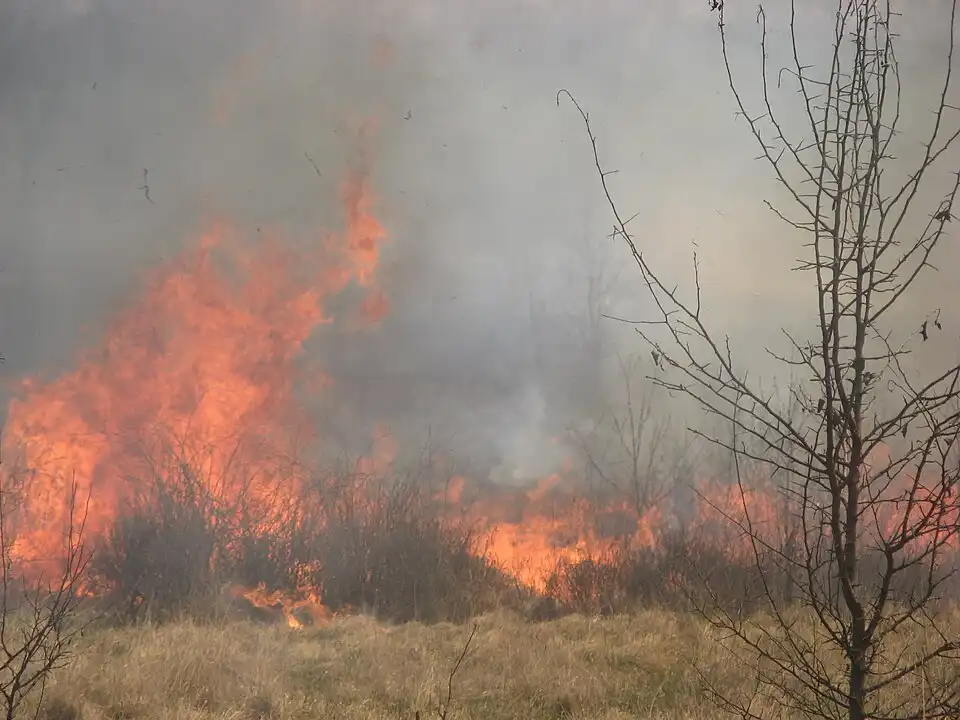
The above fire is a controlled burn intentionally ignited under administrators' supervision.
Africa conjures images of endless grasslands first. Dry season savannas are moisture-starved, blanketed in yellowed withered grass and shrubs. The whole land turns one massive tinderbox.
Thus, Africa's dry grasslands are fire-prone. These blaze without human help: dry lightning from unstable dry-season air, heat from rotting organics, sparks in ultra-arid spots.
Modern times add human causes: discarded glass/plastic bottles focusing sun, slash-and-burn farming, pasture management, careless embers.
Interestingly, not all bad for ecosystems. Controlled fires clear old grass/dead plants, make room for new sprouts, aid some seeds' germination. Reserves even set them deliberately for balance.