
Why Anomalies Are Futanari
“I get that the Human Dignity Committee is impressive. But what do you mean they ‘changed the era’?”
— After that incident, the Great Anomalies decided to let them have a go at it.
“Had a go?”
— With nothing left to stand in their way, the Committee beat down anomalies and humans alike and collected taxes from everyone.
“Uh…? Yeah… that’s… not what I expected… What about the Rules? What did the Rules do?”
— The Committee’s power is Discipline. They split it into external and internal discipline, and they simply ignore any law they don’t personally recognize. Crashing into ghost stories is fair game too.
“They didn’t lose the power they got during the Collective Order, right?”
— Since the Collective Order transformed on its own, of course they kept it.
— Their ability is weak compared to the Great Anomalies, but they attached so many restrictions to it that I heard they’re actually classified as a Minor Great Anomaly.
So this thing scams people too.
A Collective Order that can break the formless, and on top of that, separate powers gained from being an anomaly itself?
Isn’t that just a thug, whether by ability or by weight class?
“So what did they do with the taxes?”
— Having zero understanding of the Rules, they built nurseries for the Grade 5 anomalies that cause the most civilian damage, and for the most vulnerable people just entering the Anomaly World, they dispatch couriers to teach them basic information.
— I’m a nursery graduate myself, actually.
“Nothing else?”
“Hmm… In the past, they sponsored and supported an entity called the Gallery Master? Something like that.”
“Oh! There was something!”
— The Gallery Master got backstabbed by a Grade 1 anomaly called the Board Master, got gender-swapped, kidnapped, and locked up. The subsequent masters couldn’t survive the anomaly snipers, so it’s been effectively abandoned, from what I hear.
“Ah…”
The Gallery — a staple trope of ghost story fiction.
For a moment I thought how nice it would be if it actually existed, and hearing it had gone under made my heart ache a little.
Then again, in a world where anomalies play the stock market, of course the trolls couldn’t be stopped.
When I heard the word “gallery,” I imagined becoming a named user, the anonymous lurkers trembling in fear, the master throwing their hands up in surrender — but since the reality-anchoring anomalies would come along too, I gave up on the idea.
“Anything else?”
— Recently they tried making a broadcasting station and pro league and blew the tax money, or tried building long-distance transport with The Company… it all failed.
“Why?”
— For the long-distance transport, the anomalies asked to have stations built in their own territories too, but they refused, saying travel times would increase, got sniped, and the construction collapsed. As for the broadcasting station, a pro league that only gives out information is boring…
“Ah… the higher-ups are the same everywhere…”
— Ahem.
Politicians demanding a rail depot in their own district.
A city that, without any proper plan, made its low-level civil servants build something first, then went under because the resulting YouTuX knockoff was boring… and so on.
What the people at the top do really did seem identical everywhere.
— Still, for eighty years all the infrastructure was laid down by the Committee, so everyone pays their taxes properly. It’s only 5%, after all!
“But anomalies don’t need lifespan, do they? Why is lifespan a common resource?”
— Lifespan granted by the world can be converted by an anomaly into the corresponding emotional energy, you see. Even the lowest-grade anomaly can do this. And the reverse works too — emotions can be converted into lifespan.
“So when you defeat an anomaly you gain lifespan, and if you hand it over as currency, the anomaly converts it into emotional energy. Right?”
— Yes.
“Then what’s an Invitation? I vaguely remember it.”
— An Invitation is proof that an anomaly has acknowledged a particular human. Hmm… do you know the recently popular word… kkambu? Sworn-brothers? It’s like that.
“Ah… aaah, that thing.”
— One step below that, there’s also something called an Entry Pass. It’s a sign that you’re welcome to enter that territory as much as you like.
— With an Invitation, you’re treated as a guest of the territory whenever you arrive. With an Entry Pass, you enter as a visitor.
“So if someone with an Entry Pass is rude to the territory’s owner?”
— You have a match. As a ghost story.
“So it’s like an amusement park ticket.”
Then something else suddenly came to mind.
The Committee video I’d just watched, and the anomalies that appeared in it.
Aside from a few — the suited Stalker and the Mermaid among them — they hadn’t taken the form of beautiful women.
Even Kkamangi in front of me was cute, but clearly some other kind of lifeform.
“Hey, by any chance — do anomalies have variable forms?”
— Yes. Anomalies come in many different forms.
“What kind of body do they usually take?”
— Female. Mostly the form of a woman who also possesses male genitalia.
“Why?”
— Anomalies are passive beings, and most of them follow human common sense. Naturally, their outward appearance is heavily influenced by it too.
Hearing that only amplified my questions.
I could understand an anomaly’s alternate form being a beautiful girl. But why, of all things, a beautiful girl with a dick?
“Why do they take the form of a woman with male genitalia — a futanari?”
— Explaining from a human perspective, from the very basics… hmm… have you heard of humanity’s three great desires?
“Appetite, lust, and sleep, right?”
— I’m glad you know.
— First, sleep. Anomalies’ bodies are so exceptional that they’re fine sleeping only very rarely. They do have the desire for sleep, but they only actually sleep when truly enormous mental fatigue builds up.
— Appetite. In the past, indiscriminate cannibalism and absurd cooking methods sparked a war between humans and anomalies. That incident gave birth to the Great Anomaly known as the Chef, who was designated a controlled entity.
— So the only desire an anomaly can freely indulge, without control, is lust.
“What does that have to do with being futanari?”
— Their appearance follows conventional standards of beauty, so a beautiful girl. And down below, a futanari is a being with both, capable of satisfying both male and female lust, right?
“Fair enough.”
It made sense now.
They have human common sense and instinct, but precisely because of that, they obsess over their desires —
and since the only desire left unregulated is lust, they’d want to become a being possessing both male and female genitalia —
while their outward form, following universal standards of beauty, takes the shape of a woman because they want to be beautiful.
“Is it fine for anomalies to just change their bodies however they want?”
— An anomaly’s body is… hmm… how do I put it. It’s like an avatar in a virtual reality.
“I feel like I sort of get it, but it’s too abstract and vague. Be specific.”
— Creating a human body out of emotional energy, and transferring your mind into it.
— Essentially, it’s like a human buying an avatar in a virtual world through a VR device.
— One avatar for maintaining dignity, one futanari avatar for daily life.
— Most anomalies live like this. Too many bodies makes adaptation difficult, you see.
— Even if they have more, they usually just add one more on top of that. More than two bodies means paying extra taxes.
“Ah…”
It clicked perfectly.
Two bodies, no tax. Three bodies, extra tax.
So they make one as a concept piece and one as a daily-life futanari.
So even if you lose to a giant monster, you still get ravished by a futanari…
I could really feel that this was a world inside an eroge.
Even if something like Baek Room popped up, losing there would still mean getting ravished by a futanari, wouldn’t it?
— That’s why anomalies living with only one body have to be careful.
— Either they can change their appearance at will, or they’ve devoted themselves body and soul to that one form.
Then why does Stalker live with only one? I wondered, but the next words made it make sense.
Stalker can freely modify her body and alter it however she pleases, so living with one form is no problem for her.
“Then ghost stories. What body do you usually use for those?”
— If you truly, seriously need to use force, your original body. Otherwise, your daily-life body, I suppose? Once a ghost story begins, that body is locked in, after all.
Damn it…
I felt like my future had just been decided.
With this body of an ordinary human, it would be hard to provoke something into genuinely using force against an anomaly with heavy-machinery-grade physical specs.
Which meant my destiny was to trade blows — and more — with futanari anomalies…
“By the way, what happens to a human who loses to an anomaly?”
I prayed inwardly.
Please, don’t let it be the eternal onahole ending.
I prayed it wasn’t a game where a bad ending plays, you return to the title screen, and restart from a save.
Unlike a player who can retry at will, I was fated to keep living this one life.
— If it’s a man, he dies first, and has to revive using a revival item. In that case, the guaranteed 200-year lifespan gets halved each time.
— Usually he’s tortured for a week without dying, though “torture” is a strong word — these days, as a formality, they just punch a hole in something like the heart or the stomach and leave him be, from what I hear.
— Under the Committee’s supervision, all anomalies bound themselves by rule to a one-week torture limit, you see.
— The total emotional energy gained is half of what twenty years of torture would yield, but the benefits are greater, so I hear they switched to this method recently.
“Why?”
— Compared to imprisoning and torturing a human for twenty years — plus facility upkeep and the mental fatigue of management — the bonus gained from the restriction, and the bonus from human acceptance, are bigger, you see.
“The restriction bonus I get. What’s the acceptance bonus?”
— Anomalies are influenced by common sense. So by human common sense — being tortured for years to decades over a single defeat, versus feeling the pain and ache of a hole in your stomach for one week. Which one looks more reasonable to you?
“The latter, obviously.”
— Exactly. So the Committee persuaded the humans, persuaded the anomalies, and changed the old method. That’s where the bonus comes from — even though it’s only a week, the efficiency equals years of torture.
— Humans who lose also die obediently. They can just revive anyway, and pointlessly provoking the anomaly’s temper would only mean more torture added, at their own expense.
— And even if repeated defeats leave you unable to use extra lifespan, there’s a psychological safety net: you can take the exam and join the Committee before you die.
Men: on defeat, a hole punched and left for a week. Even after lifespan runs out, take the exam and join the Committee.
It was rational.
Harvesting negative emotions while minimizing torture, maximizing the benefit for the anomalies who had to manage humans —
A system designed so that neither anomalies nor humans would ever want to return to the old regime of decades-long torture, with even the Committee as insurance built in.
“Then what about women?”
But in the Stalker bad ending, I had been violated for 100 years.
For all their shouting about such a rational system, 100 years was far, far too much.
— The case of women is a bit controversial… they must receive the anomalies’ lust for ten years, and unless a request concerns their own dignity, they must grant almost everything the anomalies ask.
So that’s why the epilogue was ten years.
I’d wondered why it was ten years of all things, and now the question was answered.
The bad ending was the story immediately after the defeat; the epilogue was the story of ten years of being taken by the anomalies after losing.
“Isn’t ten years too much?”
— It is. But women who lose used to be lifetime playthings they could use however they pleased, no matter what. Ten years was the compromise they managed to cut it down to.
— Dignity means a permanent ban on mental damage and physical injury, and a ban on actions that would affect their future… I hear the Committee is looking for ways to reduce or soften even that.
— Something about tying it to the anomalies’ dignity… I don’t know the details, though.
“Doesn’t ten years mean ten years shaved off my lifespan? It’s 5 billion, isn’t it?”
— A defeated woman’s lifespan is treated as if the ghost story hasn’t ended yet, so it only decreases by one-tenth at a time.
Huh?
At those words, I turned my Save ability back on.
Autosave, and three slots below it for manual saves.
And even a notice that the ability couldn’t be used while a ghost story was in progress.
If I lose… I have to take everything, without my Save & Load ability…?!
I’d assumed I could go back even after losing.
I’d assumed it just didn’t open against Stalker, that I simply couldn’t use it.
But no.
I… was going to have to fully, completely endure ten years of an anomaly’s lust.
“Ten years… feels like I’m getting a raw deal somehow.”
— Right? I hear it’s possible to shorten it by paying lifespan to the anomaly, or through a trade…
“Tell me more about that.”
— Ten years is the period guaranteed by the Rules. Trades between individuals that the Rules tolerate can lengthen or shorten that period.
“Then what’s the market rate?”
— Trades are up to the anomaly, but buying with lifespan is usually one year per year. An even exchange.
One defeat costs ten years.
5 billion. 50 billion in real-world money.
In cash terms it was a massive loss, but with nine extra lives ahead of me, I felt reassured.
I have to buy it. No exceptions.
Stalker was 90 years, and since I didn’t know what would come in year nine, I absolutely had to trade if I lost.
I didn’t know what would come, or what kind of being it would be — but if this ordinary-human side of me ran out of time, it really would be over.
— Though I hear they’ll only trade down to nine years. And the more beautiful the woman, the shorter it gets.
Ah.
The moment Kkamangi finished speaking, I examined my body through the mirror.
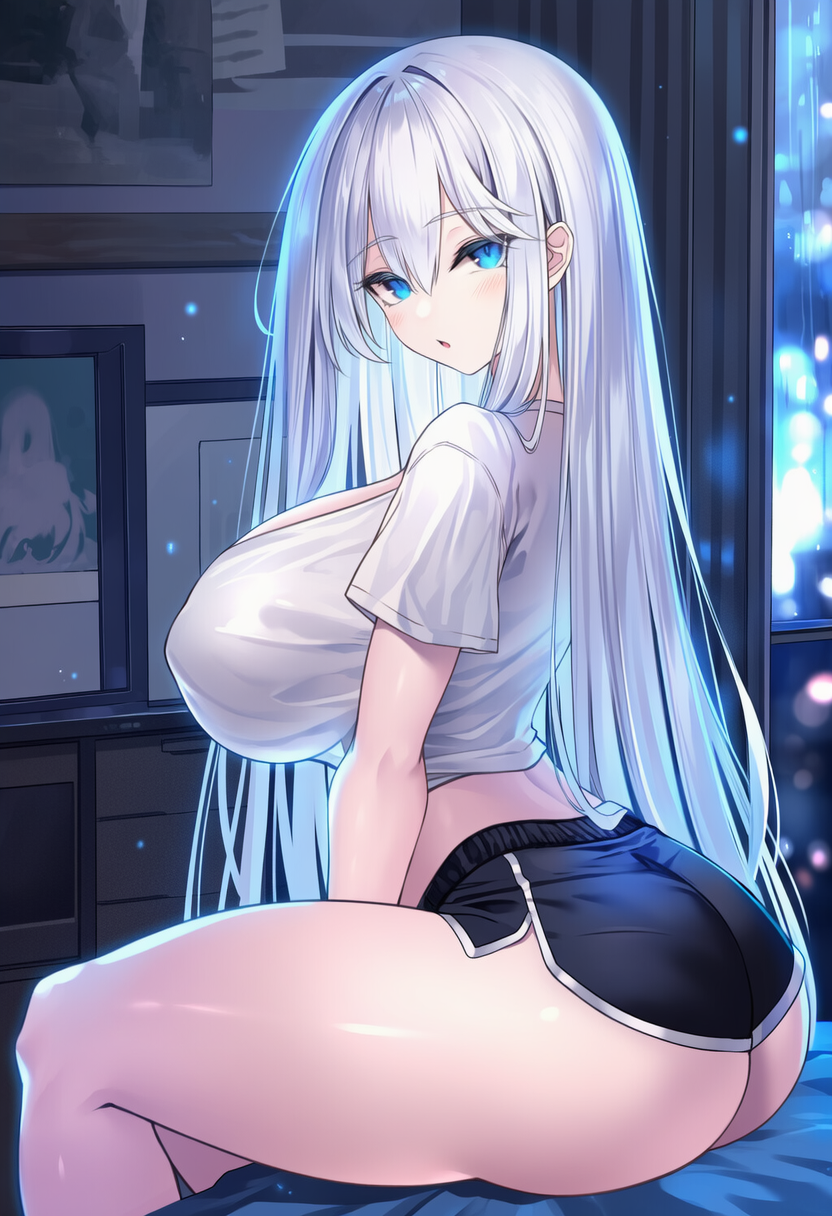
A beautiful face, a superb figure.
It might be limited to Stalker, but there was even the TS factor that anomalies supposedly loved.
As an existence, I was prey that anomalies wouldn’t want to let go of.
I’d better… get good at negotiating.
Worry about defeat was already creeping in.
If I lost… even if I had to sweet-talk my way through it, I had to buy time somehow.
— Ah! Your time is up. Would you like to extend?
“How can I get a blue letter?”
— Once you obtain one and get registered, it’s free once every three months. The rest you have to purchase from The Company at a rate of one day each. Shall I give you your free one now?
“Yeah. Give it.”
— Here you go! Thanks for your hard work!
Kkamangi held out the blue letter, and the moment I took it, it vanished as if its job was done.
I jotted down everything I’d learned, then lay down on the bed and sank into sleep.
Today had been exhausting — I’d dig deeper tomorrow.
(Preview)

(Welcome to my taxi, passenger.)
(I am a Grade 2 anomaly employed by The Company. A taxi driver.)
(My ability is Driving. The power to switch fates. If you lose, your fate will be switched, and you will become one of the taxi’s fixtures.)
(Personally, I’d prefer you become a doll.)
(Every single day. As I drive, I’ll hold you close and take you in slow, slow sex.)
(And occasionally, taking both your holes with a VIP customer wouldn’t be bad either.)