
The German Labour Party is Born
“So, I have a proposal. We’ll help you found your party—how about we work together?”
Thälmann said.
“We can set our ideological differences aside for now.”
“Hmm…”
When I’d announced my departure before, he hadn’t tried to stop me. Why the sudden change of heart?
“What’s the reason for this offer?”
“You’re even more determined than we are to win the workers’ hearts, aren’t you? After all, only the unity of the working class can lead to revolution. I’ve seen it several times—your eloquence has no equal inside the Communist Party.”
“In other words, you want to use me as a means to gather workers outside the Communist Party?”
“Come now, don’t put it like that. All workers are comrades. I know how hard you’ve struggled to walk this path, and that you’ve only just taken your first real step. Our destinations may differ, but the road we walk is the same. Cooperation would be the better choice—for both of us.”
Thälmann’s words weren’t particularly reassuring, yet they carried a certain weight.
The main line of the Communist Party, centered around Thälmann, follows the Russian-style vanguard party model.
After the revolution of November 1917 in Russia, Vladimir Lenin, leader of the radical faction of the Russian Social Democratic Labour Party, became Russia’s first chairman.
Lenin believed that to transform Russia’s pre-modern social structure into a socialist system, a vanguard party was needed—one that would plan the economy according to the people’s will and coordinate the workers’ councils (soviets).
It was practical enough, and served as a stepping stone toward Marx’s communist society, but Russia and Germany were fundamentally different.
Russia had been a country where most of the population worked in agriculture right up until the revolution. Germany, by contrast, was a strong industrial nation where compulsory education was gradually expanding to the secondary level after the Great War.
My conclusion was that Germany had no need for a vanguard party.
More precisely, it wasn’t entirely my own idea—it came from Rosa Luxemburg’s thought, which I’d encountered during the general strike in my youth.
After that failed revolution, as I chose the path of politics, she remained a kind of role model for me.
“Even Luxemburg, whom you respect so deeply, cooperated with Russia to achieve revolution. The matters after the revolution can be decided through the people’s discussion and consensus—it’s never too late.”
Thälmann’s words were faultless.
Without cooperation with the Communists or the Social Democrats, it would be difficult to achieve meaningful results in German socialism. And honestly, cooperating with the Social Democrats was out of the question.
Thälmann’s proposal was clearly strategic—now, while the Social Democrats’ influence was weakening, was the perfect moment to increase our votes.
“Very well.”
And so I decided to continue cooperating with the Communist Party.
German elections worked roughly like this.
Unlike the republic I came from, where parties could register directly and run under a number, Germany still had the Kaiser as head of state. Parties therefore ran not under numbers but as parliamentary groups seeking seats in the Reichstag.
Voters—German citizens—wrote the name of the party they supported by hand on the ballot: ‘SPD’ for the Social Democratic Party, ‘KPD’ for the Communist Party, and so on.
But not all votes carried equal weight.
Each polling station had separate ballot boxes depending on property qualifications, and the more property one owned, the greater the influence of one’s vote.
In short, it was the worst possible system for workers. Even if they tried to overwhelm the vote by sheer numbers, the value of their ballots was diminished by property requirements.
The Communist Party had petitioned the government multiple times to change this to equal suffrage, and the Social Democrats had tried as well, but the immense pressure from nobles and capitalists had prevented any real reform.
That was why concentrating the workers’ votes without scattering them was so important.
That was why Thälmann had tried to win me over, and why I had agreed to cooperate with him.
Since there was no separate registration process, we simply had to found the party and begin promoting it.
“What are you going to name it?”
“I’m still thinking about that myself.”
The next day, Sunday, I returned to the workers’ district and discussed the party name with my friends.
I was living in the house next to Frida’s, the woman who had taken me in when I first arrived here. The workers and their families I’d known since childhood, along with my friends and younger siblings, gave me enthusiastic support when I declared I was founding a new party.
“How about Labour Party (ArbeiterPartei Deutschlands, ADP)?”
“There’s already a Labour Party—the German Communist Workers’ Party (KAPD). They’re already cooperating with the Communists.”
“Ah, right.”
My friends offered suggestions, but none of them felt quite right or usable.
“What about Socialist Labour Party (Sozialistische ArbeiterPartei Deutschlands, SAPD)?”
“That sounds like it would cooperate with the Social Democrats. Not great.”
I said that, but personally, having both “social” and “labour” in the name made me uneasy.
Because in the original history I dimly remembered, the octopus-like group that would soon seize Germany had a name something like “National Socialist German Workers’ Party.”
It had been a name meant to deny Marx while still appealing to workers, but precisely because I remembered it, I didn’t want to use anything similar.
“Maybe just ‘Labour Party’ is better?”
“Then how about Socialist Party (SozialistischePartei Deutschlands, SPD)? Doesn’t that sound good?”
“Socialist Party…”
The name and abbreviation were a little too close to the Social Democratic Party (SPD), which made me hesitate.
“Hmm…”
“What about Revolutionary Party (RevolutionärePartei Deutschlands, RPD)?”
“Just saying ‘revolution’ is too vague. No good.”
The American Revolution of 1775, led by capitalists and landowners in the New World to throw off British rule, and the French Revolution of 1789, a republican revolution centered on capitalists—both were revolutions.
Republicanism mattered, but I wanted something beyond that.
“For example, putting ‘social’ in front of the name would be better.”
Socialist Revolutionary Party (SRPD)? That sounded even stranger.
“No. Isn’t there a better name?”
“I still think ‘Socialist Party’ is the cleanest choice.”
Ella said. She was the friend who had once suggested we do politics together, only to back out saying she wasn’t interested.
“But then the abbreviation would overlap with the Social Democratic Party (SPD).”
“Just put ‘German’ in front. Like German Socialist Party (Deutsche SozialistischePartei, DSP).”
“That… feels too nationalist, doesn’t it?”
Having “German (Deutsche)” at the front made it seem like Germans were the most important thing. Besides, it was the kind of party name the conservative forces that oppressed us often used.
I hadn’t heard of anything like the Nazi Party from the original history existing in this world, but I still didn’t want any nationalist coloring.
“Looking at it this way, ‘Labour Party’ really does seem like the best choice.”
“See? I told you.”
Claire, who had first suggested the name, said brightly.
“If it’s called Labour Party, it gives a different impression from the Communists or Socialists who emphasize ideology—it puts workers first.”
“And since you’re a worker yourself, someone who’s worked alongside us since we were kids, that could be a real strength!”
Claire and I got along better than I’d expected.
“Then… shall we go with Labour Party? German Labour Party (ArbeiterPartei Deutschlands, APD)?”
“Labour Party isn’t bad. But earlier you said the name would overlap?”
“It’s not exactly the same, so maybe it doesn’t matter?”
“Then I agree too. Having the word ‘worker (Arbeiter)’ directly in the name is nice.”
“I think it’s good as well.”
Once my friends gathered at my house had more or less reached a consensus, we were finally able to decide on the party name.
German Labour Party (ArbeiterPartei Deutschlands, APD).
It would be the name that symbolized us from now on.
“What about the symbol?”
Next came the question of the emblem.
“Do we really need a symbol?”
“The Social Democrats don’t have one. I want to differentiate ourselves from them.”
We were a party that valued direct worker action, not the red mass politics of the Social Democratic Party.
“The sickle and hammer are already taken by the Communists anyway.”
I wanted something a little new.
“Besides, the sickle emphasizes alliance with peasants. What Germany needs now is the unity of the workers.”
“Then how about just a hammer? Or a fist?”
“Those work too.”
“Aren’t they a bit cliché?”
“You’re not wrong.”
“Hmm… what about a shovel? Or a pickaxe?”
“Personally, I’d really like to use a rose.”
“A rose?”
A rose.
The reason was fairly simple. I wanted to differentiate ourselves a little from existing communist parties, and—
“It’s pretty.”
“What? I thought you didn’t like flashy things?”
Erica said.
She was right. I used to be a man, after all, and had lived that way…
But after living in a woman’s body for over ten years, some things inevitably change.
“It’s not about being flashy. It’s a symbol of vitality now. A symbol of resistance against the capitalists who try to steal vitality from the workers.”
“Oh, that’s good. And it’s pretty.”
“Anyway, I like the rose. What do you all think?”
“I like the rose too. Let’s go with the rose!”
And so the party flag was decided: a white rose on a red background.
Later, we added a gear (capital) surrounding the rose (the human) to give it a bit more symbolic depth.
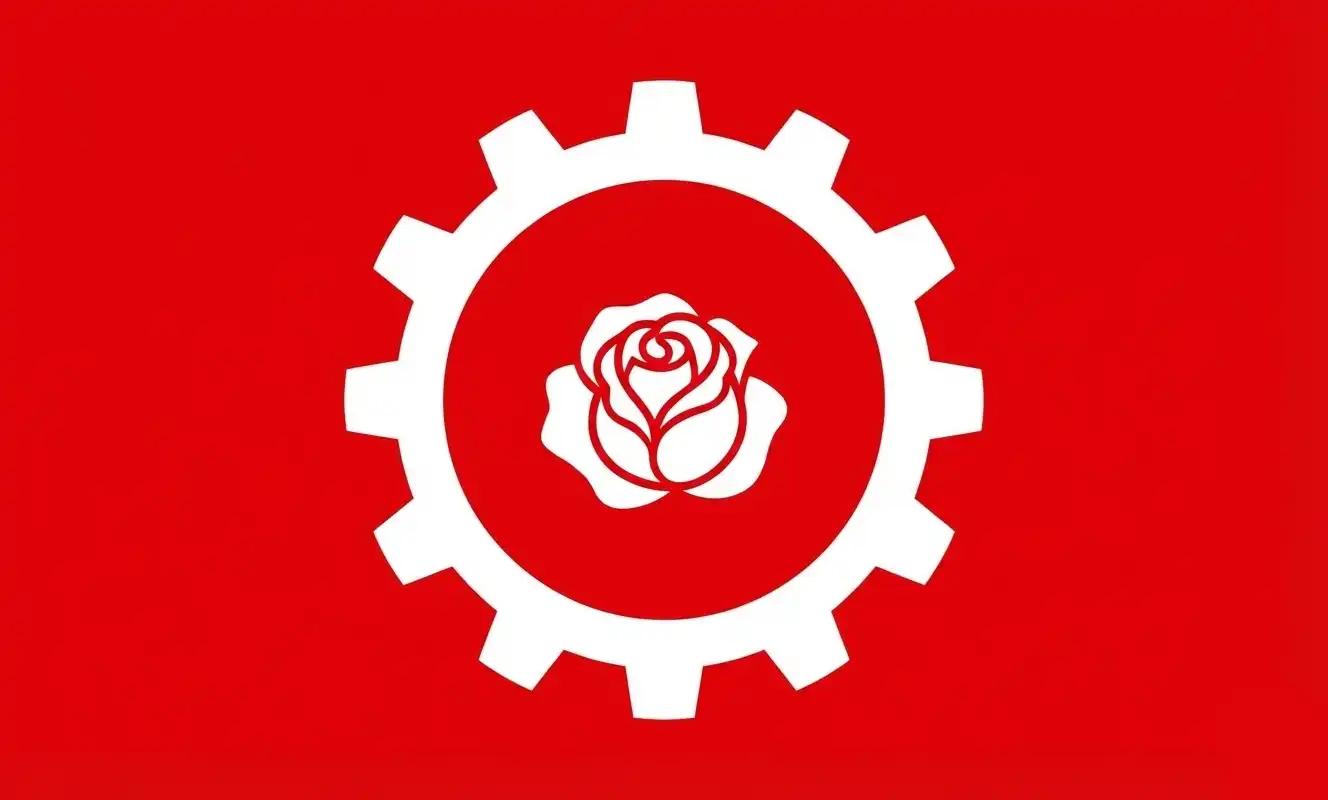
Thus the German Labour Party (APD) was born.