The European Union (1)
“Pwahahaha! What on earth is that?”
“Honestly, I can't believe it's real. That's just absurd.”
Wow. What a shame I never got to see it with my own eyes.
So apparently a ship fired its cannons and the recoil flipped the whole thing over!
“So they've got thirty-one left and they're drilling with them?”
“That's right. It looks like they're having a miserable time of it. Word is desertion is running rampant too.”
What? Deserters, on top of everything else? I guess they're working the men without feeding them again.
“Either way, it seems their preparations are wrapping up. Keep a close eye on our guests. When their numbers start to dwindle, or unfamiliar faces start showing up — that'll be our moment.”
“Yes, sir.”
With Portugal's crown dissolved and absorbed into Spain, now was the perfect time to make a move.
When the autumn of 4048 arrived, the armies of Europe began to gather.
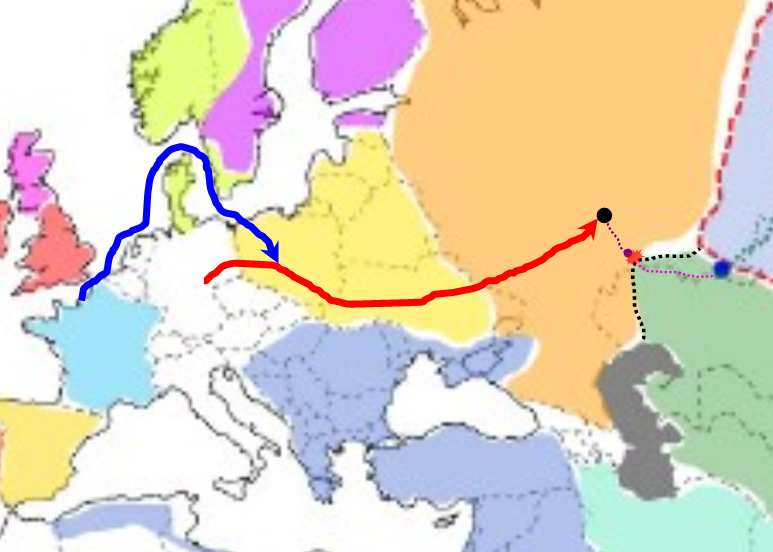
France and Poland-Lithuania, both fielding powerful land forces, and the Holy See of the Holy Roman Empire converged on Kazan in Russia, with plans to invade Qajar.
“Build roads! Roads are everything! Get to work!”
“Isn't the ground a bit too soft?”
“Why do you think we're building roads…”
And so the four hundred thousand soldiers who had assembled found themselves swarming over roadworks, their uniforms caked head to toe in mud.
Any road crossing Russia turned to swamp the moment a single rain fell, making it nearly impossible for wagons to pass.
The soldiers gathered for war were busy carving a road through Russia instead.
“Progress is slow. What say we muster more men?”
“Throwing too many in at once won't help. We need reinforcements, plain and simple.”
On the face of it, when war breaks out, a short decisive campaign — flooding the enemy with overwhelming force all at once — always looks like the smart play.
If supply lines could be solved, just that one thing, it would be unbeatable. But that was precisely the hard part.
And so the defender, who stacks up supplies in advance and fights on home ground, holds every advantage.
“What if the soldiers carried their own rations?”
“Impossible…”
Perhaps in the age of cold steel that might have worked. But now, armed with gunpowder weapons, a man had to haul powder, shot, and food besides. A battle or two — even just a march — and fifteen days would drain everything.
And even that left no room for a spare change of clothes, so a single outbreak of disease could wipe out an army mid-march.
By now even the Europeans had learned that much common sense.
“Haah… There's no answer to this…”
“What in God's name is this mudfield anyway…”
In the course of marching across Russia, the army had found itself stuck fast.
“Haah… Damn it all. We'd be better off walking barefoot.”
And so the soldiers began trudging across the cold autumn mud with bare feet.
“Eeheeheehaw!”
“A horse has collapsed!”
“Damn it.”
The horses hauling the cannons kept foaming at the mouth and dropping dead.
That was how they spent the autumn building roads, and then winter came.
“Oh. This thing is warm?”
“I heard in Daehan they call it a Kkalkkali?”
“I was worried we'd freeze to death. Thank goodness they throw in something like this.”
The Kkalkkali that Daehan had sold so cheaply had made its way all the way here.
“Hahahaha. Are they really getting beaten with goods of their own making?”
“Even the gunpowder is Daehan-made, they say?”
A great many of the supplies stockpiled ahead of the war had been purchased from Daehan.
Ironically, they were being attacked by the very weapons Daehan itself had sold them.
And the Europeans were already celebrating as if the war were already won.
“Winter suits us just fine, actually?”
“Now that the cold has set in, the ground has frozen solid. We can finally march.”
“Then we advance while we have the chance.”
“Yes, sir.”
The commander gave the order to press forward at speed.
Once hostilities began and they seized the walls, they could at least establish a forward base of operations.
But surely the war won't drag on, will it?
Only one thing kept him uneasy: a long, drawn-out war.
He worried the fighting might stretch on until the ground thawed. Supply and the movement of men would become a nightmare then.
Even now the rations were quietly, imperceptibly shrinking, and the soldiers had begun to complain of hunger.
Whew… Whatever happens, we have no choice but to press ahead, so it'll work out somehow…
「Click」
Out of habit, he fished a cigarette from his pocket and lit it with his lighter.
How on earth do they even make something like this?
It was called a lighter, and Daehan had begun selling them recently.
You filled the casing with some kind of oil, then struck a flint to ignite the wick. With one in hand you could summon fire anywhere, effortlessly — and it had become wildly popular.
Of course, they were so outrageously expensive that only aristocrats used them, mostly to light their tobacco.
What if we can't buy things like this anymore? Then we simply must win this war…
Look around — wasn't everything here made in Daehan? The shovels the soldiers carried, the uniforms on their backs, the lighter and cigarette in his very hand.
That was precisely why the kings had assembled this coalition, or so they claimed — to break free of Daehan's grip.
And yet he couldn't shake the worry: if Daehan's supplies were cut off, could they truly march at all?
Then the strategy must be a swift, decisive victory.
Just how vast did he imagine Daehan's territory to be, that he was already pinning his hopes on a short war?
Had anyone from Daehan overheard, they'd have rolled on the floor laughing at the absurdity.
“You're out here again today?”
“My soldiers are breaking their backs. I can hardly sit at a desk while they suffer.”
Atop the western ramparts of Qajar stood a man with piercing, hawk-like eyes.
His hair cropped short, his round stubborn face set in a granite-hard expression — he looked every bit the boulder he was said to be.
Damdin, the Great Khan of Qajar, was once again out on the wall, watching the soldiers dig their trenches.
“Have all the new weapons been distributed?”
“Yes. We've released ammunition without stinting — they drill with live rounds daily.”
Daehan's weapon systems had recently been overhauled, and the black-powder arms they'd used before were piling up in surplus.
And consider the sheer scale of it — the staggering stockpile of weapons and ammunition wielded by Daehan's eighteen million soldiers.
No matter how flush Daehan was with money, these weapons could never be sold to nations that might one day become enemies.
Naturally, the surplus arms flowed out to Daehan's first allied nations: Qajar and Tibet.
“It is a debt of great gratitude.”
“We hold the gate in your stead — that's a benefit to us both, is it not?”
To these self-appointed gatekeepers, Daehan was pouring out supplies at bargain prices.
Cloth, iron tools, even fuel — all at less than half the price charged to the rest of Europe.
And above all, weapons. The latest arms, so advanced that Persia and Russia — forever eyeing their borders — wouldn't dare come within a hundred miles of them.
“And that is why we live so well, no?”
“Hahaha. That is a kindness I truly am grateful for.”
Was this not the very model of mutual aid done right?
They helped each other, and each knew how to be thankful for it.
“But tell me — will digging the earth like that actually do any good?”
“What did they call it? Reducing the impact area? Something of the sort. They say it works, so we dig.”
Once Europe's invasion preparations had swung into earnest, Daehan had dispatched military instructors to teach weapon handling and combat methods.
The first lessons: trench digging and firing from a prone position.
“Ha! The state of the soldiers' uniforms after all that crawling about on the ground — it's a sight to behold.”
“Well, you want to live, you do what you must. Besides, you can't hit what you can't see — even a fool grasps that much.”
They drilled every day, crawling through the dirt. If the men hadn't been issued multiple sets of uniforms, the barracks would have turned into a mud pit long ago.
“It grieves me, the thought that these walls may one day fall.”
“Did they not tell you they'd become relics of a bygone age?”
Qajar had built a few star forts as well, but even those, word had it, would be rendered useless — so Daehan had advised them not to build too many.
“Speak not of relics. Think of it this way — that wall carries the spirit of the ancestors who guarded this land. That spirit endures in it.”
“May I take that as your official confession, sire?”
“What? Hahahaha!”
Damdin simply mourned the loss of what might be called their symbol — nothing more.
“Besides, if it falls, we simply build it again, do we not?”
Damdin, it seemed, was a man of letters, and his aide-de-camp a man of science.
“I see. Only the outer form crumbles a little. The heart. The conviction. That does not break.”
It sounded like two men talking past each other, and yet somehow the conversation carried on. A truly wondrous thing.
Soon, before the war-ready walls of Qajar, a river would flow — a river of European blood.
“Scouts were spotted again today, sir.”
“Did you capture them?”
“They observe from a distance and withdraw. There's no way to get at them, apparently.”
“Damn it…”
Gustav, supreme commander of this expedition, had begun to feel a slow suffocating dread.
The enemy had their positions nailed down at every moment. What preparations were they making, what traps lay in wait? The worry gnawed at him like a mountain on his chest.
“And still no ambush?”
“None, sir. They can't yet fathom why the enemy keeps scouting.”
“Ominous…”
Qajar had confirmed the coalition's route of advance, dug trenches before its walls, and was deep in its war preparations.
On January 7th, 4049, in the depths of a snowing winter, the European coalition army reached the bulging salient of fortress wall near the banks of the Ural River.
“Build the encampments! Form the battle line!”
Of the four hundred thousand soldiers, roughly two hundred sixty thousand carried matchlock muskets, forty thousand served as artillery crews, and the rest comprised twenty thousand cavalry and eighty thousand men bearing pikes and shields.
And from Qajar's distant walls, they were being watched.
“Hm. What exactly are they doing?”
“Hard to say?”
“All that suffering, in the dead of winter. Poor devils.”
“Hah…”
From the wall, they watched the enemy pickaxe at the frozen ground to build their barracks, and hack at the river ice to draw water. It was nothing short of comical.
For the defenders had stockpiled coal at points all along the line and were keeping themselves warm and comfortable.
They had even built rest stations at intervals along the outer trenches — places where a man could step out of the cold and recover.
When dawn broke on the morning of January 8th, the European coalition began its advance.
“Now what in the world is that?”
“Are they asking us to fire?”
Shield-bearers were forming up in front, and behind them the musketeers marched forward in long ranks.
Behind them strained the men dragging the cannons, and beyond even them rode the cavalry.
“Wait — shouldn't the cavalry at least wait until the walls are breached before committing?”
“I couldn't say.”
True, with flintlock rifles on open ground you would fight in much that fashion. But Qajar had almost never taken the field outside its walls.
In the rare border skirmishes, a few dozen men would ride up, fire off a cannon or a few volleys, and more often than not end up shot dead for their trouble.
Having only recently learned from Daehan to dig trenches and advance by crawling on their bellies, the defenders found the spectacle before them utterly bizarre.
“They're marching right up to be killed. Give the order — fire the moment they enter range.”
“Yes, sir.”
Blissfully ignorant of all this, the coalition advanced in lockstep, one measured stride at a time.
“What is this? Why has no one come out to meet us?”
“There's no one on the walls either.”
“They've fled, then? Spooked?”
In that era, four hundred thousand men was a truly staggering host. Even Europe's grandest wars had been collisions of a few tens of thousands.
「Thud. Thud. Thud.」
Some nameless confidence swelled in every breast, and the soldiers' footsteps grew heavier, more resolute.
“What do you suppose lies beyond that wall?”
“They say Mudo lies there — the richest city in the world. Stick your hand into any house and you'll pull out a lump of gold, they say.”
“Whoa… We're going to make an absolute fortune this time.”
To them, war was, first and last, a means of making money.
This was an age when the plundering of occupied lands went without saying.
“The wall should be easy enough to get over.”
“Why not just run at it?”
“You walk, you fool. Then you stroll right through whatever's left of the wall after the cannons crack it open.”
“Ahh!”
The soldiers had begun radiating the air of men out on a country picnic.
“Huh?”
“Something's coming out on the wall!”
“Cannons?”
“Damn it…”
From Qajar's walls, the cannons began to push forward on their carriages.
The wall stood higher than the ground below, so of course the range would be longer — it went without saying.
“We'll be eating a shot before this even starts…”
“God, don't let one land on me.”
「Boom! Boom! Boom!」
And then, from Qajar's walls, smoke began to bloom.
“What? They're firing already?”
“Were the guns loaded in advance?”
「Whiiiish」
The shells sailed over the soldiers' heads.
“Gah… They're shooting at the cannons, apparently?”
“Thank heavens…”
The infantry was spared, but the artillery column in the rear, dragging its guns forward, was being torn to pieces.
「Whiiiine」
“Incoming shell!”
The soldiers hauling cannons in the artillery column began to pray, silent and frantic. Please, God, let it not fall here.
「Thud! Ka-thud! Thud」
“Good Lord!”
At such extreme range, hitting anything precisely was near impossible, as everyone had assumed. A shell struck the ground beside a cluster of soldiers, and in that fleeting heartbeat of shock—
「KRAKOOM! KA-BOOM! KRAKOOM!」
— the shell at their very feet erupted.
It was one of Daehan's explosive shells.
“What in the—! Why is the shell exploding?!”
“AAARGH…”
“My leg! My leg!”
“Somebody help him! Help!”
「Boom! Boom! Boom!」
But alas, the bombardment had not yet run its course. With the roar of the guns sounding anew, Daehan's explosive shells began to scythe through the European coalition's artillery column.