
Of Those Adventure Tales Worth Telling with a Smile (3)
Knightly literature has its unwritten laws—what people call clichés.
Tales that wax poetic about romance invariably feature the motif of the knight who protects his noble lady. And The Knights of La Mancha was no exception.
In that story, a woman named Dulcinea appears.
The protagonist, Don Quixote, was forever crying out, “I dedicate this glory to my lady, Dulcinea!” and whenever he accomplished a feat or corrected a villain he would bellow, “Kneel before Dulcinea and beg her forgiveness!”
Naturally, Dulcinea was a fiction. Not merely fictional because she was an invented character—within the fairy tale itself she remained a fabrication.
The knight who protects his noble lady.
She had been written in precisely to mock, or to ridicule, that inviolable rule of knightly literature. Even inside the fairy tale Dulcinea was an imaginary presence, and she never once revealed herself, not even in the final chapter.
And the same held true for Alonso Quijano.
Alonso Quijano had been utterly consumed by the novel The Knights of La Mancha. That fairy tale was what first set him on his journey; he called himself the story’s hero, Don Quixote, and set out upon adventure.
“I am the ingenious gentleman of Quijano, Don Quixote!”
So he would cry.
“Wahahaha! I dedicate this deed to my lady, Dulcinea! For a true knight performs his feats for the sake of his lady!”
He imitated the lines of the fairy-tale Don Quixote.
He did so for decades upon decades of journeying.
And in the Outer Land—where human achievement becomes a star and takes on real power—words were never mere noise that rattled the air. They carried meaning beyond themselves.
Don Quixote is a knight.
A knight requires a lady.
Don Quixote’s lady is Dulcinea.
A portion of the feats he has won belongs to Dulcinea.
Those were the sentences engraved upon his star.
And Dulcinea is a fiction.
A nonexistent imaginary figure.
Into that final sentence—
“My name is Dulcinea.”
—a demon nestled and fed.
“Your lady has come to find you, my knight.”
Dulcinea ought to have remained a fiction. But Don Quixote had found “the place that exists nowhere—La Mancha.” He had set foot upon that land. By doing so he had forced into existence the very part of himself that should have stayed imaginary.
Heaven is not a fiction.
La Mancha exists here.
When Don Quixote declared as much, his journey took on the nature of a paradise, and an opportunity opened even for Dulcinea—his lady who should have remained a fiction.
“Congratulations on completing your journey.”
The Revelry Emperor slipped into that empty space.
“I, Dulcinea, have been moved by your travels.”
Of course the Revelry Emperor was not Dulcinea. Her true name was never Dulcinea, and no one knows the Revelry Emperor’s true name. She was neither noble like Dulcinea nor did she respect a knight’s honor or pride.
“Look at me.”
Yet what mattered was this:
“My knight.”
For a very long time the Revelry Emperor had been parasitizing Don Quixote.
“Did you enjoy the adventure? The tale of slaying the Blood Demon, the tale of surpassing the Heaven-Wandering Star, the tale of the Golden Helm, the valor sealed in the Golden Gauntlet, the stories of the countless, countless heroes you saved!”
Across that long span of years she had slipped into Don Quixote’s journey. She had cleverly wormed her way into the seams of the story. Sometimes as his companion, sometimes as the jester who danced beside him, sometimes as the villain, sometimes, sometimes, sometimes…
The Revelry Emperor smiled.
Or perhaps Dulcinea smiled.
Having nestled so cunningly into the story’s cracks, she had always been with Don Quixote—as observer, as actress, as the playwright who staged the play. For decades she had waited only for this moment.
Because she coveted him.
She was revelry itself.
Actor, stage, jester, laughter, rapture, and above all else a greater mockery. The concepts that composed her shared points of contact with everything Don Quixote possessed.
“You must have enjoyed it. Surely.”
And so she decided.
I will swallow him.
I will make this pitiable knight mine.
“How could it not have been delightful?”
The final act of the stage.
Just before the lights go out and the curtain falls, that brief darkness, the fleeting black in which the actors take their bows and end the story.
The jet-black curtain drawn across the stage for that darkness—
a blackout curtain that was also the black curtain of conspiracy.
A black veil settled over the sky of La Mancha where sunlight had poured down. And in the darkness that arrived, the Revelry Emperor whispered.
“Because this is that kind of play.”
Dulcinea defined it:
Don Quixote’s journey had been nothing more than a theatrical performance.
The Revelry Emperor existed within the story as Dulcinea.
And the weight Dulcinea carried in that story was never small. Though she never appeared, she had been one of the reasons Don Quixote set out on adventure.
Let me sing for my lady.
I offer her my feats.
So that I may stand proud before her!
Compared with his other purposes that one was slight. And so Dulcinea waited only for Don Quixote’s journey to end. She waited for this very moment when every foreshadowing had been paid off and every lingering attachment resolved.
The moment when the only remaining thread in his journey was the existence called “Dulcinea.”
“Because this is that kind of play.”
Dulcinea declared.
“There is no way so beautiful a story could exist in the Outer Land. A tale this absurd, this light, this joyful simply does not exist. Leading the stars? Those self-righteous constellations would never let themselves be led by anyone. Would they?”
She denied the outline of the story itself.
“There is not a single true thing. Do you really believe this place is heaven? Aha—truly?”
Splat—the sky was stained with paint. Rocinante and Sancho’s eyes flew wide and they tried to shout something, but their words never reached Don Quixote.
“An adventure that leaps beyond the domain of the Heaven-Wandering Star? Impossible. Every scene was staged. You leaped over the dead? You defeated the Blood Demon? All of it was merely the kindness of those who pitied you and played along with your little theater.”
Splat. Drip-drip.
Paint blotched Don Quixote’s armor. His pupils trembled. Just as he was about to shout that it was nonsense, the Revelry Emperor clapped her hands—crack!
The power of oblivion began to gnaw at Don Quixote.
It corroded his memories. It punched holes through them. What this was, what that had been, why this had become that, what connected to what—every junction the Revelry Emperor severed completely.
An artificially created blank.
Into that blank she poured her own words.
“To begin with,”
Dulcinea sneered.
“A shut-in who only read fairy tales in his room could never truly become a hero. The world isn’t that soft. The world is not a fairy tale. It is not knightly literature either. The world is simply the world, Alonso Quijano.”
She guided him.
“You are not a hero.”
She guided Alonso Quijano to deny himself.
“You are merely a madman. A delusional patient. A dreamer. Everything is a lie. Nothing but a well-crafted farce. You never began a journey. You are still locked inside your room.”
Dulcinea whispered.
Don Quixote’s eyes wavered.
“How ridiculous.”
A laugh thick with mockery echoed.
…Ordinarily, even the Revelry Emperor could never have wormed so easily into the mind of a transcendent. Least of all someone like Don Quixote, whose mindscape was so firmly established; such cheap means should never have worked.
But the Revelry Emperor stood here not as a demon but as “Dulcinea.” As a being who had once shared the same stage, she had won the right to intervene in the story.
Oblivion, staging, theater, falsehood, deception, mockery.
Wielding every power she possessed, she drove deep into Don Quixote’s mind. Everything she had prepared across nearly thirty years for this single instant she poured out without reserve.
“Reality is bleak, dull, and cruel beyond measure. You were right. Reality is not fun.”
She was not overturning every element that made up Don Quixote. That would have been impossible.
“Instead of a tedious world, a play. Instead of a crushing reality, a fictional stage, a dream, a delusion.”
She merely painted the core of him in her own colors.
“The world lacks laughter.”
Splat.
“So laugh. For nothing but laughter holds any value.”
The Revelry Emperor’s body melted like paint.
The sky, the earth, everything that met the eye was stained with color. A bright yellow sky. Blood-red grass. Blue apples. Black smoke. A blue field and a green lake.
Across the paint-smeared world, laughter rang out.
The laughter that resounded was neither refreshing, nor cheerful, nor beautiful.
Only mockery.
Laughter that existed solely to sneer echoed and re-echoed.
Don Quixote was stained with paint.
Vivid colors were poured into his skull. Into the mindscape that had once been filled with laughter, derisive laughter now began to resound. Don Quixote frowned hard.
Grit.
He ground his teeth and clutched his head. The mockery echoing in his ears threw his mind into chaos. Unknown memories and fragments of information flooded his thoughts.
No. It’s a lie.
But what was the lie? Where did the falsehood begin and end? Had he truly forgotten his memories? Or had it all been his delusion from the start?
In the confusion Don Quixote thrashed.
In a grotesque hell smeared with every color of paint he screamed. Where was this place? Had he been calling this nightmarish land heaven all along? Even while screaming he resisted.
No—I am Don Quixote.
The ingenious gentleman of La Mancha, Don Quixote.
The laughter I know is nothing like this. This can never be laughter…
“My lord! Don Quixote, my lord!”
Sancho and Rocinante supported him. Come to your senses, they cried; that demon is deceiving you. But in Don Quixote’s eyes they no longer looked like companions.
They looked only like grotesque monsters wearing jester masks.
“H-hyaaaaaaaah!”
Don Quixote screamed and fled. Not understanding why, Sancho and Rocinante chased after him. Through the heaven that had become hell, screams and mockery rang together.
Cackling, shrieking, ahahaha!
While only derisive laughter echoed, Sancho and Rocinante did everything they could. They held him, recounting the adventures they had shared so that he might recover his mind.
If it’s Don Quixote, he will come back to himself.
They believed that.
They tended the knight as he slipped into madness. Yet for all their effort, one day Don Quixote began to cry out that he had to find Dulcinea—that he had to find his lady who had vanished somewhere.
“Dulcinea. Where is Dulcinea?”
His condition worsened day by day.
“We have to get out of here.”
“If we stay we’ll go mad ourselves.”
Sancho and Rocinante tried to take Don Quixote out of La Mancha, but every attempt failed. The place they had believed was heaven had become hell, a prison that kept them locked inside.
The Revelry Emperor had made it so.
The paint-stained heaven was hell.
“Please, my lord, please come back to your senses!”
Sancho, Rocinante—everyone was slowly breaking. The unending mockery ate at their minds. Still they kept trying.
Believing that someday Don Quixote would recover.
—But that wish was never granted.
Sancho knew.
He knew how this story ended.
In the end Don Quixote breaks. He denies everything he is. And so the star of Dalso—the Star of Laughter—is stained with paint and transforms into the Star of Contempt.
One day Don Quixote cried those words and rose from his sickbed.
He burst into laughter.
He laughed until the world itself seemed to wash away. Mocking everything, scorning everything, looking down on everything, declaring everything worthless—Don Quixote laughed and laughed. It was more fitting to call it maniacal laughter.
“Ah, Sancho! My one and only friend!”
“You… you recognize me?”
“How could I not know you? Come! Let us set out on adventure, Sancho! The world awaits us!”
Has he come back to himself? At last? Thinking their long effort had been rewarded, Sancho smiled—and was run through by Don Quixote’s lance.
“My lord…?”
“Come along. Let us go together, Sancho.”
Even as he coughed blood, Sancho could not understand. Eyes wide, he died. Watching him, Rocinante clasped both hands and prayed.
“Why do you give us such a trial?”
The prayer never reached anyone. At Don Quixote’s hand Rocinante was cut into pieces. The fragments were cast into the paint-stained lake and rose again as a demonic beast—for lakes always hold the magic of mysterious sorcerers!
“Run, Rocinante! Run with all your strength!”
Rocinante snorted and stamped.
“Come, Sancho! Our adventure must continue!”
The scream of Sancho, now one with the lance, rang out.
“Uha—uhahahaha! Uhahahahahaha!”
Laughter.
Mockery.
It echoed through the heaven that had become hell.
In that place the ingenious gentleman of La Mancha, Don Quixote, was no more.
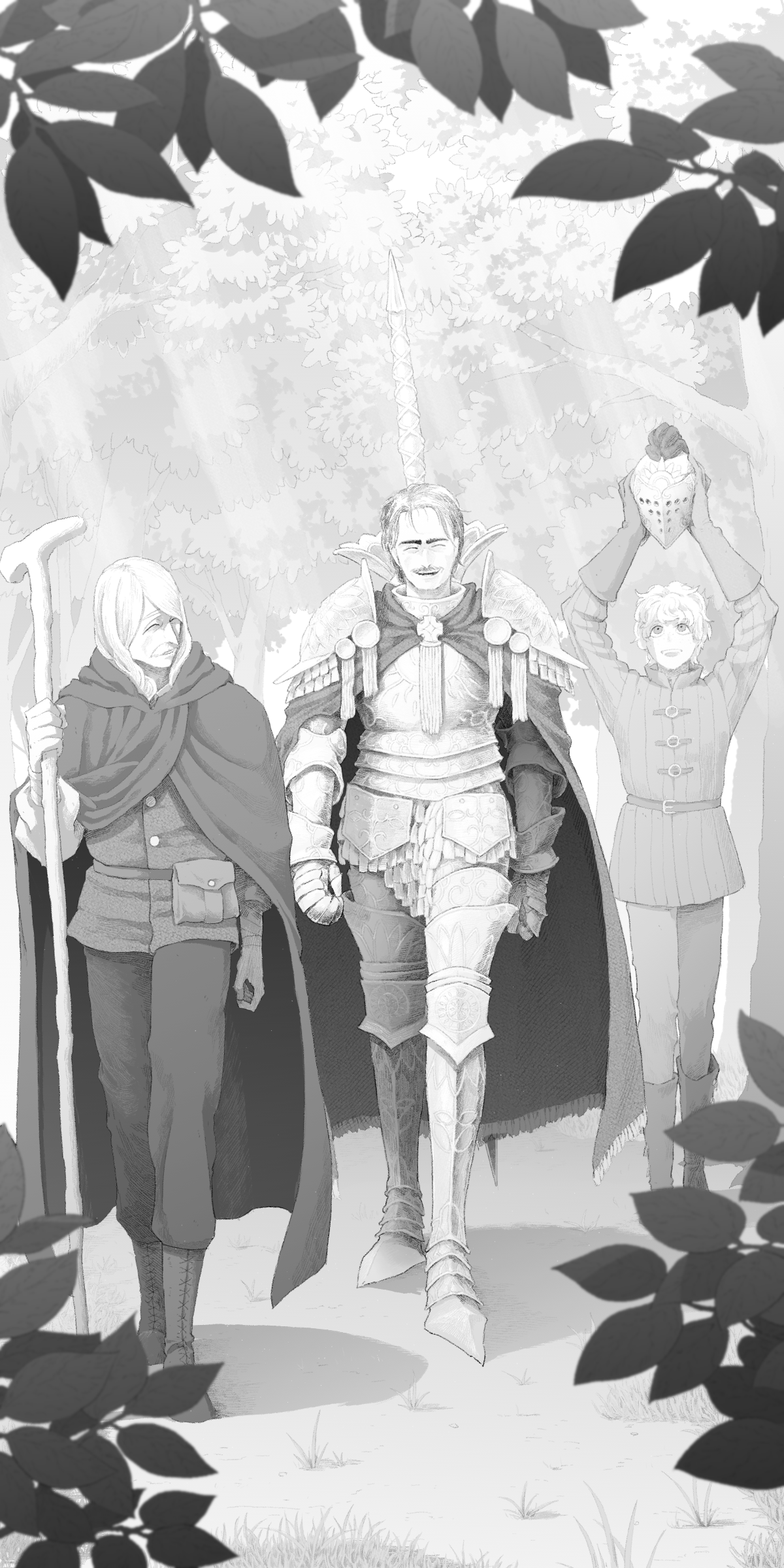
The cheerful knight who had hoped that, for as long as someone read his story, they might set down their worries and laugh—he existed no longer.
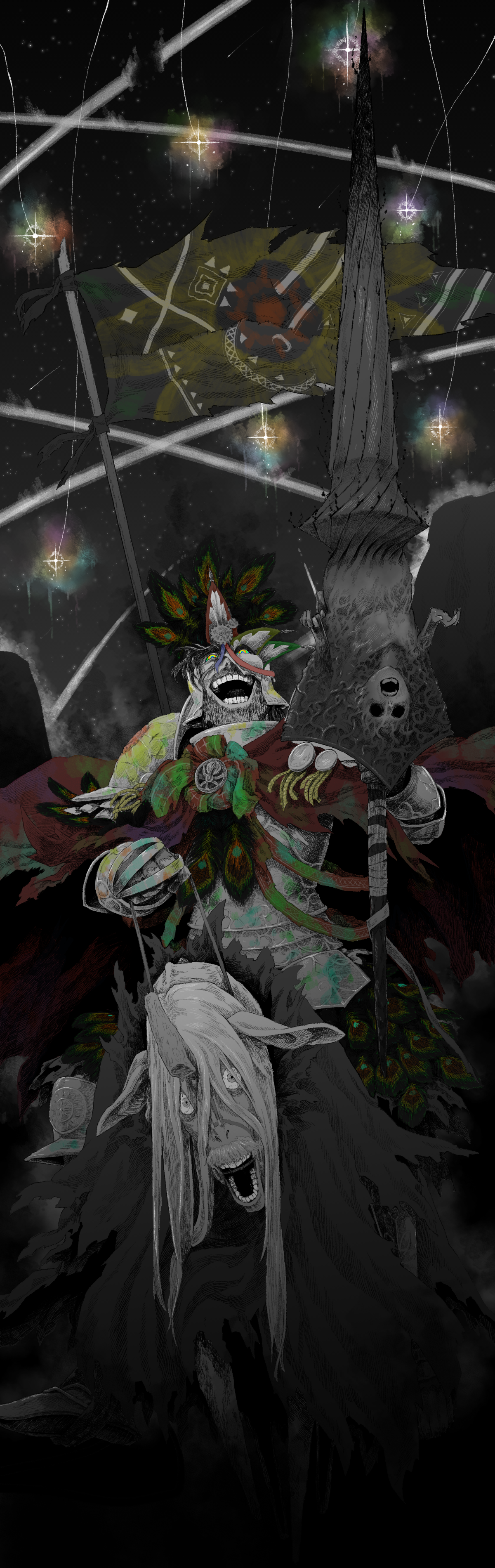
What took his place was the Star of Contempt.
Nothing but a jester enslaved by the Revelry Emperor.
“So.”
And then—
“So that is what you went through.”
A certain knight who had watched it all opened his mouth.
“Sancho.”
The knight rose. Across from him sat a boy. The knight spoke to the boy.
“I understand what you’re trying to say. Then send me back.”
“Outside the dream?”
“No. To the place where you stopped.”
“……What are you going to do?”
“I’m late with the introduction.”
The knight smiled.
“I am Najin. Free Knight Najin.”
“What’s a free knight?”
“A knight who protects knights.”
“Then……”
“Yes.”
The free knight drew his sword.
“I make knights act like knights. That’s my job.”
Najin opened the eyes he had closed.
When he opened them, what he saw was Don Quixote thrusting a lance toward him. Taking in the sight of the knight who had risen from his sickbed and finally gone mad, Najin moved.
It was not Sancho who moved. It was Najin.
The change happened in an instant.
Instead of the cloth armor Sancho had worn, a free knight’s coat flared. When he reached to his hip, what his hand found was not the longsword Sancho carried but Najin’s own blade. When he reached to his back, the Cross-Star Lance settled into his grip.
The master of the stage had permitted Najin’s intervention.
Given the role not of Sancho but of a free knight, Najin moved a step ahead of Don Quixote.
“Lord Don Quixote.”
Najin said.
“It’s about time you came to your senses.”
Ramming.