Forging Ahead: The Crucible Steel Furnace
Time flew by at the Crucible Steel Furnace like water rushing through a stream. A few months after I started my workouts, growth spurt hit right on cue—my height shot up by about half a handspan, and my body noticeably bulked out. Every time I caught my reflection in the water, it felt like some stranger was staring back. I hadn't fully shed the frame of a boy yet, but my shoulders had broadened, and solid muscle now wrapped my forearms. It was the payoff of daily workouts, training, and a steady supply of protein.
"Ahem, cough, cough." I cleared my throat, but out came a voice laced with a gravelly rasp—totally unfamiliar. Puberty had crashed the party, wrecking my voice. When did growth spurts and voice changes usually wrap up? Even digging through memories of my past life, it was fuzzy. Looked like I'd be stuck like this for a while.
Growing meant my clothes didn't fit anymore—tailoring or new ones all around—but it wasn't a bad hassle. No guy hates getting taller and more muscular.
Pottery trades had cooled off again, back on cooldown. I gazed at the silver coins stacked in the box on my desk, mentally punching the calculator. My holdings had blown past 1,000 silver coins. Considering this world's prices, it was a fortune no serf or commoner would touch in a lifetime. Pure profit-wise, I was out-earning my father, an upper knight already.
Switching production to only high-grade white and celadon porcelain had doubled revenue overnight. Early days had high failure rates and trial-and-error headaches, but now the process was stable, defects near zero. Surplus everyday ware covered consumables with change to spare, netting serious profit. Call it capital income? Build facilities with money, facilities make more money—snowball effect kicked in hard.
Once the wealth was too obvious to hide, I stopped sneaking around. Spent a bundle midstream on this and that, buildings too, but the money just multiplied. Worries about greedy neighbors eyeing my cash? Shelved. I was already kicking a cut upstairs via butler Hermann anyway, and Dad hadn't said a word—tacit approval. Proper handover later, and he'd let it slide. What mattered now wasn't prying eyes, but leveraging this cash for the next phase.
Production methods seemed solidly settled. Time to move on.
Now it really begins. I pictured the workshop tucked in the village corner and took a deep breath. What a long detour. Finally ready to build that steel-producing furnace from my original plan.
The furnace I was building this time was the Crucible Steel Furnace—leagues beyond the pottery or brick kilns. Tiny compared to other small furnaces: chamber was a capsule with 45cm inner diameter, 60cm height. Entry at the top of the capsule, unlike passive-draft pottery kilns; bellows were mandatory for forced air.
Crucibles: 8cm inner diameter, 12cm height, firebrick material, held about 1kg iron each. One firing heated eight, yielding 8kg steel. Pathetic next to blast furnaces pumping tons, but the output? Far more uniform and superior to what local smiths hammered out over days and nights.
Unlike labor-hungry blast furnaces that bled cash on downtime, this ran solo, fire up or shut down anytime. Flexibility no blast furnace could match.
To melt steel right, chamber needed 1,450℃. Way beyond standard kilns' limits. Even firebrick-lined, it started cracking after 20 firings; max 60 with perfect care. Frequent use meant rebuilds every couple months, maintenance hell.
That's why I'd kept firebrick production rolling—needed stockpiles for constant rebuilds.
Hitting 1,450℃ had hurdles, but firebricks, white refractory coating, and efficient structure solved most. Still, fuel alone didn't cut it; combustion maxed, heat loss minimized via tech tweaks. Final piece: heat exchanger, specifically a 'recuperator' exhaust recovery ventilator.
Air from bellows didn't blast straight in; it snaked multiple loops around chamber and chimney before entering below. Principle: preheat incoming cold air with kiln heat and hot exhaust. Blocked outer wall cooling from ambient air, kept chamber air from dropping—intake jumped from 20℃ room temp to 200-400℃ preheated.
Easy in theory, nightmare to build. Air ducts clinging to outer walls? Tricky. Solution: modular process.
Double-wall chamber first, fill gap with broken bricks or sherd aggregate for base. Stack bricks for ducts, mortar seal, dry, repeat—like 3D printing layers meticulously.
Result: The intake duct looped through the chamber and chimney in a vertical S-pattern, dumping into the chamber base. A total maze.
Mortar on chamber walls: same as pottery kiln—firebrick mix soil plus extra sand for refractory clay, fired in place. Gaps leaked heat, tanked efficiency; airtight seals critical.
Small but finicky—high build difficulty.
Clay and I took a month, building slow and steady.
"Young master~ Is this really gonna work?" Clay wiped sweat, caked in dirt. Her eyes screamed confusion at the weird, convoluted contraption.
"Jackpot if it does, rebuild if not." I played it cool, but I'd triple-checked the design in my head.
Done deal: workshop clearing now sported brick kiln, pottery kiln, and Crucible Steel Furnace side by side. Quite the sight.
Finished furnace: fat little capsule with a 2-meter stubby chimney. No visible mouth—baffling at a glance. From afar, squinted, it looked like a thumbs-up fist.
While building, I fired the pottery kiln for 150 consumable crucibles. These were steel production's heart—disposable, but endured insane heat and chemistry; firebrick-grade refractory, obsessive quality.
Commissioned box bellows from the forge too. Past 1,300℃, heated interior air expanded, overpressuring against atmosphere—blocked natural intake. Thermal barrier. Fan bellows? Useless. Needed sustained, powerful blast.
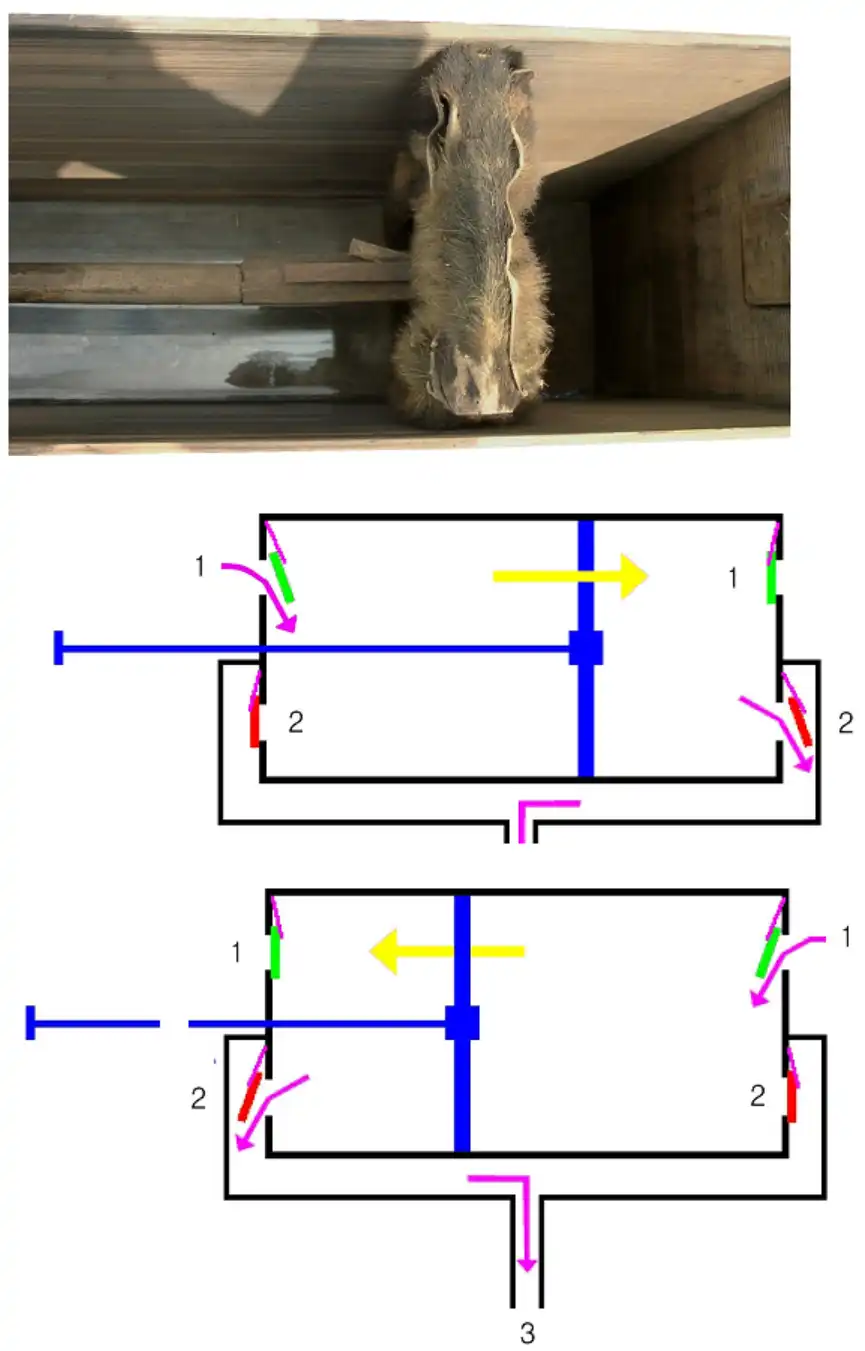
Box bellows: box-shaped, scaled to furnace—50cm square piston, 1m stroke plenty. Simple: snug wooden boarder in box, push-pull pumps air. Leather-flapped valves prevented backflow.
Runtime: reciprocate 30 strokes per minute. Simple, but hand-pumping hours? Torture. Engineering fix: adapt foot-pedal wheel to drive piston via crank shaft and linkage—rotation to reciprocation.
Durability key—cast iron frame, no skimping materials. Clay could handle it easy now.
Installed, test-fired bellows.
Whoosh, whoosh. Steady roar, powerful jet from nozzle.
Bonus: my custom box bellows outclassed their old fans. Forge upgraded unintended—smith's eyes bugged, coveted it, copied days later. Tech leak, but unhideable anyway; good relations worth more. Ignored.
All set. Go time.