
Toward the Front Lines - 5
War is a far more disgusting thing than one might imagine.
The earth looks red. The sky looks yellow.
People’s corpses are torn apart into scraps of flesh that scatter and drop right before your eyes.
Simply experiencing war grinds the mind down; a clean body acquires scars and becomes an ugly wreck.
The Empire dresses war up as a war for humanity and hurls the gifted onto the battlefield before they can fully bloom, letting them fall as buds that never opened.
Even if they might one day become better resources, if they fail to return alive from the field they are nothing more than worthless scraps of meat.
Better resources or not, the Empire is not affluent enough to invest in them.
That vast expanse of mud—the swamp that has already swallowed half the southern continent.
In the mire that seizes a man’s feet and drags him under, people die with every day that passes.
Yes. That is the place we are heading for now.
Will I be crushed and burst apart beneath the countless disasters that come hunting me, or will I sever their throats one by one, burn them, and smile atop their corpses declaring that I lived and they died?
We are bound for the battlefield where everything is decided.
I have never experienced war.
One could claim I experienced it in the game, but that was not war.
Even if a party member dies, you revive them, manage the [Erosion Rate], and keep using them as pieces. Even if ordinary soldiers block the way, if killing the enemy is possible you accept the sacrifice and burn them together with you—can I still do that in this place that has become reality?
Can I stand unshaken beneath every last person’s hatred and say, “Yes. I killed them”?
These people were not NPCs.
They were even less my pieces.
They could improvise. They had emotions. Each one was a mass of variables made of numbers.
In the end, they were people.
But if it is for my survival, I will use them all.
That is my resolve, my way of surviving, the method I will employ, and the road I will walk.
The path a person walks is not a well-paved highway, and it is certainly not a dirt track either.
The path I will walk is a road of thorns, paved with the corpses of those I use; and if I ever return to the original world, it is a road I will leave behind and discard without a second glance.
Yes. Thinking these things while the carriage carries me toward the front is self-hypnosis aimed at myself.
I tell myself I am someone who can abandon them, rationalize it, because the moment such a situation actually arrives I will not be able to abandon them.
So I say it in advance.
There are things that must be done even when one cannot do them.
Yes. Perhaps I should get a little sleep.
I ignored the people filling the seats beside and in front of me, filling the entire carriage, and closed my eyes.
This time I only hoped that useless Saintess would not appear and interrupt my rest.
Jerome and the Hero confirmed that the Saintess had fallen asleep and opened their mouths almost at the same moment, neither truly first.
“Hey—”
Jerome promptly yielded the right to speak first to the Hero.
“You go ahead.”
The Hero accepted on the spot.
“Ah, yes.”
The Hero already possessed a wealth of information about Jerome, so he had no real questions to ask. What mattered to him now was restoring the bonds with the comrades who had existed in his past.
The connections and experiences he alone had shared with them—adventuring together, enduring war—had lasted only half a year, yet they remained precious memories.
The knowledge that he alone remembered those relationships often saddened him. Even after turning back time, he remembered every moment of rebuilding those friendships, repeating the adventures and journeys, standing back-to-back on the battlefield, and finally parting.
So this time, in order to save them, and for a future in which, once everything was finished, they could clink glasses and laugh together saying “It was like that back then,” he wanted to walk beside them again.
“Don’t you think we’re being a little too stiff with each other?”
“We’ll be seeing each other’s faces every single day on the front lines soon enough, won’t we?”
As the Hero said, the time they had spent together was short, yet they still used formal speech and treated one another with businesslike reserve.
It was hard to believe they were party members at all.
Jerome could not quite deny it.
“Ah… that’s true enough.”
The Hero pressed his advantage.
“How about we drop the formalities?”
Jerome was the sort who found it difficult to refuse when the other party pushed, so though it felt a little awkward he agreed.
“All right.”
“Ah… yeah.”
Being overpowered in presence by a boy clearly much younger than himself—someone whose face still looked freshly adult—and letting his words slip out wrong was embarrassing even to him. Jerome cleared his throat repeatedly, ahem, ahem, in awkward little coughs.
A fleeting thought crossed his mind: Is it really all right to speak casually when the Hero is younger than I am?
But there was no time to dwell on it. The Hero answered at once.
“Yeah.”
Feeling a faintly unpleasant aftertaste, the two of them dropped formal speech.
The Saintess later noticing the two of them speaking casually and wondering about it was something that happened a little while afterward.
The rattling carriage finally came to a halt in the middle of a desolate plain.
They had traveled a long way, so someone needed to wake the Saintess, yet no one dared reach out a hand.
As if she were a being no one was permitted to touch, the Saintess with her eyes closed seemed utterly pure.
Before anyone could touch her, she sensed that the motion had stopped, opened her heavy eyelids herself, and looked around.
The awkward atmosphere, and the Hero’s hand that had frozen in midair while reaching toward her, only made things more awkward still.
The hand that had tried to wake her and then stopped in embarrassment was hastily withdrawn.
Flustered, the Hero began explaining even though no one had asked.
“I was going to wake you to say we’ve arrived.”
The Saintess gave a short nod to show she understood.
After they stepped down from the carriage, just as Jerome was beginning to wonder how this place—nothing but wasteland as far as the eye could see—could possibly be the front line, a soldier came running from the distance.
He wore heavy regulation plate armor, yet the iron plates looked awkwardly bolted over leather sections, giving him a distinctly shabby appearance that suggested he was low-ranking.
Huff—huff—
Breathing hard, he stopped in front of the party and introduced himself between gasps.
“I’m a junior knight sent to serve as your guide!”
I was more surprised by the fact that he was a junior knight than by the passionate tone of his answer.
In the Holy Kingdom, Holy Knights were those who had spent long years as priests, or freemen and mercenaries who converted to the faith. In the Empire, only the sons of nobles or the children of certain wealthy families could dare call themselves knights.
So why would the scion of such a house appear before them looking so shabby?
The thought crossed my mind that he had stated only his rank and not his name because he was ashamed of his family.
He finished speaking and, as if determined not to leave any opening for questions, spun around at once and began leading us toward the front.
His pace was a little quick, yet not so fast that this frail body could not keep up.
My stamina was simply insufficient; if I overexerted myself I sometimes bled. It was not as though the body had any actual functional disability.
They said the Saintess had died of illness, yet so far there had been no sign of disease either.
After walking across the long brown plain we finally reached the front line.
Wooden palisades stretched endlessly, military tents stood in dense rows, and the place looked far too wretched for human habitation. People shouted, carried corpses, and moved like organic parts of one enormous machine.
I blanked out for a moment, then quickly collected myself and looked for the Hero and Jerome.
The Hero pushed through the tents as if he already knew the way, strode without hesitation into one of the better-looking ones, and Jerome followed close behind.
The distance was not great, so I trailed after them at once.
Inside the tent only a few candles provided a gloomy light. In front of me sat a man whose bald head was impossible to miss—
Wait. Why is he here?
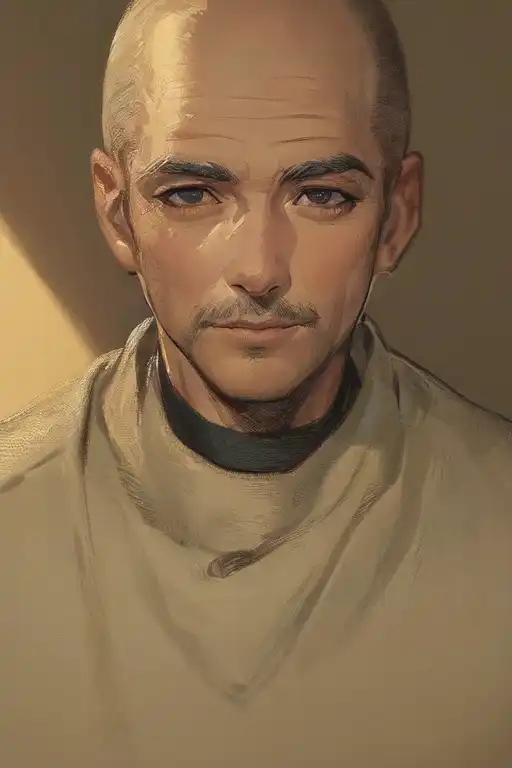
“We never even properly introduced ourselves back then, did we?”
“Name’s Lloyd. Akan’s disciple.”
“I’ve been assigned as the officer in charge of this front.”
Disciple of Akan • Deputy Master of the Magic Tower
Officer in Charge of the Front Line
From that moment on, we moved together with him.