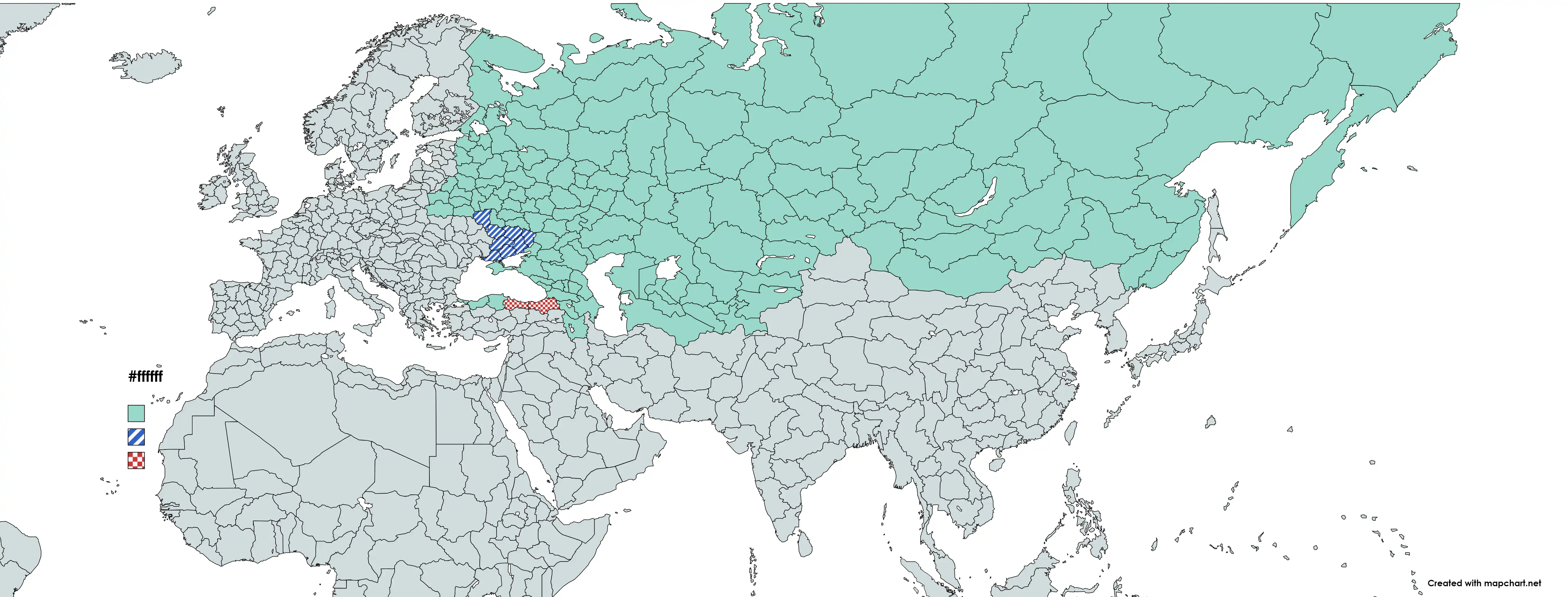
The Madman (Map Included)
As usual, I was busy patrolling the regions still dominated by the reds, quelling unrest and keeping the peace.
One day, someone came looking for me.
“My granddaughter has grown so big already. Hehehe. Is this really my granddaughter?”
It was Dagmar of Denmark—Marie Sophie Frederike Dagmar, consort of Alexander III, father of Nicholas II. She had traveled all the way to Moscow.
Her sister’s son was England’s George V. I had heard she once mistook Nicholas II for being alive because of how closely they resembled each other.
In the original history she had escaped Russia with British help amid the horrors of the civil war, but in this altered timeline she was able to come all the way to a Moscow still under reconstruction.
She had come in person, weeping, clutching my hands in hers.
I should have fled straight back to Yekaterinburg.
“Gr-Grandmother?”
“Yes. I am your grandmother. How much you must have suffered, so young. Sob. To have watched your father die, your mother die, your sisters and little brother die—how terrible it must have been.”
I was fine, though.
I never actually saw the bodies.
Those strangely reformed Bolsheviks had spared me the sight.
Later, once everything was settled, we would decide whether to move the remains from Yekaterinburg to another resting place.
The real Anastasia would have been devastated. I was not.
“Grandmother, I’m all right.”
“With how deep your resentment must run, you even dragged your frail body into battle against the Bolsheviks. Sob sob. This grandmother persuaded George for your sake.”
“Did you?”
So that was one of the reasons England had helped.
Well, it made sense. Still, it felt strangely uncomfortable.
No matter how I appeared on the outside, the person inside was someone else entirely.
I wasn’t the real Anastasia, so this kind of scene pricked my conscience.
“Have you no thoughts of marriage?”
“Marriage? Russia’s situation is hardly good enough for that.”
A political marriage might be worth considering, but there simply wasn’t a suitable candidate.
Germany had the divorced Joachim, but he was far too old. England had no particularly appealing options either.
Even in a marriage of convenience, a groom who would diminish the dignity of the Tsarina would be unacceptable.
“Then how do you intend to handle the succession?”
“There is Vladimir, son of Grand Duke Kirill, is there not?”
Grand Duke Kirill Vladimirovich.
After Nicholas II died, Michael was assassinated and Alexei executed, he had been the closest in line among the surviving Romanovs.
Anastasia’s survival had changed much, yet from the history I remembered, he had a son—Grand Duke Vladimir Kirillovich.
Of course he was still a child now.
Designating young Vladimir as heir apparent seemed best.
In a land where revolution had already slaughtered so many and succession had become a farce, if the Saint of All Russia and Tsarina declared she would take him as successor, who could object?
It was not impossible to marry into a noble house rather than a royal one, but I was hardly in a position to be selective.
I had only meant to slip away quietly once the civil war ended, yet they had raised me to Tsarina. They had even recaptured Constantinople.
In peacetime it might have been different.
We had the Great Depression to prepare for, and countless reforms were needed to properly establish a constitutional monarchy.
Perhaps the very chaos of the civil war had made all this possible.
“You need not shoulder everything your father failed to accomplish. Yet why…”
“If I possess the ability, then it is right to do so. I may have won this civil war, but they could turn red again at any moment. If not now, when will we bring them to heel?”
Now was precisely the time to solidify constitutional monarchy.
If I fled while everyone hailed me as Tsarina, Trotsky might emerge from hiding somewhere. Or a second Lenin, a second Stalin.
Therefore I had to remain here.
Besides, I was not the real Anastasia to begin with.
“Is there nothing this grandmother can do to help?”
“If you could focus on maintaining friendly ties with England, that would be enough. We will need their assistance to properly implement constitutional monarchy.”
“Very well. I shall return to England and speak to them myself.”
Grandmother departed once more for England, ready to do anything for her granddaughter.
The British were an island people, yet they were a constitutional monarchy, were they not?
I believed we could learn from that example.
At least for present-day Russia, it was necessary.
I first sent word to Grand Duke Kirill in Finland that I was considering his son Vladimir as successor. Once the domestic situation stabilized, he was to return home.
Now, the coronation.
Alongside the Manchuria partition agreement, the coronation was the most urgent matter facing Russia.
“How should we conduct the coronation?”
“Holding it in Constantinople is only natural.”
The imperial family and nobility were returning to Russia, so of course it was taking time.
We could hardly hold a coronation in a place that contained only soldiers. On the surface, we needed to restore the full majesty of the imperial era.
“Yes. I understand General Anton Denikin has already ordered the White Army under his command to purge Ottoman influence from Constantinople.”
“Really?”
The man was certainly working hard.
It seemed he disliked being overshadowed by Pyotr Wrangel, who served under him.
At the very least, he meant to purge the Ottoman presence from the Second Rome.
“We have decided to abolish the name Istanbul entirely and refer to the city only as Constantinople.”
The place the Ottomans called Istanbul.
Constantinople, Konstantiniyye, Constantinopolis—called by many names, yet in the Slavic world it had also been known as Tsarigrad, the Emperor’s City.
“To suit the Slavic sphere, how about calling it Tsarigrad, the Emperor’s City?”
“Constantinople has a better ring to it, does it not? After all, we call the Tsaritsa ‘Tsarina.’”
In any case, it was best to use whichever name came easiest.
Personally, Constantinople carried more of the flavor of Rome.
“Your Majesty the Great Khan.”
There was only one man here who addressed me as Great Khan.
Grigory Semyonov.
He had boldly taken part in the Duma debate on the coronation, but right now his eyes looked completely drugged.
Here he went again.
“What is it?”
“Incarnation of Tengri and Great Khan of the Mongol Empire!”
What sort of groundwork was this madman laying now?
The single most nationalistic, history-obsessed person in Russia at this moment was Grigory Semyonov.
Unlike in the original timeline, he had not collaborated with Japan, but the White Army’s victory, his own elevation to Mongol Khan, and the recovery of Constantinople had twisted his eyes in a most peculiar way.
His gaze refused to focus; his pupils rolled wildly up and down.
He radiated pure instability.
In alternative-history novels Ungern-Sternberg was always the Mad Baron, yet somehow Ungern remained sane while Grigory had become this raving lunatic.
“Speak. What is it?”
When he got like this, it genuinely frightened me.
“Originally the title of Tsar derives from Caesar and means heir to the empire. It does not signify the emperor himself. Therefore the Tsar of the Russian Empire is not the true title of the empire’s master!
Now that we have recovered the lands of the ancient Eastern Roman Empire, blessed by the Russian Orthodox Church, I believe we must rightly be called the all-powerful Imperator of the Roman Empire!”
“No, has this man lost his mind!”
“Ahem. Members of the Duma, please hear me to the end. Now that we have reclaimed the soil of the old Eastern Roman Empire, I believe we should, with the blessing of the Russian Orthodox Church, be called the omnipotent Imperator of the Roman Empire!”
If one were to be precise, recovering only the Eastern Roman lands might make Basileus more appropriate. Still, the claim was not entirely wrong.
Ultimately, if we were to adopt the ancient title beyond the Slavic sphere, that was how it would be.
“Uh… well, then, like holding the title of Mongol Great Khan concurrently, we could also hold the title of Byzantine Emperor at the same time. Yes.”
Yes. Let’s just go with that.
Russian Tsar, Mongol Great Khan, and Byzantine Emperor.
I was most curious how the Greeks would react.
If we were to argue Roman legitimacy under current conditions, both Greece and Russia would be mentioned, but I hardly knew enough to debate it.
Even if we glossed over the fact that my soul was Korean, I remained doubtful whether Russia could truly claim the Roman throne as Rome’s successor.
“Kuk kuk kuk. Then all that remains is the Son of Heaven of China. The Qing Emperor who once held the title of Great Khan no longer matters. Joseon, which claimed to inherit China’s legitimacy, became the Korean Empire; its king ascended the throne of the Son of Heaven, only to be annexed by Japan. Therefore we should gather the Koreans who fled to Manchuria and make their emperor—”
I stopped listening.
If I let him continue, there was no telling what else he would attach next.
Unlike in the original history, everything was going his way, so he had grown even more unhinged.
Yet his military talent was real—he kept repelling Chinese incursions into Mongolia—so we could not simply lock him away as a lunatic. When on earth had he studied Korean history?
“Well, I see no harm in also holding the title of Roman Emperor. Since you have transferred power to the Duma under constitutional monarchy, it is necessary to elevate the imperial family’s prestige by holding several omnipotent imperial titles concurrently.”
“You think so?”
There was logic to it.
Having relinquished actual power, we needed to create an inviolable sacred domain. The Roman imperial title would fill that role nicely.
Even if it was nationalistic fantasy, the argument held water.
Rome. Who would dare challenge that name?
“Coincidentally, Japanese Foreign Minister Uchida Kosai has arrived in Moscow to conclude the Manchuria partition agreement. Would it not be good to have him witness the coronation of the Roman Emperor as well?”
“Uchida Kosai?”
“Yes. He came directly to Yekaterinburg as Japan’s foreign minister to handle the Manchuria agreement.”
This was clearly an attempt to create an ally.
Either that or Prime Minister Hara Takashi was under pressure from the right wing.
In the original timeline those rightists would have assassinated Hara; here he had survived.
Probably because the chance to seize South Manchuria had presented itself.
“Japan seems rather desperate to gain an ally.”
“Since we are the only power capable of exerting influence in the Far East, it makes sense.”
Those people were far too suspicious.
I had the feeling they would stab us in the back the moment it suited them.
The Great Kanto Earthquake—wasn’t that when the massacre of Koreans occurred?
Hmm. Since I knew the future, I wanted to help the Koreans who would die if possible, but as someone not originally Korean, I had no means to do so.
Only if I had possessed an independence activist rather than Anastasia could I have extracted them.
Finding a way to save them might still be worthwhile.
It left me feeling strangely unsettled. This was exactly why it would have been better to be possessed in Korea instead of Russia.
“Well, the Duma may handle that matter. I shall go distribute food to the orphans who fled from villages the Bolsheviks burned.”
“You personally, Your Majesty?”
“Not yet. The coronation has not taken place. Besides, the Bolsheviks burned those villages to seize manpower and supplies for their fight against us. I should take responsibility for that much.”
Yes. There was no need for me to attend the negotiations with Japan.
Doing public works to win hearts and minds was better.