
303. An Offer You Can't Refuse.
I did not know Chinese characters well.
Had I been born in the Joseon era, I would surely have been illiterate. The distance between Chinese characters and myself was deeper than an abyss and as far as the Milky Way, but even after leaping across a life, there was one word I still remembered.
Beginner's Mind.
I did not recall where I had seen it, but it was a word I remembered because the image of a heart beside a blade was striking. I still did not fully grasp the detailed meaning, but perhaps preserving one's beginner's mind required a sharpness like that of a blade.
Perhaps I had simply been unconsciously fond of the blade itself back then.
[Fuuung-!]
My sword, which could be described as imposing rather than merely sharp, came crashing down with a sound like a vacuum cleaner whipping through the air.
[Chwak!]
In the wake of the blade, blood belatedly burst forth and scattered into the air, chasing the already departed visitor. I raised the downward-pointing sword and resumed my attack stance.
Helgi Swordsmanship, First Form. Downward slash.
[Fuuung-!]
[Seogeok!]
"Huk—"
When I first learned single-handed sword and shield fighting from Hrólfr, I had been taught how to thrust the sword from various angles and block axe, blade, and spear tips with the shield from all sorts of directions.
But because of my strength, my size, and my rate of growth—which no one in Uppsala or Árós had ever seen before—I had to devise a swordsmanship style meant solely for myself.
[Fuuung-!]
[Kwajik! Charreuk! Chwak!]
"Agh!"
Because to mix in feints, my sheer physical strength was far too great, and to block attacks with a shield, every part of the world around me was far too slow.
All those masters of quick sword, quick spear, and quick axe did not even last a single blow from me, and all manner of so-called mighty gods and great warriors of jarls failed to properly receive my sword or axe as it fell upon their heads.
And that was not all, for there were not even weapons that could fully bear my strength.
"Uwaaaaa! Shaytan! Please just die! Yaaaaa!"
[Puk!]
"Hurg—"
Thus, seized by a dreadful loneliness, as though I were left alone in the world, I retained only the paths of three forms in my swordsmanship. First Form, Downward Slash. Second Form, Horizontal Slash (slashing to the side). Third Form, Thrust.
These three directions were sufficient for where the blade needed to go, and I filled in all the rest with sheer overwhelming physicality—sight, grip strength, waist flexibility, leg power, and the like.
"Uriyaap—!"
[Tatat— tat!]
Charging forward with force, I leaped toward the enemies who were desperately trying to distance themselves from me.
[Fuuung-]
"U— uwaaaaa!"
The distance closed in an instant. Feeling the wind graze past my faceguard, I raised the greatsword over my head in a large motion.
"He-e-el— laaaaa!"
[Bung-]
"Aaaaaagh!"
[Kwajik! Seogeok! Kugung-!]
Then, when I brought the sword down with all my might, combining every ounce of my weight, strength, the speed of my sprint, and the force of gravity—the aerial downward slash, a variation of Helgi Swordsmanship's First Form, was complete.
[Puhwak! Seogeok! Seureureu— charreuk!]
It was true that a heavily armed man on a battlefield could die with body parts flying off here and there, but when one witnessed a man being cleanly split vertically and collapsing right before their eyes, it became difficult for even elite soldiers to keep their wits.
"U— uheoeo—"
"O Ali..."
"Th- this is madness... I, I have to get out of here...!"
Discipline and courage were most honorable and holy things that set humans apart from other beasts, but even a man of the strongest spirit, when faced with a warrior who had already torn halfway through a solid battle line through sheer individual might, and who—showing no sign of fatigue—was lightly butchering Ali's elite soldiers as if slaughtering four-legged beasts, could not help but suffer a collapse of his sanity.
"Fight him! Ali does not forgive he who turns his back!"
"There is no paradise where you flee! To a glorious death! Brothers!"
From behind the ranks, the voices of Muslim commanders and enforcers urging advance, battle, and death could be heard, but such words no longer reached the ears of the Muslim warriors already seized by terror.
Soon, beyond simply shuffling backward, they fully turned their backs and moved to the left, to the right, to the rear—anywhere where the Helgi Ragnarsson before them was not. Then, intense hoofbeats and vibrations struck the rear of the fleeing Muslim fighters.
[Dugudugudugu—]
"Invincible Ro-o-ma—!!"
"Constantinopolis!"
"Christos—! Christos—!"
The emperor's own heavy cavalry charged in, the distinctive Eastern Roman cross-banners (the Chi-Rho flags) fluttering. At their forefront, Nikephoros rushed forward like a fierce lion and seemed intent on chasing down the fleeing Muslim command staff, but he turned his horse's head upon hearing my shout.
"Nikephoros! Focus on splitting the enemy! Drive them toward Örn!"
[Dugudugu—]
[Yaaaa!]
[Uaaaaak—!]
[O Ali! Save us!]
The once-rampant Muslim army's formation was now cleanly split in two by my head-on intrusion and Nikephoros' charge from the rear, and the enemy abandoned their rear to keep fleeing and being driven away toward the flanks.
On a battlefield that was entirely tilted toward Örn, the Örn side and the Örn wing were inevitably the strongest, and Jarl Oleg thoroughly lived up to my expectations by grinding down the enemy's left flank to nothing.
Conversely, Edmund's Eastern Roman forces from Reggio were holding out magnificently against the enemy's main body.
Having confirmed that Nikephoros' cavalry was aiding Oleg's troops to annihilate the enemy, I reined in the center force, which had been blindly charging at the foes in front of them, and turned them toward the enemy's Örn-side wing, which was still fiercely resisting.
"Halt! Do not chase! Seutorolpeu! Warriors of Rome! To the left! Drive the enemy to the left! Relieve the Reggio army! Aid Strategos Edmund!"
"Halt! Halt! You pig-fucking sons of bitches, halt! Heracles has commanded! To the left! Slaughter every last one of those barnacle-like bastards!"
[Pik— pibik— piiiiiik—!]
[Peolleok— peolleok—]
[Follow the words of the Fylkir! Brothers! Aid the warriors of Reggio!]
"Attack! Attack!"
The bright white banner of the North African emir was no longer visible on the battlefield, and only the red and white banners remained, brilliantly displaying the symbols of the eagle and the skull.
All that was left was the sight of enemies frantically turning their backs and fleeing, and the frenzied shouts of my warriors who had reached their promised victory.
I stopped walking before that now all-too-familiar sight and plunged my greatsword into the soft earth for a moment.
"Hel. I offer this victory to you."
The ritual of kneeling on one knee and placing a hand upon the ground concluded, and beside me, the warriors of the North Sea and the soldiers of Rome who still kept their wits stood guard, escorting me as they watched the perimeter.
Soon after, voices singing of victory, horns, and all manner of signals rang out, followed by a tremendous roar of cheers.
*****
The clearing of the battlefield was as gruesome as the brutal battle itself.
Had this fighting ground been Normandy, or Verden, Hamburg, Britain, or even near the Attila where the Volga flows, I could have shown all kinds of humanitarian aid and mercy backed by the North Sea's immense resources.
I never thought I would say such things, but the Eastern Roman Empire was not as prosperous as the North Sea, and the situation in Sicily was not so comfortable as to allow caring for deeply wounded enemies one by one.
It meant that while we were already struggling to care for our own allies injured in this battle and the preceding sea battle, there was no spare energy to look after the enemies who had fought us with their lives.
So naturally, the clearing of the battlefield could only be harsh upon the foe.
[Thud!]
"Guk—"
[Thud!]
"Al...lah..."
Men lay fallen everywhere at a ratio of eight or nine out of ten. The warriors and wounded of North Africa and Rome. The Roman army, striking in their red cloth, and the North Sea army, striking in their blue cloth—save for those who had begun establishing the encampment—were all thrown into the post-battle cleanup. They checked for enemies still breathing and dispatched them, or pulled out allied dead and wounded buried among the corpses, sending them to the healers or to the bishop waiting near Syracuse.
Naturally, most of our army's casualties had come from the left wing that Edmund had commanded, but the Roman legion from Reggio had fought truly bravely and could be called the chief contributor to this victory.
Since I recorded their merits precisely, without a hair's breadth of error, Michael, who would be waiting anxiously for news in Constantinople, would surely bestow generous rewards.
I did not know if that would be enough consolation for the families of the dead, but this was an age accustomed to bleeding and killing and dying. The people would endure.
The North Sea warriors under Oleg who had struck the enemy's left wing, those warriors who had left their comfortable homeland behind and ventured on an adventure to this distant place—they too had lost many lives.
Spears, swords, arrows—they were unfeeling, eyeless, lifeless things regardless of the will or courage of those who swung and blocked them. So, the bravest man could die, and the luckiest man could die.
But we are the North Sea warriors who serve the Goddess of Death. He who takes up sword and spear must always know that he himself may die.
Thankfully, the people of Syracuse willingly gave up land to bury the fallen North Sea warriors, and we decided to make the familiar ship-shaped graves there. It involved laying those who had passed life's final stage to rest gently, and upon the firmly packed earth, arranging stones of suitable size found nearby in the shape of a longship.
And upon the largest stone, the glorious final battle of these men would be recorded in the North Sea script refined by the linguistic genius Kyrillos.
Of course, afterward, Oleg or Stórolf and the other Jarls and Karls would have to manage the wounded or compile the names and birthplaces of the fallen dead to send up to Árós via Constantinople, but the mourning for the fallen ended there.
The officers of Eastern Rome did similar work, and thanks to the glory of the great victory, the atmosphere in the encampment was not entirely dark.
For the survivors had to keep living. The supply line stretching from Reggio to Syracuse diligently carried the necessary medicine, food, and other supplies to the camp without delay or shortage, while messengers raced without rest between Admiral Niketas, who had commenced operations at sea, and the allied forces on land.
Just like a battlefield, a war on a larger scale was also connected like a single battle line, so the victory on land naturally influenced the sea as well. Soon, Niketas had little trouble subduing the Muslim pirates near Balharm.
And upon receiving that welcome news, the combined North Sea and Eastern Roman allied army marched north along the open roads of Sicily.
At last, we were able to reach the Muslims' most crucial forward base alongside Chandax, Balharm, and join forces with Admiral Niketas's fleet that was blockading the city.
It was while I was reminiscing and talking with Admiral Niketas about our respective battles that an envoy flying a pure white flag came from Balharm.
A pure white flag marked with no pattern, no writing.
We brought the envoy from Balharm, who had come to negotiate surrender, into the large tent. The turbaned man, his under-eyes dark from having suffered terribly on land and sea, barely opened his mouth, struggling to hide his trembling voice.
"God's blessing upon the Fylkir of the cold sea! This humble one greets the noble one."
As if the Muslims of Balharm had not simply been idle while we reorganized, the man bowed his head straight toward me, bypassing the Eastern Roman Admiral Niketas.
In one sense, I was merely the sovereign of an allied state; from the perspective of Niketas, who held practical overall command of the Eastern Roman army, he could have taken the Balharm envoy's action as an insult to himself. Yet the Empire's old admiral merely watched the envoy silently from beside me, with an expression that seemed to find it natural.
"What could we ever hide from the exalted Fylkir? Our warriors of Balharm, who had not yet realized the Fylkir's power, were forced to lie down upon the cold evening fields of Sicily. But if the merciful Fylkir permits, we wish to surrender this fortress and withdraw...!"
We would have to discuss the actual terms and methods in more detail, but the Muslims of Balharm had clearly expressed their intention to surrender.
Truthfully, I had not expected them to surrender so easily. Did they have some hidden motive?
I rested my chin on my hand and looked down silently at the envoy, who was bent almost at a right angle and sweating cold. I could not detect the foul stench of deceit in particular, yet I was curious about the intentions of the North African emir who must be lurking behind that envoy and Balharm.
I then presented the bowing envoy with various conditions, and only ceased speaking when his descending head was nearly touching his own toes.
☆☆☆☆☆Reference☆☆☆☆☆
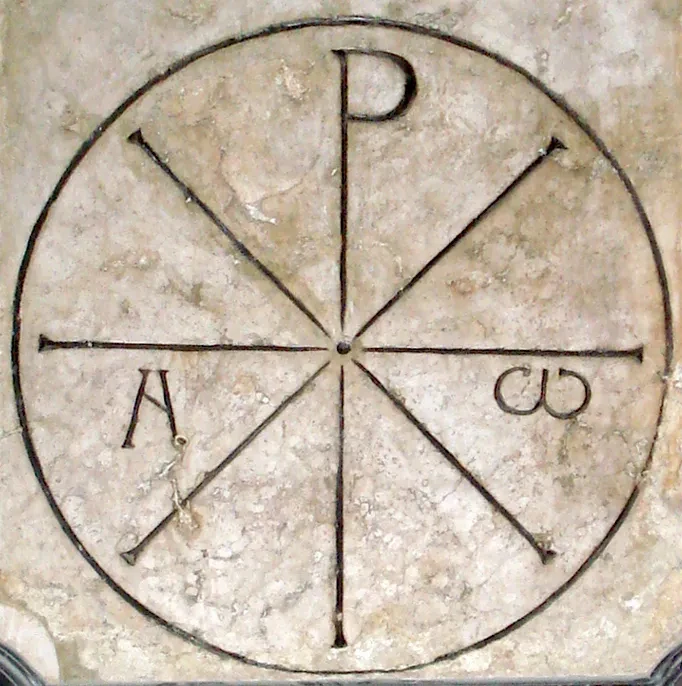
G.dallorto (modified: Dbachmann), CC BY 4.0 <https://creativecommons.org/licenses/by/4.0>, via Wikimedia Commons
It's the Chi-Rho symbol incorporating Alpha and Omega...!
It's a symbol marking the first and second letters X and P of ΧΡΙΣΤΟΣ Christos...! One of the oldest symbols of Christianity, and it was the symbol of Eastern Rome after Emperor Constantine...!! So cool...!