
298. Heracles (4).
Having traversed the world, I had come to feel that even the screams of men differed by region and the language they spoke. At first listen.
"Aaargh—!"
"Gaaaaah—"
"Save me!"
"By Áli!"
It all sounded similar, yet the cadence hidden within was, how should I put it, different? You would not know unless you heard it yourself. I could not express it precisely, but it was unmistakably subtle.
[Chulleong! Geureureureung—]
"Abandon the ship!"
"Armor! I must shed this armor—"
"By Áli! By Áli!"
"I do not want to die!"
These were Muslim pirates, none too virtuous, who had set sail with beaming dreams of a full hold—not of fish, but of plunder. Wailing pitifully, they could not even bring themselves to raise steel against me, either accepting the death that approached or denying reality as they strained every sinew to think of a way to live.
But with a ship broken at the waist and a heap of heavy iron strapped to their bodies upon the wide sea, obtaining what they wished looked truly difficult.
[Geureureung— Sswaaaa— Cheolssak! Hududuk! Huduk! Pungdeong! Pungdeong!]
The great vessel emitted a hideous death rattle as it slowly slipped into the warm bosom of the Mediterranean, and, by a kind of seesaw motion, the men and wooden splinters that had shot skyward accepted their appointed fall one by one.
"Ack!"
"Ugh!"
"Ghk!"
You see, I had heard them in the west and east of the North Sea as well, and the cries men let out were indeed slightly different. Only two ships had been literally smashed, yet both foes and allies who had witnessed my strength, incomprehensible by ordinary reasoning, had all gone mad.
[Buuuuuuuuung———!]
"Aaaaaaah!"
"Fylkir! That is our Fylkir!"
"Faster! Row harder! Let us reach that glorious place!"
"This is the Fylkir! This is Valhalla! Ancestors! I walk alive into Val—hall—a!!"
"Hel! Odin! Tyr! Thor! Helgi Ragnarsson!"
[Guuuuuung— Sswaaaa— Sswaaaa—]
"Garmr Brotherhood! In the name of the Fylkir! Charge—!"
[Iyaaaaaa!]
[Guuuuung— Kwang! Kwakwang!]
[Aaaak!]
When I rose from the sea and outright smashed the enemy's monsters—their killer whales—and their flagship, then shredded the escort vessel beside it, the enemy line naturally fell into chaos.
Even if naval battles of this era were centered on boarding actions, without at least a minimal command structure nothing could proceed properly. The North Sea longships that came tearing in like madmen and immediately drove their dragon heads home shattered the ships of the Muslim pirates they rammed using the sheer strength of superior timber, and the Muslim pirates strewn about the violently heaving decks soon had to face the Garmr Brotherhood, which had entered a state of collective frenzy.
"A-o—oooooooh—!"
"Aoooooo—!"
From the ships that had rammed the enemy's heads, they leaped over the dragon heads; from the ships that had missed their aim or had their course wrenched by a sudden wave and struck the enemy broadside, they surged over the port and starboard rails all at once.
In the ancient past, having reverted to the primeval state that still breathed somewhere in human DNA, transformed into single beasts, the Garmr Brotherhood—the wolves of the North Sea and Hel—howled like black wolves facing the sunset and, with the force of their descent, brought down axes and blades.
[Hwoong—! Pak! Kuk! Seogeok! Puk!]
The sounds of sharply honed sword edges, axe blades, and spearheads cleaving the air, followed by a medley of varied percussions. One fellow split open helm and all, another caught sprawled on the deck and met a miserable end, and yet another who did gather his wits and raise his weapon, but the descending force was so overwhelming that his own lifted blade was driven into his face.
Immediately, the screams humans let forth filled every direction, but the beasts of the North Sea, seeking to reach the head wolf, did not check their steps.
"Is there none! One who will grant me a glorious battle! Is there none here!?"
"Onto the next ship!"
"We go to the Fylkir! All of you, follow!"
The hundred-man leaders who still kept their wits searched, with one eye on the fearsome beasts under their command and the other eye on their Fylkir who was once again penning new myth at the van of the battlefield.
The demigod of the North Sea, the god of all North Sea warriors. The strongest man in this world, Helgi Styrkr, was holding a festival at the fore.
[Hwoooong—!]
"I said surrender!!"
"S, surrender—"
[Kwakwagwang—!!]
"Aaaak—!"
"Should have spoken faster!"
*****
"Fire."
"Aye! Admiral! Fire—!"
[Bam— Bambababambam— Bam—]
Raucous signal calls carried the admiral's will toward the dromon (an Eastern Roman galley) standing at the head of the imperial fleet. The will to burn every last infidel who dared oppose the great Roman Empire and its Emperor.
Upon hearing that the enemy had appeared south of Crete, Admiral Niketas and the Fylkir of the North Sea had already discerned that it was a hostile trap.
Shameful as it was, the great Empire possessed no small number of corrupt men unworthy of its name, and so the movements of the imperial army were always made known to the enemy first. If I might exaggerate a little, the information of every important personage departing Constantinople would be heading toward the enemy even at this moment.
Of course, the Roman Empire likewise received real-time reports on the moves of key figures surrounding it—but in any case.
Normally, if an army's line of march or supply route were compromised, one would halt all operations or advance more cautiously, but the news that the Muslim lords east of Iberia and in North Africa had directly intervened in the Sicilian conflict left no room for delay.
Thus, Niketas himself and the Fylkir of the North Sea had deliberately thrust their heads into the enemy's maw, and, as expected, the pirates of Egypt and Syria attacked the Roman-North Sea allied naval lines from both sides.
That the warriors of the North Sea were strong was a fact known to every Roman soldier, yet the battlefield was not governed by strength alone, and especially in a battle of such immense scale, above all else, mutual coordination was paramount. Therefore, the Fylkir of the North Sea and the Roman naval admiral realized that the best course at that moment was for each to command his own forces.
[Take aim! Take aim—! Loose! With the holy flame!]
[Geureureung— Hwaaaaak——!]
The single most important combat doctrine of the Roman navy was securing distance from the enemy. Faced with many foes and limited soldiers, the imperial navy ever valued efficiency. Though the Empire's enemies and latent foes—such as the "barbarian king" of Italy—derided it as cowardly or craven, the imperial navy had established this doctrine above all because it possessed a great weapon that they lacked.
[Hwaaak— Hwaaaaak—! Hwareureuk!]
At the signal, the dromons of Rome that courageously advanced forward spat a dark-hued liquid onto the enemy as the machinery mounted beneath their hulls rumbled into motion, and soon the holy flame upon the briny sea blazed as if it would burn up the very seawater itself.
"Aaaak—! By Áli!"
"Throw water on it! Scatter sand!"
"Save me—!"
Creatures without even the capacity to learn, half-baked pirates utterly devoid of the iron discipline of a regular army. No matter how urgent things were, how dare they challenge the imperial navy head-on?
Niketas shook his head as if he could not comprehend it and gave the order to form a long line centered on the sea blazing directly ahead and encircle the enemy.
With respect to the front Niketas was facing, on the Örn side the warriors of the North Sea would by now be locked in fierce struggle with the enemy. Niketas knew full well that the Fylkir of the North Sea was the mightiest warrior in the world, yet in a sea battle where the space to fight was restricted, it was difficult for a single champion to overturn the situation on the battlefield.
So he had to burn the enemies as quickly as possible, and then go aid the warriors of the North Sea.
Niketas, who had briefly turned his head with such thoughts to look upon the battlefield of the North Sea, soon had to change his eyes filled with worry into a gaze full of question, for he saw a sight that looked like something resembling a person flying through the empty air.
[Kung- Kugung- Kugugung-]
It was a sound heard from far away, thus faint, but on the eastern battlefield, something massive continued to strike. It was not clearly visible due to the distance, but certainly something was flying through the air there at that moment.
'What on earth is happening over there...? Could it be, could it be that the Fylkir of the North Sea is now destroying the enemy ships?'
The Fylkir's great feat of shattering the Holy Gate of Attila was now known to all in Rome. The overall reaction was disbelief, but there were too many witnesses who had watched the spectacle. The people of Rome simply devoted themselves to purchasing the icon of Heracles (who rather resembled Helgi Ragnarsson) issued under the leadership of the Patriarch Photios.
Niketas himself had enshrined the icon of Heracles (Helgi) in his mansion in Konstantinople, and was the Heracles of the North Sea truly working yet another miracle upon this sea?
He wanted to turn his ship around at once and confirm it with his own two eyes, but Niketas had a fight to finish, and the enemy had a prepared move, contrary to expectations.
"Admiral! Enemies on the flank!"
"Enemy sighted on the left flank! Enemy sighted on the left flank!"
Enemies appearing on the flank of the Roman navy, which was concentrated on the front. The number approaching at high speed was at least one hundred ships. Unlike the fleet halted beyond the wall of flame burning fiercely at the front, their movement and momentum were precise to a fault.
"The heathen rats have laid a trap! Up to the 10th Century, keep the front enemies in check. The rest, turn aside at once and face them. Move the flagship to the flank!"
"Aye! Admiral!"
Behind the voices of the sub-commanders bustling about and urging the signalmen, Niketas's gaze, from the highest point of the vigorously moving flagship, scrutinized the newly appeared enemies.
The Empire's great weapon, which they also called the Roman Fire, the Greek Fire, had weaknesses: due to the nature of the substance, which was difficult to make and even trickier to manage, a large quantity could not be deployed onto the battlefield at one time; and the weight of the heavy ship and fuel made rapid maneuvering difficult.
The enemy had properly exploited these weaknesses. At the cost of their comrades.
'The words comrade, colleague, and friend must mean nothing to them.'
To so readily use allies as bait. Was that not a foe worth a measure of respect?
With such thoughts, the Roman admiral inspected the Roman naval line, which had shifted direction with nimble speed and now formed a serviceable battle line.
Even without the holy flame of Rome personally consecrated by the Patriarch, the Imperial navy was still strong.
"Adjutant. Send the signal to advance."
"Aye! Admiral! Sound the advance trumpets!"
"Sound the advance trumpets-!"
[Bam-ba-bam-ba-bam-!]
Although the Mediterranean was originally a calm sea, fierce waves ceaselessly surged in from the eastern battlefield where something tremendous was occurring, and the clamorous sound of brass horns resounded among the dromons swaying back and forth.
When the melodies that had rung out in succession, as if in competition, finally ended, the oarsmen, in place of the sails long since furled in preparation for the enemy's arrows, pushed the seawater back with all their might.
[Beep-! Swoosh- Beep! Swoosh- Beep-! Swoosh- Beep! Swoosh-]
The line of dromons advancing in unison to the sound of the whistle even evoked a certain majesty, and the countless monsters of the sea continued to increase their speed toward the enemies approaching from the opposite side.
"Skorpio! Fire-!"
"Onager! Shoot-!"
[Tung! Tutung! Tak! Tatak! Sweeeek- Sweeeek-!]
The ships advancing at the very front launched sharp, large bolts at the enemies entering their range, and the larger ships behind them launched ship-mounted catapults.
The projectiles advancing in unison briefly exchanged greetings in midair with the projectiles fired by the enemy, and soon parted ways with the similar stones and bolts, falling and flying toward their intended destinations.
[Sweek-! Sweeeek! Plunk! Thwack! Keuk! Kkureuk- Kkuik! Hwooung- Kwang! Splash! Thwack! Aaargh-!]
The navies of the Eastern Rome and the Muslims, who had fought for long years across the Mediterranean, were similar in many ways, from the look of their ships to their methods of fighting. Beginning with long-range strikes, the ships that rammed into each other without a single step of concession soon plunged into close-quarters combat filled with the stench of sweat, the stench of blood, and the smell of the sea.
"In the name of God! In the name of Christos, kill every last one of those heathens!"
"In the name of Allah! In the name of Muhammad, let us kill all of those heathens!"
[Yaaaaah!]
In an instant, the battlefield was filled with battle cries and screams, the clashing of blades and the crashing of ships. The Roman navy, living up to Niketas's expectations, did not retreat a single step; rather, they were seizing the enemy ships, but the pirate bastards who had halted beyond the barrier of fire could be seen gradually skirting around and approaching.
At this rate, the casualties among the Imperial navy, every last man precious, would grow.
Must I accept the losses and unleash the holy flame here? Even if the Roman soldiers fighting with all their might ahead should burn to death in those flames?
Just as veins were rising on his tightly clenched jaw, something strange suddenly caught Niketas's eye as he surveyed all directions. The enemy fleet that had been skirting around the wall of fire still fiercely blazing and approaching. The sight of that fleet, which had been tied up at the front, chaotically fleeing the battlefield as if escaping from something.
'Why are they-'
It was all too obvious the Eastern Roman navy would be utterly routed if even they joined the fray, so why were they suddenly fleeing?
[Kwa-kwang-!]
With a massive crash, a heathen warship shattering into pieces far in the distance answered Niketas's question.
☆☆☆☆☆Reference Material☆☆☆☆☆
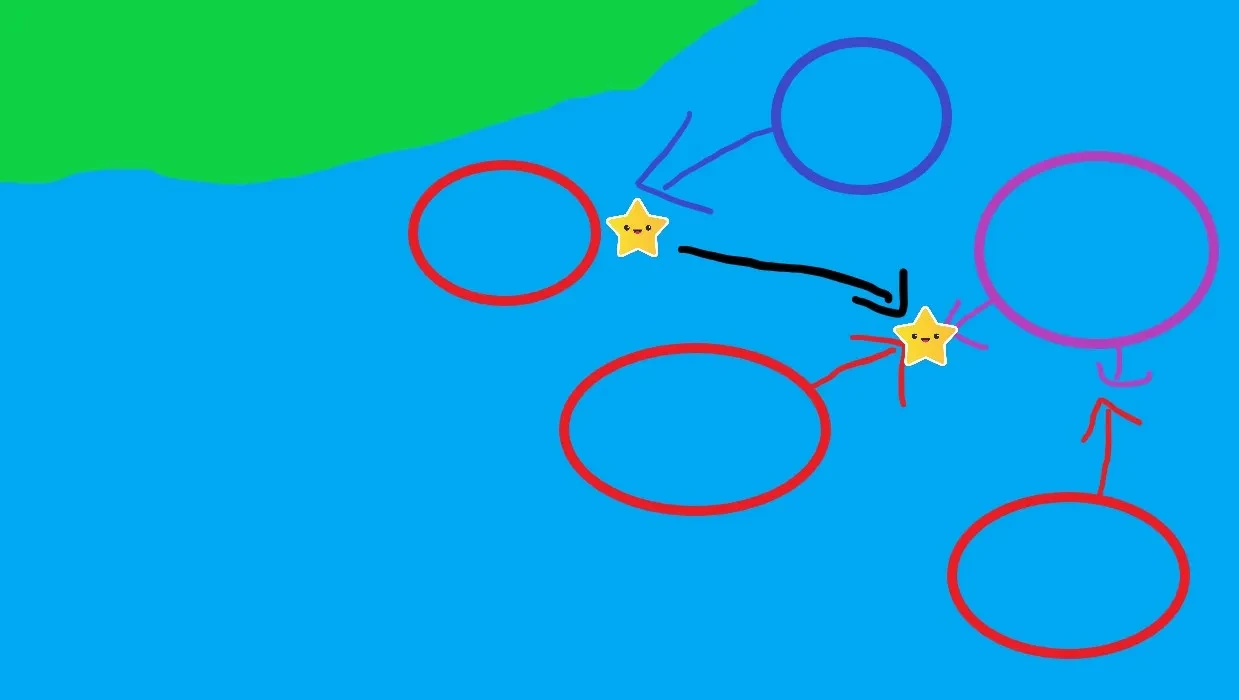
my laptop. my brain.
Spring 867. This is a rough schematic of the battle south of Crete~ lol
The cute little star marks Helgi's movement path...!
The Chandax (Crete)-Egypt-Syria pirate alliance, which had been split into three major groups, closed in from all sides, and Emir Shuwaib's main force waited in the deeper sea before striking the Eastern Roman navy's flank with uncanny precision... but such tactics must have become meaningless... How can a human block a torpedo... sob my gosh...
The blue is the North Sea forces, the purple is the Eastern Roman navy, and the red is the Muslim pirate alliance...! The Greek fire burned even on the sea, and they say it even spread easily...!! What's surprising is that the way to put it out was actually vinegar, I'm told lol
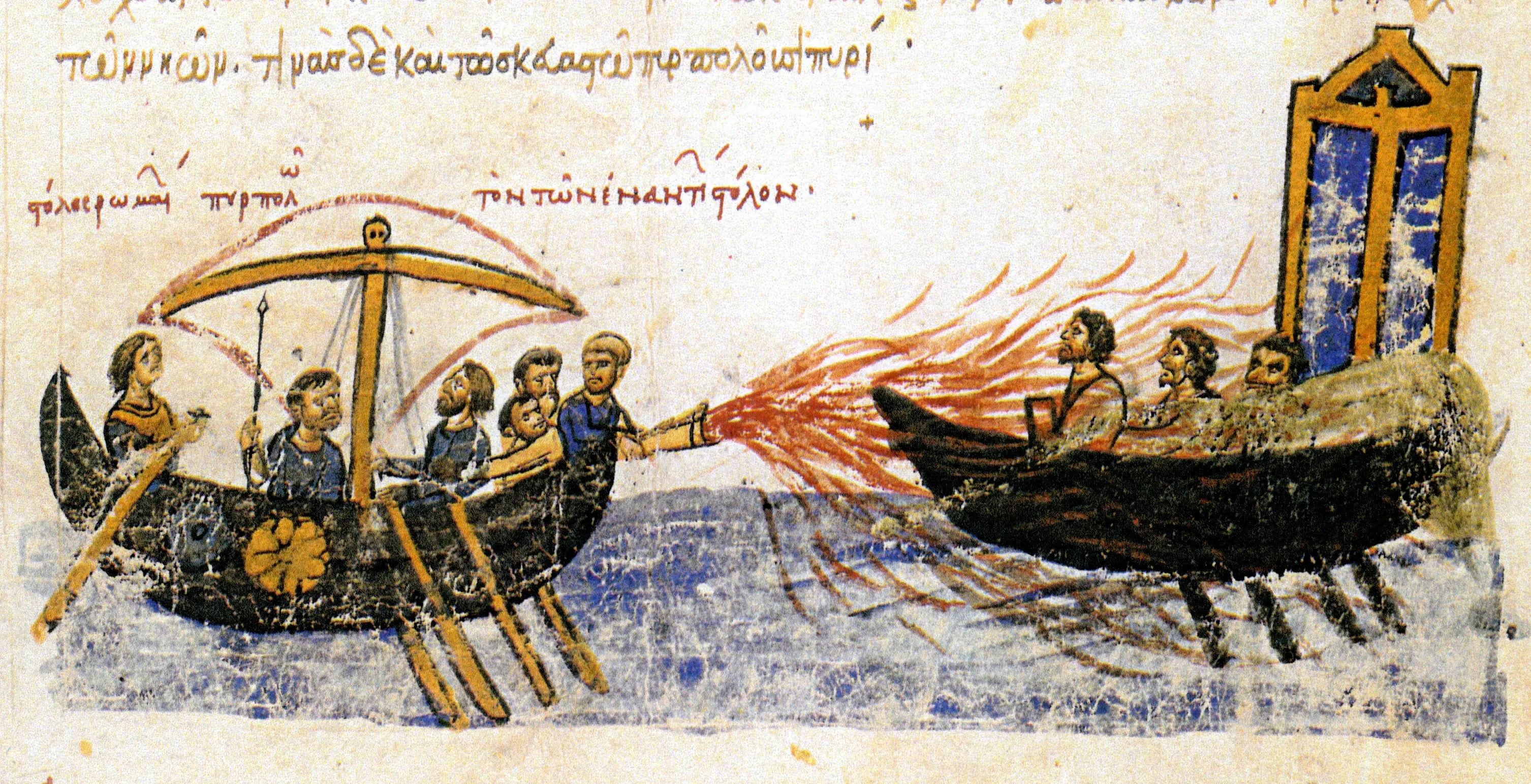
Search term: greek fire. Public domain, Wikipedia.
This is Greek fire...! The terrifying weapon that protected the Eastern Roman Empire...! A unique item strengthened by sacred consecration...!
Truly, it must have been a holy flame brought down upon the enemies of the Empire...! But it seems even this weapon wasn't invincible, as the Eastern Roman Empire was beaten quite badly in many places too...!
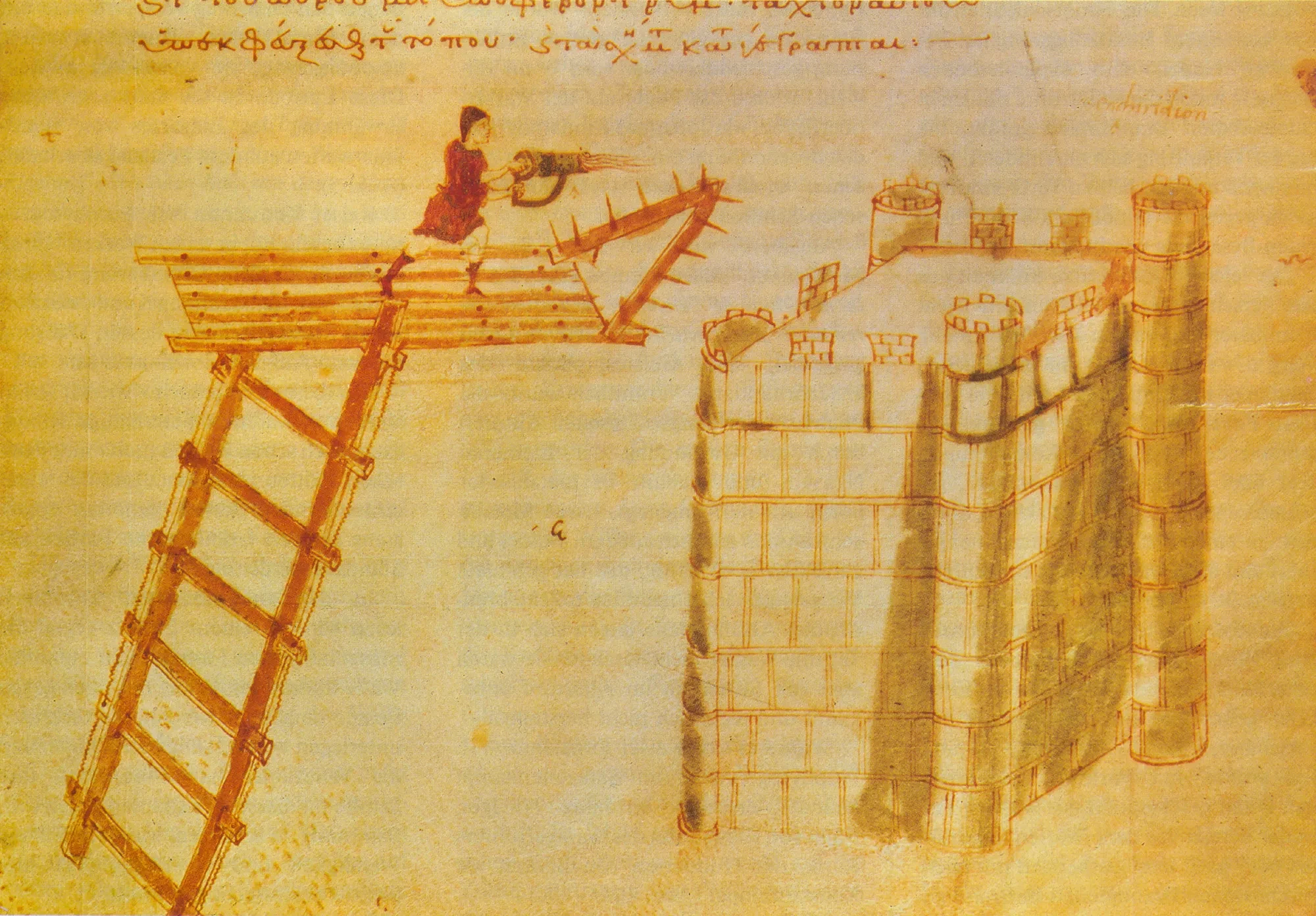
See page for author, Public domain, via Wikimedia Commons
Its use in siege warfare. This is a medieval flamethrower...!
Regrettably, its exact composition and operating mechanism vanished along with the Eastern Roman Empire... But through the efforts of scholars, a fair amount has been deduced! For those who want more detailed information, I would be grateful if you could search for Greek fire on Wikipedia..!
There is also related information on YouTube, so I expect it will be very interesting...!