
296. Heracles (2).
The banquet, which lasted until late evening, ended surprisingly(?) cleanly.
I had heard that people find it hard to change, and for someone who enjoys drinking, giving up alcohol all at once is as difficult as quitting smoking. Perhaps because he had nearly died from it, the banquets hosted by Michael were neatly begun and neatly concluded. In a way, it might have been because the sons and daughters of the noble houses of the Eastern Roman Empire, including Leon, were all showing their faces. The interest in me—I who bore titles like hero out of the storybooks of the Greco-Roman Mythological Era, emperor and protector of the empire—was far greater than I expected, and the more curious the children, the more pronounced that tendency became.
"Is your name Fylkir?"
"Did you really smash a castle gate with your fist? Doesn't it hurt?"
"Why are your hands so big?"
"If your body is that large, don't you get hungry?"
"I have the prettiest glass eye bead in the world; will you play marble-flicking with me?"
At least the children around Leon's age—around nine—were already showing self-restraint thanks to the education that began from infancy, but the younger line, from three to seven years old, armed themselves with pure innocence and curiosity and approached me, who was called a true bear, without the slightest fear, pelting me with all sorts of questions. Starting with curiosity about my conspicuously huge frame, to whether I was truly the reincarnation of Heracles, had I visited Olympus, what sort of relationship I had with their own god, and so on.
Naturally, the parents of the children broke out in cold sweats and hurriedly took away the children who suddenly burst into tears and refused to leave my side, and I, laughing good-naturedly, enjoyed this novel experience.
'Even though my body and mind had entered a superhuman realm, the onslaught of children's questions was still exhausting.'
After being harried by little children for about an hour, my soul felt roughly half wrung out. Fortunately, the emperor cut off the banquet at an appropriate moment, or else, for the first time in Helgi Ragnarsson's life, I would have dozed off sitting upright. Truly, one never knows until one experiences it personally; seeing this, I realized anew how good and lovely my own children were. On a parenting difficulty scale of five, they were maybe a 0.5? Having evenly encountered children from difficulty level five down to three at this gathering, I missed my children terribly. Sigmarr! Randulfr! Raghnilldr! And our youngest, Ingifríðr! Papa misses you so much!
The body that had actually shown more vitality while fighting one pitched battle after another against the elite troops of West Frankia and East Frankia felt truly tired for the first time in a long while as that evening waned.
The bedchamber where I had fallen asleep with the window wide open—something unimaginable in Árós at this time of year—filled with a suitably dim yet bluish light.
The large bed, clearly made with my huge frame in mind, was heaped with familiar northern furs atop soft silk bedding, and the pleasant feel and warmth together put me in a good mood. It felt like sleeping with a cotton blanket in midsummer with the air conditioner on. Halfway through I got too hot and kicked everything off, but after tidying the bedding as best I could and rising to stand by the large arched window—
The sea of Constantinople shone blue below.
Fishing boats that had already ventured out to the distant sea in the early dawn, and farther off, the majestic warships of Eastern Rome.
And beyond that horizon, Egypt and Syria, surely. The pirates of those lands. My enemies.
As I was mentally picturing our as-yet-unseen foes, I abruptly came to my senses at the dawn call of an early-rising bird, and I pulled on my clothes piece by piece.
The scheduled departure was five days away.
There was quite a lot to do.
*****
"Five days from now. The heathen of Eastern Rome and the heathen of the Shaitan will come out to sea."
In the late 9th-century Mediterranean, where Muslim pirates and Catholic pirates crossed blades, the islands lying between them—Crete, Malta, Sardinia, and the rest—were naturally all akin to the shared property of these peculiar groups called pirates. There were certainly emirs of Egypt, emirs of North Africa, or lords appointed directly by the Caliph in Baghdad. Yet if one looked a little more closely, one realized that the true owners of these islands and their nearby waters were slightly different. In other words, it was a case where the nominal owners and the actual owners differed. In any case, these pirates regularly paid taxes and slaves to the Muslim lords strung along the southern Mediterranean like a crescent moon, and in times of emergency they could also be used as a navy. So the Catholic pirates, who were not much different from these Muslim pirates, were again happily plundering and selling each other off that day as well.
However, for the last few years a cataclysm had been shaking this peaceful(?) Mediterranean sea, and it began with the Eastern Roman occupation of the island of Crete.
A counterattack by the aging Empire that had meant to meekly yield the soft inner flesh of the Aegean.
Naturally, the pirates who had gathered from Iberia, North Africa, Egypt, Syria, and elsewhere lost one of the Mediterranean's most vital strongholds in the space of a bewildered moment, and while gnashing their teeth at the Grand Admiral of the Eastern Roman Navy, Niketas—who conducted a spaced-out defense like siege tanks dug into a hill—they trickled in and assembled at the southern coast of Crete and along the coast of Egypt.
"Let everyone bear this in mind. Until we have shattered those spawn of devils, who is the successor of the great Prophet Muhammad, who is the caliph or emir we serve—all those things are meaningless."
It was blasphemy and disloyalty, but regrettably, those gathered here were not men of deep piety. If they believed in anything, it was perhaps the power of silver or gold coins? No, at their assemblies they probably only trusted the armor they wore, the sword at their hip, or the personal water (liquor) cup they always carried inside their robes.
"Of course, Emir Shuwaib. Are we not, after all, brothers in faith? It is what Áli desires that we defeat those abominable heathen wretches; how could we harbor any other intention?"
A typical pirate with a vicious smile and yellow teeth did not inspire much trust no matter what he said, but then, every man in this place was untrustworthy anyway. The title that had now lost its substance—the Emir of Chandax (Crete), Shuwaib ibn Umar—smiled with the same expression as the pirates grinning before him and nodded his head.
"First, if only we can reach Chandax! We can easily occupy Chandax through a secret passage known only to the members of my family! Then we shall open the secret vault, also known only to a member of our family, and divide its gold, silver, and treasures among the emirs present here! Therefore, let us vow victory to the great Áli and His Prophet!"
"Good!"
"Allāhu akbar!"
"Áli-hu allāh!"
"As God wills!"
It was a high-spirited mood as if they were about to cut down every enemy blocking their path. But such appearances vanished entirely the moment each man turned his back. No matter how hideous their reputations, these pirates called themselves emirs (lords) but had in truth never received a title from any rulers; their hearts were far too black to harbor dreams, hopes, or a common goal.
Still, it did not matter. What mattered was an unbroken spirit...! I would use them to reclaim the throne of Chandax that my father had handed down to me! And I would burn every coast of Eastern Rome...!
It was just as Shuwaib, draining his cup (filled with liquor) as if swallowing gall, felt the heat rising from his belly scorch his throat, that an unfamiliar voice sounded beside him.
"Is that true, Emir?"
The water (liquor) tasted particularly bitter today.
Exhaling deeply to quell the heat inside his body, Shuwaib replied in a composed manner to the strange man.
"What are you referring to, Photios?"
"The secret passage. Did such a thing exist at Chandax?"
A Roman, smiling greasily as he approached and impudently seated himself before a devout Muslim such as Shuwaib, downing the sinful wine without hesitation. This Eastern Roman betrayer, originally accepted because his name matched that of the Patriarch of Constantinople, had turned out to be a surprisingly excellent naval commander, and before long he had become Shuwaib's pirate band's—no, the Emir of Chandax's—most important general.
"As far as I know, it does not."
Shuwaib said it nonchalantly as he knocked back the liquid in his cup. Photios, sitting next to him, nodded as if he had expected that and set down his own empty cup.
[tak-]
"But it is not a lie, either. Because there might be a secret passage after all."
"As you see fit, Emir. The one leading the Eastern Roman fleet is Niketas Ooryphas himself. I hear that the purpose of this expedition is to safely escort the Fylkir who came down from the North Sea and his warriors to Sicily."
Photios casually dismissed Shuwaib's self-justification while conveying high-grade intelligence.
They could not keep paying those pricey taxes to the fearsome emir of Egypt while lingering beside the harbor of Alexandria forever. If the occupation of Chandax did not go according to plan, they needed to at least secure Cyprus—neutral ground between Eastern Rome and the Abbasids—to make the accounts balance.
And for that, a victory large enough to make Shuwaib's name resound across both empires was necessary.
What made Niketas Ooryphas fearsome was always his mobility in striking the blind spots of the Muslim pirates and that cursed Greek fire. In a head-on engagement drawn out in a long line, the odds were surprisingly in their favor. Above all, they overwhelmingly outnumbered them in sheer headcount.
They would shove the cowards into the very front, exhaust the Greek fire, and then close in from all sides. Greek fire was impossible to deal with in small skirmishes, but that accursed weapon of the Shaitan was not invincible. And paradoxically, the Muslim pirates and Emir Shuwaib, who had faced the Eastern Roman navy the most, knew the method to counter it better than anyone.
"As expected, supplies are being stockpiled on both Rhodes and Hellas; the Hellas side appears to be a decoy. They will come to Rhodes."
Eastern Rome had certainly grown stronger under the rule of the fairly excellent heathen monarch Mikhaíl, but a colossal empire inevitably developed cracks everywhere. Many Eastern Roman harbors had been well-bribed by Shuwaib and the Muslim pirates, and the resulting high-quality intelligence was analyzed by the former Eastern Roman soldier, Photios, exposing the enemy's route of advance as clear as day.
"Then we set sail three days from now. We'll land the fools from North Africa south of Chandax to draw attention, and catch Niketas Ooryphas as he approaches from Rhodes."
Various details were attached to this vast operation, but the core was ultimately to settle things with the heathens south of Crete, where Eastern Rome could not easily provide support.
Shuwaib filled his empty cup to the brim with water (liquor, distilled spirits) and tossed it back in one go.
*****
All across Constantinople, arguments broke out between citizens and clergy arrayed in strange rags that imitated the toga—the traditional garb of ancient Greece—while monks clicked their tongues and recorded the spectacle. Conversely, artists drunk on wine and brimming with inspiration suddenly produced an increasing number of sculptures, poems, songs, and paintings related to Heracles, passing through a festival-like period.
The vast festival, in which chariot races honoring the already renowned ruler of the North Sea, Fylkir Helgi Ragnarsson, were held over three full days, passed by like a dream, and then the Fylkir and the warriors of the North Sea, together with the soldiers of Eastern Rome, all boarded their ships with solemn expressions.
[Buuuuuung---!]
[Baaaam-bam-bam-!]
The departure—accompanied by the combined sound of horns and brass instruments—proceeded without a hitch according to a meticulously planned order, and amid the fervent cheering of the emperor who had come down to the waterfront to see us off and the citizens of Constantinople, the allied Eastern Roman-North Sea fleet maintained its solid formation and slowly turned its heading southward.
Twenty longships of the North Sea. Eighty escort vessels of Eastern Rome.
Of course, if every ship scattered across the empire's vast seas could be gathered, the numbers would swell further, but the imperial navy, which had to keep blocking the mosquitoes, could never all assemble in one place. So this was our best at present, and to our enemies—who had been able to gather in one place precisely because they lost Chandax—it would look like a chance they would never have again.
With such thoughts, and with an impressive gentle wind, we followed the western coast of Asia Minor toward Rhodes for roughly half a day.
Our enemies moved far faster than I had expected.
"Admiral! Pirates have appeared south of Chandax!"
A ship urgently dispatched from Rhodes reported the enemy's appearance, and Niketas, who was sailing his ship right alongside mine, and I met each other's eyes.
A great battle was waiting for us on that sea.
☆☆☆☆☆Reference Materials☆☆☆☆☆
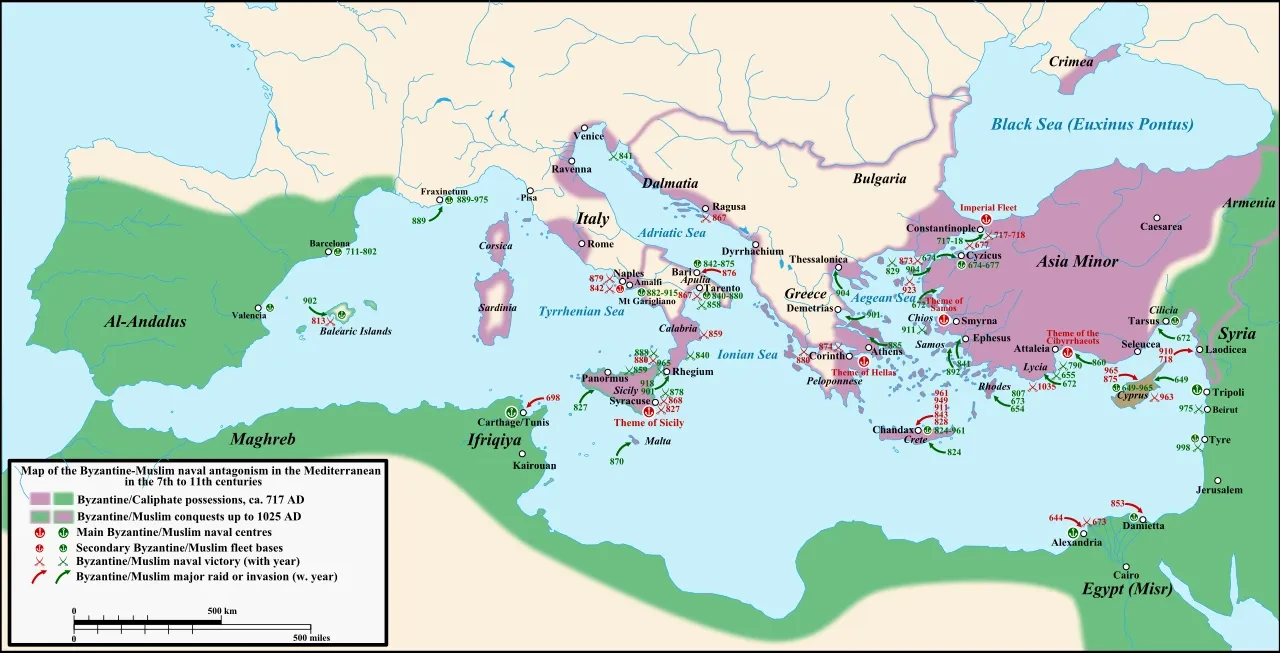
Cplakidas, CC BY-SA 3.0 <https://creativecommons.org/licenses/by-sa/3.0>, via Wikimedia Commons
The history of the Eastern Roman Empire and the Crescent (the Muslim sphere of influence) contending for the Mediterranean.
Looking at it this way, the Muslims seem too united, but actually they were divided lol
They fought viciously...!!
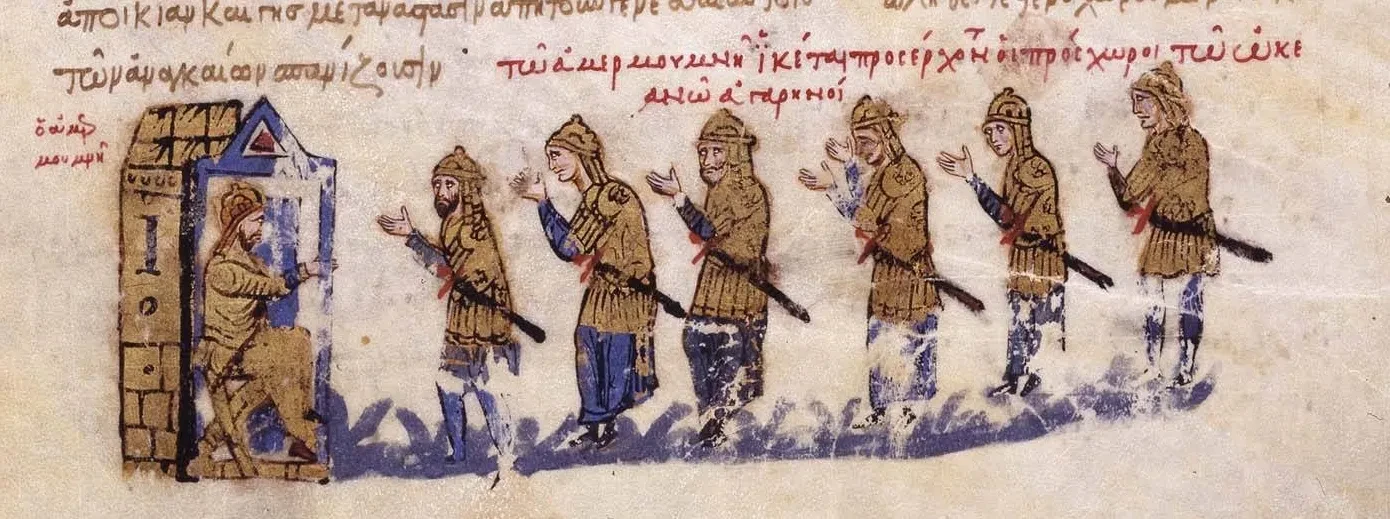
Unknown, 13th-century author, Public domain, via Wikimedia Commons
Muslim warriors depicted by an Eastern Roman historian.
It seems the blades hadn't yet curved... the heavily armed appearance is impressive...!