
289. The Most Important Problem (3).
Spring of 875.
One would have thought of brilliant flowers and warm sunlight. Fluffy drifting clouds and gently soughing breezes. But in truth, the ones who enjoyed spring the most were the bugs.
[Bzzz- Bzzz-]
Mad insects that all began stirring as if boiling over. As an intellectual of the 21st century, I knew well the subtle and beautiful balance that the natural environment and ecosystem held.
I knew that even the most insignificant-seeming mayfly was immensely important to our ecosystem, and that swatting them away as I pleased just because they didn't suit me could invite unforeseen catastrophe.
But those mosquitoes—wouldn't it truly be fine to exterminate every last one of them?
With that thought, I declared war on the mosquitoes.
"From this moment on, there are no mosquitoes in our encampment. Catch and kill every single one you see!"
"Aye! Fylkir!"
The terrifying thing about creatures that chased only blind instinct, mindless organisms like bugs (though they possessed basic intelligence, hence they flew about and sucked blood, but surely they couldn't do arithmetic like humans), was precisely that these things did not fear death much at all.
[Bzzz- Bzzz- Bzzzzzz- Pffft-]
'These goddamn mosquitoes.'
Just look at them now, brazenly flying at me, Helgi Ragnarsson—who had subdued even the lofty fortress gates of Attila and the strong, fierce warriors of the steppe—without a shred of fear, just to try and suck a bit of blood.
The thought of waging another battle this year against the maddening mosquitoes, bedbugs, and all the other vermin suddenly made my chest tight. At times like this, I honestly preferred winter. Though I couldn't voice that thought before the steppe folk now, could I? Only those with ample leisure, like the people of the North Sea, would fret over such trifles as bugs. For the vast majority of people in this world now, was not the matter of eating and surviving the most important?
But at least the people of the steppe who had come under my banner no longer needed to worry about what they would eat tomorrow.
[Bzzzzzzzzzz---!}
"Ships! Ships are coming in!"
"It is the blessed ships of Hel-Tengri! Food is coming—!"
"By the eternal might and power of Hel-Tengri! For Fylkir Khagan Helgi Ragnarsson! All of you, shout!!"
"Kiiiiiii—!"
"Arrrrrrr!"
The Volga River broadened steadily as it approached the river mouth. At its far edge lay the great city of Attila. In scarcely a month, full spring had arrived here, and there was no barley pass—no spring famine season, when food stores ran dry—to be found.
Rumors on the steppe traveled swifter than the wind, and the tribes of the steppe who had heard tidings of longships laden with endless food descending from that far, frozen land in the north flocked to Attila in numbers that made one wonder where all these people had been hiding. They promptly threw themselves upon their faces, proclaiming that they would become the most loyal servants of the Fylkir Khagan, blessed by Hel-Tengri.
How they sorted out their own rankings among themselves I could not say, but from some point onward, whenever I went down to the docks of Attila to greet the fleet of the Marmaros Council, they arrayed themselves on either flank of my guards and bellowed such cries.
Somehow, it felt strangely like becoming a 9th-century mafia boss. To be honest, I didn't have a speck of desire to rule this vast steppe, so I had simply left them to their own devices. Once their bellies were full and their backs were warm, they would start having other thoughts. That way, they would drift away naturally.
What I intended to take was Attila and all the land west of it, centered on the Volga River.
Though I could not expect the cosmic-level defense—I wouldn't use the term Maginot Line, that was a symbol of six weeks—of the Dnieper River, where I had effectively built a North Sea version of the Great Wall by erecting relay stations here and there, I anticipated establishing something of a buffer zone against the far more ferocious steppe warriors to the east through this Attila in the southern Volga and the friendly Bulgars to the north, who had in practice submitted to me.
Moreover, if those turbaned ones in the south—who had sharply raised their guard on account of the strange new neighbor that had suddenly appeared—could be made to loosen the firmly shut bolt, I would be able to set one foot upon the Silk Road trade through this Attila.
New cultural goods were always welcome, after all.
In truth, I had already obtained the most important cultural good.
[Flap- Flap-]
"Kiiit! Kiya-hoo—!"
"Kah-hah-hah-hah!"
"O Hel-Tengri! Grant the Fylkir Khagan eternal might and power! Watch over us forever!"
As the longship drew ever closer, amid the steppe natives who were intensifying their own rituals, I swept my hand over the white paper crafted by my master papermakers.
The fluttering texture, the frailty that felt as though it would tear a hole the moment a finger was pressed into it.
And yet, this weak product of wood and other mixtures could perhaps achieve a feat mightier than all the conquests I had wrought.
One might conquer an empire on horseback, but one cannot govern it from the saddle, as the saying went!
Of course, Genghis Khan would have picked his ear at hearing that, but in any case.
Haldis, the next High Priestess who sat in the seat of commander-in-chief of the Hel faith over the isle of Britain. Not long ago, she had sent me the Hel Holy Scripture, the first edition of the Hel Bible, and its contents were roughly as follows.
First, the prologue.
The Big Bang.
In the beginning, there was a great shock. Boom!
The world was born, and darkness and light danced and spewed forth their offspring into the world.
This world upon which we tread was one among them, and when beheld from afar, it took form round like a bead.
The sun floating in that sky was likewise one among them, and our world, together with its siblings, circled about the sun. It had circled for ages that to humans felt like eternity, and perhaps it would continue its dance with the sun long after we humans had all breathed our last.
Beyond that sky, in the world beyond our sun, there were yet other suns, and their number could not be counted.
Your world and life, which seemed so eternal, were in the end finite, so live your life fervently! This is the first lesson delivered by the one inevitability that all things in this world cannot escape: Death.
Chapters 1 and 2, which followed, respectively organized the evolution of life and the existing Norse faiths as tidily as possible. Things like how the boiled chicken that had recently become a staple cooking ingredient in the North Sea was actually a distant relative of the dragons that had once been the masters of this world long ago, or the well-known tales of Odin and Thor and Tyr.
Overly serious matters were not included. For instance, the idea that humans had once, long ago, been squishy life-forms in the depths of the sea. Or that the birthplace of humankind might possibly be those grasslands of eastern Africa.
Instead, the Bible of Hel, packed full with stories centered on interest, was, in a sense, merely borrowing the names of the old gods like Odin, Thor, and Tyr. It was closer to a North Sea version of Romance of the Three Kingdoms, chronicling the rise and fall of the chaotic dynasties of the northern hemisphere before the emergence of the North Sea.
The content that proceeded thus concluded in the 9th chapter—the sacred number of the Norsemen—with a story about me, and...
Truly, no matter how much I had told Haldis to do as she pleased, this, no matter how one looked at it, had been crafted into a story combining Moses and Jesus.
Things like, a journey that would normally take a full month at least being crossed in a mere three days by the ship I boarded and the fleet that followed behind it; gathering the Godis—old priests—who could not let go of the shadows of the old gods who had already departed for the world beyond the sky and who stubbornly persisted in wicked human sacrifice, assembling them all in one place and rebuking them sternly, shattering the sacred boulder of Uppsala with a single thunderous punch like Thor's lightning.
And for those who even then did not believe, he personally subjugated the isle of Britain, so that the long-sundered kinsmen of the North Sea, the Rus folk who dwelt beyond the East Sea, bowed their heads, and new worlds in the west—Vinland, Iceland—at last revealed themselves, and so on.
Just like that, I had become Hel's great warrior and prophet, the Chosen One (Hel's Chosen)!
Thinking this was a bit excessive, I naturally petitioned the head of the publishing house (the Great Temple of Hel, that is, my mother the High Priestess) to revise that part, but Mother, who had studied the Catholic Bible with great interest, said she found it rather regrettable that it couldn't be exaggerated even more, and she did not grant my request.
No matter that I am the Fylkir of the North Sea, the last dragon left upon the world, a demigod walking this earth while still alive—how could I ever prevail against my mother?
So I resigned myself to becoming the mascot of the North Sea, and the reactions went roughly as follows.
"O Fylkir!"
[Thump!]
"All glory to the One who alone is eternal! Hel's lowly servant beholds Her regent!"
[Thump! Chk!]
Men who dropped to their knees with a thump, and men who dropped to their knees while bringing their right fist to the left side of their chest. The North Sea people who met me for the first time divided neatly into these two kinds, and it seemed the military salute—which had first spread among the Garmr Brotherhood who had gone with me to Constantinople—was now taking root as the formal rite of the Cult of Hel.
What could I call the belief in the corners of their eyes? Yes, it would be truer to call it madness. That blazing fanaticism resembled the look in the eyes of the clamorous nomad lads, after all. The more my elite Engineer Corps, ever toiling with weary faces, unloaded the provisions, the louder the nomads' noise in decibels became; Attila, which bubbled and boiled with even greater vigor despite a gigantic war having been fought, overflowed with fresh strength like a seething furnace.
"Rise, all of you. Since when have the men of the North Sea knelt so? Come, everyone rise."
"Yes! O Fylkir!"
"Glory to the Fylkir!"
The nomads of the North Sea, who shouted even while rolling their eyes ceaselessly to observe the interaction between the North Sea merchants and the Fylkir-Khagan, began whispering among themselves and imitating the rites that the North Sea people offered to the Fylkir.
I had no particular desire to conquer the steppe beyond the Volga, but I also had no inclination to turn away those who came to us; and in my heart a certain possibility suddenly dawned.
These nomads, whose frequency of fighting is so great that settled folk can scarcely understand it, and who are equally swift to accept victory and defeat. I had beheaded their Khagan Zachariah with my own hand, yet the surviving Khazar warriors immediately swapped the nameplate above their own heads to "North Sea" and began a competition of loyalty toward me.
At first they tried to offer a woman; when I said I had no need of one, they hurriedly canvassed my nearby underlings with hand gestures and footwork to ask about my tastes(?), and promptly began to procure and present superb warhorses from somewhere.
Usually I am a man who does not readily accept such bribes, but to be honest, these warhorses were too magnificent and beautiful. Too magnificent, one might say, to refuse.
So, in truth, I had intended to spare all of them anyway, but I made a show of mercy, sparing all the Khazar tribes that had served Sagarya Khagan, and they swore by drinking the blood of a white horse that they would become my first cavalry, or so I was told.
The faint possibility that took shape in my mind started right at this point.
The Alans, who claimed the left wing of the Fylkir-Khagan and Atil; the Pechenegs, who held the right wing; and the Khazars of the steppe near Atil, who, though defeated by the Fylkir-Khagan, still retained strong numbers.
What if these nomads, who had historically only lagged and moved grudgingly beneath Khazar Khagans, were truly to become one beneath the shadow of the North Sea and myself?
That would be truly terrifying.
For me? No—for the powers around me.
And so I decided to make Atil a direct territory and to leave Ivar and Hrolf here. I would gradually shift the Norrland main force, which had mostly been stationed around the Dnieper River, eastward, and make this Volga River into a second Dnieper.
My defensive line advances! Forward is the best defense!
At any rate, I was in the middle of discussing just such a plan with Ivar, Hrolf, Refil, and Hrolf of Árós.
[Chk!]
"Glory to Hel and the Fylkir! O Fylkir! A letter from the Chancellor (kanslari—the North Sea's administrative system mostly used the Eastern Roman Empire as a textbook, and this term too was plundered from the Eastern Romans) to the Fylkir!"
"Hrolf? Thank you."
A stalwart messenger who saluted at a blade-sharp angle. From this warrior who moved at perfect right angles like a robot, I received a leather pouch; within it, I spied several pieces of parchment neatly folded.
I would have to examine them carefully once I returned to the study in Atil's palace, but a quick glance picked out reports on the state of various North Sea places and movements in the empire's west.
For the past five years, the Umayyad dynasty of al-Andalus and the North Sea had effectively been at war by proxy, using Muslim pirates and Wessex pirates—no, Alfred's navy—as their surrogates.
It came as no surprise, therefore, that the lords of the western North Sea, especially my brothers Björn and Ubba, were keen to move in earnest.
What worried me was only that the Muslims of al-Andalus were not so easily dealt with. I had heard that even the Iberian land that would be known as Spain in the distant future was no easy ground for an expeditionary force. I hoped that the experience of the West Frankish emperor, who had already botched things there once and badly, would prove useful.
Since I still had work left to do in Atil, I could only trust my brothers and the lords of the western North Sea.
Another letter was full of praise for Sigmarr. And at the very end, in tiny scrawl, it included a denunciation of Sigurd. The gist was that after having been summoned to Árós to work, he seemed to have spent his time dragging my children around here and there for amusement instead.
It was so like Sigurd that a quiet laugh escaped me, and I felt grateful, too. On the way back I would have to gift him a nomad instrument.
With such thoughts, I picked up the next letter, and a familiar, crude handwriting met my eyes.
[To the greatest Fylkir in the world.]
Twisting runic letters. In places, traces of old characters written and then erased were visible.
[Help me! O Fylkir!]
Stripped of all the elaborate rhetoric, the core was exactly that sentence.
It was an SOS signal from Jarl Oleg, who was in the middle of fighting as a mercenary for the Eastern Roman Empire in southern Italy and Sicily.
☆☆☆☆☆ Reference Material ☆☆☆☆☆
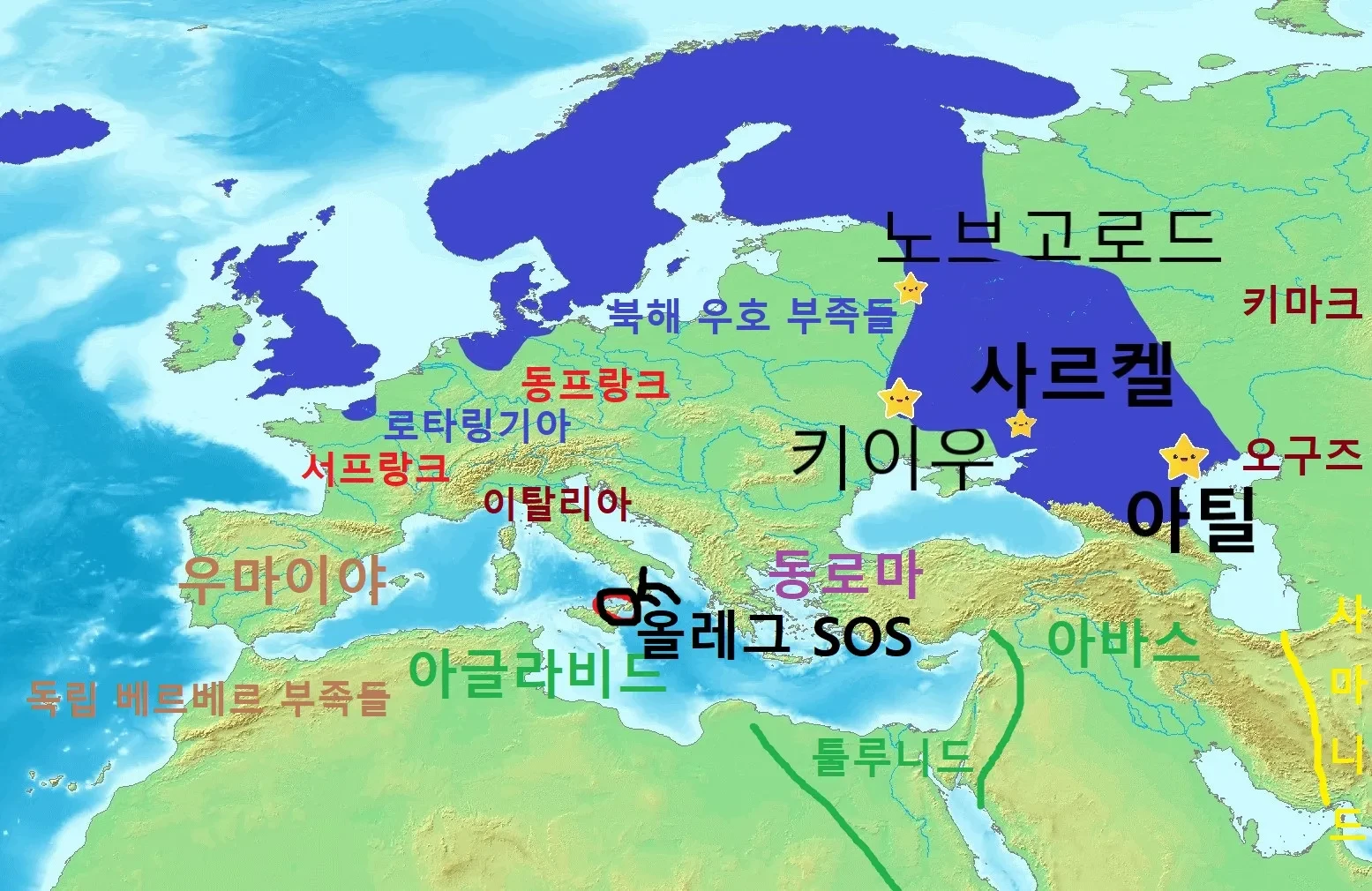
Map created from DEMIS Mapserver, which are public domain. Koba-chan., CC BY-SA 3.0 <http://creativecommons.org/licenses/by-sa/3.0/>, via Wikimedia Commons
Eurasia in 875 AD. This shows the confirmed sphere of influence of the North Sea and the surrounding political situation~!
Going overland from Atil to the location of Oleg's distress call would be far, but if you go by sea via the Black Sea and touch Constantinople and Crete, southern Italy comes into view right away~...!! The sea route, as ever...!!
Most of the tribes, including the Pols (Poland), the largest power on the southern shore of the Baltic Sea (East Sea), have had their grain markets swallowed up starting from the harsh winter~...!!
And above Lotharingia, stretching across Flanders and Frisia, and up to Brace at the upper-left corner of West Frankia—any land that touches the North Sea's waters is, for now, friendly to the North Sea~...
Uniquely, except for Dublin, the kings of Éire (Ireland) still enjoy relatively free? independence... but Rhodri the Great of the Cymry (Wales), who has effectively been incorporated into the North Sea's sphere of influence, is preparing something~...!!!
There are a few powers left out, but I'll wrap it up here for now! lol