
281. The Trumpet of Jericho (3).
[Uung—]
A force that could not be explained in any other way advanced, using Helgi Ragnarsson's Örn fist as a medium.
[Kwaang—!]
The leather glove—well-dried and trimmed deerskin, sewn by a skilled artisan—met the rough, hard surface of the wood as soon as the surface of the glove, slightly torn by the Fylkir's grip, touched it. With a massive impact, the gate began to retreat backward as if by a lie.
And then, bang!
The middle of the gate, where it had directly met the fist, was pushed inward and then burst apart. The metal hinges that supported the large, sturdy gate, and the whole wall around it—solidly built of stone and earth—trembled, shaking off the dust that had accumulated over long ages.
[Kugung—!! Deolkeong! Pshhh—]
Unable to withstand the overwhelming impact, the gate ultimately chose the path of breaking its own body, yet, still unable to fully dissipate the force that had been suddenly transmitted, it quaked violently.
Wooden splinters and dust scattered in all directions. The severely bent hinge and the twisted gate conveyed the reality of the phenomenon that had just occurred to everyone around.
Why? Why? How?
Such questions rose in the minds of countless people inside and outside the wall, and even the fact that they were in the midst of battle was wiped from their minds.
This was, in other words, like a meteorite suddenly falling in the middle of a battlefield. Like the indifference of Mother Nature, who pays little heed to the affairs of men.
"Eura-yap!"
[Hwirik! Kwang! Kwajik! Ujikkeun! Taaaang—! Kugung!]
The Fylkir's kick, mercilessly delivered to the gate that had dared to endure without falling from a single punch. In its wake, the hinge of the gate, which had barely held on and let out a pitiful scream, finally flew off. The stone wall that had firmly held the hinge crumbled, and the gate that had been bolted below finally shattered into pieces, bidding farewell to its beautiful days.
[Kiiii— Kung! Pshhh—]
The left gate had watched wistfully as the Örn-side gate shattered and flew away in an instant. It stood alone for a moment, looked down at the people of Attila who stared at it with blank expressions, and then slowly tilted and collapsed onto the ground of Attila.
And dust rose again.
"Hoooo—"
When the Fylkir of the North Sea, who had destroyed the beloved gate of the people of Attila in one blow, straightened his kicking posture and let out a long breath, the dust that had been mourning the fallen gate scattered in panic like a herd of zebras that had spotted a charging lion, vanishing to either side. At last, the demigod's form was clearly revealed to the people of Attila.
Green eyes slowly lifted within the gradually thinning dust.
So deep was the exhaled breath that the gust of dust driven toward the people of Attila in unison with it felt like a dragon's flame.
"I- I-"
"Uh- uh-"
Was this what it felt like to face the notorious tiger of the Caspian Sea bare-handed? Was this what it felt like to face the shayāṭīn of old myths? It was said that humans standing before a beast of prey were divided into two kinds—the brave and the eaten—but before the power of nature, all humans were equally helpless.
The warriors on the wall, who had been shooting their bows diligently, all clung to the wall in the face of the sudden earthquake, busy looking down. The warriors in front of the gate, who had been preparing for a desperate resistance, forgot they were bleeding from wood splinters and sat down on the spot, staring blankly up at the one who had caused this disaster.
Those who had built houses beside the wall that blocked the rough wind of the steppe watched this scene from beyond their windows, and the nobles of famed tribes who had been held as hostages or captives in the heights of the Khazar Khagan's palace all watched this scene.
The veteran hundred-warriors of the North Sea army, who had bravely rushed out after the Fylkir when he suddenly left his position, running between the solid gate and the shower of arrows, also stopped in their tracks. And all the North Sea warriors advancing toward the solid wall under the raised flag of Hel, with drums beating and horns blowing in unison, looked toward one point.
The long and harsh winter had already shown its end, yet the Fylkir, who had frozen the whole world with a single punch, moved alone within that frozen world.
Flashing green eyes stepped over the catastrophe they had caused—one step, two steps, and on the third step, they finally crossed the boundary between Attila and the outside world.
"Attila! I will tolerate no further resistance! I am the Fylkir of the North Sea! Helgi Ragnarsson! I will spare your lives! All of you, surrender!"
A voice that resonated through the whole of Attila's space burst out from beyond the faceplate that covered his face.
All those who had been sitting down swiftly shifted from a sitting posture to a kneeling posture, and the North Sea warriors, whose souls had briefly left their bodies, rushed toward Attila's gate with shouts let out from a state of spiritual ecstasy for the sake of their great Fylkir.
The warriors of Attila on the wall, watching that sight, could not hide their bewilderment as they looked at the North Sea warriors surging forward like fate, impossible to stop with the bows and arrows in their hands.
The city of Attila, which had ruled the Caspian Sea and the steppe above it, had required, astonishingly, only a single day for the fortress—built with the fortification techniques of the era's greatest empires, the Eastern Roman and the Abbasid—to fall.
*****
Indeed, the technology of the Eastern Roman and Abbasid empires!
The gate of Attila was a rather tough opponent. It withstood my fist—wasn't it a cut above the split rock of Uppsala? But what it overlooked was the fact that human leg strength was greater than arm strength. Kicking was far more powerful and lethal than punching.
In the end, in this match, I, the survivor, won. The gate of Attila was shattered to pieces.
...
Does this even make sense?
That I had to ramble such frivolous thoughts showed that the proof of strength I displayed today was an absurd spectacle even to the people of this 9th century, where myths and superstitions still lived and breathed.
"..."
"..."
Even Ivar, who usually joked around and always lifted my mood when it sank heavily after battles, and Stórolf, the ever-energetic chief of action, and Djur, whom I had brought along in a role similar to an advisor—even those who might have been expected to talk to me in this expedition force held their breath and sat with somewhat blank expressions.
Still, these men had spent a long time with me, so their reaction was only at that level. But in the case of my other guards and the green thousand-man commanders, the Jarls like Hrólfr, their already stiff discipline pierced the sky and ascended, and they were acting as if they had become robots.
Chik! Chik! Kkigik— kkigik— Ppigeudeok— ppigeudeok— Chik! Chik!
Look at them now. What kind of human walked swinging arms and legs like that simultaneously? Why did they keep whipping their heads around like that and sweating cold sweat? At this rate, I had no idea if they could properly fight the coming battle against the Khazar Khagan.
However, rather than that, the state of my warriors could be said to be fine compared to those cast away like baggage before me.
"H-Hiiik! Kkeureuk— kkeuk—"
"Spare me! I will give everything that I and my tribe possess! Just spare my life!"
"Are you an angel sent by Yahweh? Did you come down yourself to punish us? I have committed so many sins in life. *Sob*."
One man foamed at the mouth and fainted on the spot. Another, seized by a fit of terror, ground his forehead into the soft carpet and begged for forgiveness. Yet another shed two thin streams of tears, raised his eyes to the heavens, and made confession.
I had, it seemed, physically shattered only the city gate of Atil. Yet it was as though a great hole had been blasted into the minds of every person surrounding it.
"That's enough. Hrólfr, escort all of them outside. We shall confine the prisoners we've taken inside this palace and manage them. So long as they cause no disturbance, see to it that they are afforded every possible comfort."
"Aye! Lord Fylkir! I shall lay down my life to see this command fulfilled!!"
"...Don't go laying down your life. Let our commanders ensure the warriors under them get sufficient rest, and once their weary bodies and minds have recovered somewhat, we'll meet again in the deepest part of this palace of Atil. We've taken a fortress without shedding a drop of blood, so why does no one look happy!? Aha-ha-ha-ha!"
"Yes, Lord Fylkir!"
"Understood!!"
"Ha-ha-ha— ha-ha— ..."
The ice-breaking failed to land.
"Then let us all meet again at this spot when the sun rises tomorrow."
"Yes, Fylkir!"
"It shall be done!!"
[Click! Squeak— squeak— click! click! click!]
The commanders moved only at perfect ninety-degree angles as they filed out beyond the great doors with mechanical precision. The sole saving grace was that my brother Ivar, at least, moved like a normal human being with a dazed expression on his face.
They would be somewhat better by tomorrow. Holding that thought, I rose to my feet and surveyed Sagarya Khagan's opulent chamber.
I had heard that the Khazar Khaganate reaped all manner of profit between Eastern Rome and the Abbasids. But it seemed far more wealth flowed through this place than I had supposed.
That object there appeared to be a galloping horse carved from elephant ivory, and there stood swords and arrows forged of melted silver and gold, and a depiction of the sun arranged around a piece of amber as large as my fist. And what was this? What have we here? A Hebrew Bible written in golden ink.
The book cover, moreover, had been dyed with purple dye. They truly lived in every kind of luxury, it seemed. Oh? But could this possibly be—
[Slide— flutter-flutter—]
Could this texture possibly be, paper?
[Flutter-flutter—]
In an instant, the fine hairs all over my body stood on end. That cool sensation. An unexpected encounter always brought joy mingled with bewilderment.
[Slide— slide—]
As if meeting an old friend, I laid both hands upon that longed-for texture and remained still for a long while, lost in thought. Was this, perhaps, the very feeling the people of Atil and my warriors were experiencing? My mind could think of nothing but how this small discovery would bring about an enormous change across our North Sea realm.
No matter that the North Sea had no shortage of vellum, it was no match for paper. If only I could learn the art of papermaking, the North Sea and I could achieve the grand task of educating an entire populace in the ninth century.
The abundant timber resources of Scandinavia, whose forests grew faster than they could be felled. The priests of the temples of Hel who had already penetrated as far as the remote mountain villages. And, after my tearful shaving of the head, the mysteriously swelling numbers of mendicant monks— no, the bald monks— scattered throughout the North Sea Empire.
Once the 'Sigurd's Exciting North Sea Mythology' project, led by High Priestess Haldis in Britain, was completed, paper— which consumed all of vellum's advantages by dint of being mass-producible— would prove an immense strength. And was that all? It would raise efficiency in military affairs, the economy, administration— in every task that required a scribe or official.
This was a technology I had to possess, no matter the cost. But how had the Khazar Khagan obtained it?
[Slide— thud!]
I closed the splendid purple book, tucked the volume that fit perfectly in my large hand under my arm, and walked toward the window, which was striking for its beautiful stained glass.
Stretching out a hand and opening the window, I saw the whole world laid out at my feet.
The garrison of Atil, every last man's eyes unfocused, were surrendering their weapons one by one under the direction of the North Sea warriors and trudging toward the holding area of Sagarya Khagan's vast palace.
The people of Atil, who had crept out from doors firmly barred during the battle, all raised their heads to gaze at the Khagan's palace where I stood.
Eyes filled with awe.
In the eyes of the people of Atil there was, naturally, fear of their new ruler as well. Yet more than that, they were filled with a feeling of beholding something sacred.
At this rate, the settlements beyond the Volga could be secured with ease, and at the least, they would not stab me in the back when Sagarya Khagan's army drew near. Still, on the off chance, all civilians of the fortress of Atil would soon have to cross to the far side of the river together with the prisoners. Even if the battle here was over, the war still went on.
I had to summon the Bulgar Khan from beyond the river, and call in the Eastern Roman mercenaries raising havoc in the south and the chieftain of the Alans as well, and talk with them.
And then I would meet Sagarya Khagan.
Stroking the Hebrew Bible with my left hand, I laid my hand upon the smoothly finished wooden window frame.
The sun, riding high in the sky, shimmered above the heads of the people of Atil as they milled about near the shattered city gate.
*****
Let him who blows the trumpet be there.
Menashe could not believe his own eyes, and he could not believe his own mind.
Though he was Menashe, the head of the Jewish community in the Khazar Khaganate, the man who held the commerce of this entire region in his grasp, he had learned only today that the influence and wealth he possessed meant nothing at all.
"Good heavens... The city gate has been shattered?"
"How could anyone fight and win against such a foe? Master Menashe's words were right. Facing the North Sea is madness. Even if it were Amura Khagan himself."
"Then what becomes of us now? How must we go on to survive?"
The Jews, Arabs, and the handful of Greeks who remained in the fortress of Atil all gathered before the broken city gate, warily eyeing the fierce North Sea warriors, and shared their worries for the days ahead as they sought to quiet their anxious hearts.
But Menashe and a few others, who had already watched the entire spectacle from the windows of a mansion near the city gate, gazed only at one place, as though possessed by spirits.
"There is life in that place. That man is our path to survival."
Soon all the people of these steppes would know. The strongest one had at last descended upon this land.
☆☆☆☆☆Reference Material☆☆☆☆☆
Asta~commonswiki, Public domain, via Wikimedia Commons
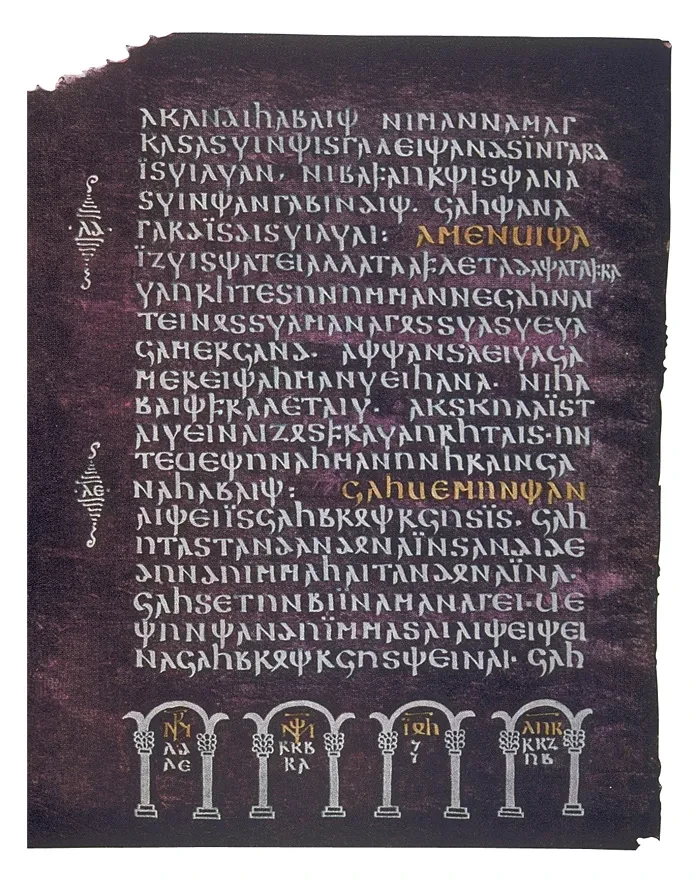
A Bible written in silver and gold on purple vellum.
The image above is of a Bible given to the King of the Ostrogoths, the true heirs of True Rome (;;) hehehe. These Goth friends had some aspects that were remarkably ahead of their time(?), like eagerly translating the Bible into their own language...
Afterwards, splendid Bibles made using this purple vellum were frequently commissioned(?) by the emperors of the Carolingian and Otto the Great lines as well!
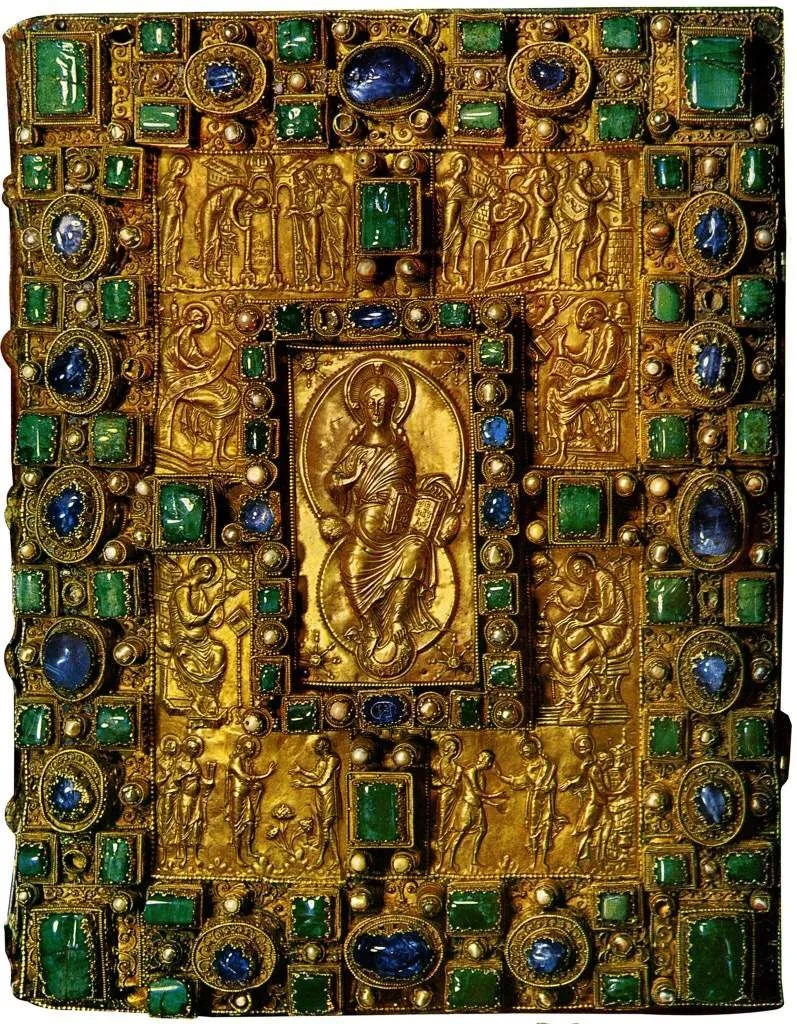
English: Image was made by the Bayerische Staatsbibliothek München and the work itself was made by Carolingian craftsmen in ca. 870 AD.Français : Image réalisée par la Bayerische Staatsbibliothek München, d'un travail fait vers 870 par des artisans carolingiens., Public domain, via Wikimedia Commons
And this is the book cover of a late 9th-century Gospel collection(...)...!!
Setting aside the heart of faith for a moment, it seems that this thing called the Bible was the exclusive property of nobles, royalty, and clergy, used as a sort of luxury item. Should we call them the true heirs of True Rome after all? Not only in the fallen Western Roman Empire, but even in the still-living Eastern Rome, noble ladies commissioned lavish Bibles... It really makes me think— is luxury simply a primal, fundamental human emotion that transcends time, place, religion, and race...!!!