
273. Wind (3).
While the Fylkir and the North Sea in the distant northeast pushed alone against the limits of the world and time, the world west of the North Sea Empire fought fiercely.
Well, in the chaotic world of the late ninth century, who didn't fight fiercely? But the confusion stirred up by Umayyad al-Andalus, Carolus's West Frankia, and Alfred of Wessex with the North Sea at his back grew ever deeper, ever sharper, and gave off a foul stench.
No wonder—the coast of West Frankia had been burning for five long years, and the embers had already crossed the Pyrenees and spread to al-Andalus. Once things had reached that point, the clash between Muslims and Catholics, who had never found it easy to live face to face under one sky, became a problem that could no longer pass without a full-scale collision.
Because of the kings' internal prestige, religious pride, sincere faith? However you labeled it, in the end it was always because of earthly desires. The coming colossal war could not be avoided. There was no way they could go on forever with this sort of sham plundering—closing their eyes and flailing at each other with birch switches.
Alfred, who had lent an arm to stirring the chaos in the midst of that great current, felt the truth of it as vividly as seawater slapping his skin.
[Sswaaa- cheolsseok! peolleok! peolleok! Sswaaa-]
Njord's endlessly roiling waves and the great sail fluttering in the wind. The aides who stole furtive glances at Alfred, scrubbing the innocent longship with their filthy rags or pretending to stare far off into the distance.
The men of Wessex, before he knew it, had grown so well accustomed to this rough, savage sea. And the sea west of the North Sea still as indifferent as ever. Alfred suddenly realized that he didn't mind any of it at all.
It sounded absurd, but catching these unceasing swells and the endlessly emerging devils of al-Andalus was far more worthwhile than fighting that demigod of the North Sea or his brother Ubba Ragnarsson.
Six years ago, to overcome the unfavorable situation at the time, he had offered the Fylkir of the North Sea the title of Bretwalda. Looking back now, six years later, that choice had probably been the single most right decision in Alfred's not-very-long life. A son born from the wife he had taken into his Ealdorman's house—no, his Jarl's house—in Wessex a few years back, Alfred's son Eadweard.
And the beloved brother, Æthelred's son Aethelhelm.
Brother had bequeathed the kingship of Wessex to Alfred himself instead of to his own son. So then, should Alfred himself pass the kingship of Wessex on to Aethelhelm? And in that case, would his darling nephew Aethelhelm let Alfred's son live?
That was why entering under the North Sea had become the better choice. Alfred had not yet made any official proclamation, worried about the gaze of the bishop still in Canterbury or the powerful clergymen. But in truth, all the Ealdormen of Wessex and the good people beneath them already knew, and they accepted it.
That Wessex, and beyond the sea West Frankia as well, no longer possessed the strength to stand against the rule of Helgi Ragnarsson.
Since things had already turned out this way, it would be difficult to expect a meaningful change no matter who inherited the throne of Wessex. So even if Alfred himself sent his beloved nephew to that sacred place of the North Sea, Árós, there would be no one who paid it any great attention.
'Wouldn't this be better than kin shedding each other's blood? Brother. Father. You great former Cyningas of Wessex.'
This weak Alfred still cannot think of a better way.
Over the past five years, Alfred's face, reborn as a complete man of the sea, had taken on the aspect of a seasoned warrior under the sea wind and blazing sun, as if looking at well-tempered iron.
In other words, on a face that had aged somewhat, a complicated heart surfaced and carved a long line upon his brow.
"You seem especially troubled today, my king."
"Shh! Lower your voice! You thick-headed fool!"
"Maybe the lot we caught last time was a bit small in number? Damn it, should we have gone for the port-side ship instead of the one on Örn's side?"
"I say the al-Andalus bastards are driving the price down! We'd be better off just plundering the lot of them—"
When you spent a long time in the rough sea life, you faced countless storms. Storms of thunder and lightning raised by nature, and storms full of blood and screams raised by men.
Living through all that, men inevitably lost a little of their hearing, and their voices, inversely, grew naturally louder. Still, it was a mercy if they only lost their hearing—during the already dozens of sailings, those who had lost their lives were without number, and many had lost their souls.
Before Wessex had met its rapid change, these were warriors he had simply looked upon as mere underlings, or as numbers. But now Alfred regarded them as family. Of course, at first, it had been nothing more than an attempt to imitate the Fylkir of the North Sea, the Bretwalda of Britain. Yet little by little, he felt he could understand the truer meaning deep in his heart.
So Alfred quickly shoved the complicated thoughts into a corner of his chest, deliberately scowled, and bellowed.
"I'm not deaf yet! And if we'd struck the port-side ship back then, how many of you Örn lot do you think would have survived on this ship? Since you're all spouting useless chatter, you must have energy to spare—best take up your oars!"
"Take up your oars, you're commanded!"
"The Red Alfred! Our great Cyning has spoken! Move smartly!"
"Oh hell, why'd you go and blather about Örn on the port side, you dolt!"
The bustling crew members, grumbling half-audibly with masterful complaining skills, each entered their designated positions and, at the signal of a veteran sailor, began to row in unison.
A sharp-eyed crewman who had climbed to the high mast shouted that land was visible far away, and at the same time the longships of Wessex surrounding Alfred's flagship all sounded their horns together.
[Buuuung-!]
The madmen who had bolted out of the comfortable North Sea, and the warriors of the Red Alfred who followed none but Alfred, be he of Wessex or Catholic.
Beyond the singing of the pirates whom the people of al-Andalus were certain were shayāṭīn, the kingdom of their Catholic brethren revealed itself.
Asturias.
The kingdom of the northern frontier of al-Andalus ruled by Alfonso III.
Perhaps Alfred's most important client.
The kingdom that, for already more than a century, had been waging the same war against al-Andalus that the Emperor of West Frankia had failed at a few years ago.
As the land of Asturias drew nearer, the singing of the crew grew louder and louder.
*****
The Isle of Britain in the North Sea Empire.
Originally, the isle of Britain grew colder the farther north you went, and more desolate the farther west.
It had to be so. In the old days, the Romans too, and the Angles and Saxons as well, had set foot on this land through the southeastern shore. And before them, the Celts, and people far more ancient whom no one remembered anymore.
The place where men first tread on this land was precisely the region of Kent, where Canterbury lies.
Thus, the northwestern land of Britain, where the footsteps of men were latest and the number of people scant, was a place to which the word "desolate" truly befitted.
No, that was what it had been.
"So much has changed. This place, and I."
Long ago, back when Rhun ap Arthgal had not yet been born into this world. Rune's father Arthgal was an ambitious new king who had newly ascended to the position of Ríheu (king) and felt the need to display his strength to his neighbors.
And the target of that display was a small village by the name of Dull Blann. In order to send a sort of message to the expanding northern Scots—Picts in truth—and the kingdom of Northumbria to the east. Dull Blann became the scapegoat for Arthgal's enthronement, and everyone assumed the incident would simply vanish as one more case of plunder and destruction among many on this land.
If things had gone that way, Rune would have succeeded his father as Ríheu, and would have seized another village to hold a raiding festival. For raiding cattle and horses was originally our tradition. If necessary, Rune too might have plundered even human lives, just like his father.
But as it happened, in the village Rune's father raided there was one particularly persistent blacksmith named Paereogeos, and this man, after his own village was burned to the ground, lived for decades devoted solely to revenge.
And when at last from the east the end came for the Kingdom of Strathclyde—the Gorge Kingdom—and it took Paereogeos under its wing.
The Avengers of Dull Blann completed their vengeance, and Arthgal the Destroyer met his death at the hands of Paereogeos.
Was it not like a tale from the old myths, where a hero slays a wicked dragon?
The problem was that the wicked dragon was none other than Rune's father, and the wicked dragon's stronghold was none other than the kingdom Rune would inherit. Rune no longer had any desire to inherit this cycle of revenge, nor the ability to do so.
It was now the 8th year of the Fylkir's calendar. The season when winter was gradually creeping to their very toes.
The scenery along the Long River, which would have once been desolate, was still welcoming, but the character of the people living beneath it had changed greatly. At this time of year, they would originally have been people who feared starvation and thought only of raiding the food of the old, the young, and the powerless in the village to fill the hungry bellies of their own children.
The people who came to the throne of Alt Clut (Dumbarton) seeking aid were neatly dressed and well-fleshed, every one, and most of all, bright smiles, rarely seen in this barren land, were to be found everywhere. This sight was so unfamiliar and yet so warm that it tickled Rune's heart.
And before such a sight, Jarl Rune Arsgalson of the North Sea knew well that picking at old enmities was meaningless, and something that could never be accomplished.
[Dagadak- Dagadak- pururuk!]
"Whoa— Whoa—"
This place was the starting point of the desolate northwest of Britain. Dull Blann, the village where all the ill-fated ties had begun and ended.
Rune set foot on this land newly built by the avengers, dismounted from his restive horse's saddle, and cast his gaze about.
People working diligently at the harvest, all of them. On roads that looked to have been only recently swept, animal dung, rarely seen in Árós, was visible, yet to Rune's heart, a rural village filled with such dirt and welcoming smells felt all the closer.
He walked a little further, took the horse's reins, and walked slowly along the road.
The working folk, those who passed Rune and his Huscarls pulling carts, and those who had been having a drinking party in the middle of the village—all at first looked upon Rune and his guard with eyes full of wariness, but soon, upon seeing the flag of Hel raised high by Rune's guard captain, they were instantly put at ease.
These people and Rune were now enemies no longer. No longer were there distinctions such as people of the Gorge Kingdom, people of Dull Blann, or Picts, Scots, Islanders, Marshfolk. All were now people of the North Sea Empire.
Rune Arsgalson could truly feel in that moment the power held by that vast difference, and the meaning borne by that flag bearing the symbol of Hel.
And then suddenly, the eyes of a man who had glanced at Rune's face, full of remorse, and then turned his head back to the drinking party, slowly widened.
The clamorous villagers, one by one, also quieted their voices, and when at last only the nonchalant chirping of birds remained around this peaceful and beautiful space.
The one who spoke first was Jarl Rune, who had ridden alongside the great Fylkir and grown in body and spirit.
"Paereogeos. It has been a long time."
Rune's own voice had never felt so alien to him. It was as if his mind and soul had separated from his flesh, and he was merely looking down from the far distant sky upon his own figure facing his father's enemy.
The rightful avenger, Paereogeos, and the people of Dull Blann, seemed for an instant struck speechless, sitting still as if nailed to the spot.
'Rhun ap Arthgal. My trusted Huscarl, my fine cavalry commander. I wish now to return to you what I have long kept in trust.'
In the midst of this awkward standoff, the conversation Rune had shared with the Fylkir suddenly drifted into his mind.
'In return, I would ask but one thing, just one promise. I know how ridiculous it is for me, who has avenged your father's grudge, to say this, but I cannot help but say it to you. Jarl Rune, who shall rule Alt Clut and the Gorge Kingdom. Promise me that you will set aside revenge. As I have taken Paereogeos under my protection, I cannot simply stand by and watch your vengeance be carried out.
Instead, I shall grant you whatever you desire. If you wish for independence, be independent as much as you please. If later you wish to gather strength and take revenge upon me, do so as much as you please. But I hope you will leave Dull Blann and Paereogeos be.'
"If my eyes do not deceive me, you are indeed the son of King Arthgal. Rhun ap Arthgal. The likeness of King Arthgal is visible in your face."
Over the Fylkir's voice that had been continuing in his head, the voice of Paereogeos, who had risen from his seat, overlapped.
Rune, waking from his reverie, recalled the promise he had sworn to the Fylkir.
No longer did resentment and remorse dwell in Rune's eyes as he looked upon Paereogeos.
I am the rightful heir of the Gorge Kingdom and the great rock (Alt Clut), and a Huscarl and liege lord (Jarl) of the North Sea and the Fylkir.
I shall surpass my father and my ancestors. I shall sever the cycle of revenge and bring about a better future. Beneath the North Sea.
"Paereogeos. I am called Rune, newly appointed as Jarl of Alt Clut. Compared to other regions of the North Sea, the people of our old Gorge Kingdom still have much work to do. So please, I ask you to help me."
Rune bowed his head, and Paereogeos lost his words.
☆☆☆☆☆Reference Material☆☆☆☆☆
See page for author, Public domain, via Wikimedia Commons
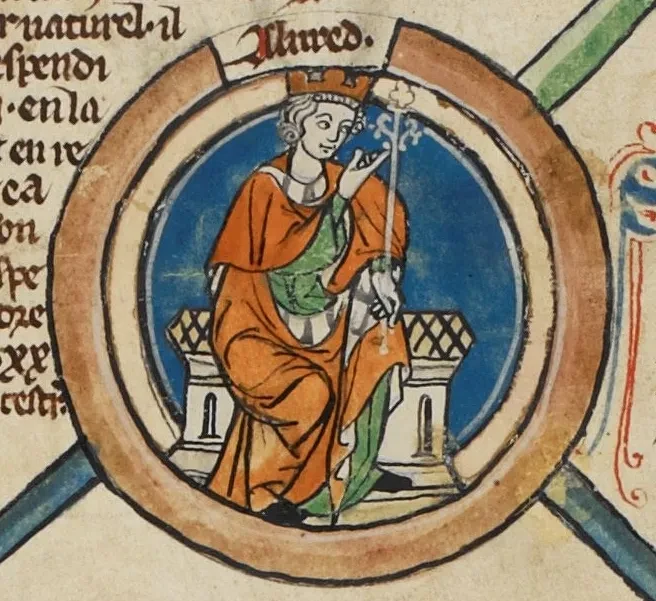
'Red Skull' Alfred. He's the Shaytan of the sea. lol
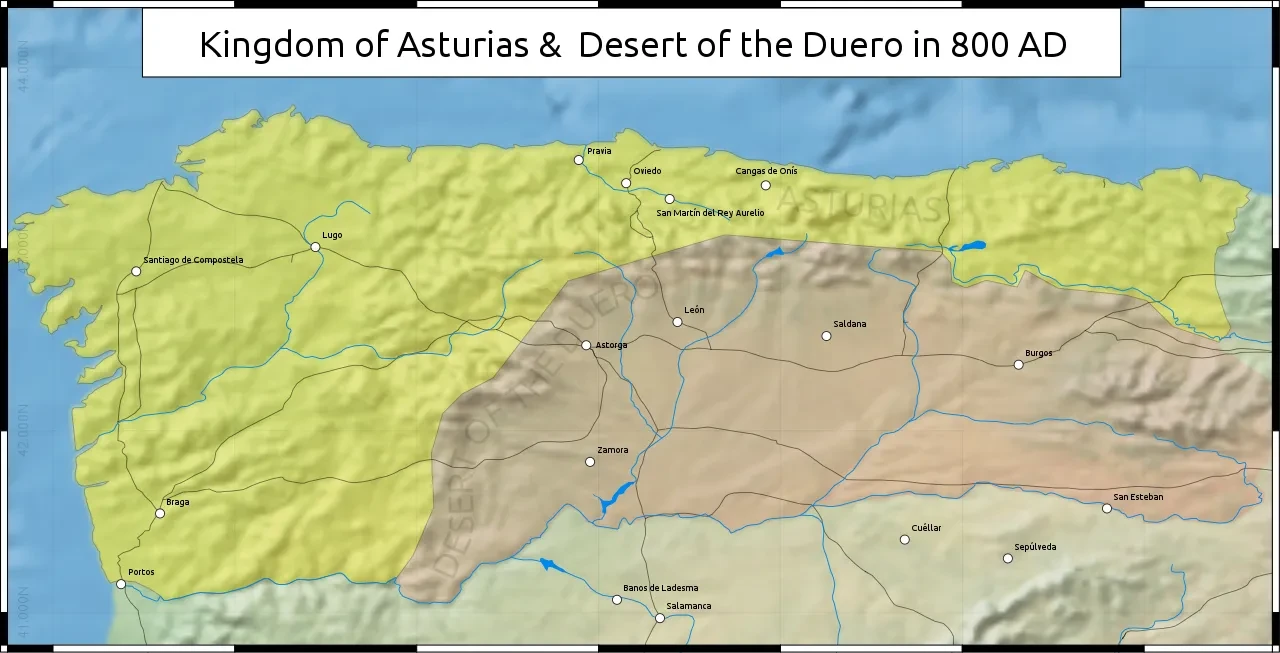
Go-Chlodio, CC BY-SA 4.0 <https://creativecommons.org/licenses/by-sa/4.0>, via Wikimedia Commons
The Kingdom of Asturias in the 800s. There isn't much difference from 874 AD here...!
Looking at the kingdoms of Al-Andalus and Iberia, you basically start with racial issues and religious problems baked in...! Naturally, there are tons of rebellions and independent states popping up like mushrooms everywhere, that's also a characteristic lol.
To the east of this Asturias are the Basques, and there's also Barcelona, which cooperates with the Emperor of West Frankia, and below that is the Umayyad dynasty.
Umayyad and Abbasid dynasties' trait: They look huge from the outside, but once you look inside, they're all fractured.
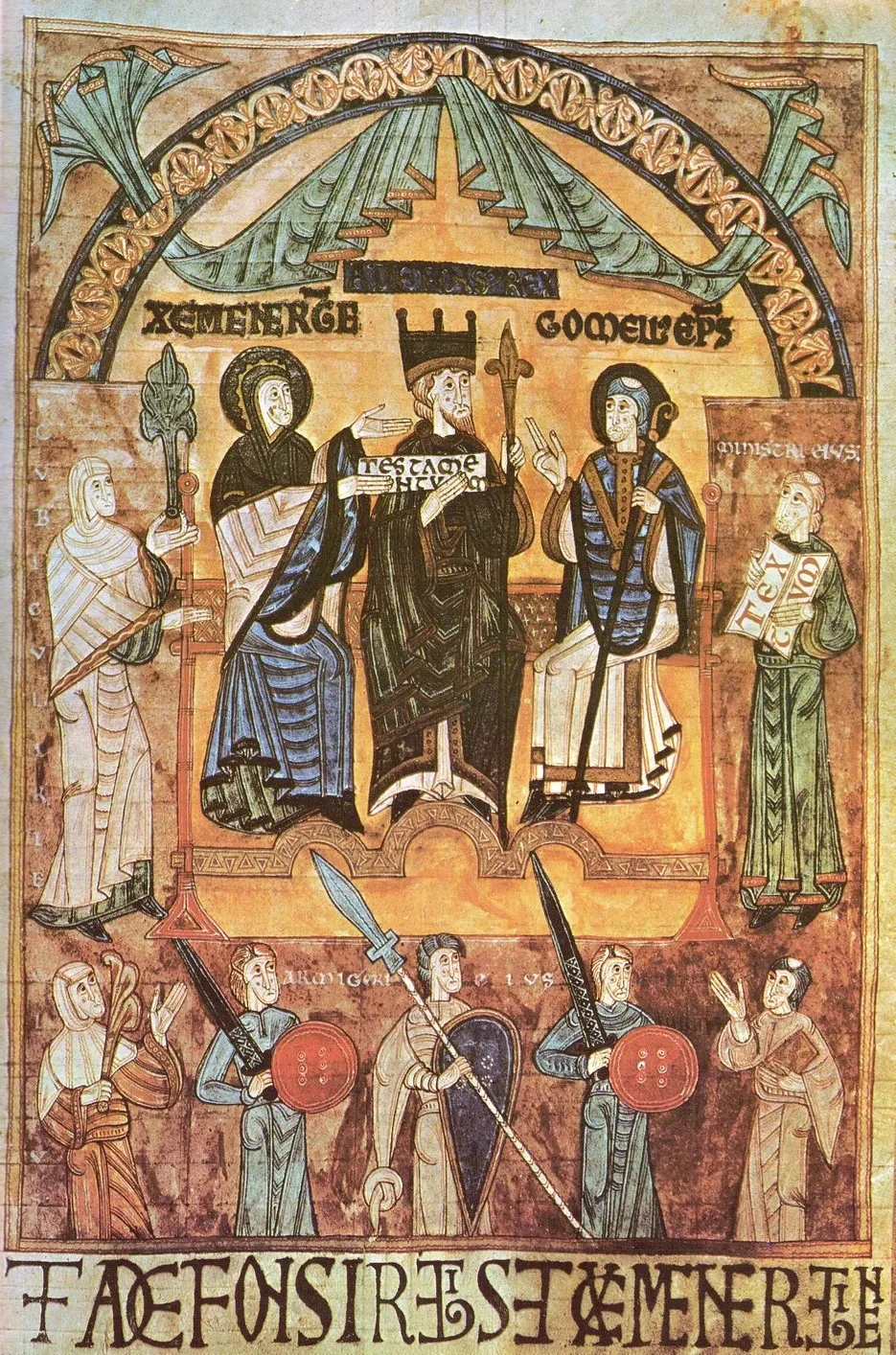
Pelagius, Public domain, via Wikimedia Commons
Alfonso III.
In original history, like Alfred, he is a king who was given the title 'el Magno'—the Great.
Taking advantage of the Umayyad dynasty's fragmentation, he expanded the realm of the Kingdom of Asturias and even inquired about purchasing a crown from West Frankia? He developed the kingdom in many ways and wielded great prestige.
Of course, it all became a beautiful memory when his sons stirred up trouble and the kingdom was eventually torn apart by partible inheritance...
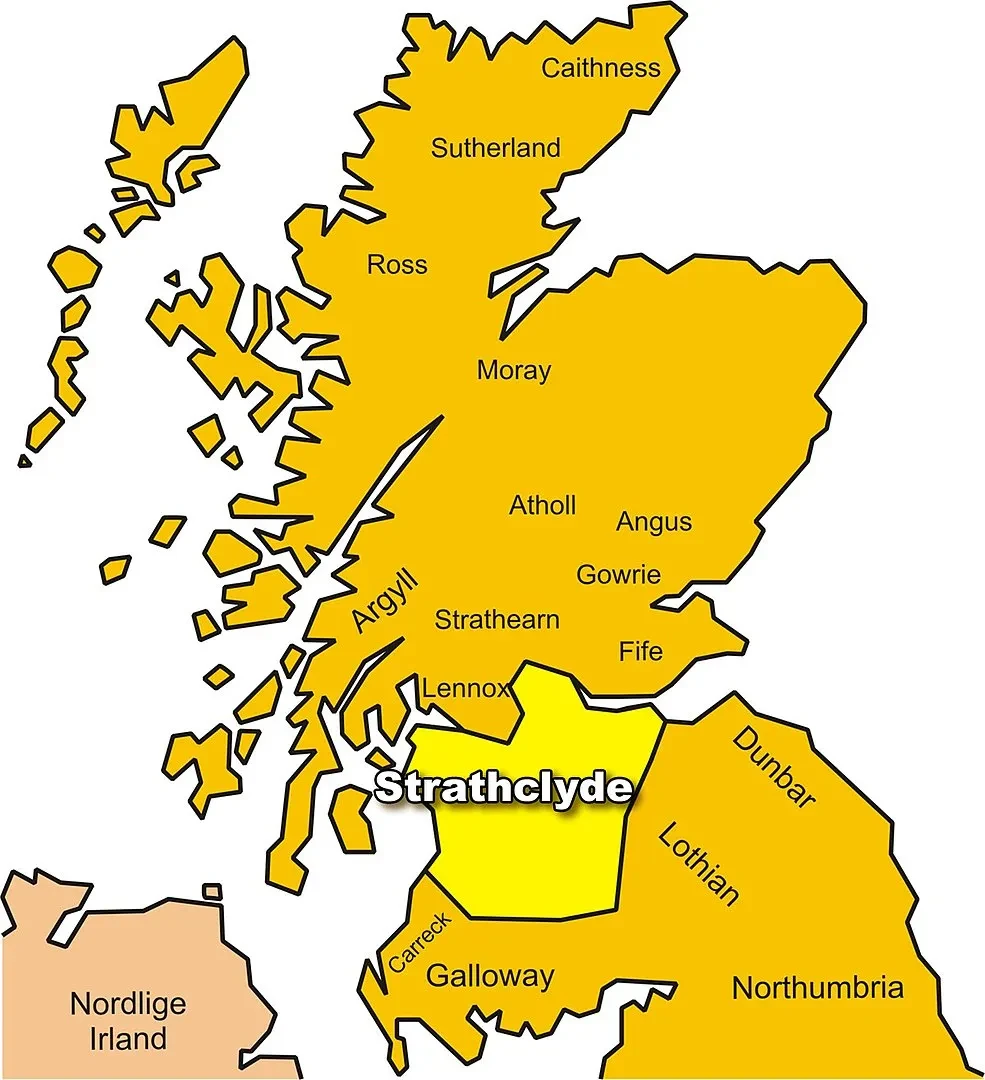
Finn B, the uploader, Public domain, via Wikimedia Commons
The Gorge Kingdom makes an appearance after a long time! The term 'Gorge Kingdom' isn't actually used. It's a term I just attached arbitrarily to help readers understand, lol.
Strathclyde. It's a kingdom spread along the River Clyde. It was a kingdom that endured for quite a long time, surprisingly.
Rhun ap Arthgal, who has finished hardening his body and mind under the Fylkir, has returned.