
260. Autumn Butterfly (2).
A second child? A second child?
When Sigmarr first came to us as a couple in days past, I felt as though I held the entire world in my hands. At the same time, I underwent a process in which the meaning of everything around me was redefined. It was a magical thing that cannot be understood without experiencing it. Was it ultimately just the work of hormones that steer human life? I wanted to believe it was something more meaningful than that.
Having undergone such a great transformation once, I had thought—if a second child ever came to Inga and me someday, wouldn't I be able to face it with greater courage and experience? That was what I had thought, yet before Inga's smile-filled face, I still became a mute fool who could not manage a single proper word.
How could she be so brave? Did this slender woman—taller than most men, in truth—mean to say she was not afraid at all? Björn's wife, Ivar's wife, countless other women of the 9th century died giving birth, or fell ill and died after giving birth.
Was this woman, who had already shaken my world several times over, a great warrior of Hel like myself? Was she saying she did not fear death?
Thus did every imaginable emotion whirl through my head like a vengeful spirit.
Joy and fear. Emotions that seemed incapable of coexisting, yet blended with a strangely fitting harmony, seized my lips and refused to let go easily.
And in the end, it was Inga's voice that drove my anxiety far away with a soft breath.
"I had actually been uncertain for a while, but Mother Asta listened to my troubles and confirmed it with the midwife. A child, a second child—it is true that a second child has come."
"U-u-o—"
Festivals and whatnot be damned—from somewhere below me, as my head spun dizzily from an unexpected uppercut, a strange sound came drifting up.
"Uu-o! Ooo—"
I lowered my head to find Sigmarr, his mouth opened into a round shape and his pupils opened even rounder, making an adorable sound. Had he been startled by the news that a younger sibling was coming? It suddenly occurred to me that my own expression probably resembled this little fellow's, and I hastily shut my mouth.
"Uhyo—!"
[Slap! Slap!]
Don't make weird noises, you little rascal.
As I tickled the cheeks of Sigmarr, who was smacking my shoulder as though in approval, I raised my head and looked at Inga again.
'Thank you. Without you, I, who would be nothing more than a stranger of the soul—a displaced person who lost his homeland—would have found living in this world much harder. Because you exist, I feel emotions I never felt even in my previous life.'
'Which of these should I say to her?'
In those deep, transparent brown eyes that seemed as though they might swallow me whole, there was a faint fear I had not noticed before. And to dispel that fear, I spoke with sincerity.
"Thank you. Inga, I love you."
When I compressed that long sentence as much as I could, what remained were the words 'I love you.'
At my voice, Inga closed her eyes and slowly leaned her body against me, while Sigmarr continued making strange noises as he smacked my shoulder.
"Uhyos—!"
*****
AD 868. The fourth month of summer. Tvímánuður. The harvest month. (Late August - Late September)
The long island of Britain, stretching up and down, was a truly amusing place. The North Sea people up in the northern isles were already walking about in winter clothes, while the North Sea people down here in Mercia and the rest of East Anglia were only now tending to their winter furs.
And so, the reports arriving from Uhtred and Ecgberht in the north, Sigebryht in the south, and Alfred in Wessex all differed—here in Tamworth, the Fylkir's directly-held seat in Mercia, which was steadily becoming the heartland of North Sea Britain.
Preparations of hay and firewood had gone smoothly. There had been a shortage of labor to cut the crops. Trivial-sounding matters, yet what was important was the act of submitting reports to Ubba itself. Ubba Ragnarsson, who intended to swallow the entire island of Britain for the Fylkir in the long run.
Right now, Ubba's gaze did not linger upon Árós, where the Great Sports Tournament would have just ended, nor upon his intended bride—Ealhswith of Mercia—whom he was to marry in the spring of the coming year.
Ubba's gaze lingered upon those powers on this soil of Britain that had not yet bowed their heads before the Fylkir.
Alfred of Wessex, Rhodri of the Cymry, and the highland tribes who had fled into the lofty, rugged mountains of the Scot lands to the north.
Of course, there were figures like Dungarth of Kernow, but Dungarth and the people of Kernow had already sent word of their intent to submit under the Fylkir and the North Sea. So in the end, Wessex, Cymry, and the highland Scots were what stood in the way of forming a unified Britain under the Fylkir.
Cymry, having been our ally in the last war, was an opponent to be dealt with slowly, with much time and effort invested from now on. And as for the fierce people of the northern highlands—so fragmented that they called to mind the old Northmen, killing one another in endless strife—when the time ripened, Thorstein of the Isles would descend upon them.
But this Alfred of Wessex had made a most interesting choice.
[I seek to punish the insolent ones who have dared defile the shores of the Bretwalda. I humbly request that the Fylkir grant his permission and bestow upon us a banner we may raise.]
Out of nowhere, he had sent a letter with this content to Ubba in Mercia. The fact that he had sent it through Ubba of Mercia rather than directly to the Fylkir in Árós was likely intended to curry favor with Ubba, the one who practically governed Britain, and to ensure the letter caught the Fylkir's eye more effectively.
Noticing even such small details, Ubba thought, showed that Alfred was far more remarkable than he had expected. It was just unfortunate for him that his opponent had been Helgi, leaving him powerless and forced to submit.
The increasingly brazen activities of the turban-wearers pushing inward had been irritating Ubba even without this. But when someone came forward unbidden to scratch that very itch, Ubba's own intention to devour every last scrap of Britain's soil could not help but shift a little. After all, the most important thing in this land of Britain—and indeed in all the North Sea realm—was the Fylkir's will.
The Fylkir did not cast out those who proved their usefulness.
Thus it was that Alfred's letter, bearing the seal of the Jarl of Mercia pressed beneath red candle-wax, crossed the sea once more and arrived safely in Árós. It brought back the Fylkir's reply, along with a red banner painted with a pure-white skull—and news that Ubba had not anticipated at all.
"The Fylkir has a second child on the way!"
The face of his adorable nephew Sigmarr had been flickering in Ubba's mind, and ruminating upon that child's extraordinariness—who had not yet even passed a single winter properly—had been Ubba's recent pastime. And now a second was coming?
Spread brightly across the smiling Ubba's desk lay the crimson banner, and the pure-white skull painted at its center grinned broadly back.
Soon after, the news that the Fylkir's second child had entered the womb of Drottning Inga spread through Mercia's Tamworth alongside the harvest festival, racing across the whole of Britain like wildfire. And Ubba, his heart grown generous, dispatched a few longships to Wessex along with the crimson skull banner.
And a few days later, Alfred of Wessex, under the command of the Bretwalda, hung a bright red flag from a tall mast for the purpose of guarding the island of Britain.
Before long, the sailors of Wessex, who had begun earning income by clashing with the turbaned ones, secretly started calling this flag 'Jolly Alfred'.
*****
While all the citizens and honored guests in Árós, where joyous events overlapped, spontaneously extended the festival for three more days.
In Orkney, north of Britain and a little removed from the center of the North Sea, a man was burning with ambition.
"Dear, must you truly go?"
"Father, I too can now do a man's share!"
"The neighbors say they are settling around Edinburgh now."
The family that had followed his worthless self from the western coast of Scandinavia all the way to this distant Orkney. Since he could no longer cause his family hardship, Flóki—a valiant Geat, no, now a man of the North Sea—spoke calmly.
"Thanks to the Fylkir's grace, we no longer have to worry about starving, so let our family all do what they wish. You may farm, or you may start a business with the silver coins the Jarl gave me. But I must see the end of that sea with my own eyes."
Back when he had been stealing from his homeland and was driven out worrying about feeding his family, his future had been utterly dark. But after Flóki and his family, who had somehow drifted into Orkney, were taken in by Jarl Rognvald, the era of the Fylkir arrived and the world changed.
So now, all that remained for Flóki himself, who had shed the worries of life, was the ambition that had burned fiercely even when he set out into exile, relying on a single longship without a destination.
The foolish thought of seeing with his own two eyes the light that must exist beyond that dark and rough horizon blazed fiercely.
He bought a house for the family members, led by his wife, who wanted a stable life by moving to a large city like Edinburgh. He pounded the pavement to get his second son into a merchant company heading into the glens. He met a landowner who offered good terms and leased a little land for farming. He also went to the temple of Hel to seek care for his still-young daughters.
After exhausting all the silver coins he possessed to get them settled, truly, nothing stood in Flóki's way any longer.
"My son. I do not know what lies beyond that sea. If Njord permits, we will be able to see anything, and if not, we shall die. Even so, will you come with me?"
"Father. Had Njord forsaken our family, we would have already fallen into the water and drowned when we were driven from our homeland. If you look at it that way, this is a chance to repay the life we owe Njord, so it is no loss. How could I send someone who no longer has the strength to properly tie a knot off alone? I am going."
"You fool. You stubborn bastard."
"Am I not my father's son?"
Thus, Flóki and his son conquered (?) the Faroe Islands and gathered a few precious pieces of information there.
"On days when the sky is perfectly clear, a shadow truly does flicker far in the distance. I have heard rumors that long before we Northmen ever reached this place, someone had already crossed the sea. They say they wielded wicked magic, eh?"
Tales from old men with few teeth left, perhaps.
"Stop that madness at once. If you are a sailor, do you not know the sea? There is a limit to chasing the bright stars night after night. If you encounter a storm doing that, you go straight to Njord's hall."
The sharp advice of a man with his wits about him, perhaps.
"I have seen someone with eyes like yours. Are you the only one in this world trying to erase the past and seek a new chance? If you truly mean to launch a ship, you must seek help from things superior to yourself. Seek the help of winged things."
He also listened to the counsel of a man whose face held hidden stories.
Thus, while Flóki recruited supporters just as mad as himself, and caught a few ravens to tame them with earthworms and the like while preparing for the winter, Jarl Rognvald, returned from Árós, personally commended him.
Beyond the heavy pouch of silver coins that Rognvald, his face slightly flushed, handed over himself, what caught Flóki's gaze was a longship of massive and elegant form.
Twice the height of a standard longship, with a hull broadened by a span and a half? Perhaps two spans. In the end, though its body was somewhat enlarged, the moment he saw this longship that could still navigate shallow rivers, Flóki experienced the sensation of his entire mind drifting hazily away beyond the distant waves, just like the day he first met his wife.
With this, he could challenge the sea. This friend could carry them to the end of the horizon.
"This is a longship the Fylkir has bestowed directly upon you, Flóki. Besides Jarl Halfdan Hvitserk of the Jutes, you are now the only man in this North Sea to have received a longship directly from the Fylkir."
The beaming Jarl Rognvald drew closer to the deeply moved Flóki and whispered secretly.
"Every sailor in the North Sea knows the word that Njord's protection rests upon the Fylkir. He was certain that a land of ice and fire lies beyond that sea. So take courage, Flóki Vilgerðarson."
Perhaps Jarl Rognvald had said such a thing purely to instill courage in Flóki himself. But the fact that the Fylkir was certain carried a different resonance.
If a man whom storms themselves would avoid had pointed it out, was it not truly worth staking one's life on?
That winter was the first warm and mild winter the people of the Faroe Islands ever experienced, yet the flame inside Flóki's heart blazed ever more fiercely.
At last, the sixth month of summer passed, and after the first, second, and third months of winter came the fourth month when the ice melts.
Þorri. The month when the festival inviting and bidding farewell to the winter spirit is held.
Flóki set out for the sea he had awaited so long.
☆☆☆☆☆Reference Material☆☆☆☆☆
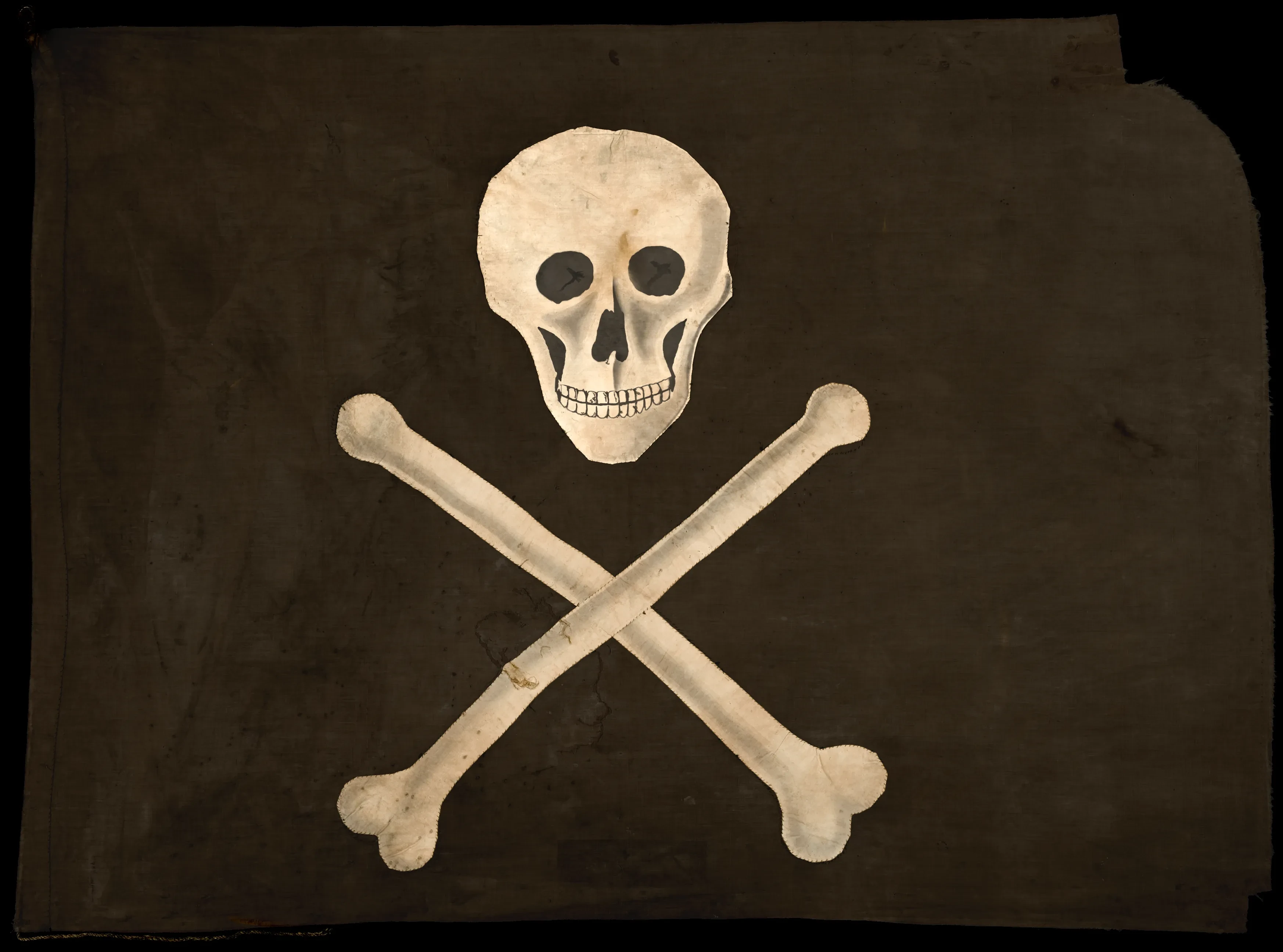
Karlsson, Anneli, CC BY 4.0 <https://creativecommons.org/licenses/by/4.0>, via Wikimedia Commons
Ahoy— All hands aboard! Set sail!
It's the terrifying Jolly Roger...!! If you spot that flag on the Atlantic, you must flee at once...!!!!
But if you ask why it is red, I answer you that it is because black dye was terribly rare at the time....
In the Sagas, black clothing does appear, but I suspect it was likely a very dark blue... If any reader with expert knowledge of medieval dyeing history is out there, I humbly seek your advice...!!!!
A Black Viking? I just can't resist that.
Anyway, Jolly Edmund ended up red..!! The very origin of the word 'Jolly Roger' for a pirate flag may come from the French phrase 'Joli Rouge' — 'Pretty Red', and they say French privateers at the time did fly red flags lol. What an incredible coincidence...!