
234. Can Not the Whole World Be Happy (4).
The road home was like walking down a gentle slope of a low hill.
Somehow, the end of this road seemed to lead to the shore of that warm southern sea.
In truth, Árós lay to the northeast by the compass, but it was just a feeling.
Wouldn't anyone feel that? A hometown must be designed at the genetic level to make humans instinctively nostalgic.
Thus, the homeward march of our expedition along the eastern coast of Scandinavia in full summer was suffused with warmth.
I carefully folded the chainmail that I had worn without noticing its weight, placed it in sturdy wooden boxes, and, dressed lightly, felt the cool sea breeze blowing in and out as I drank in the sight of Camembert's gentle sway, the distant sun and sea spread out before me, and the pageant of every shade of green grass and trees.
On the east, the mirror-like sea in the distance shone golden as it caught the sun, and on the left, the deep brown of the fields—plowed smooth with the help of all manner of stubborn weeds and trees, aurochs and horses—blended together to make the long line of Scandinavia's heather-grey mountains behind them even more striking.
The procession of me and my warriors walking the middle line between them did not show the blade-like ferocity or the needle-tight discipline we had displayed beyond the rough southern sea. But in the seemingly lax, easy laughter of the warriors, their expressions, gestures, and glances, a fearsome animal spirit lurked, surfacing from moment to moment.
An aura that those who had crossed between life and death and had been exposed to prolonged tension naturally came to carry.
At first, I had intended to write back to Hrolf, who had sent me an unexpected plan for a triumphal celebration, telling him not to start such useless business. But my brother Sigurd had strongly supported Hrolf simply because it looked fun, and I had been forced to approve it grudgingly under his pressure.
Now that I thought about it, perhaps the seasoned Hrolf had wanted to wash away, even a little, the great soot-filled pit that war alone leaves behind, in which the warriors were floundering.
My warriors, already giddy just from the news that an event was prepared for them and the mere fact that they were following Fylkir Helgi, who had stepped from legend into the realm of myth, laughed, chattered, and moved about vigorously, and before long, with the sun dropping beyond the sea behind them, they lit fires here and there.
Of course, even in the midst of that, we had to establish the encampment with strict precision, but that was how it was.
Somewhere along the southeastern coast of Scandinavia, which had turned into a vast campfire scene, the main figures of this great war one by one stuck their faces into my tent, where we were drinking together through the night with the fires kept bright.
Of course, Konungr Bagsecg, Björn, Ivar, Halfdan, Sigurd, Refil, Stórolf, and Uhtred were already with me, and also Harald of Kaupang, who had joined a day late; Guthrum and Djur, who had been working to stabilize the area around Rouen Fortress; Thorstein of the Isles; and even Ubba and Sigebryht, who had been overseeing the massive supplies moving from Britain toward West Frankia.
It was as if the entire military strength of the North Sea had been set in motion, yet it secretly shocked me that despite all this, the northern base of Jorvik on the island of Britain and the forces of the Árós-Uppsala Front still retained their strength.
As time passed, this bond and strength would only grow stronger.
Then what thoughts and decisions would my people make? Would they enjoy an era of peace and prosperity rare in the history of Europe? Or...
Would they want more?
The hearty laughter of my followers who had raised their names under me and the playing of the bards directed by Sigurd blended into one beneath the dancing flames, weaving a melody.
Through the hole left open in the tent roof for the smoke to escape, the stars of the night sky appeared and disappeared repeatedly. As I watched that game of hide-and-seek for a moment, I shook my head and cast aside the complicated thoughts. Even in the 21st century, human desire could not be controlled—how could I, in the 9th century, possibly control it?
Soon, I joined the crowd laughing, chattering, and dancing drunkenly, put my arms around my men, and sang heartily. The next morning, taking the place of my followers who had entirely wasted the morning, I went around the encampment and played the part of a diligent, competent, and wicked commander.
"Hm? This drainage ditch is a bit unusual. Was it originally dug like this?"
"...! I-I will correct it! Fylkir!"
"What is for lunch today?"
"Yes! Bread, salted meat slices, and beer!"
"Oh, tell them I look forward to it."
"...!"
By the time the Jarls, horrified at the news that the Fylkir who had downed whole barrels of drink with them through the night was now walking around the camp perfectly sober and poking into everything, broke into cold sweats and began to come to their senses one by one...
With Sigurd still unconscious and bundled like a pack onto Camembert's rump, our column set off again, advancing slowly alongside Thorstein's fleet that had joined from the eastern sea at dawn.
For a while, as the smooth road laid with stones and gravel came into view, mounted patrols hurried between our triumphal army and Árós, saluting me and reporting the city's state of readiness, then dashing off to Hrolf to relay our estimated time of arrival—all bustling about.
At last, the massive shape of Árós emerged in the distance.
To the east, it looked like a giant seated on a broad plain with waterways. A shaft of light descending from the sky seemed to shine especially white upon that city alone.
To the left, fully cleared land was visible, and beside the road stretching beyond, large granaries stood, symbolizing the immense abundance of the land. Beyond that road, new villages had sprung up like the suburbs surrounding Seoul, and past the sprawling campus of the University of Árós, Uppsala appeared with its tourist attraction named Proof of Helgi.
The workshop district prepared for the blacksmith Randi and his disciples, in cooperation with the shipwrights, had created a kind of craftsmen's quarter. The normally ceaselessly moving carts, horses, and other land transport, as well as the merchant ships that inevitably had to change shape like our North Sea longships to cross the treacherous Dnieper River, were nowhere to be seen.
Instead, the broad road was lined with people, all wearing bright smiles; those who had flowers scattered petals, and those who did not waved their hands, welcoming us.
"Fylkir! Fylkir!"
"Protect us forever! Dragon of the North Sea!"
"Gods! Look upon this place! Here stands Fylkir Helgi Ragnarsson!"
"His side is Valhalla! Wherever he is, that is Hel's domain!"
Camembert, striding at the head, had his nose in the air from all the cheers pouring down on me, thrusting his forelegs forward in a bizarre, spirited gait. The Konungrs and Jarls following behind me also lifted their shoulders and necks, maintaining a solemnity through strange expressions and gestures as they moved among the crowds cheering, shouting, and fainting.
If the reactions directed at me and those near me were of envy, admiration, and a desperate longing for the unreachable, then what poured down upon the battle-hardened warriors following behind was something akin to a festival—fervent cheers and embraces.
The sight of them searching for their sons, fathers, or brothers, or finding their loved ones, calling out names at the top of their lungs, shedding tears, and embracing one another...
Of course, if Hrolf, who liked things neat in all matters, saw this, he would scold his subordinates, asking what kind of disorderly spectacle this was; but I, thinking that this sight was, rather, the true face of our North Sea, felt glad.
Thus, leaving the explosion of happiness erupting behind me, I strode forward boldly for yet another moment.
Now I could see the familiar faces gathered before the ever-closer Seongmun. Though the frost of years had settled slightly upon them, they still retained their beautiful appearances—not least my two mothers, and the sight of Inga, like a goddess gleaming in gold draped in red cloth and a purple cloak, invaded my mind.
The name of that violence, which mercilessly shattered the staunch defensive line of my psyche and pushed its way in, was love—a compound of longing, gladness, joy, sticky possessiveness, and desire.
From Inga's embrace, the fruit of that love leapt to the ground, performing a rather high-level full-body twist.
A creature with Inga's beauty carved into his face, and my strength alone extracted and poured into his whole body.
His momentum was extraordinary as he flung away with all his might the adorable little cap that Inga had made or my father-in-law had gifted him, then came charging straight at me.
The sight of the little fellow, still with barely a few strands of hair upon his topknot, waddling as he ran while keeping his head balanced, was both ridiculous and endearing, but above all, my heart was anxious that he might topple forward flat on his face. So I hurriedly dismounted from Camembert's saddle and ran toward my son.
Erasing from my senses all the surrounding noise and unnecessary sight, I pierced through the winds as if deleting space and closed the distance with minimal resistance, sweeping the toddling Sigmarr into my arms.
[Tatatatat! Sook-]
"Ubuh- ububuh-"
"Sigmarr."
This creature, his green-gleaming eyes so like my own, working his mouth busily—so full of drool, with so much he wished to say.
In an instant, the welled-up emotion pushed moisture to the rims of my eyes. I engraved the weight, the sounds, the scent of this living being, held tight in my arms, firmly upon my fleshly senses, my mental senses, and my soul.
'Now I can understand Lothar. I, too, would do anything for your sake. Sigmarr.'
[Tak! Taktak!]
"Uaah- ubuh-"
Seemingly unaccustomed to the long beard upon my face, the little one tugged at it and slapped my cheek, his tiny touch tickling.
"Ehe-ehe- ehe-"
Not wanting to forget that bright, laughing face, unaware even of the drool spilling, I stood thus for a long while.
[Purrrruk! Purrrruk!]
"Iya- ii-"
Had it not been for Camembert, who came up beside us and thrust out his pitch-black velvety nose, I might never have thought to move. At Camembert's mischief of blowing a hot snort of breath, Sigmarr twisted his head this way and that, waving his short arms. I held Sigmarr secure in the firm arm of the Orn and grasped Camembert's reins with my left hand, leading him gently.
Far off in the distance, Inga's face, watching all of this, grew clearer now. Beside her, Bokshiri and the two cats, who all came dashing out together, had all become pigs plump with flesh, but that very sight was all the more joyous.
Presently, standing before my wife with beasts circling around me, a horse, and a child in my arms, I knew not what I should say.
Then Inga's voice, pulling both the big child and the newborn huddled together into one tight embrace at once, softly seeped into my ear.
"Helgi. I've been waiting."
I am so very glad you have returned safely.
My hearing caught that faintly whispered voice as though it were only natural, her fragrant head buried against my left shoulder. Though she smiled brightly and embraced me as if nothing were amiss, the subtle trembling of her body revealed the emotions she had held through these times.
"Uaa-i-"
Was it the weight of Inga added upon my solid forearm that made it stifling? Sigmarr made strange noises and twisted his body this way and that, but Inga's embrace remained in place for a time.
Feeling all those emotions and that warmth, I was relieved, and yet.
My thoughts reached out to those who could not arrive here with me.
"Inga. Let us go inside, home."
Then, with Inga, who nodded, I also exchanged greetings with my two mothers, as well as Konungr Halfdan, Olaf, Hrolf, and the others. Their influence, stretching across western Scandinavia and beyond to northern Britain and as far as Dublin in Eire, was truly proving a great strength in the establishment of the North Sea Empire.
Along with Rurik, Oleg, Mirosław, and Haskuldr, who would soon arrive, their houses were highly likely to remain important pillars of the North Sea for generations to come.
Imagining how their futures might unfold would, of course, be a pleasant thing, but what truly mattered now was being together in this moment with the people of the North Sea who filled the interior of Árós.
Walking among these people, who cheered as if they would wholly burn this day away with boundless vitality and often even shed tears, the honored guests of the North Sea who traveled with me arrived at the vast square that Leon had painstakingly built (copying diligently from the Eastern Romans) and came to a halt.
Beside it lay the path leading to the Fylkir's Hill, while the majestic marble statues of the gods, set between the pillars of the uppermost tier of the circular round square, each exuded their divinity in turn.
Down below, at the lowest and broadest part's exact center, before the colossal statue of Goddess Hel, the High Priestess of the goddess, my mother Asta, slowly advanced.
Soon after, the people of the North Sea, who had been shouting my name and cheering victory, gradually quieted into silence, centered around the square.
Beneath the solemn gaze of the goddess who presides over death, and of Odin and Freyja, who ever covet the finest warriors, the people bowed their heads as one and honored those who had departed first.
"Remember death... (Memento mori)"
As if he found this atmosphere, instantly transformed into such solemnity, impressive, the low murmur of Leon the Roman reached me, his eyes darting about even as he kept his head bowed. In the midst of this, the song begun by my mother spread slowly from the priests of Hel to the mouths of all the North Sea people.
The actual content of that song, which sang of death and the goddess, mattered little, in truth. Nor did the tune, passed down through long ages, or the humming of those who missed notes here and there or forgot the lyrics, hold any real meaning.
What mattered was that through this act, we honored those who had gone, that we did not forget them.
And from this, I could know that my North Sea would grow yet stronger and more steadfast.
☆☆☆☆☆Reference Material☆☆☆☆☆
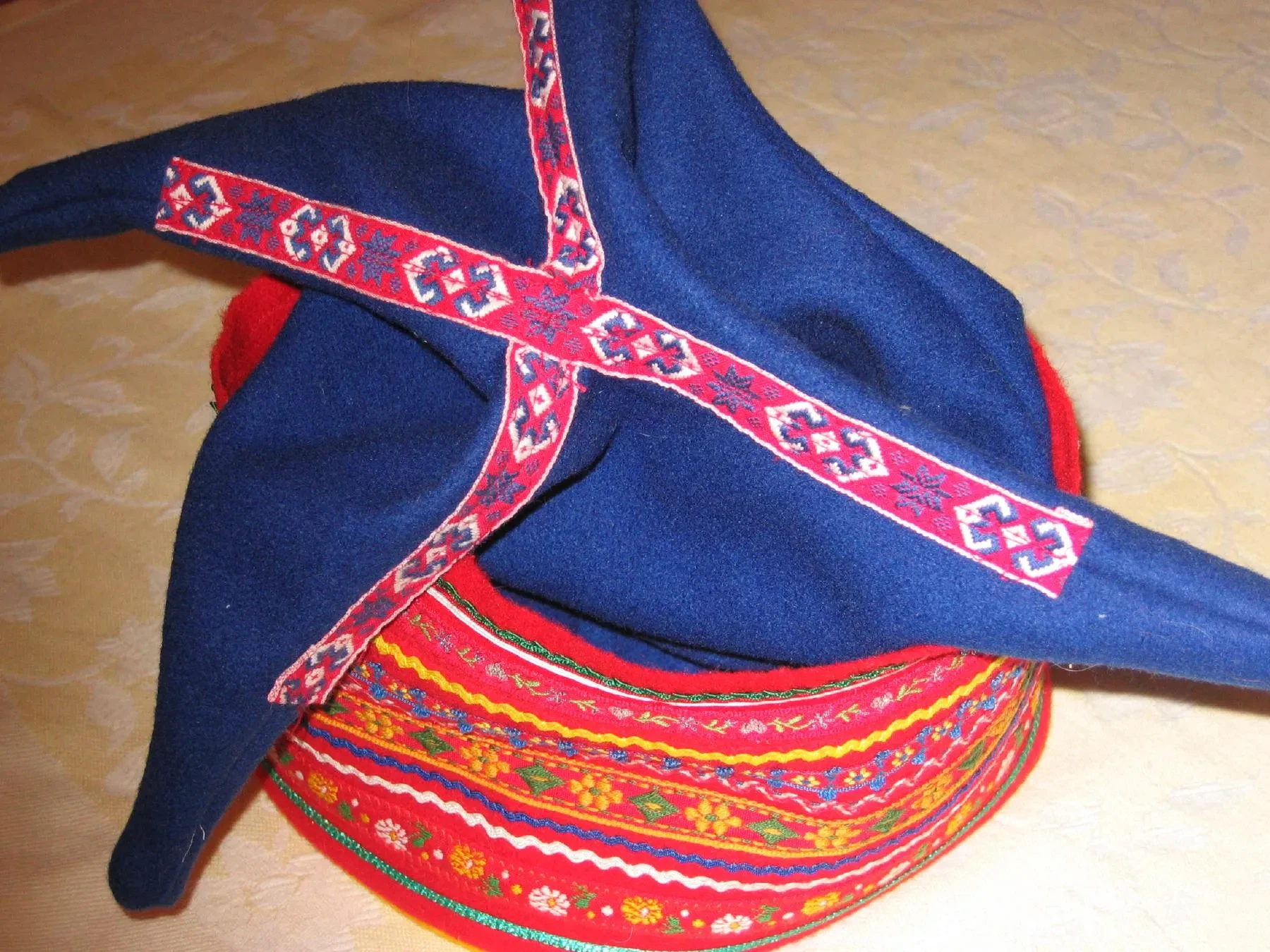
From Wikimedia Commons, the free media repository, Ranveig, https://creativecommons.org/licenses/by/2.0/deed.en
This is a traditional Sámi hat...! The blue color symbolizes the sky, and the patterns indicate one's birthplace and tribe, etc...! The four pointed decorations shaped like winds each signify the ends of the earth, and that's apparently because the Sámi people perceived the world as square-shaped lol As for the inside, they say it was packed with down (animal fur) commonly known as goose down to keep its balance...!
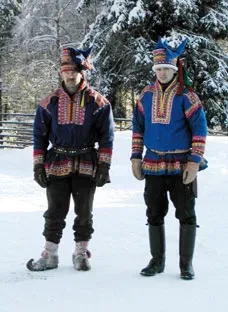
From Wikimedia Commons, the free media repository, Terfili, https://creativecommons.org/licenses/by-sa/3.0/deed.en
An actual wearing example. Actually, this outfit is a rather liberal interpretation(?) of the traditional Sámi clothing called gáktis.... They say patterns like that were not actually used...! The actors in the photo above are Finns lol So they've been receiving fierce protests from the Sámi people...!
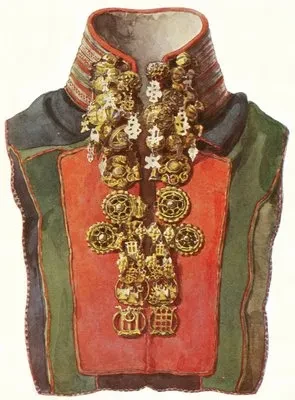
Thorguds, Public domain, via Wikimedia Commons
This is the real gáktis women's garment.
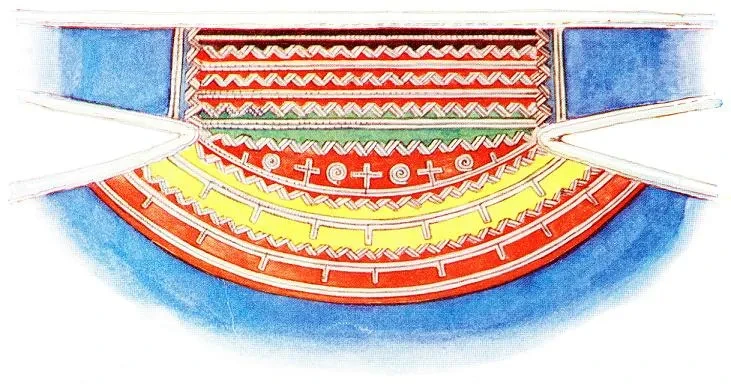
Thorguds, Public domain, via Wikimedia Commons
This is the men's garment...! It's characterized by the use of gold thread, if that can be called a characteristic...!