
230. A Season Full of Red (4).
Regensburg, the capital of the East Frankish Empire.
Having no fixed residence was a characteristic of Western European emperors in this era, yet every empire had a city of the greatest importance, and for East Frankia, Regensburg was that city.
The city Charlemagne himself had used as a base when subduing the east.
A place situated in the center of the East Frankish Empire, from which troops could be deployed north or south at any time.
Now, nearly seventy years after Charlemagne, the master of this splendid palace moved toward his throne, freely unleashing his displeasure with footsteps grown considerably rougher.
'The German' Emperor Louis Germanicus.
Since the death of Lothar I, this formidable emperor, known as the most capable in war among all the Frankish emperors, clenched the strong jaw inherited from that renowned ancestor Charles Martel and swallowed his rage.
"A war that brings nothing but losses—truly, it has been a long while."
Even in his fierce struggles against Lothar I, he had never been pushed back this far.
The newly emerged warriors from the east called Magyars and their commander Árpád were chillingly cunning, and they had preserved intact the primal bestiality that Frankish warriors themselves had once possessed.
The desperate, ruthless strength possessed only by those who had survived a life on the plains, never knowing when death might come.
That beast-like instinct, indiscriminate in means and methods, combined with the schemes of Rastislav, the sly wretch of Moravia and the old nemesis of East Frankia and Emperor Louis, had created an enemy more dangerous than any threat East Frankia had ever faced.
Though Carloman was an unfilial and ungrateful eldest son, his abilities had never been inferior to Louis himself, and from the moment Carloman's Bavaria had urgently requested aid, Louis had felt a shiver of dread.
A sensation as if the extreme cold of midwinter had licked the nape of his neck with its tongue.
Something he could not quite explain—the feeling of an unidentifiable, enormous beast circling around him in the forest, showing only its shadow.
Soon after, a messenger sent by Bořivoj, the Dux of Bohemia—Louis's true friend and a brother bound by the power of faith—arrived at the palace in Regensburg with a face drained of color, and only then did Louis realize that the unrest in the east was no mere treacherous scheme hatched by a worthless son, and raised an army.
Bohemia could not withstand the attacks of Moravia and the horse riders without East Frankish support, and so must rightfully be rescued.
This simple proposition, as it turned out, was itself the trap, and in the end Louis and Carloman fought fiercely against the combined Moravian-Magyar forces that had already seized the advantageous high ground and open plains, lying in wait for the East Frankish army.
The heavy cavalry that East Frankia took such pride in finally broke through the Moravian shield wall, but the Magyar light cavalry, with relentless endurance, struck and withdrew against every part of the East Frankish host, throwing their ranks into chaos and exacting one-sided losses.
To Louis's eyes, it was fortunate that Moravia and the Magyars were not yet well-coordinated—had their linkage been just a little more fluid, the entire East Frankish army would have had to bury its bones on some nameless plain.
The battle, each side tormenting the other's main force, came to an end only after both had suffered casualties requiring a long period of recovery, and to placate the already maddened Rastislav, Louis had been forced to release the noble prisoners he had captured in his previous victory over Moravia.
Even supposing the wounded pride of Moravia and Rastislav could be soothed in such a way—what was to be done about these Magyars?
Throughout the negotiations, the cunning wolf Árpád had regarded Louis, Carloman, and even his own ally Rastislav with the eyes of a savage beast eyeing its prey.
If only they would be satisfied and turn back now, how fine that would be—but Louis could already tell that Árpád and the Magyars would not stop. Because Louis himself would never have stopped.
He had prevented that lawless horde from breaking into East Frankia, but the north had been left completely empty. He could only hope that Bohemia and their young lord Bořivoj would hold firm, and that they would make good use of the precious time Louis had bought them.
Having felt true powerlessness for the first time in a very long while, and having seen the face of his eldest son Carloman—who lived on his own arrogance—filled with rage and humiliation, Louis could not even bring himself to offer a rebuke, and so had returned straight to Regensburg.
Naturally, every renowned Dux, Comes, and attendant who served the emperor strove to be quiet as dead mice, suppressing even the rustle of their collars, and into the palace of Regensburg—which felt as though it were holding a funeral—bad tidings had arrived in succession.
Namely, news sent by his second son from the Saxon lands, and news sent by his third son from just above the Alps.
Respectively, that northern Saxony had been lost to the Norsemen, and that Emperor Ludovicus of Italy had dispatched an envoy in the name of the Pope.
And Louis finally understood.
That the root of all this turmoil was none other than Lothar of Lotharingia. That his two nephews—of Lotharingia and Italy—who had drawn in every surrounding enemy and in the end even pulled in the Pope himself—were behind all of this.
Gripping the letters held in both hands, Louis let out a hollow laugh; the light in his eyes was the exact same light that shone in the eyes of his brother in West Frankia, Carolus.
A cold, blue light that promised future vengeance.
*****
"Now—hurry it up! Just finish this and we're done!"
"Karl (Centurion)! Shall we haul it down now!?"
"Wait a moment! There's no one below, right!? Now pull!"
"Aye!"
[Tak! Charrrreuk— Peolleok—]
The great flag that had soared high without regard for the heavens, hanging from the Örn Tower, came down to the ground with a faint sound.
This place was now Hamburg under the North Sea Empire, no longer East Frankish territory.
Unlike the vicinity of the northern gate, which had been wrecked in the clash with Bagsecg, Halfdan, and Sigurd, the area around the southern gate had preserved, comparatively, the original beauty this city must have once possessed.
The defensive towers rising high here and there, the churches and noble mansions that had clustered in the southern area—which felt safer than the north facing the enemy—the administrative offices, and the palace.
Although the warriors of the North Sea and I were not, like the Vandals of old who committed vandalism, destroyers who smashed every visible sign of civilization—nor great warriors of the earth and the natural environment—
My warriors, brimming with pride in the newly risen North Sea Empire and its chief deity Hel, had hauled down wherever they saw the costly cloths that fluttered throughout the city—as if symbolizing the wealth and splendor of Hamburg—and the crosses painted upon them.
As for the deeply devout clergy who watched this scene, they shed tears like chicken droppings rolling down, and there was some commotion as a few residents of Hamburg, mistakenly believing that the Norsemen's full-scale pillaging had begun, shrieked and cried out for their lives—but on the whole, the occupation of Hamburg and its surrounding region was concluding smoothly.
Perhaps the reason the dominion over Hamburg passed so smoothly was, of course, my oppressive presence and the existence of the North Sea warriors being the greatest factors, but I thought that on top of that, after the battle ended, Stórolf came with Bruno loaded onto the saddle of a horse like luggage, proudly carrying the lord of Hamburg over his shoulder and crossing the gate, and that seemed to have been the final decisive blow.
To Stórolf, it was like carrying around the enemy commander I had personally defeated as a trophy. To the locals, it might have seemed like a threat not to try any nonsense.
It was a case of a person's pure (?) heart bringing about an unexpected result. But the residents of Hamburg, injected with extreme fear, really followed our orders obediently, and after a while, even the Saxon named Otto, along with Bruno who had regained his senses, bowed their heads and surrendered to me.
Thus, I had achieved the feat of conquering all of the Saxon kingdoms of Britain and the last remaining Saxon land (Saxony) on the European continent. I was the conqueror of the Saxons, the destroyer of the Saxons.
Anyway, since the south gate had been wide open, what trick could there be left at the north gate? Naturally, commanders like Konungr Bagsecg, Halfdan, and Sigurdeu all rode their horses in at once into Hamburg, which had opened its gates in all directions.
In particular, the expression of Konungr Bagsecg, who bore direct and deep grudges against this fortress, was a mix of great joy, regret, and a sense of something like liberation.
At the victory feast that followed, for the first time in a long while, the Ragnarsson brothers other than Björn and Ubba gathered to celebrate the successful siege and reunion, relieving their fatigue, and they appointed Sigurdeu as the person in charge of continuing the construction of the northern fortress they had already begun, turning it into a twin city guarding the Elbe River.
Since they couldn't leave the influential brothers Bruno and Otto in place, they moved the noble captives to Árós, and as they prepared to send all the clergy who had no intention of following the new law and god back to their own lands, time flew by and half of the second month of summer had already passed.
As a result, they had swallowed not only Bremen but also Verden whole in the blink of an eye.
The northern Saxon territory had effectively fallen into the grasp of the North Sea-Frisian allied forces, but this territory alone was already so much that Frisia was stuffed to bursting, so further expansion was impossible even if they wanted it.
Thus, just as the war in northern East Frankia had split into Paderborn and Verden and entered a lull,
Lothar, moving like lightning, finally obtained the consent of his two unworthy uncles, and straightaway sent me word that he would divorce his former wife Teutberga and hold a wedding ceremony with his open lover Waldrada.
In many ways, this was a divorce-cum-wedding that would go down in history. In a letter that looked like he had written it with his own hand, Lothar praised me, the Fylkir of the North Sea, with excited handwriting and tone, thanked me, and even invited me, a heathen and a barbarian (from their perspective), to his wedding...
I had actively participated in Lothar's divorce war because I was blinded by the spoils, but the truth was that I was not that close with Lothar, so I wasn't keen on attending in person.
Of course, given the human characteristic of valuing face, even in the 21st century, snubbing a wedding could be seen as a grave insult, so I had to send an envoy who could uphold my dignity while also saving Lothar's face, and a person with the capacity to do that immediately came to mind.
"For that reason, I have asked you to come like this, so I am counting on you, Damian."
"An old, worn-out man like me has been given the audacious task of representing the names of two rulers, the North Sea and Rome, so I will simply mind my body and heart and straighten my mind."
That protagonist was Damian. Damian, who had been living almost invisibly in my palace in Árós, focusing on winning the favor of my two mothers, Inga, and Sigmarr, readily accepted my request.
I felt heavy-hearted, as if I was entrusting a great responsibility to an elderly official with a face full of wrinkles, but seeing the occasional joy and the gleam in his eyes amid his poised sentences, it seemed my worries had been needless.
As someone who openly corresponded with the Eastern Roman Emperor Michael and the Patriarch without any attempt to hide it from me, he might have had some ulterior motive I didn't know about. But that was a matter of Rome, so it was none of my business.
Actually, apart from the hassle, there was another reason I could not attend Lothar's wedding (divorce ceremony).
It was because of the expeditionary force of Rurik and Oleg, which had entered the territory of the Obotrite confederation to the east, where there was no way to receive any news at all.
In this era, there was no radio wave, let alone wired communication, so news could only be exchanged by people traveling on foot.
The territory of the Obotrite tribal confederation east of Hamburg was literally a sea of deep forest made of trees, and if an outsider unfamiliar with the forest paths ventured in recklessly, they could end up circling the same spot and die at the hands of wolves or bears, or starve to death.
Where exactly was one supposed to send a courier? How was anyone to know where Rurik and Oleg even were?
Therefore, I used to inquire for news via merchant ships traveling the sea route between Árós and Novgorod, and the last news that reached me was that Rurik and Oleg had led their fleet, been lavishly entertained in the land of the Est tribes, and then continued westward.
I couldn't make head or tail of whether I should raise an army and invade as well, or whether I should wait.
A report that some suspicious figures had been spotted beyond the eastern gate of Hamburg reached me, passing through the centurion (Karl) and chiliarch (Jarl) in charge of that area, and then through the hands of Refil, who could be called my chief secretary.
These people, who looked a little different from us or the Hamburgers, clad in the light clothing typical of forest folk and armed with bows, carried a rolled-up parchment. On it, there was an attempt to draw a dragon, but it had turned into a twisted serpent of the underworld, and on that long body, several familiar rune characters were written in crooked letters.
[Liubice. Helgi's. Continue. Attack. Negotiation. Successful. Sea. Hel's.]
☆☆☆☆☆References☆☆☆☆☆
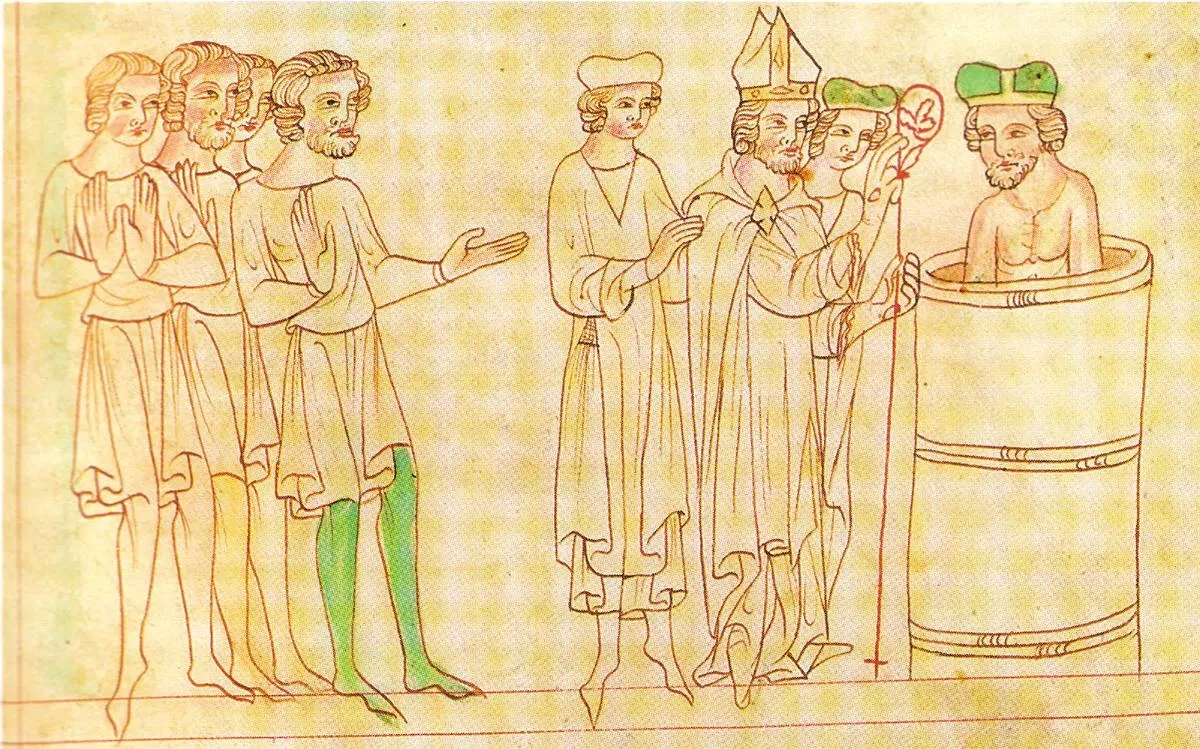
See page for author, Public domain, via Wikimedia Commons
The baptism of Bořivoj.
Bořivoj... can be considered the first Dux of Bohemia.
He called himself Kníž, that is, Knyaz—a king, so you could say he took a stance of "king at home, duke abroad," right?
Bohemia was in the process of converting to Catholicism, and it was a tribe that got pushed around between East Frankia and the Great Moravian kingdom at its peak...!
Afterwards, the very famous European royal house of Přemysl ruled and prospered, and Bořivoj is the very first historical figure of that Přemyslid dynasty...!
Nowadays, Prague in the Czech Republic is its center, and Prague also began to develop in earnest under this Bořivoj...!
Prague would later become one of the greatest cities throughout the medieval era!