
220. The Snake That Climbs the Tree (2).
The spring rain began to fall.
It had been exactly seven days since the great battle at Bremen had ended. The sound of droplets striking iron helms stuck in the field felt strangely unfamiliar.
[Ting- tiding- ting- tididing- ting-]
Torrential downpours like those seen in Southeast Asia were hard to find in 868 Europe.
Instead, it was more of a drizzling, sunshower sort of rain that seemed to fall grudgingly through the thick fog and wretched weather.
Thanks to that, our side's mood, which had been shooting up without end like a volcanic fire, grew a little calmer—should I be grateful for that?
Bremen was a typical Frankish-style wooden stronghold, essentially a strategic point on the Weser River marked by a round hill, a square palisade, and a stone church.
Regrettably, there were no animals playing instruments in these parts, but on rainy days like this, with nothing else to do, our North Sea folk, who all showed remarkable musical talent, would pull wooden flutes or little harps from their coats and play and sing.
I and my men, still more comfortable with timber houses than stone, had claimed the largest house in the fortress, kindled a fire, and were tearing open the wrappings of fresh supplies that had arrived at dawn, gnawing on mead, beer, and well-aged smoked meat that emerged from within.
The scene looked closer to a dreamy portrait of a young man who had sailed far off with his close friends to camp, rather than a den of warriors about to march on Verden two days later.
[Piriri- piririri- diring- diririring-]
Fierce lyrics that didn't match the lyrical melodies flew about here and there, and Jarl Hrorek of Frisia and Hrodulf, still not fully rinsed of the excitement of battle, draped their arms over each other's shoulders and danced bizarre dances, bringing smiles of laughter to people's lips.
They clapped their hands together to the beat, laughed loudly, and even performed the dances popular among the Sámi that they had learned under Inga's loving guidance.
In the midst of devouring, drinking, and playing in a whirl, the rain had stopped before we knew it, and the warriors' tents where fires had been lit were bustling with the preparation of supper.
As I leaned quietly against the longhouse at Bremen, gazing at that pastoral landscape and the gently sloping hills stretching endlessly toward the horizon, my second brother, who had wept with laughter while mocking my dancing, came swaggering over with his face still full of mirth.
"Now who's this! Isn't that Fylkir, the finest stepper in all the North Sea!? Like this—was it like this?"
[Tat tatat]
His approach was a wretched sight, twisting his waist this way and that with impish steps.
"When did I ever dance like that? It's like this, see?"
[Tatat!]
After I showed another dazzling step, Ivar laughed so hard that the cups in both his hands nearly overflowed, arching his back.
"Uh hahahaha! Ah—ahahahaha! I'm dying! Stop it! Stop!"
"What, don't I dance well? Watch closely! Like this—left foot up, then step to the side and raise the Örn foot."
"Uwaaaah! Uwaaahahahahaha!"
Ivar, who had spilled half the contents of his cup on the ground, went to his knees and poured out his laughter.
A moment later, the two of us brothers, having settled down a little, each took the left and the Örn side of the great door and leaned back against it to gaze at the deepening twilight.
"If you showed that dance to the Franks, they'd surrender on the spot."
"Wouldn't they just be amazed and say even bears dance?"
The cup Ivar had handed me held bright red wine, and the liquid that slid smoothly down my throat without any resistance delivered fresh vitality to my brain.
While I exchanged trivial small talk with Ivar, countless calculations were running through my head. The East Frankish army at Verden, which had fallen utterly silent, had made no moves whatsoever these past few days.
They simply huddled down like a beast licking its wounds. Occasional messengers were confirmed heading south to Paderborn and returning, but no movement could yet be felt from Paderborn either.
Did Heinrich, the East Frankish commander, intend to hold Verden?
'Did I crush too much of their confidence?'
East Frankish numbers should still be greater. Had they chosen to cower the moment they lost a single engagement?
Surely they were not thinking that I could do nothing if they hid behind walls.
I no longer knew the limits of my own power, either, so confirming them at Verden this time would not be a bad thing.
From what I had heard, it was a fairly well-built stone wall. I had climbed over more than one or two stone walls in my time.
"Whoa—whoa—Helgi. Calm yourself."
Ivar's voice scattered my thoughts, which had been full of grim musings on how to smash them to pieces.
When I turned my head, my brother, shrugging his shoulders, was laughing in circles and taking a sip from his cup.
"Sitting beside you, so full of killing intent, raises goosebumps all over my body. Word has come from Halfdan and Sigurd. They say they are repelling the Hamburg lot's attacks with ease. That means almost half of the Elbe River is as good as ours already. No matter how much Rurik and Oleg of Novgorod drag their feet, by now they should be attacking Liubice east of the Elbe."
Ivar's movements were careful as he drew a brown hair comb from his coat and swept through his blond hair, strand by precious strand.
[Sshhk- Sshhk-]
"Still, my heart keeps shouting at me to be cautious. Seizing Hamburg and seizing Verden are slightly different stories. Both would be dreadful news for East Frankia, but they can somehow come to terms with Hamburg and the Elbe. After all, it has only been fifty years since this land became theirs. But the Weser River and Verden are a slightly different tale. It's best not to expect that they will give up this land meekly."
The subject Ivar laid out was even more careful than his combing fingers.
He meant that however well things had played out and allowed us to occupy the rear beyond Hamburg, it was too great a burden to swallow all at once.
For words coming from Ivar, who had always shown only a thirst for battle and adventure, they were extremely calculating and rational, but then, the North Sea folk were extremely calculating people, so I did not find it strange.
To put it another way, from East Frankia's perspective, this would be divided into grudges they could stomach and grudges they could never accept. Meaning that seizing Verden and the Weser outright could be dangerous. I understood well.
"Ivar, let's clash first. If their resistance is stubborn, we need only retreat. If it proves manageable, we can negotiate using Verden and the Weser as bait."
Having neatly emptied the cup Ivar had already half-spilled in his belly laugh, I pulled a pure white comb from my coat and roughly ran it back through my hair—sshhk, sshhk—.
"If the Magyars have shaken central and southern East Frankia as much as I anticipate, the East Frankish emperor will never be able to send reinforcements here. Unless he comes in person to discuss surrender, it's likely we won't see each other's faces. We'll smash Verden, then march straight north and topple Hamburg as well. It's a simple matter."
Then the Elbe River and the seas on either side would become wholly ours.
"Good. I suppose we must first face Verden and Heinrich, then."
[Buuuuuuung-!!! Dang-dang-dang-dang-]
As Ivar slipped his comb back into his pouch and nodded, the long-drawn horn blast and the clangor of the church bell from the tower clashed together in a wild jumble at that very moment.
The sun had nearly set, so it was the signal to cease for the day, come inside the palisade, and prepare for the evening's end.
Now a last trace of red bade farewell to the purple-stained sky before sinking away. Ivar and I turned our steps together toward the hall, where candles and oil lamps were being lit one by one.
*****
Verden. Or Verdun. If read another way, it was the same name as the Verdun in West Frankia.
That word, a ford on a river—a name mostly given to places where people move about—had naturally turned into a village's name, and, just as with Árós in the North Sea, it stuck as the proper noun for a particular region.
"Yes. So this is the very Verden."
But in the world of 868, Verden held an even greater significance.
This was the very place where the old Frankish emperor Charlemagne had cut down several thousand Saxons at a single stroke.
"They say he tore the sacred tree out by the roots and stained the pure white tree wholly red with Saxon blood. After that the Franks may have gained this land, but they earned the wrath of the gods of the North Sea as well—I can't well say whether it was a clever thing to do."
My own personal feeling on Charlemagne's elegant handiwork? He'd done what an emperor has to do. I could sum it up at roughly that.
At the time, Saxony had been a newly conquered territory, the heathens would not meekly bow their heads, and they rose in rebellion around the name Widukind, so Charlemagne would have needed to display strength and authority.
While he was at it, he thinned the numbers of the heathens a little, pulled out that unpleasant great tree, and had a pretty church set up in its place.
In any case, the outcome was not bad. Some sixty-eight years, roughly two generations, had flowed by, and the Saxons grew more subdued. Catholicism had struck root smoothly.
Only, the Norsemen—driven wild by that shocking method—had gone berserk, but raiding along the coasts and rivers? Hadn't there always been such things? Frankish royal affairs were more important than those trifling(?) raids, and the lords' private wars of plunder were the more brutal. They'd have thought it was all fine.
But in truth, it was not fine at all.
The rancor of the refugees who'd fled in all directions while the Saxon lands blazed had remained for two generations. That fury now rioted before Hamburg, dreaming of a blazing return.
The Catholicism here had not taken root as perfectly as the Frankish kings imagined, and the people were surprisingly free of hostility toward our North Sea host passing through their land.
Of course, they may simply have grown accustomed to Norsemen tramping through day in and day out, but at any rate the combined North Sea-Frisian army advanced without difficulty and soon had Verden right before its face.
Its numbers I marked at roughly five thousand.
The East Frankish force opposing us at Breden was estimated at around six thousand, the result of the Battle of Bremen.
The dead, the wounded, and the deserters added up to a staggering loss of some four thousand.
In my estimation, Heinrich's skill in somehow rallying and gathering his troops while fleeing headlong was no small thing, but in any event the morale of our victorious combined North Sea-Frisian army soared high.
"Beloved Fylkir, blessed by the gods! The deployment of the troops is complete, and I have scattered scouts in every direction! As you instructed, we gave closer heed to the movements in the south! Not even a single dog of theirs shall escape the eyes of our scouts!"
"You have done well, Jarl Hróðulfr. The elite forces of Frisia are truly dazzling."
"Compared to the Fylkir and the warriors of the North Sea, we are but naked beasts! Pray, speak comfortably to us!"
"Hahaha. That would not do. Is Frisia not our ally? You are the heir of Konungr Hrørekr, so it is only proper that I treat you accordingly."
From the first time I had seen him in Árós, Jarl Hróðulfr had been sending me a look of something akin to adoration, and ever since the Battle of Bremen, he bowed his head to me as though he had become my very vassal.
The Frisian warriors were no different. Just like the warriors of the Kingdom of the Isles, these traditional Norse warriors were quietly lifting North Sea supplies—mostly armor, swords, shields, and the like—and even drawing on the symbol of Hel, driving up the blood pressure of the unfortunate logistics officers.
They copied exactly the behavior the warriors of the Kingdom of the Isles had shown when first campaigning alongside the North Sea army. Konungr Hrørekr and Jarl Hróðulfr, watching that plundering with expressions of pride, exchanged furtive glances and whispered among themselves, and whatever they spoke of, they bowed their heads to me all the more, till matters reached that point.
Was this the true face of a power that served three lords at once—the three emperors, Carolus, Lothar, and Ludovicus?
Given Frisia's geopolitical situation, it could not be helped, but if I were to formally take them as my vassals, I could not help having to mind the gaze of Lotharingia, which had grown into a powerful ally of the North Sea.
Lotharingia, planted squarely in the middle of the Frankish realm with Aachen at its center, and Italy beyond it, were a precious ally and market that could offer new possibilities—silver coin. Therefore, a suitably uncomfortable relationship was best for both Frisia and the North Sea, so I labored to smile and receive Hróðulfr's lavish courtesies, but Hróðulfr seemed not to mind in the least.
"There had been no time during the surprise attack at Bremen to closely examine their skill. Let us now take a proper look at Heinrich's ability. Jarl Harald."
"Yes, my Fylkir!"
I turned my head with effort from Hróðulfr, who was sending up an ominous aura like wavering heat-haze on my left, and looked toward Örn.
There stood a warrior of golden hair and blue eyes that even a helmet could not hide, waiting for my command.
"Commence the attack."
"I follow the Fylkir's command. Asvald! Give the signal!"
"Yes, Jarl Harald!"
[Peolleok- peolleok-]
Behind Harald, a warrior of immense build, comparable to Storolfr, was waving a blue flag back and forth.
[Buuuuuuung-!]
Presently, with the sound of the horn, the whole line of the host moved forward at once.
☆☆☆☆☆Reference Materials☆☆☆☆☆
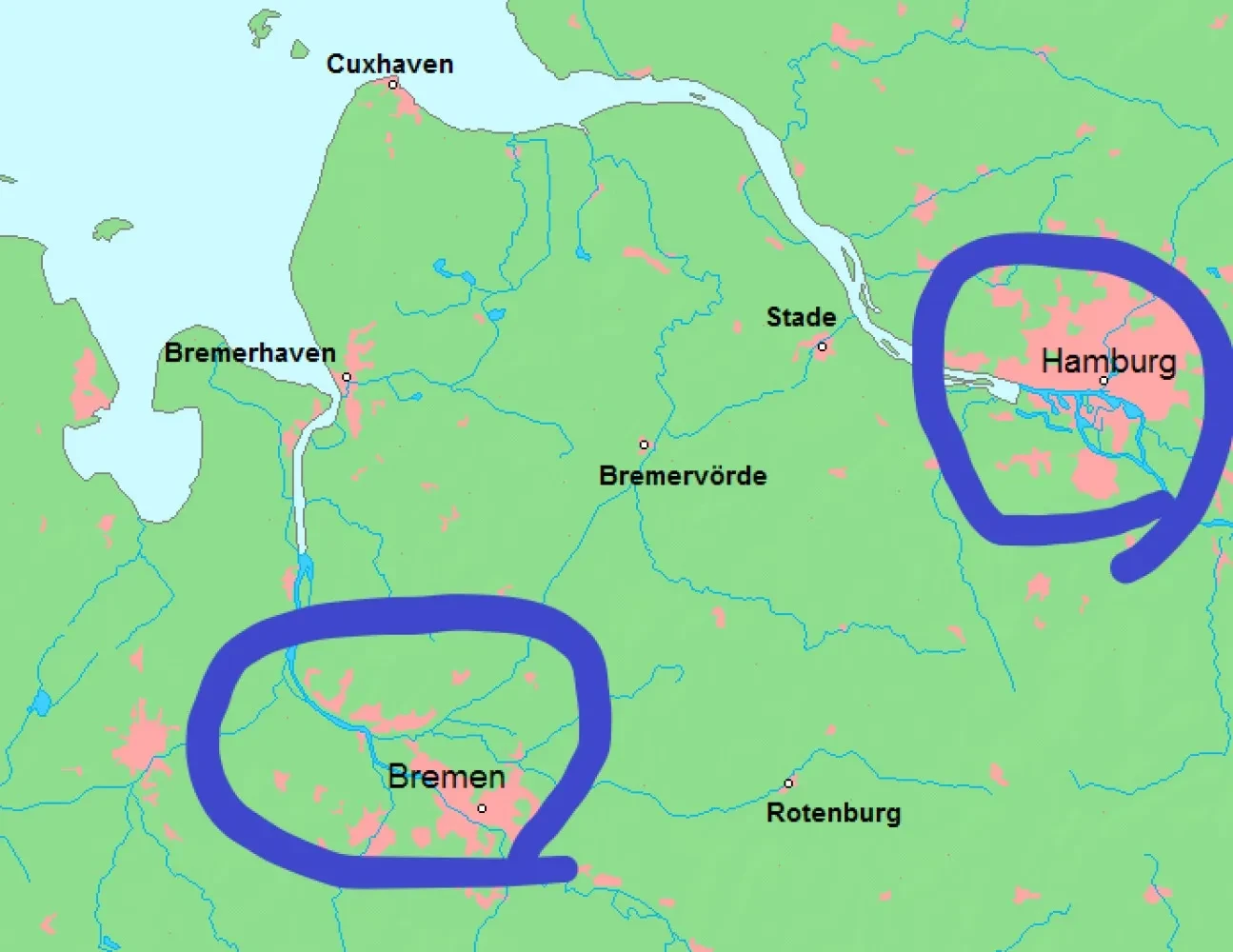
based on map data from www.demis.nl, Copyrighted free use, via Wikimedia Commons
This is the land between Verden and Hamburg!
It's also called the Elbe-Weser triangle, or the lowland triangle!
As of now (868 AD), Bremen and Verden haven't merged yet, so the Bremen on the map is actually Breden lolol
At this point, Bremen is a small fortress surrounded by a palisade, located a bit further down the Weser estuary on the map!
The characteristic of the lowlands... what is it? First off, once you clear it, it's rich! Plenty of river water!
That's right... there's lots of water!!! In Europe, especially Western Europe, being by the water is a blessing but also a curse... it looks like a great place for the Norsemen to come and go as they please!
The loss of Hamburg and Verden, the Elbe and the Weser, means the loss of northern Saxony...!