
195. The Crow Caller.
868 AD.
Northern Neustria, the heart of the Seine basin. Paris.
A place named for the Celtic tribe (Parisii) that lived here before the Roman Empire.
The Île de la Cité, situated in the middle of the Seine, was, as its name suggested, an ancient trade hub and the most important city on the river.
It had been a seat of countless kings since antiquity, and it was even where Clovis (Merovingian), who could be called the spiritual father of the Frankish Empire, built a castle and dwelled.
It was also where the holy martyr Saint Denis had met his end.
In a cathedral on this island, steeped as it was in the physical and spiritual history of the Franks, Archbishop Hincmar of Reims sat in a chair still holding the morning chill, seeking wisdom.
Though he had long since turned to God and risen to the rank of archbishop, Hincmar was originally a nobleman from Saint-Denis, just north of the Île de la Cité.
His family still governed the fertile lands around Saint-Denis, so this massive invasion by the Norsemen was no distant matter to him. And was not the master of this place, Carolus Imperator, his old friend and political ally?
Thus, Hincmar had answered the Emperor's summons faster than anyone else, and now sat here, waiting with a trembling heart for news from Rouen.
'According to those who fled from the port village, scores of large ships continuously sailed back and forth between the sea and the river. If so, just how many of them have crossed over? Oh Lord.'
Impatient, Hincmar rose to his feet. The troops he had led from Reims numbered roughly 1,500. This was possible because Reims was prosperous and effectively governed all the villages in the surrounding region.
The other regions of West Frankia would only just now be slowly moving toward Orléans, where the Emperor resided, and even that could not be guaranteed to be committed to the Seine basin.
For the Emperor's old enemy, Salomon of Brittany, had finally bared the fangs he had long concealed.
In this suffocating situation, Hincmar suddenly thought of Lothar II, who ruled the vast Lotharingia just to the right of Reims, but quickly shook his head, dismissing the thought.
'Lothar having a legitimate heir is an impossibility. The Imperial throne of Italy could easily pass to that child.'
People spoke of it in hushed tones, but the truth was that Lothar of Lotharingia was not the only one lacking an heir. The Emperor Augustus of Italy, Ludovicus, also had no male heir.
Of course, those two Emperors were still young, but who could claim to know the ways of the world?
A grand seat was best filled by the one closest to you, and Carolus, Emperor of West Frankia, was the Emperor of the very land where Hincmar's own domain and family lay.
Therefore, asking Lothar for help was unthinkable, both from the Emperor's perspective and that of those beneath him.
'Rouen is a stout fortress. And here, Paris has strong bridges and iron chains spanning both sides of the island, so those godless Norsemen can never pass.'
In truth, this Île de la Cité, now called Paris, had once been roughly handled by the Norsemen. The Paris of today had undergone every possible reinforcement under the orders of Carolus Imperator afterward.
So, even if Hincmar and the relief force from Reims planted their backsides here, it made no meaningful difference to Paris's defense.
'If only Rouen could hold out a little longer...'
What West Frankia and its Emperor needed now was time. Only time could defeat these attacks by the Norsemen and the Bretons.
Moreover, considering it was planting season, they had to drive out these uninvited guests quickly. Otherwise, no one could predict how harsh the winter, which would come as surely as it did every year, would be.
With such tangled thoughts running through his mind, Hincmar had even dismissed the meal prepared by the castellan. What drew his attention as he sat in a quiet church, seeking wisdom, was a small commotion outside.
"I have urgent news for the Archbishop! Let it be conveyed at once!"
"Did I not say to wait? His Grace is at prayer!"
"I am a messenger from Rouen! Rouen is under attack, I say! Let me deliver my message!"
An urgent voice came from beyond the familiar silence.
The moment Hincmar caught the words 'Rouen' and 'attack' in that voice, he felt a flash of divine clarity and hurriedly rose to his feet, leaving the sacred space to throw open the door to the secular world.
[Kiiiik—]
Eyes accustomed to the dark momentarily winced as they took in the sudden flood of light. Amidst the people hurriedly bowing their heads, Hincmar approached the man whose clothes and face were covered in sweat and dirt.
"Rouen under attack—what is the meaning of this? Messenger, explain in detail."
"Yes! Your Grace...!"
As the urgent-voiced messenger continued his account, Hincmar felt the resolve in his heart hardening.
Soon, unable to ignore the crisis befalling their brothers in the faith, the men of Reims, following the bishop in whom their trust was unshakable, began their advance across the northern bridge of Paris and beyond Saint-Denis.
*****
The first stage was the western and northern gates of Rouen.
The 4,000 warriors from East Anglia and Mercia, commanded by Björn and Ivar, Ubba, and Guthrum, maneuvered menacingly as if they would assault the west gate at any moment.
Simultaneously, the 4,000 warriors from Norrland led by Refil and Stórolf advanced along the path thick with the scent of fresh grass toward Rouen's north gate.
The plain, open on all sides, was actually the worst possible place for a siege, but all the nearby villages had already become ghost towns, so there was no need to worry about the worst-case resistance of local guerrilla fighters.
Naturally, Rouen fell into a panic, and soon Tostain, who had already crossed the river ahead of the main force, sent word that an enemy messenger had departed from the east gate.
That meant it was time to proceed with the second stage of the plan.
As befits commanders of the North Sea, Refil and Stórolf, who hated open spaces more than anyone, were doggedly establishing a camp even near the north gate.
The cavalry I led swept past the Garm brotherhood, all wearing grim expressions as they shoveled dirt, and continued galloping eastward.
Another advantage of attacking along a river was that there was no worry of getting lost.
No matter what insane new craziness humans might devise in a terrible direction, a river's current was not something that could be altered overnight.
Therefore, far ahead in the view of myself, confidently leading Camembert.
The figures of the guests I had been waiting for finally began to appear.
'A banner with a cross fluttering upon it.'
Not a raven or the symbol of the goddess Hel, as North Sea warriors would fly, but a blue banner painted with a red cross. The bulk of the force was heavy infantry. Around fifty cavalry at the vanguard.
Supply wagons moved in the middle of the column, and the warriors marched in single file around them as if escorting them.
'So this is the Frankish army.'
A creation born from blending the military knowledge Charlemagne acquired through years of experience with the texts left behind by the brilliant luminaries of earlier Rome.
As I had felt when facing Mercia or East Anglia in Britain, there were none here who lacked iron and therefore could not don armor. If anything, the Frankish warriors were better equipped, their spears and shields of uniform size, and every helmet gleaming.
These were people who knew how to wage war properly.
"Torbjörn! The enemy is moving! We shall make a wide detour to escape their sight! Silence the horn! Follow my banner!"
"Yes, Fylkir!"
On a 9th-century battlefield with no radar or radio, the side that spotted the other first always held the advantage.
I, who possessed unbelievable eyesight superior to those Magyar hunters and akin to a bird of prey dominating the sky, naturally could not lose this contest of vision.
Furthermore, the vast Frankish plain, where even a low hill was nowhere in sight, was the perfect battlefield for me.
[Dugug— dugug— dugug— dugug—]
Following my lead, the North Sea horses turned their heads in unison and gradually picked up speed behind Camembert, soon veering away from the direction of the unidentified column and racing northward.
"Torbjörn! Send a messenger to Refil and Stórolf at the north gate of Rouen Castle! Tell the Garm brotherhood to leave the north gate and move to the east gate! We shall crush them between us!"
"Understood! Fylkir! Hweeeee-ik—!"
Torbjörn, having received my order, momentarily slowed and let out a sharp whistle. Run, who took over the position, had a face filled with tension.
"Fear not! Lord of Alt Clut!"
"The Run of Alt Clut might fear, but the Run of the North Sea knows no fear! Fylkir!"
Run ap Arsgall, by now looking quite natural with the distinctive North Sea face-covering and his riding posture, shouted his answer to me, and I smiled with satisfaction.
"Now then, let us see how well they fight!"
Having put a suitable distance between us and gradually slowed, the cavalry was now positioned behind the rear of the Frankish column, which, for infantry, was moving along at a fair pace with the help of wagons.
It seemed they had fortunately failed to notice our movement, which had circled around far beyond their range of vision.
Five horsemen who received my orders hurriedly moved westward toward the Garm brotherhood, while the remaining 495 cavalry rested and slowly followed the rear of the column.
Was the commander of this Frankish army, which was certainly a relief force from Reims, an experienced one? As the Frankish column drew closer to the fortress of Rouen, they rapidly donned various weapons and shields from the wagons and soon formed a battle line.
Their objective was the front of Rouen's east gate, where Tostain's men and the warriors of the Kingdom of the Isles lay in wait.
Having neatly gathered the wagons, which were of little use in a pitched battle, and stacked their food and tent supplies, the Frankish warriors now advanced vigorously, even breaking into song.
Mostly songs praising God and His Son, songs revering Carolus Magnus, songs declaring the men of Reims the finest.
'So it was the Reims relief force after all.'
The expressions of those who had been advancing so triumphantly changed the moment Tostain's army, hurling all manner of foul and obscene abuse from in front of the wall, entered their field of vision.
Before the full emergence of the North Sea, the warriors of the Kingdom of the Isles, still retaining the old ways of the Norsemen, were exceptionally skilled at provoking their foes according to the flamboyant traditions of the North.
"You bitches! If you've got a cock, come out here right now and take my blade—!"
"Keekee! You beardless bastards there! You unwashed bastards! The ones every maiden despises!"
"The only thing you'll see from that wall is my arse! Yaaah—!"
"Kahaha!"
What on earth were they doing?
The warriors of the Kingdom of the Isles, who could barely understand each other's speech, seemed utterly delighted as they hurled abuse, while the faces of the Frankish warriors watching from atop the wall turned crimson as if they might burst at any moment.
The pace of the Reims warriors watching this scene quickened as well.
I realized the moment to fight was near.
"Let us go! Tostain! Let us go! My horsemen! Blow the horns with might! Follow my banner! Ride like Sleipnir!"
[Bwoooom—!]
[Dugug— dugug— dugug— dugug—]
The horses, still full of vigor, responded to the resonant call of the horns and gradually quickened their pace. Behind me, Tostain, who had returned, and all those with horns at their waists blew with all their might.
On a triangular banner made with the wind in mind, the face of Hel was stern, and the arm of Run, gripping the shaft, bulged with sinew, revealing his resolve.
At the sudden emergence of cavalry from the rear, every human head arrayed before the east gate of Rouen Castle turned, and soon expressions of horror dawned on the faces of the Franks, while rapture spread across the faces of the Norsemen.
[Dugug— dugug— dugug—]
Enemy cavalry rode out to meet us as we charged forward. Realizing there was no time for hesitation, the commander of the Reims forces ordered an advance.
"Break through—!"
Our cavalry force was clearly the larger, even at a glance. The Frankish horsemen charged out, heedless of their own lives, solely to buy time for their main body.
Admirable, but courage alone could not win a fight.
"Hup—!"
[Hwooong—! Puk!]
I pulled a javelin from the right saddle and immediately hurled it with force. Starting with my javelin, propelled by the power of my upper body alone, piercing the enemy's vanguard like a bolt of light, javelins flew through the sky in unison.
☆☆☆☆☆Reference☆☆☆☆☆
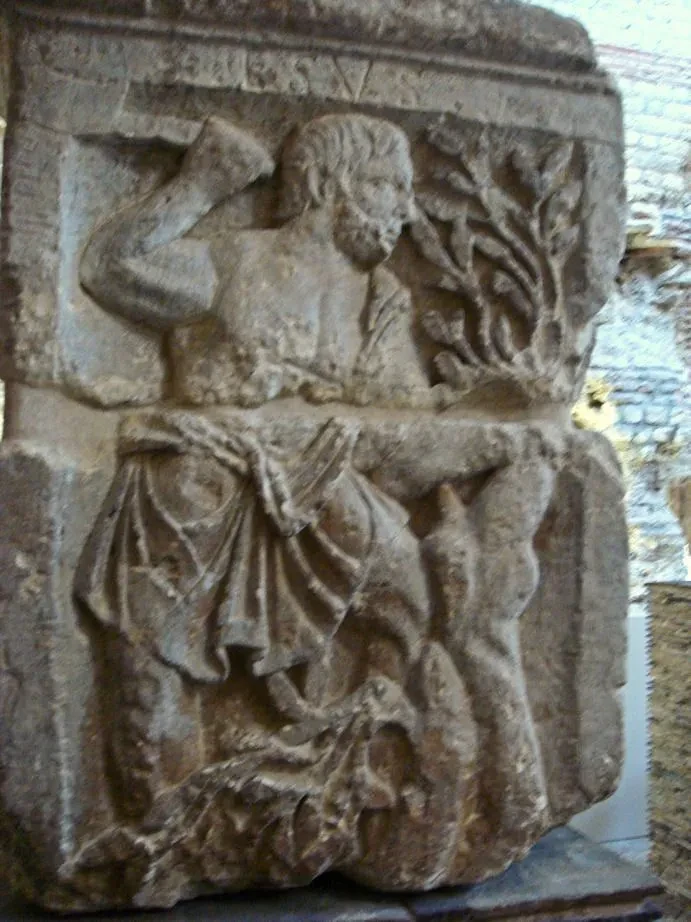
PHGCOM, Public domain, via Wikimedia Commons
Remnants of Rome left in Paris. A depiction of Jupiter carved in the 1st century.
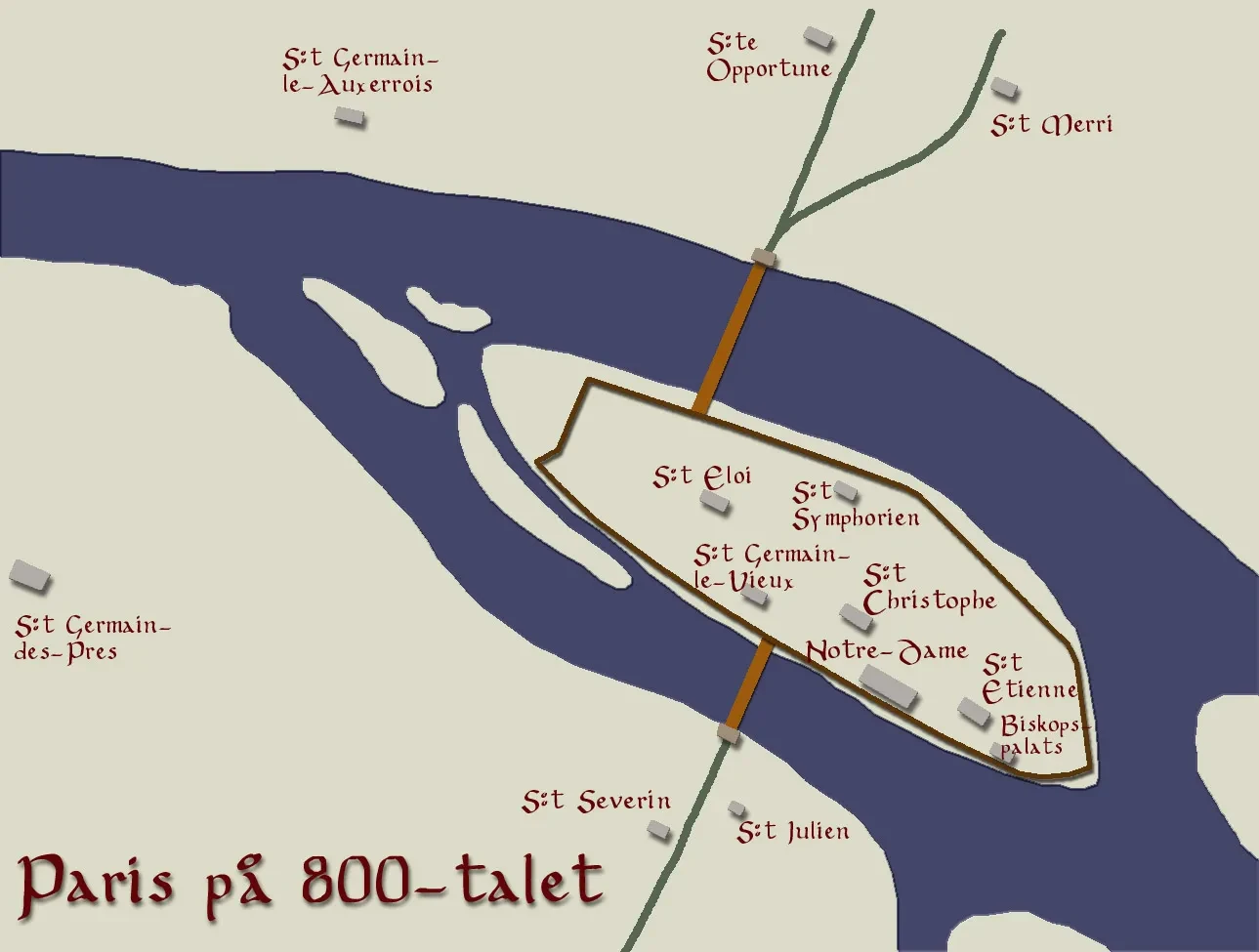
Sven Rosborn, CC BY-SA 3.0 <http://creativecommons.org/licenses/by-sa/3.0/>, via Wikimedia Commons
The appearance of Paris in the story. The city concentrated on the Île de la Cité. To the north is Saint-Denis.
The bridge blocking the river's flow is impressive...! A precious (blood-inscribed) lesson taught by the Vikings...!!!!
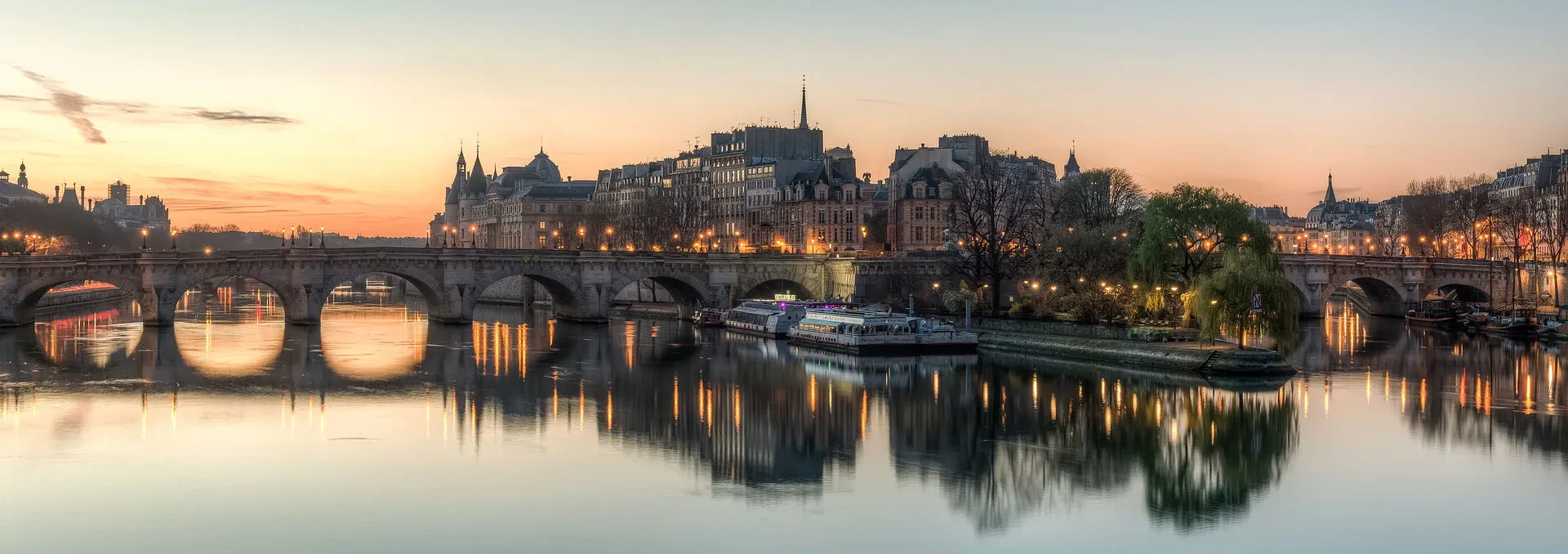
Daniel Vorndran / DXR, CC BY-SA 3.0 <https://creativecommons.org/licenses/by-sa/3.0>, via Wikimedia Commons
The beautiful Île de la Cité and the bridges on either side.
It's too beautiful ㅠㅠ Though the photo probably helps a bit...!!!!
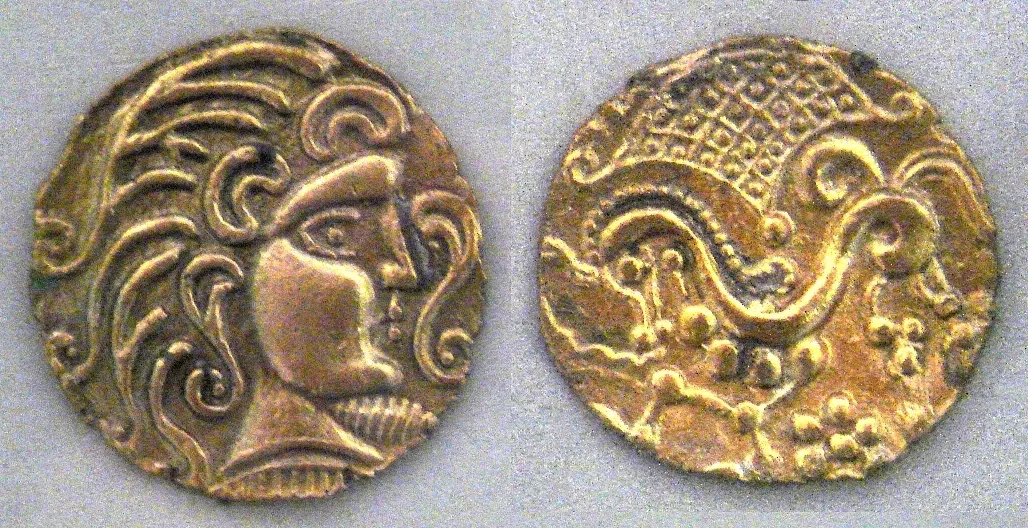
No machine-readable author provided. World Imaging assumed (based on copyright claims)., CC BY-SA 3.0 <http://creativecommons.org/licenses/by-sa/3.0/>, via Wikimedia Commons
1st century BC. A gold coin issued by the Parisii tribe!
If there had been a great king who unified all the tribes of Gaul, how would history have turned out...!
Huh? There was one? Who? You say his name was Caesar?
Hahaha
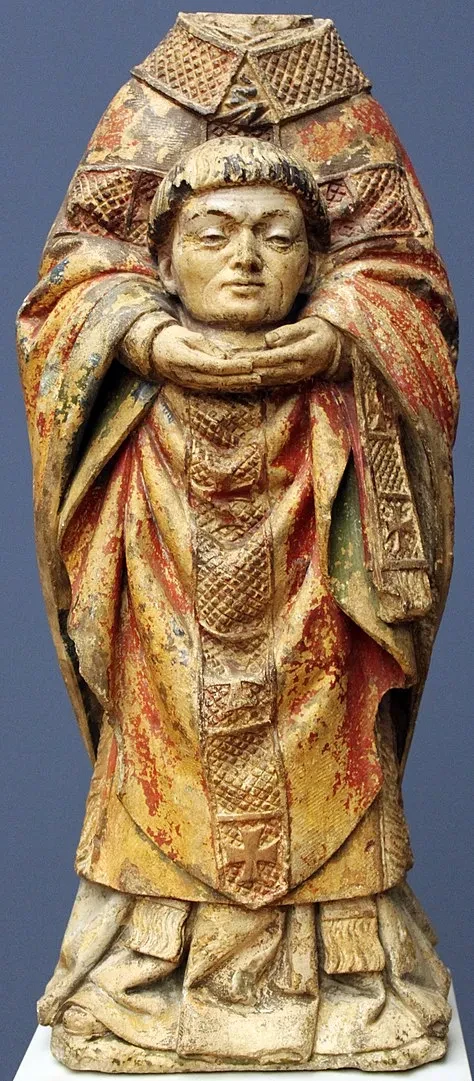
Antoine Le Moiturier, CC BY 3.0 <https://creativecommons.org/licenses/by/3.0>, via Wikimedia Commons
The Saint. Denis, the patron saint of Paris.
Also called Denys.
He was beheaded during his conversion work. One account says he carried his own head in both hands and walked northward, but...
In truth, it's said the Christian brothers of that area carefully collected the body and buried it on a hill.
If the name Saint-Denis sounds familiar, you can think of it as a name honoring this figure.
He had deep ties to the hill of Montmartre. Originally named the hill of Mars, the god of war, after his and his fellow monks' martyrdom, it came to be called the hill of the Martyrs.
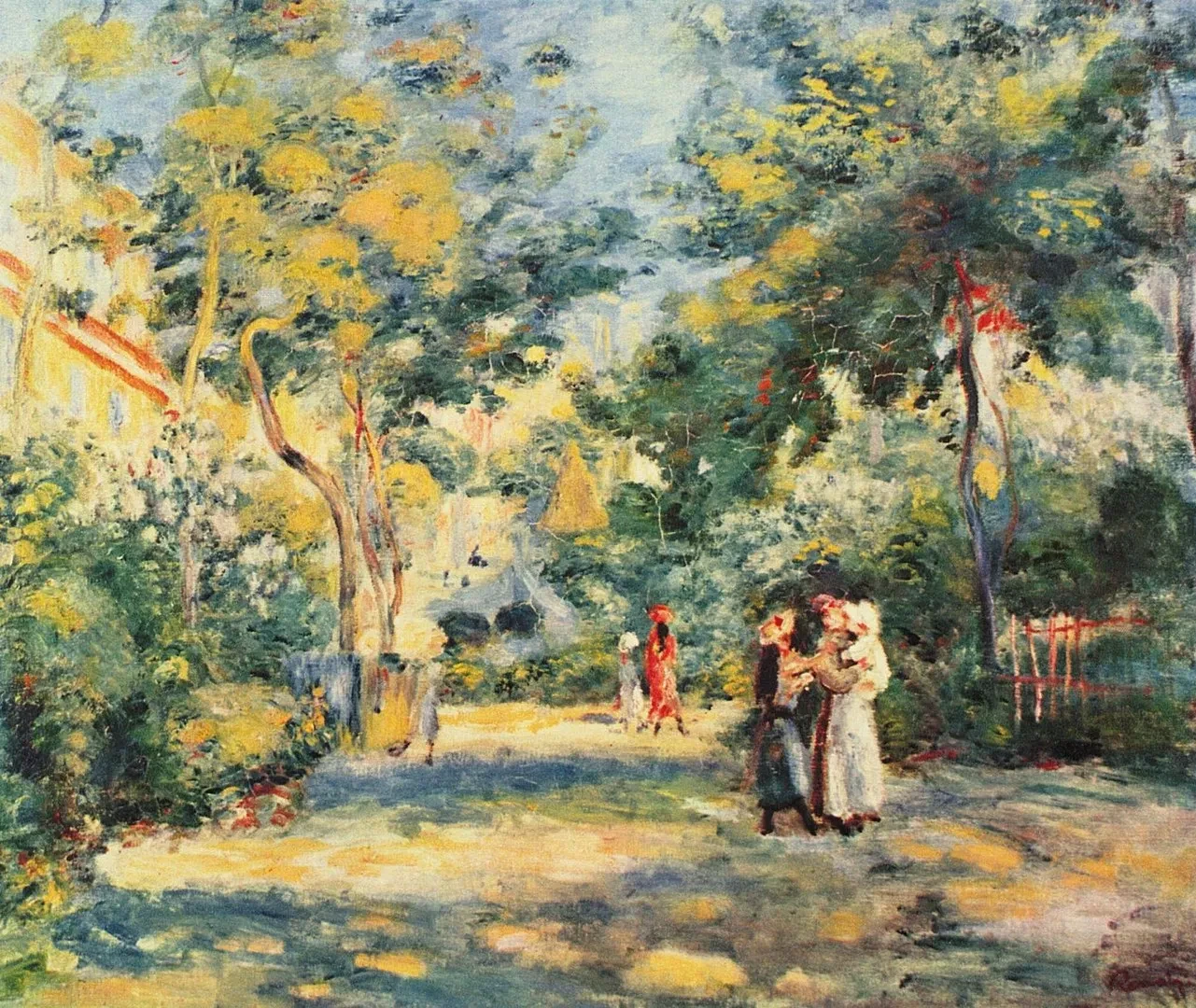
Pierre-Auguste Renoir, Public domain, via Wikimedia Commons
Renoir, Garden in Montmartre.