
182. Winter Sun (4).
"Halfdan is having a child too?"
An irrepressible smile lingered on Ubba's lips.
The island of Britain, Mercia. Tamworth, the Fylkir's direct domain.
Paradoxically, Mercia, now a new member of the North Sea, saw a peaceful winter only after losing the greatest war.
The empty spaces left behind by those who fell in the last war and those who departed after their old king served, laughably enough, as ample buffer for Mercia to join the ranks of the North Sea.
Just as it had been in East Anglia, and in Northumbria and the lands beyond. Fylkir Helgi's generous offer: 'I will spare all of you.' 'I will let you believe in whatever God you wish.' 'I ask only one thing. Let no God nor custom come before my name.'
The clergy and nobles who departed, declaring they could not abide by those three conditions, and even the anxious-eyed people who followed them down.
In the blink of an eye, holes appeared across Mercia and empty ghost villages sprang up here and there. Yet, incomprehensibly, the people of the North Sea—no, the people of Mercia—who accepted with uneasy hearts the rule of the newly arrived Fylkir and his deputies, actually experienced a warm winter.
How could winter be warm and full?
Ubba thought to himself that those who had left, and those who had hidden themselves deep in the woods where few people tread, would surely return one day; in the end, they would have no choice but to accept the North Sea's rule.
'Those fools are becoming fathers now. Already I pity my nephews.'
What did Æthelthryth and Bothilda see in those fellows?
Helgi Ragnarsson was a hero he dared not judge, but Sigurd and Halfdan... though Ubba himself loved his brothers, one was a fool for songs and the other a carefree fool who did nothing but spout romantic prattle.
Truly, the world was difficult to understand. As he gazed at the snowflakes drifting beyond the window, Ubba lifted a scrap of parchment caught in the flickering candlelight.
It was embarrassing to even call the administrative void created by the absence of the clergy and church a void. The ledgers recording the personal details of each village, the church's financial operations—these had lost all meaning from the moment the mass exodus occurred.
But had the North Sea not long since transformed into experts in such things—conquest? Under the Fylkir's command.
Just as they had done in East Anglia and Northumbria. The kingdom's largest cities and their surrounding areas were designated as the Fylkir's direct domain and personal property, and once one waited, the right sort of people gathered.
As with honeybees, it is a law of nature that they ultimately gather where the flowers to suck from are plentiful.
Those seeking at least tenancy were recorded from that point and accepted as members of the North Sea, then deployed where they were needed: farming, fishing, mining, military, administration.
There was no need to actively encourage commerce separately; were the merchants, who always survive by their wits, not the very ones who thrust both arms into the air as Mercia fell, crying, 'The North Sea is the most perfect empire this world has ever seen, and its Fylkir Helgi is the great warrior of Hel!'? They had sworn allegiance long ago.
In a way, in the world of merchants, even more ruthless than the world of kings, they turn their heads without hesitation toward whichever side offers the greater profit, whether the ruler's name is Burgred or Helgi Ragnarsson.
And so, barely half a year after the end of the great war on the island of Britain, the threshold of Ubba Ragnarsson's office, governing Mercia, was already crisscrossed by letters freighted with all manner of florid rhetoric from Mercia's renowned ealdormen.
'The accession of Wessex.'
The most striking among them was a secret invitation from Alfred, newly seated as the Cyning of Wessex.
Wessex might be cornered at the moment, but as the nominal lord of Canterbury, the center of the British Catholic faction, such a decision could not have come easily.
Alfred asked for a meeting without hesitation, and Ubba, persuading his guards who warned of a possible trap, rode across the lands of Wessex.
And the result of that meeting suited the taste of the North Sea and Mercia perfectly.
In conclusion, Wessex entered into a kind of covenant with the North Sea.
Wessex would actively cooperate with the North Sea, and the North Sea would not treat Wessex as an enemy.
At first glance it seemed equal, but in truth, in Ubba's mind, this was no different from a declaration of surrender by Alfred.
'You might call it surrender, but leaving a sliver of room, shall we say?'
For Alfred, it was probably the best option. Too vast to oppose, too many watchful eyes to place himself beneath.
So he seemed intent on buying time and watching how things played out. Did Wessex and Alfred know? That as time passed, Wessex's hope would be snuffed out as well.
'If he meant to settle it once and for all, he should have thrown himself at us by any means necessary right now. Because the Fylkir's true strength is not the shattering of all who face him on the battlefield.'
The one who embraces both life and death is my brother.
Was his power not, in truth, akin to the image of the Goddess he serves?
At any rate, with the thought that they could now focus more on West Frankia when spring returned, Ubba swept the handsomely written Fylkir's letter aside and picked up a new one.
'Æthelred of Buckingham. Angles and Saxons truly love the name Æthel.'
Æthel: noble. Just how noble was the one who sent this letter?
Even if the price had fallen, parchment was still classified as a luxury here in Britain, yet the letter, which used it generously and even left large blank spaces, bore the handwriting of a man named Æthelred, who had been an ealdorman of Buckingham and became a Jarl.
Having found an interpreter somewhere, the letter was written in part with Svear characters and cautiously broached the subject of discussing a marriage alliance with his own daughter.
'Buckingham. A strategic point encompassing the entire southeastern region of Mercia. And my marriage partner carries the old Mercian royal blood on her mother's side, does she not?'
Ubba, innately cold and calculating, weighed even his own marriage in terms of profit and loss. At heart lay the insolent thought that, with his brothers already welcoming grandchildren one after another, his mother would not have much to say about his own marriage—but fundamentally, the thought was not wrong.
'Ealhswith, was it?'
Cold yet shrewd, Ubba collected his thoughts and began to write. One letter to the Fylkir. One letter to his mother. And one letter bound for Buckingham.
When the time beyond the window had passed and the burning candle had grown a little shorter.
At last, Ubba rose from his seat, tidied the letters, and pressed the seal bearing the image of Hel firmly into the red wax.
"Who is outside?"
"You called, Jarl Ubba!"
Ubba's sworn warriors, who looked as though not a single drop of blood would come out even if you pricked them, likewise prided themselves on iron discipline under their Jarl.
"Deliver these letters, and we must send men to East Anglia, Northumbria, the Kingdom of the Valleys and the Kingdom of the Isles, and of course to the allies in Cernyw and Cwmry as well."
"Give the command!"
"First—"
Ubba's orders, spoken low, and his adjutant's eyes, glinting in the candlelight.
That day, riders who had burst out in all directions across Mercia spurred their horses as one.
*****
"Dux (Dux, later Duke, independent lord) Salomon! This is an opportunity. An opportunity that will not come twice!"
Brittany, Roazhon.
A beautiful city nestled along the Vilaine. As were all the cities of Brittany, Salomon thought it a land truly like richly ripened grapes.
"You must have heard the name Bjǫrn Ragnarsson, Dux! He is the friend who crossed the lands of those turban-wearing men with me, passed the place where lands touch, and went all the way to Rome!"
Of course he had.
He had mistaken Luna for Rome, had he not? How could he not know of an incident that shook the entire Catholic world and the world of the turban-wearers?
"Comes (count, later Count, lord) Hásteinn. Unless I am mistaken, that sounds like what you always say when you are drunk."
And he always conveniently omitted the memory of how they had been humiliated by those turban-wearing men on the way back.
Even though it was winter, no particular chill was felt in Salomon's palace in Roazhon. Perhaps because of the extensive trade with the North Sea, the household had become considerably more prosperous; the steward had vowed to use firewood generously this winter.
Or perhaps, the passion of the Northman warrior, whose hot blood showed no sign of fading even as time passed, had driven away all the bitter cold.
"That—dammit, Salomon! I, and Bjǫrn too, but before the Fylkir we were reckless fools! Bjǫrn and I nearly died on the way back!"
Oh?
At Hásteinn's words, uncharacteristically bringing up his own blunder, one of Salomon's eyebrows rose.
Hásteinn, who had been awkwardly using honorifics as if wearing ill-fitting clothes, suddenly blurted out a coarse address, but that did not trouble Salomon's mood in the slightest.
After all, Hásteinn had been set in Nantes to counter internal rivals like Pascweten and Gurwant, and the powerful West Frankia beyond their borders. Would it not be foolish to expect courtly manners from this fierce and precisely calculating warrior of the north?
Rather, what piqued Salomon's interest was Hásteinn's attitude.
'It does not seem like drunken rambling. Something important must have been discussed in Northumbria.'
In truth, Hásteinn and himself were like the relationship between Salomon himself and Charles of West Frankia.
Nominally a lord, but one he had no need to genuinely follow, nor a combination that ought to be. In the end, they lived for their own interests, did they not?
And Hásteinn, who knew this fact well, was now entreating him like a man desperately thirsty.
[Glug—glug—]
Indeed, Hásteinn, who had emptied the cup before him in one gulp, leaned a little closer and spoke in a lowered voice.
"Salomon. My beloved Dux. After this winter passes, once the seeds are sown in the fields, the North Sea will move. The target is the northern coasts of West Frankia and East Frankia. They gave no detailed explanation, but there is a high probability that Lotharingia stands behind it. Then what should we in Brittany do?"
What?
The North Sea does what?
Lotharingia behind it? Why Lothar? Ah—. Those Frankish bastards, they were at it again.
Salomon's mind, which had been filled with the thought of teasing Hásteinn, momentarily refused to function normally.
The cup held gently in his hand stopped short of his lips, and his other hand, stroking his luxuriant beard, stilled as well.
Moments later, his pupils dilated slightly, and Salomon, who slowly lowered his left hand together with the raised cup, suddenly felt a dryness in his throat.
Not a physical thirst, but a spiritual one.
"Hásteinn, my dear friend. Brittany's most reliable Comes and warrior. Explain in a bit more detail."
A sly, fierce grin spread across Hásteinn's lips, and in his pale blue eyes reflected Salomon's own face.
Such eyes filled with greed.
Salomon might have been disconcerted by his unfamiliar reflection, but he thought it was not such a bad look.
Was it not their tacit covenant that each found his own way to survive?
Salomon had something he desperately wanted, and the opportunity was faintly revealing itself before him.
All that remained was how high to raise the stakes. That was all.
*****
A mountain, towering pure white.
The winter, which had freshly redone its makeup that grew fainter through spring, summer, and autumn, now passed its peak.
When the bear in deep slumber turned over, and that frozen northern sea began slowly to stir.
The Fylkir's swords, who had been briefly away, began to return one by one to their masters across the blizzard-lashed seas and rivers.
Bjǫrn and Ívarr, who had crossed to the island of Britain and coordinated this and that alongside Ubba, Uhtred, Hásteinn, Egbert, Sigebriht, Tostig, and Guthrum.
Konungr Bagsecg, who had left his daughter and son-in-law, so unexpectedly pregnant, back in Árós and returned alone to the land of the Jutes to prepare for war.
Refil and Stórolf, who had established relay stations along the Dnieper River basin across the eastern sea, trialing their operation and setting up a base for the Brotherhood of Garm.
Hrólfr, Leif, Miroslow, Rurik, and Oleg, who had tidied up the lands of the Finns and transported grain into every nook and cranny without a hitch according to the Fylkir's solemn command.
The midwinter wind that seemed as if it would split the skin had gradually subsided. But a new wind soon began to rise from the seas of the North Sea.
☆☆☆☆☆Reference☆☆☆☆☆
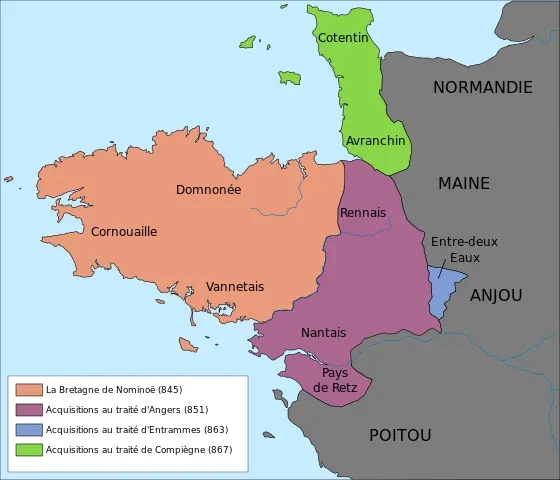
France - Grand Ouest - map-blank.svg: (Sémhurderivative work: Fab5669, CC BY-SA 3.0 <https://creativecommons.org/licenses/by-sa/3.0>, via Wikimedia Commons
At this point in the story, Brittany's territory also includes that green protruding piece of land! You could certainly call it its heyday!!!
... Of course, compared to the distant Celtic ancestors who once occupied all of Gaul, it's enough to bring tears to your eyes...
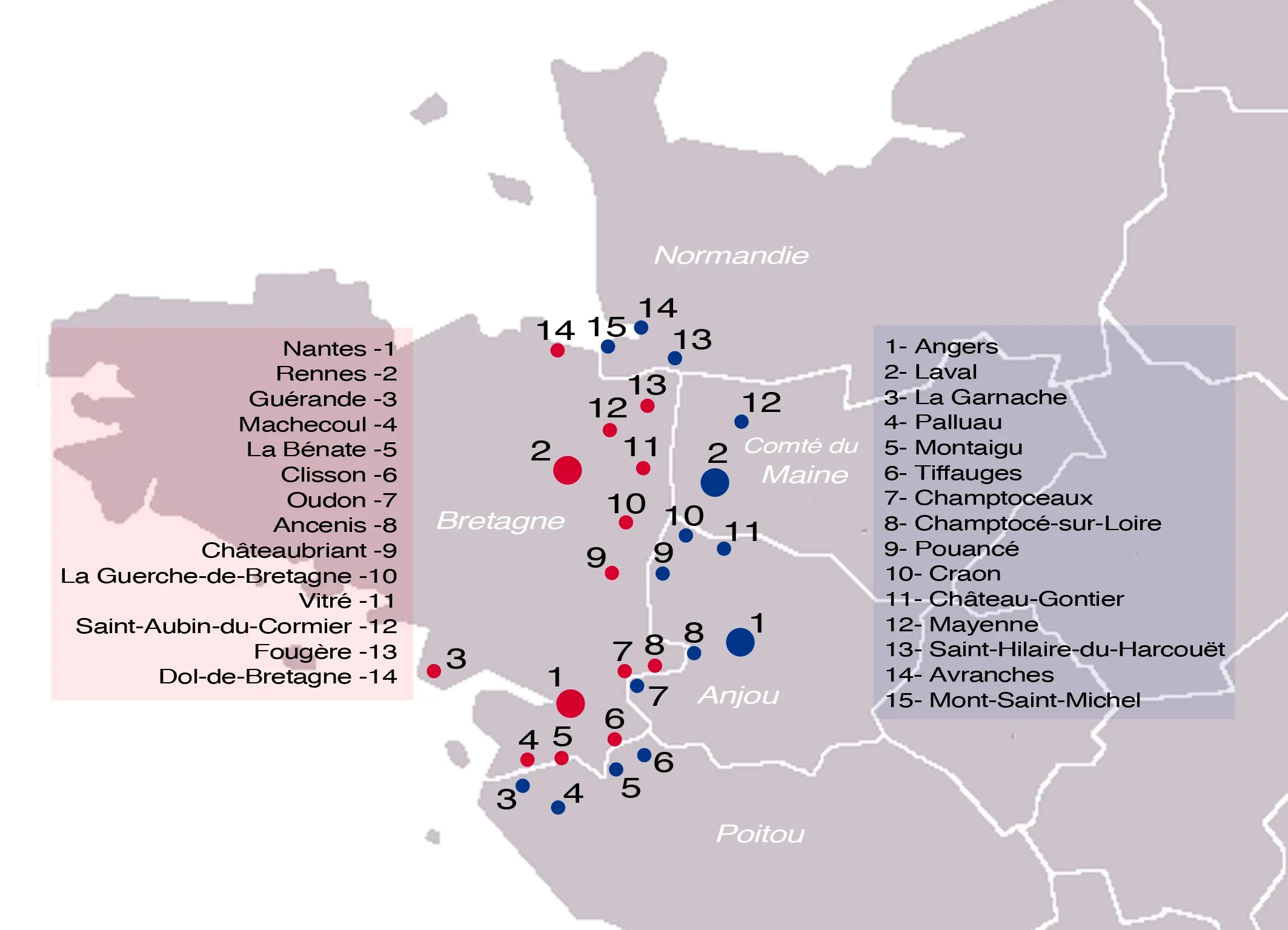
Provinces_of_France.png: OwenBlacker derivative work: Cyril5555, CC BY-SA 3.0 <http://creativecommons.org/licenses/by-sa/3.0/>, via Wikimedia Commons
Here is a map that makes it easier to understand the situation of West Frankia and Brittany!
West Frankia had two Marches in the north! So there were two Margraves as well!
One was Baudouin, and the other was Robert in the direction of Brittany!
What you need to take note of here is that Brittany occupied the western part of Anjou. 1. Hásteinn's Nantes and 2. Rennes were important as Salomon's bases...!
Look at all those strongholds...! They fought fiercely...!